You will find download buttons for the scans and transcripts, or you can view them online by clicking the links where it says “View in new tab:”.
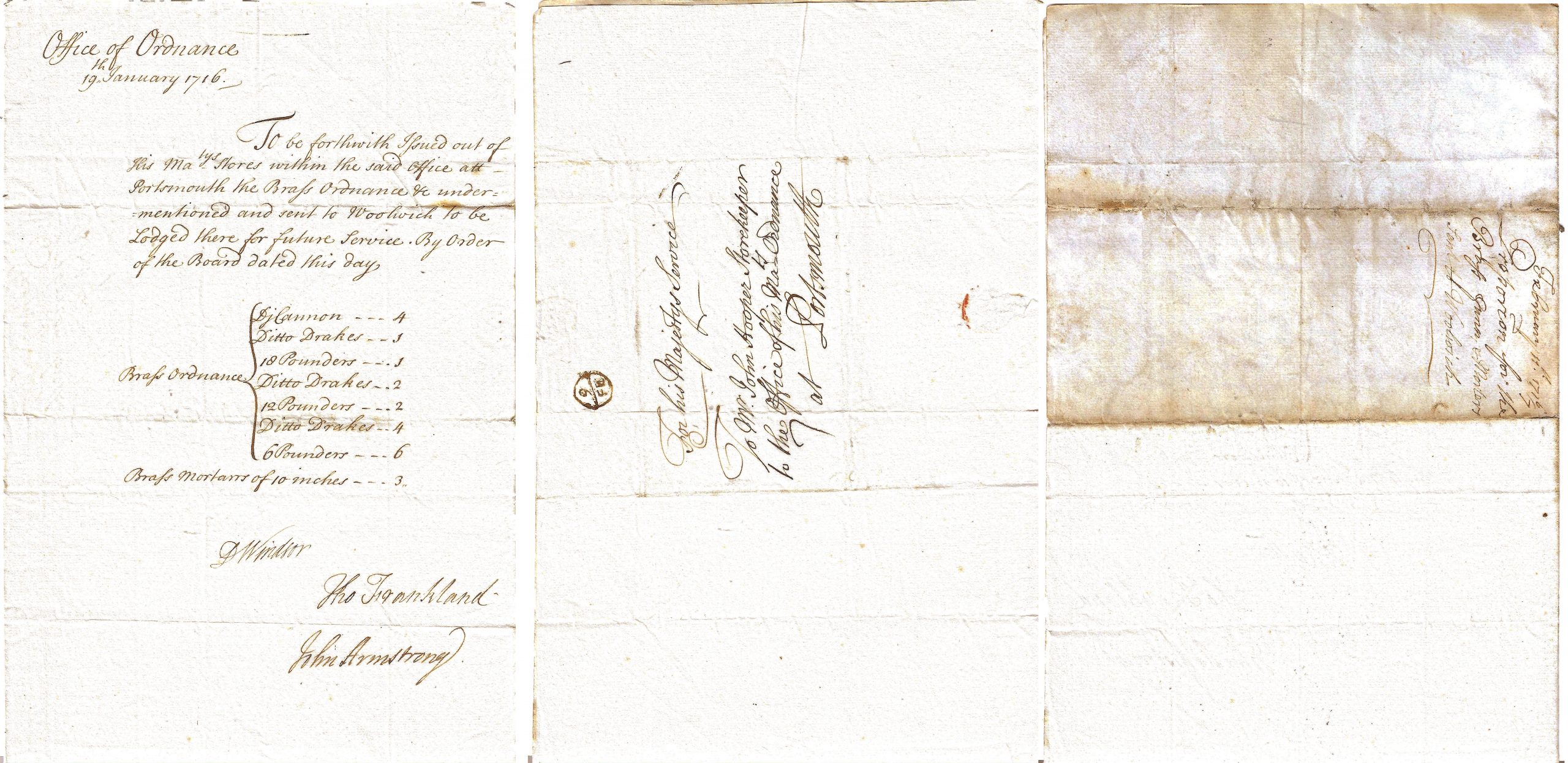
The dates on this letter are somewhat confusing. It was written on 19th January 1716, but date stamped in Portsmouth on the 9th February and the precis was written on the 11th. It is unusual to see these dates differ as, generally, letters were posted and arrived, and processed the same day.
One of the signatories (John Armstrong) of this letter, who was Chief Royal Engineer, was involved in an accident at the foundry at Moorfields in May 1716 when an explosion killed 17 people. The accident initiated the establishment of the Royal Arsenal at Woolwich.
View in new tab:
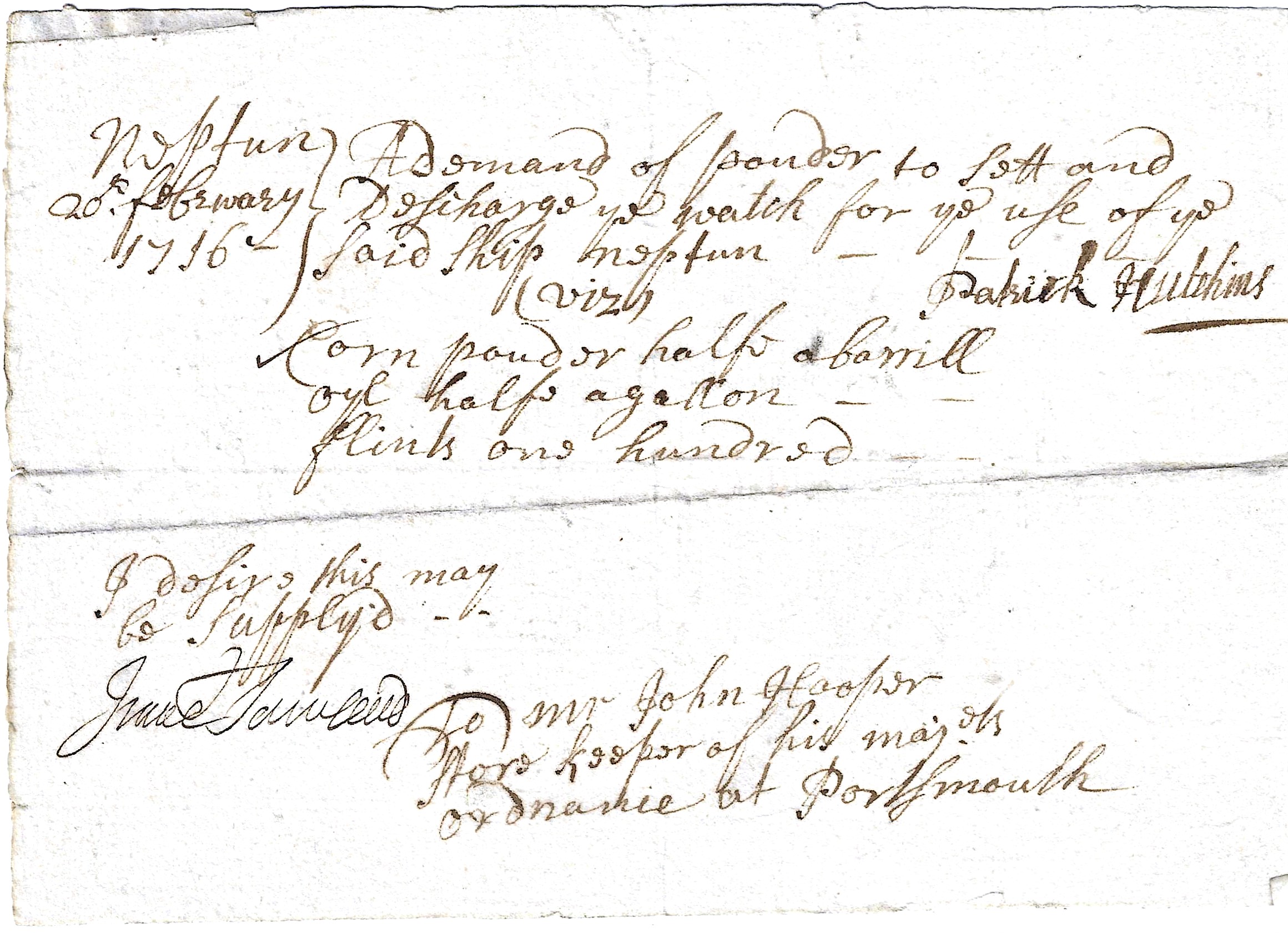
In September of 1715 Patrick Watkins of the Neptune submitted a demand for powder, now on the 20th February 1716 we have another demand for powder and oil for the 90 gun HMS Neptune (1610), endorsed by Isaac Townsend.
View in new tab:
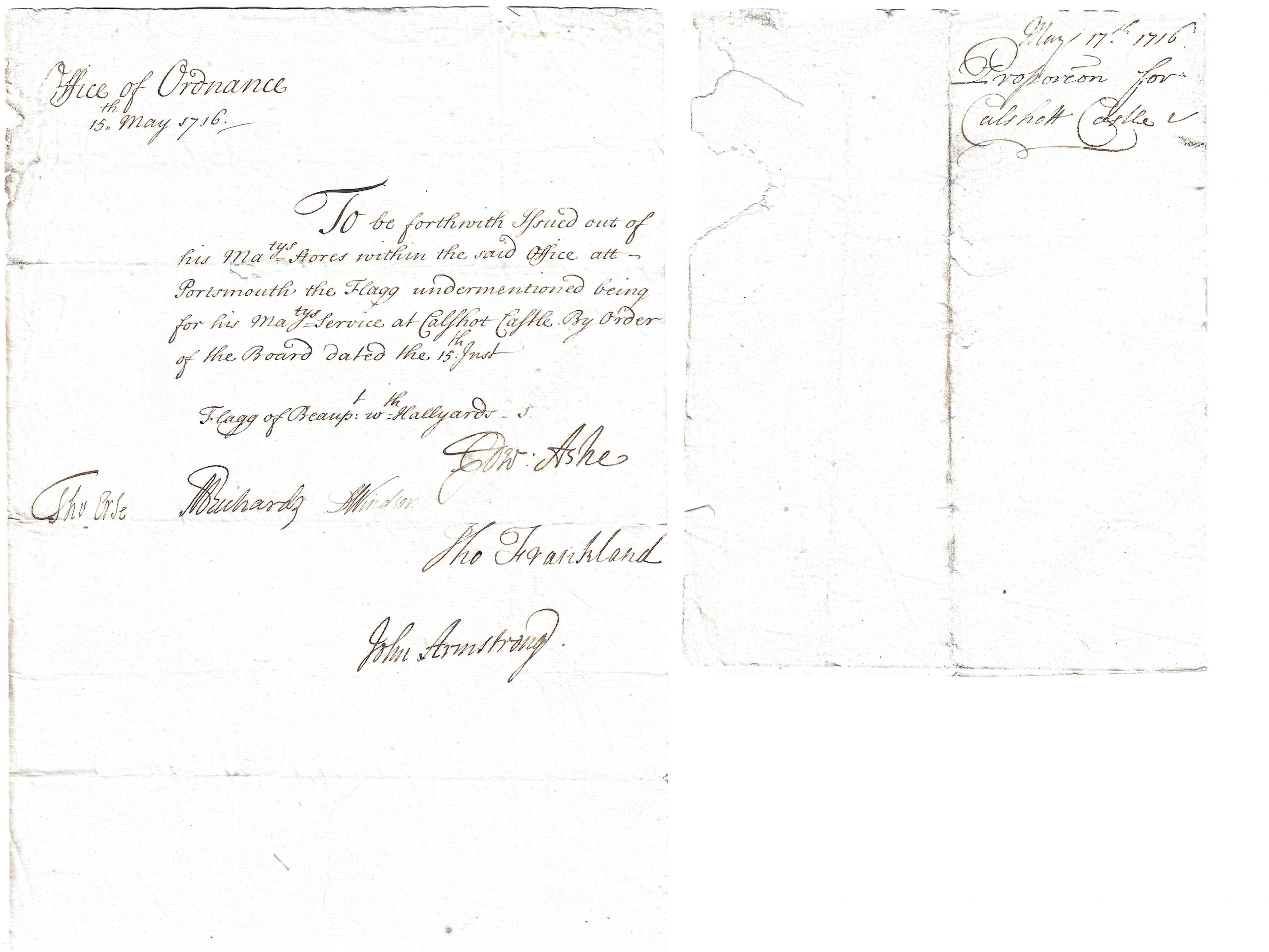
In May 1716, a flag of Beauport for Calshot Castle, and in July a bill of laden for the Marlborough hoy for unserviceable arms and ammunition.
View in new tab:
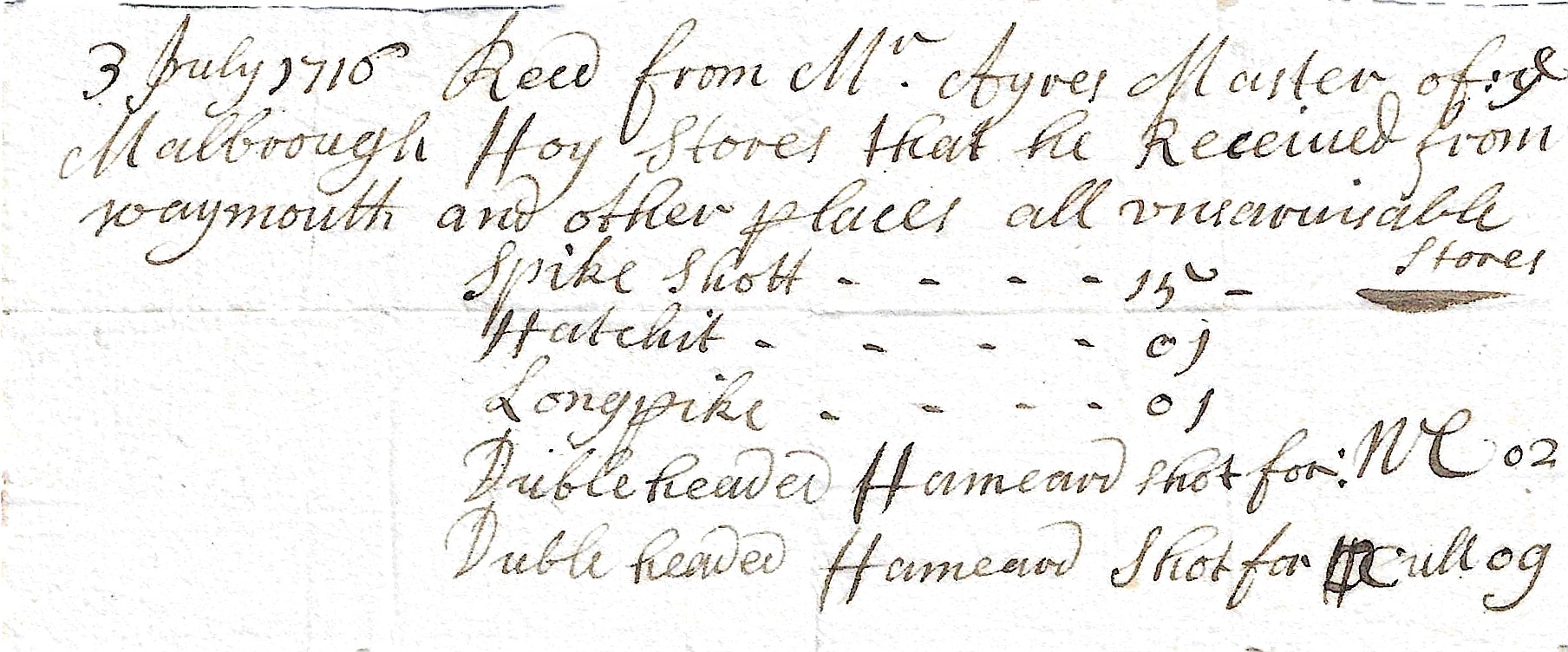
A receipt for gunners’ stores from Weymouth delivered by the Marlborough hoy.
View in new tab:
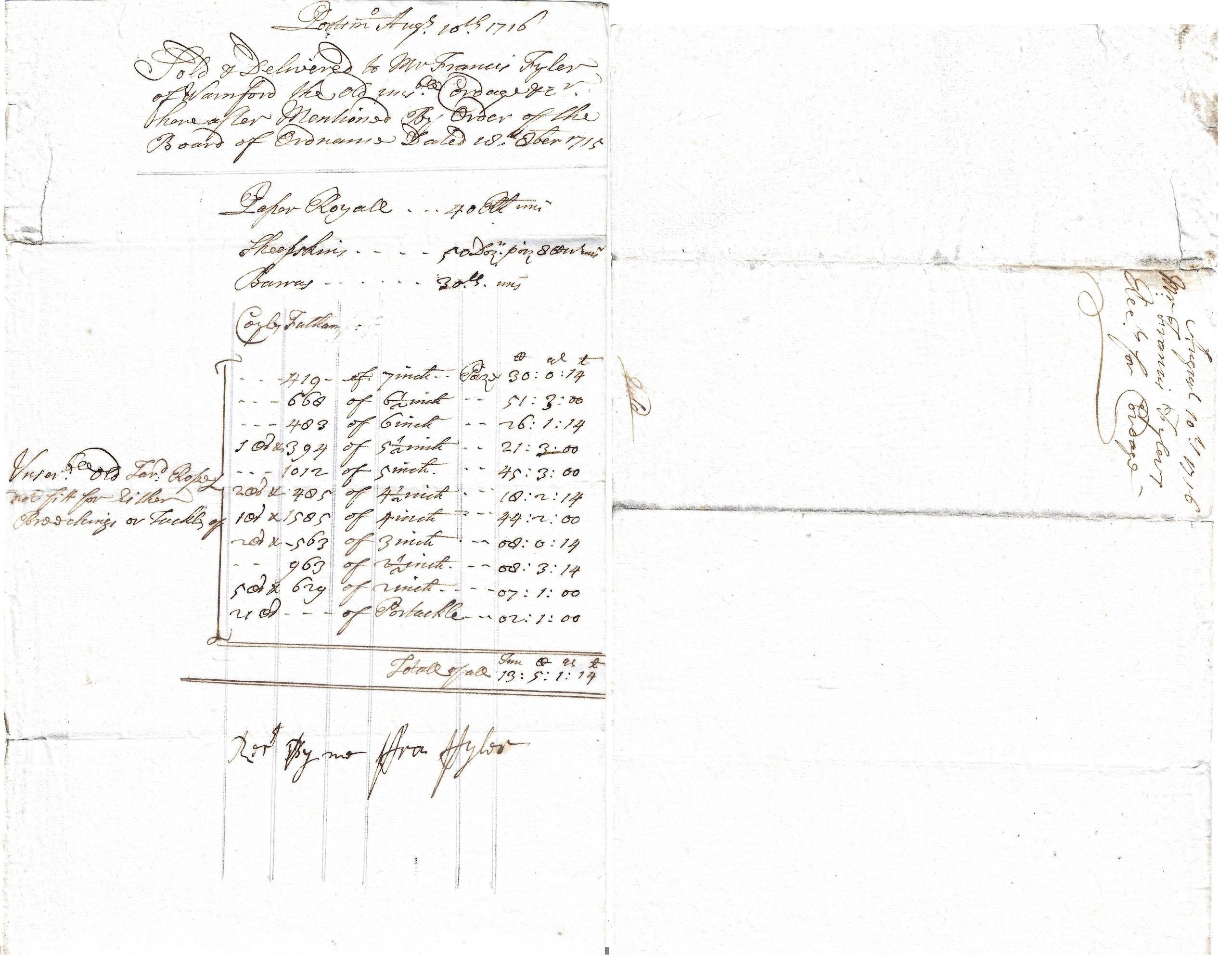
Dated 10th August 1716 is a receipt for paper, rope, sheepskins etc. delivered to Mr. Francis Tyler of Warnford, a small village to the north of the Meon Valley in Hampshire, about 20 miles from The Dockyard.
View in new tab:
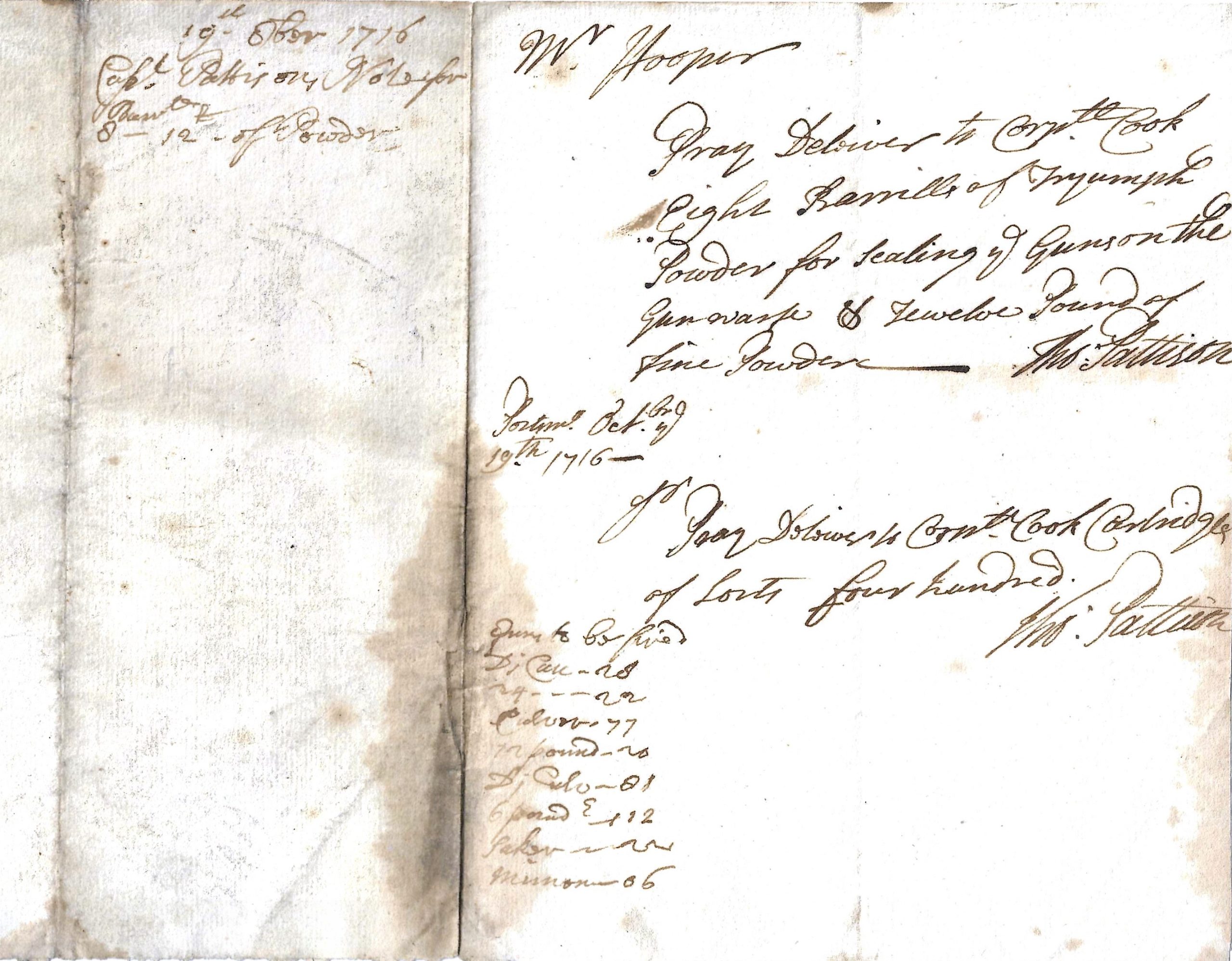
Captain Thomas Pattison, who worked at the gun wharf, requested “Eight barrills of triumph powder for scaling the guns on the gun wharf” this is the only mention of triumph powder in all of the documents. He also asks for twelve pounds of fine powder. One wonders: was triumph powder the same as corn powder?
‘Scaling the guns’ was a procedure whereby the guns were fired without a projectile, in order to loosen any rust that had ‘scaled up’ the bore of the gun allowing easier removal.
View in new tab:
In January 1717 it would appear that times are hard and that a rethink on the quantity of stores issued to vessels. The letter dated 9th January refers to “the proportions I now send you”, unfortunately we are not privy to that document.

View in new tab:
On the Gosport side of Portsmouth Harbour is a small island now known as Rat Island. In the past it was known as Burrough, Burrow or Barrogh Island. The name ‘Burrough’ is an old spelling of ‘Borough’, and the island was named as such because it was in the Borough of Portsmouth (now the City of Portsmouth), at a time when Gosport was not a borough.*
Burrough Island on which in 1678 building commenced of a small fort known as Fort James or Burrough Fort with access via a spit of land from Hardway (Priddy’s hard). It had a square tower 46ft across and 19ft high. 14 guns were mounted on the tops and sentry boxes were constructed on the corners. The blockhouse sat on a defensive platform 110ft square, surrounded by a parapet. The north and south sides were defended by a dry ditch. There is an unlikely legend that the fort was on the site of a Norman Castle.*
It is known that the fort fell into disrepair by 1847, but the exact date of its abandonment was unknown. A note to Messrs Hooper and Baxter of 9th January 1717 gives us a strong clue as it lists gunners’ stores being returned to the Dockyard.
An episode of the television show ‘Time Team’ was filmed on the island where they uncovered the burials of, allegedly, convicts who had died on the prison hulks moored in the harbour. An interesting article on the subject can be found <here>.
*My thanks to David Moore and Philip Eley for their assistance on this subject and in transcribing the document.

View in new tab:
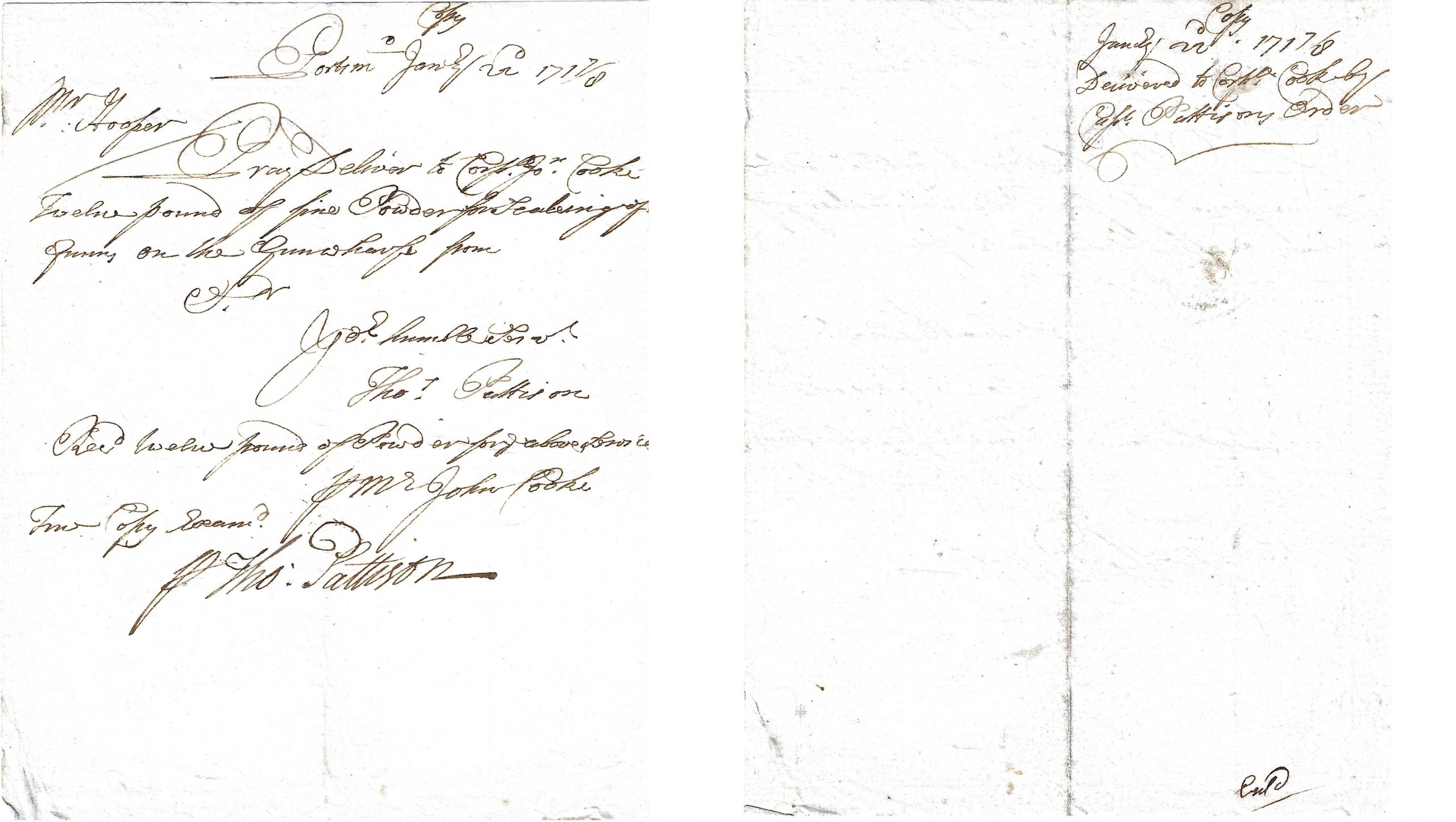
An instruction to provide Corporal Cooke with fine powder for ‘scaling of guns’.
View in new tab:
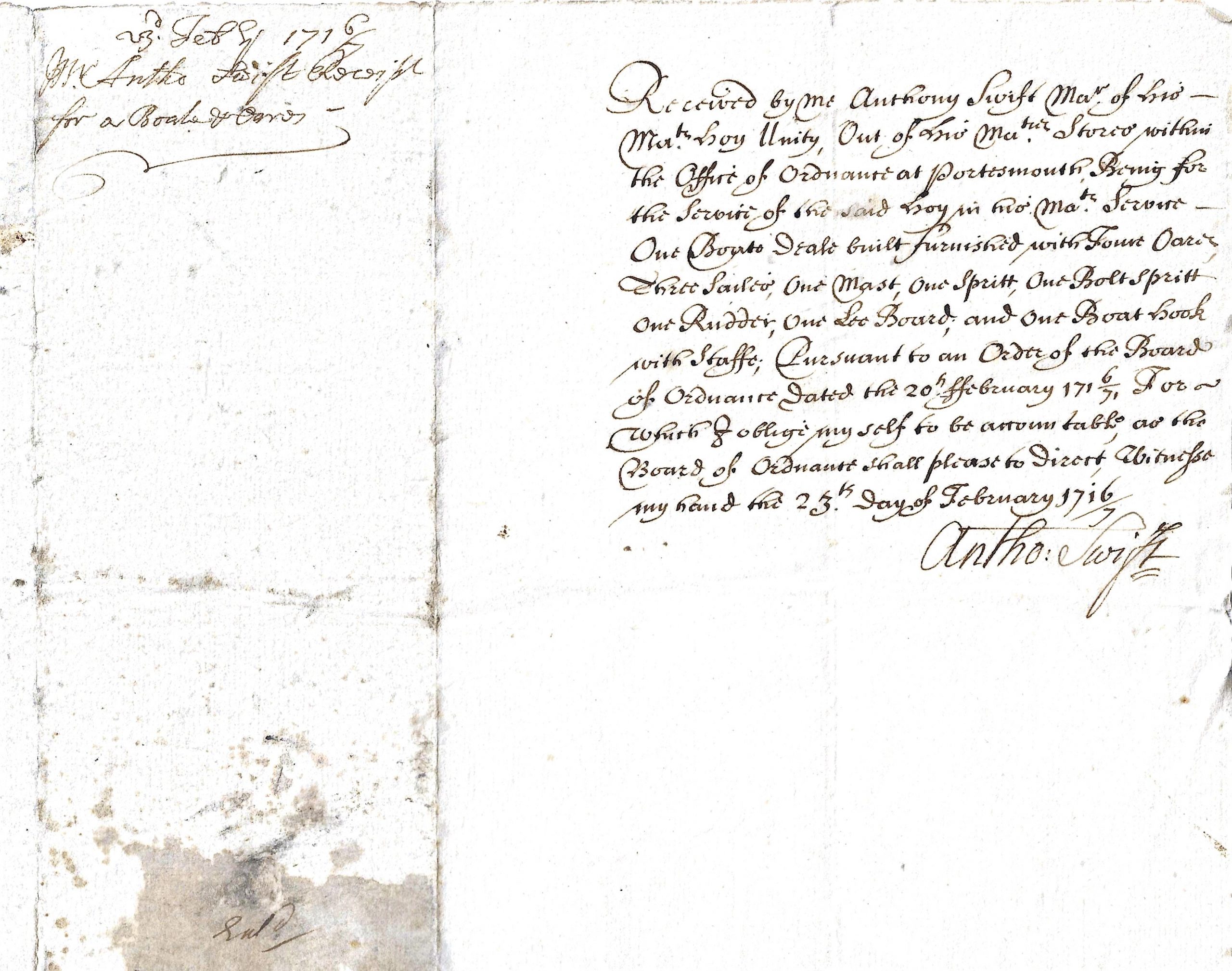
Anthony swift, master of the hoy Unity was in receipt of a four oared boat with mast, sails and sprits. It says that it was ‘deale built’. This may refer to the wood it was made of, or, more likely, that it was built at the naval yard in Deal, Kent.
View in new tab:
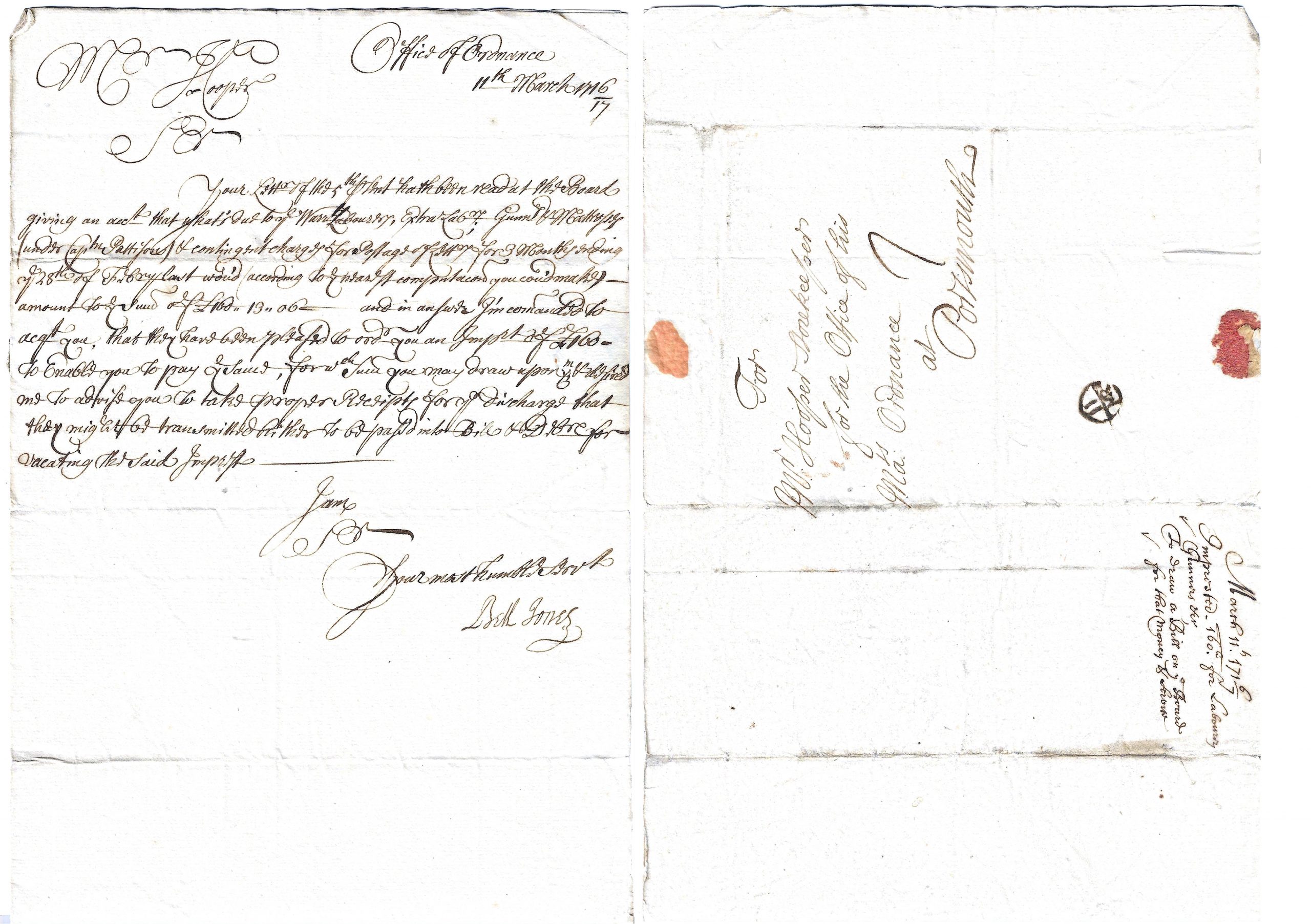
Mr. Hooper is issued an imprest of £100/13/6 in March of 1717 to pay Captain Pattison’s labourers at the gun wharf.
View in new tab:
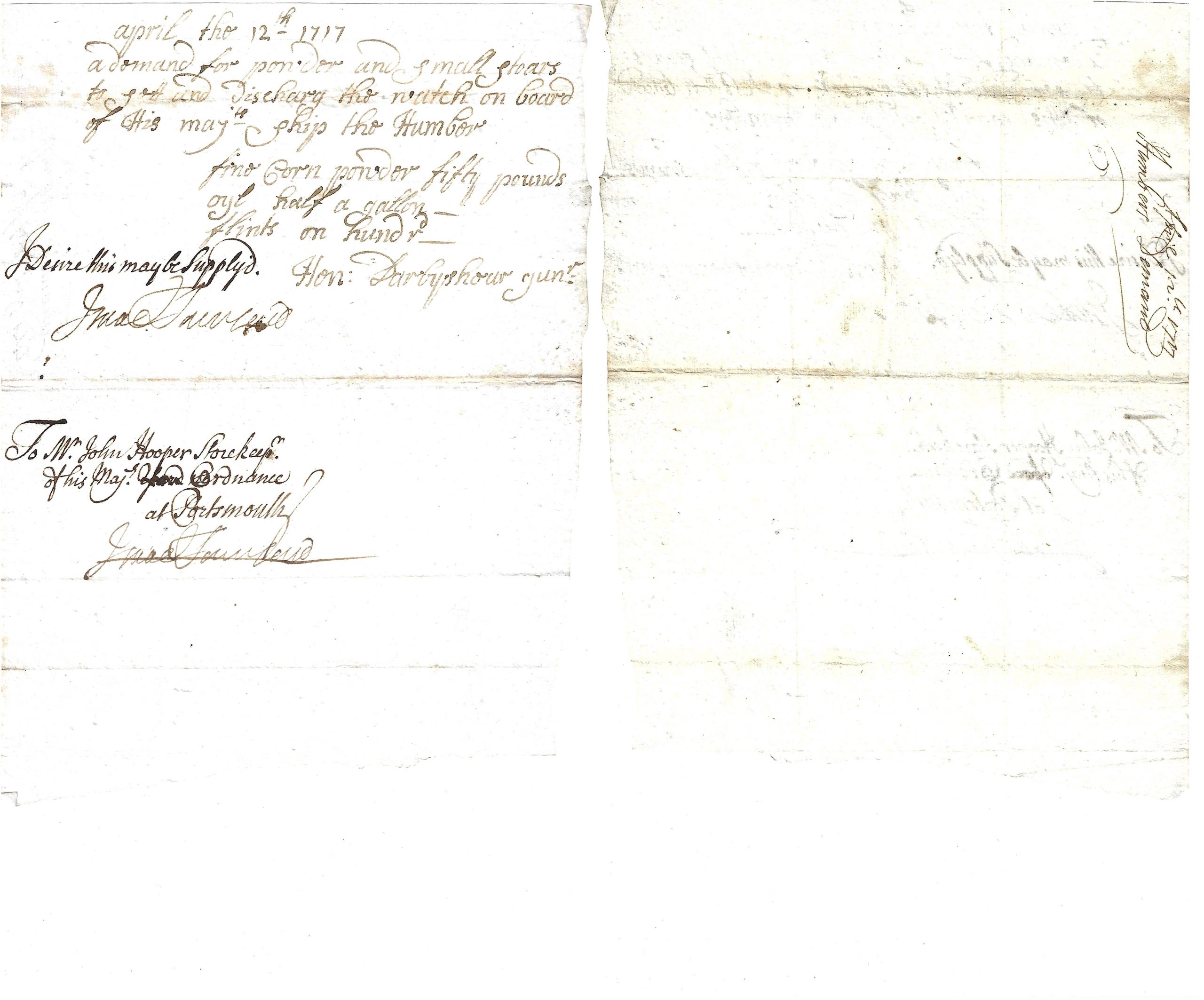
On 12th April 1717 a demand for powder and small stores from Henry Darbyshour, master gunner of the Humber (1693) endorsed by Isaac Townsend.
View in new tab:
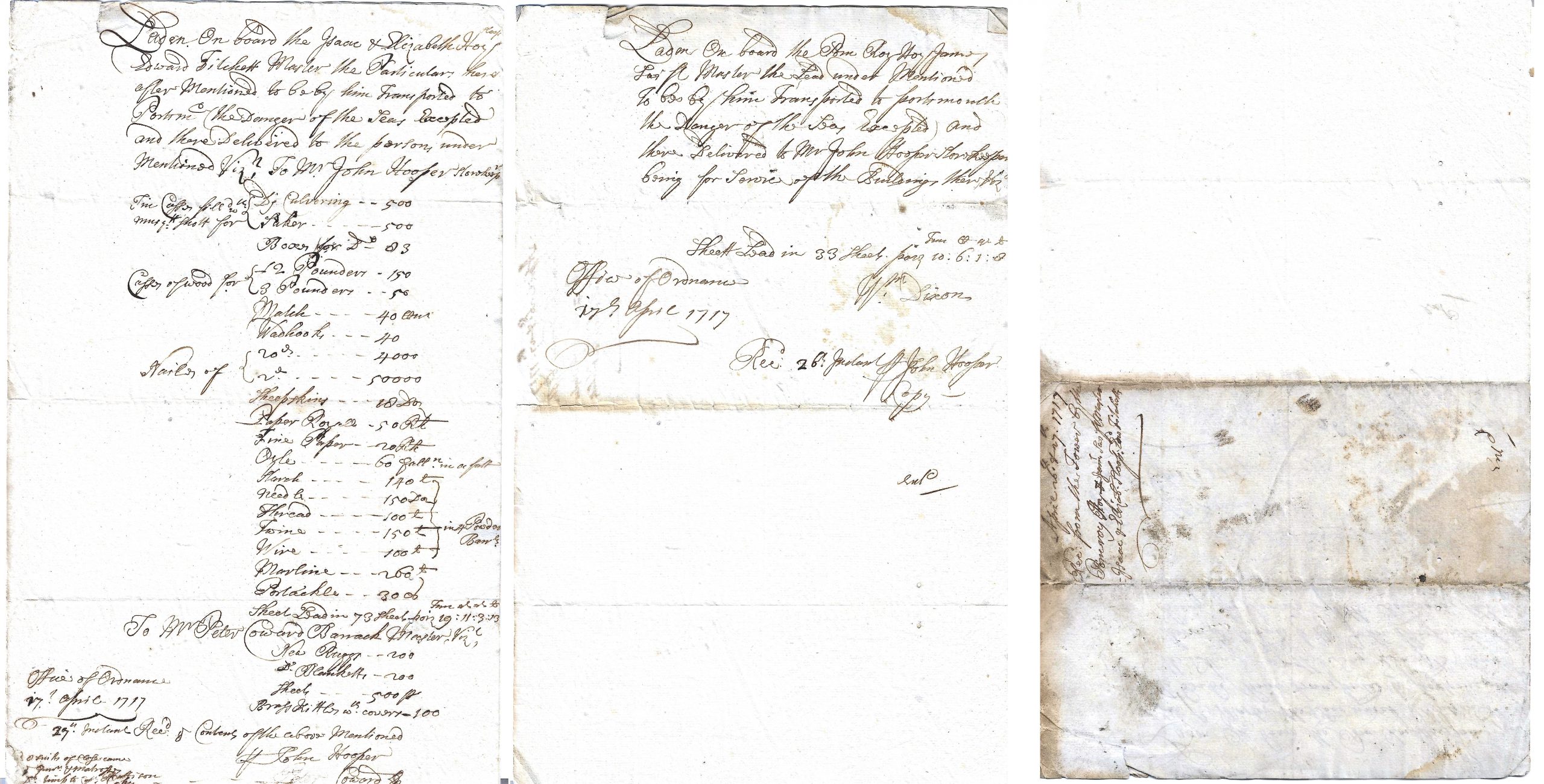
Although somewhat faded and difficult to read, from Edward Fitchett’s bill of laden, 26th April 1717, we learn that Peter Coward is Barack Master. He endorses the bill on behalf of John Hooper. Unfortunately the very bottom of the document missed the scanner.
View in new tab:
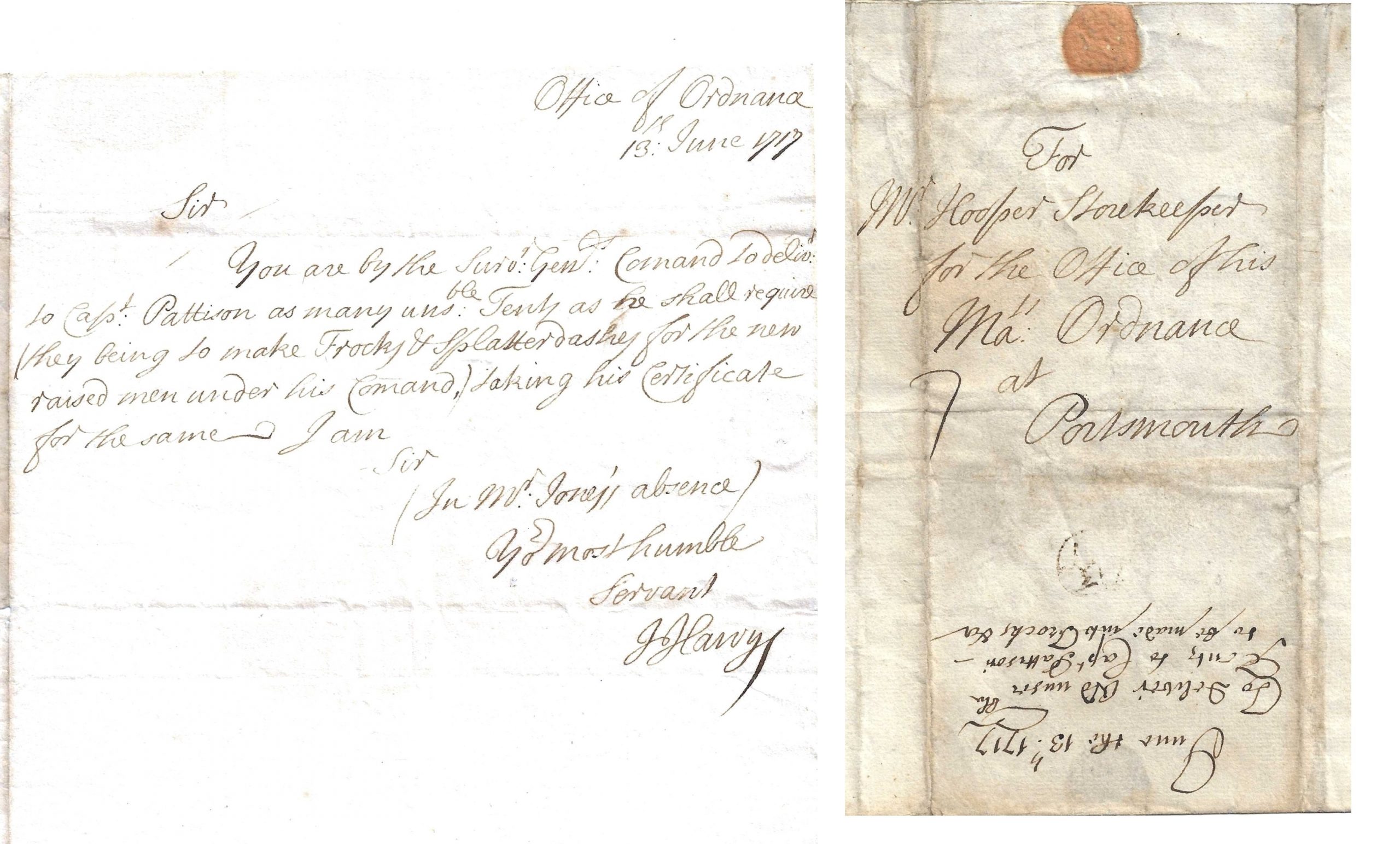
13th June 1717 Mr. Hooper is asked to supply unusable tents to Captain Pattison to make splatter dashes for newly raised men. Splatter dashes were like gaiters or spats to protect the shoes and lower legs from mud, splashes etc.
View in new tab:
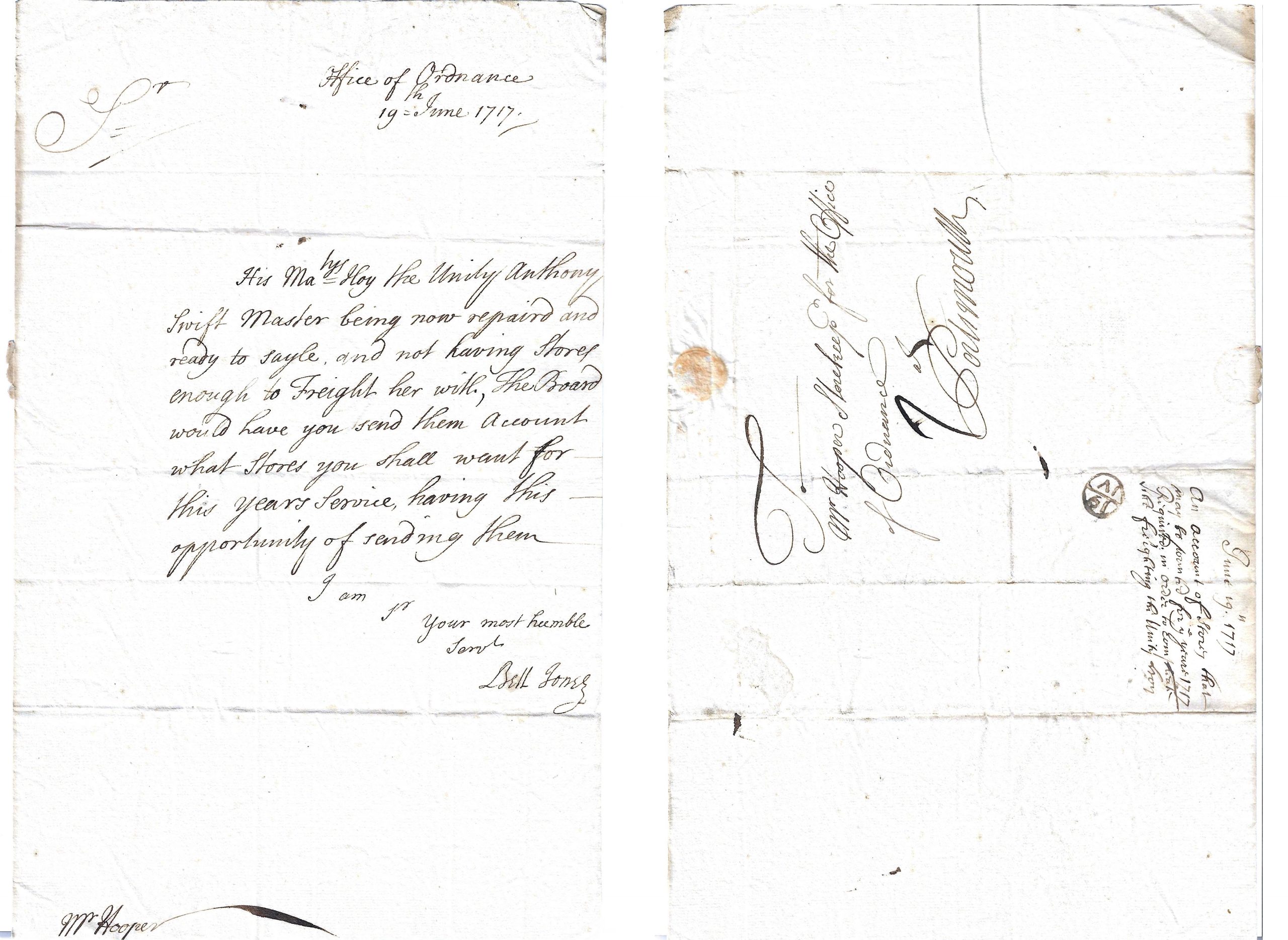
The hoy Unity, on 19th June 1717 was at Greenwich, only partly laden, so Bell Jones wrote to Mr. Hooper asking for a list of required stores. The letter was written and received the same day, and there is every possibility that Bell would have had his answer that day.
View in new tab:
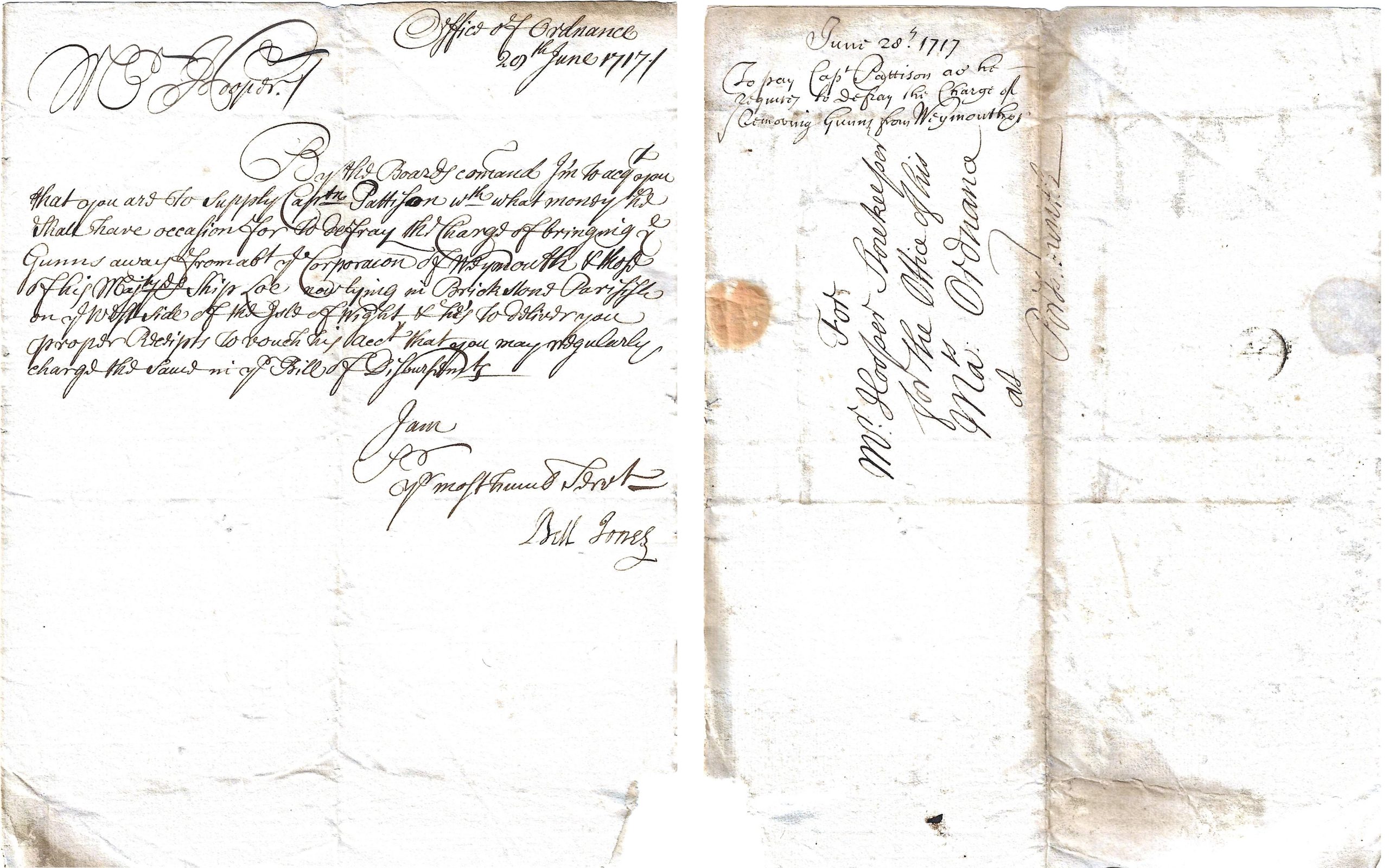
On 28th June 1717 another letter from Bell Jones advising Mr. Hooper to provide Capt. Pattison with funds to bring guns back from Weymouth and HMS Loe, but that receipts should be obtained for any expense.
View in new tab:
Bell Jones writes on 5th July 1717 to Mr. Hooper to advise that he is supplied with £220/13/6 to pay: labourers, gunners and matrosses under captain Pattison. Matrosses were gunners’ assistants.

View in new tab:
An instruction to supply Brigadier Stairn’s regiment of foot with powder and shot.

View in new tab:
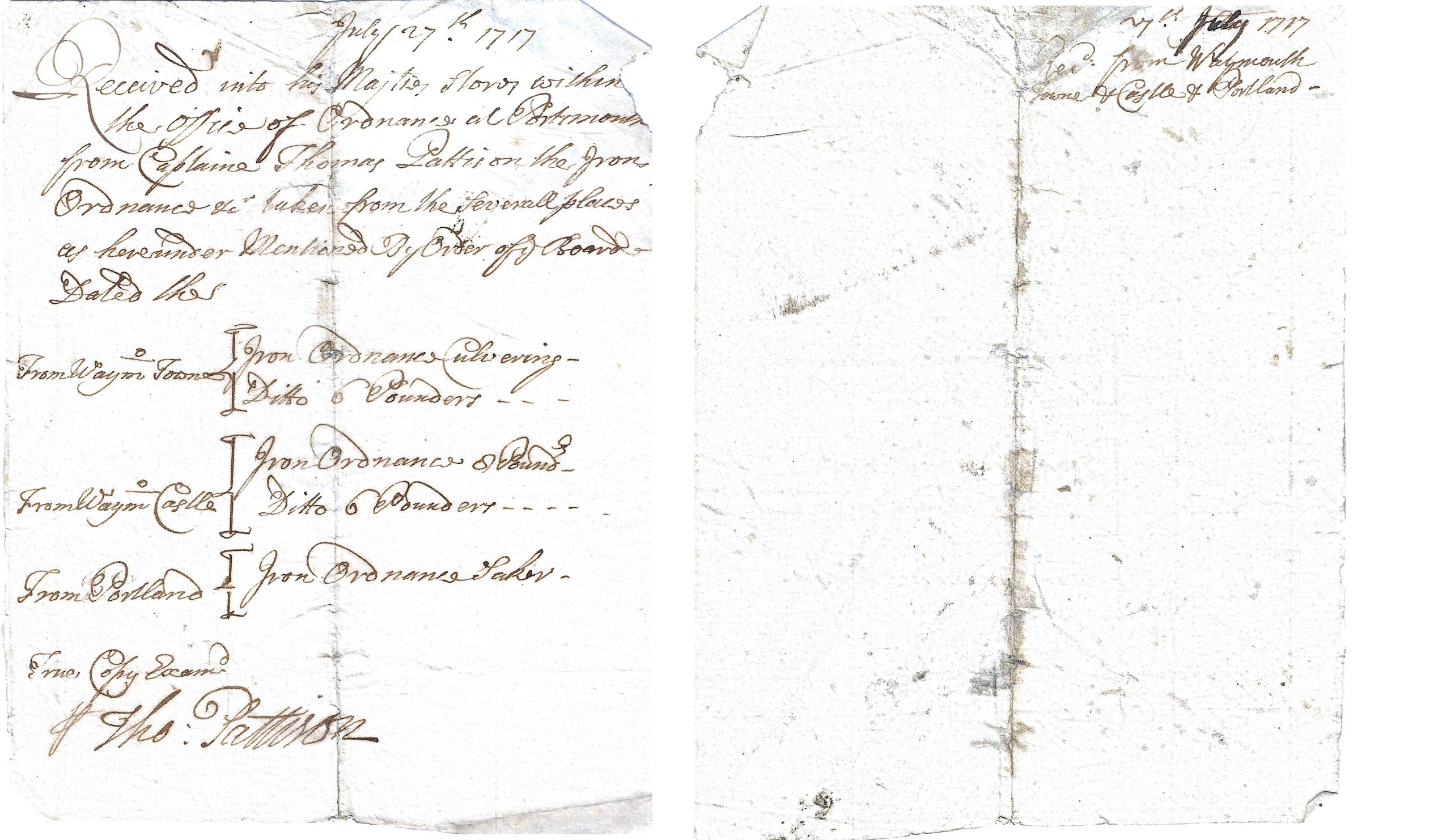
On 17th July 1717 powder and shot is to be delivered to Brigadier Stairn’s Regiment of Foot, then on 27th we see a detailed receipt for the guns from Weymouth being returned by Capt. Pattison.
View in new tab:
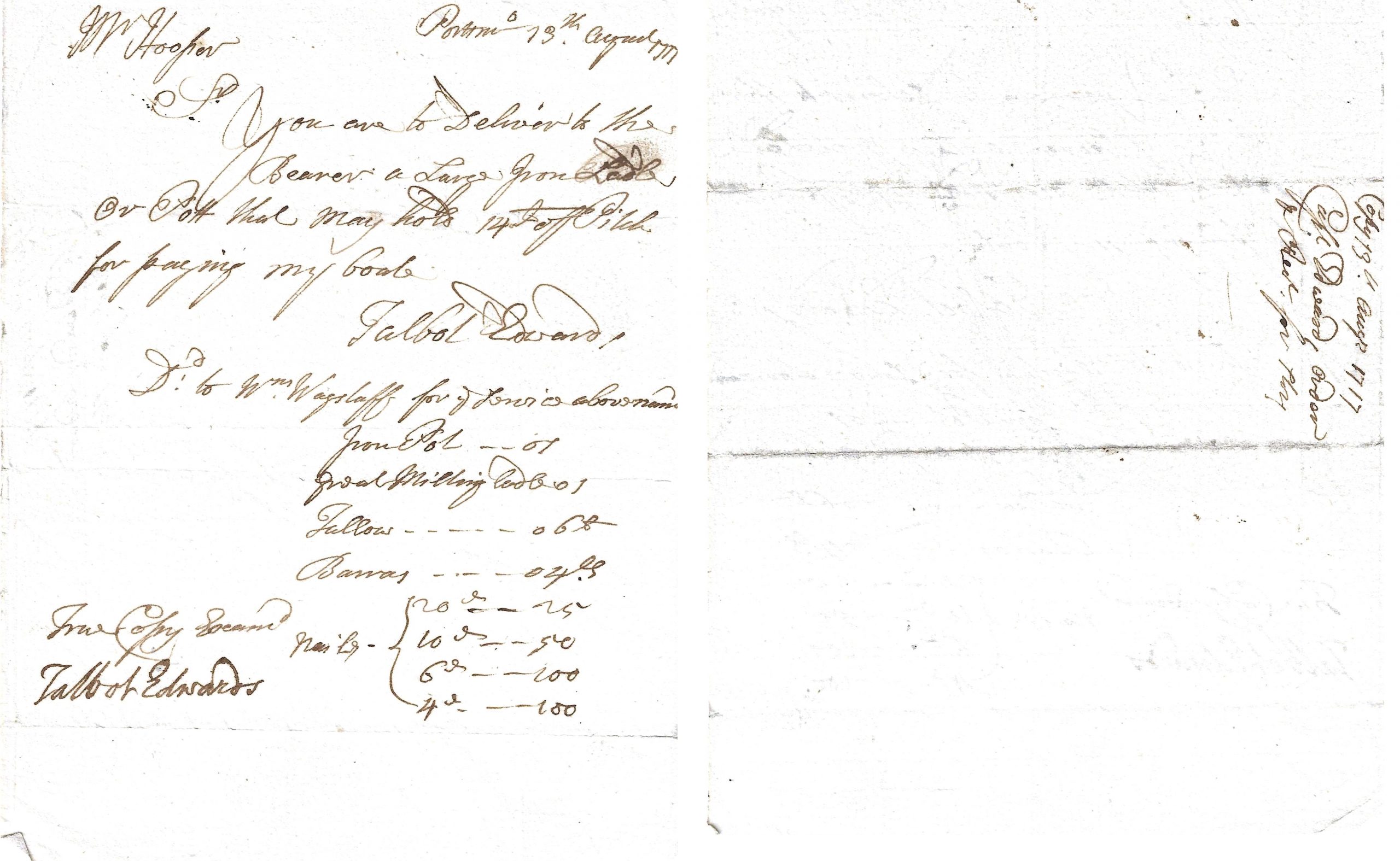
Talbot Edwards, in his abrupt manner, orders an iron ladle or pot and acknowledges receipt. He actually gets both a pot and a ladle together with tallow, barras (for caulking) and nails.
View in new tab:
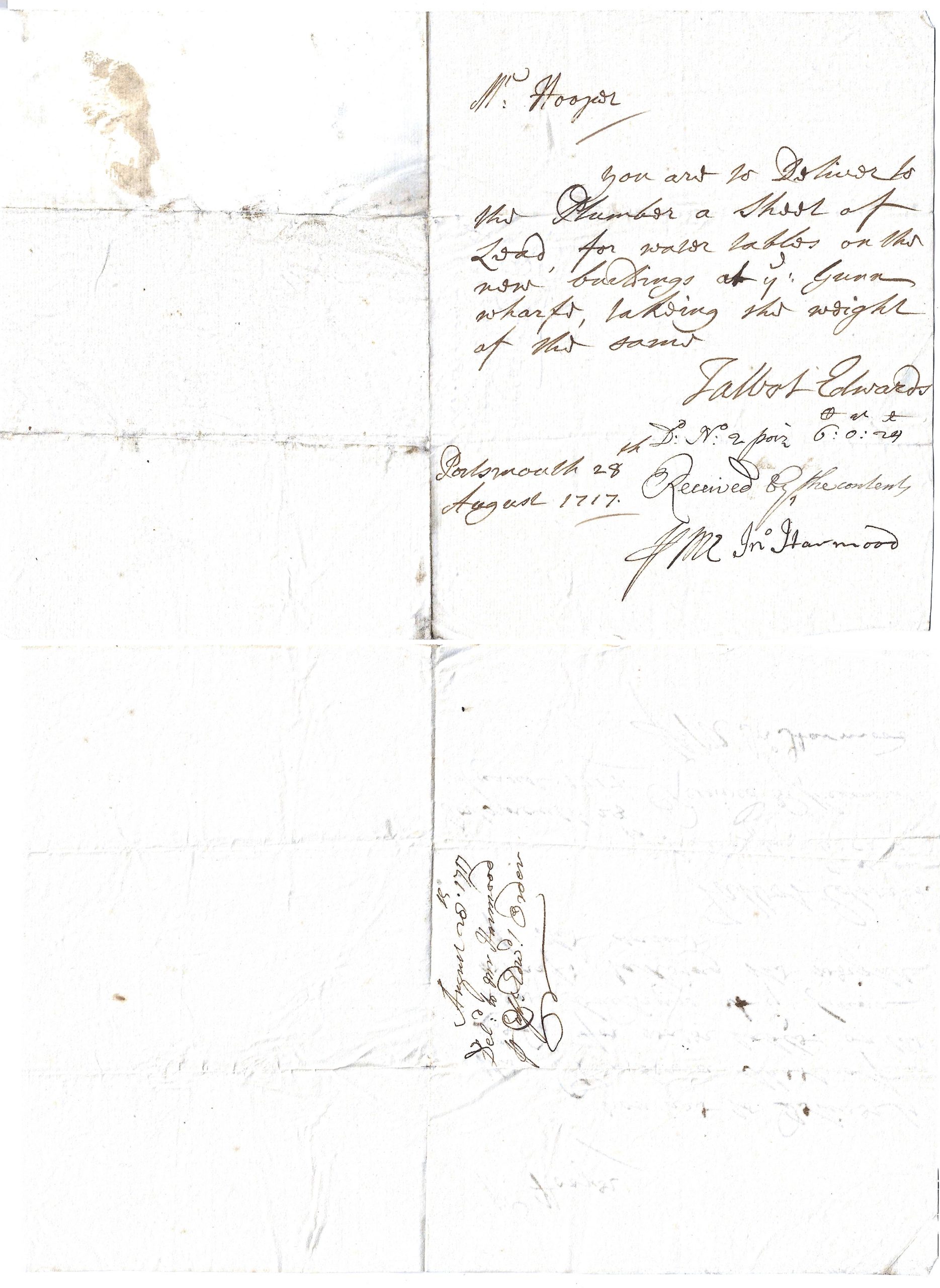
A demand for lead sheet from Talbot Edwards. This is for a water table which is a projection at the lower part of a wall designed to deflect water away from the foundation.
View in new tab:
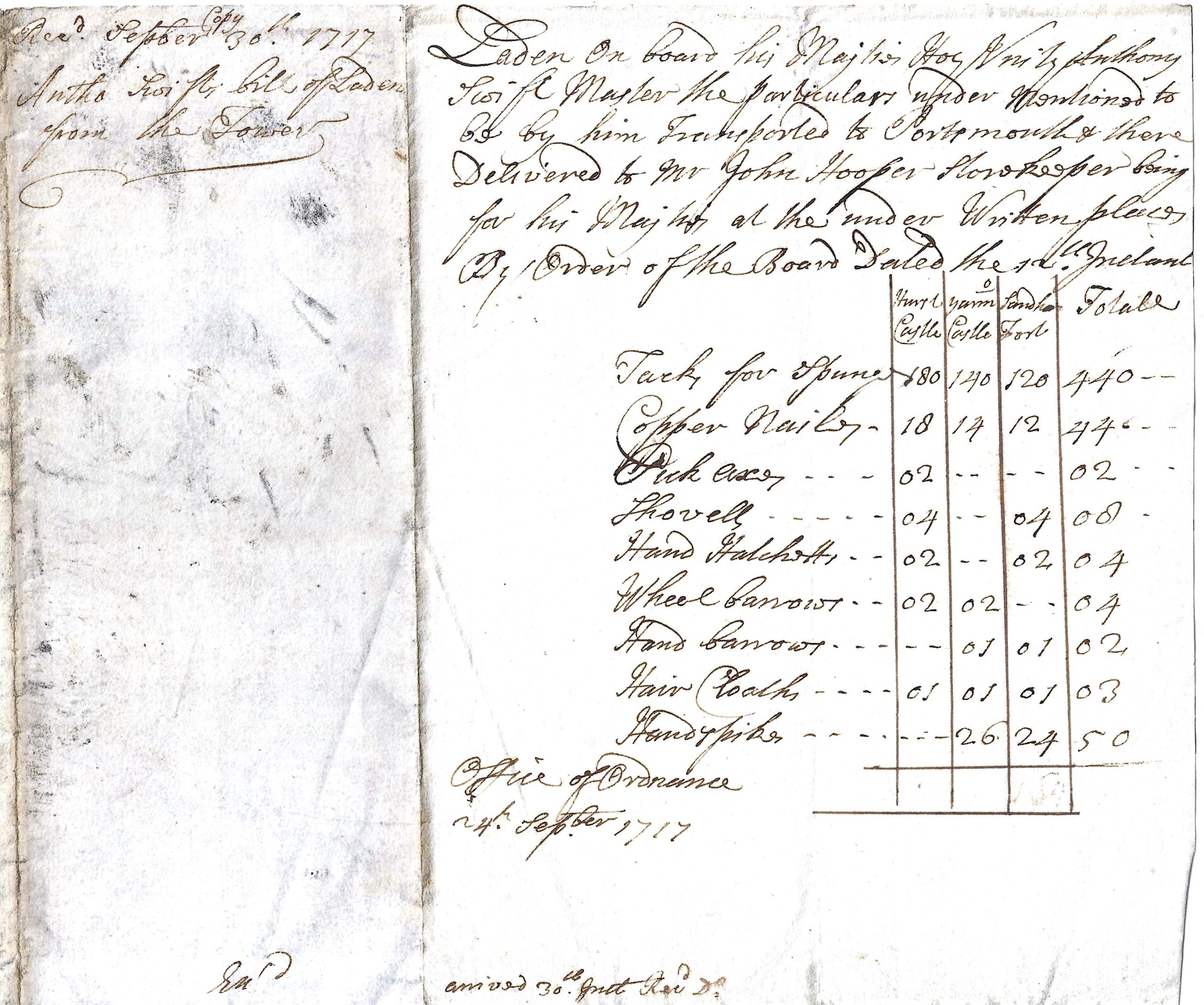
A bill of laden for the hoy Unity.
View in new tab:
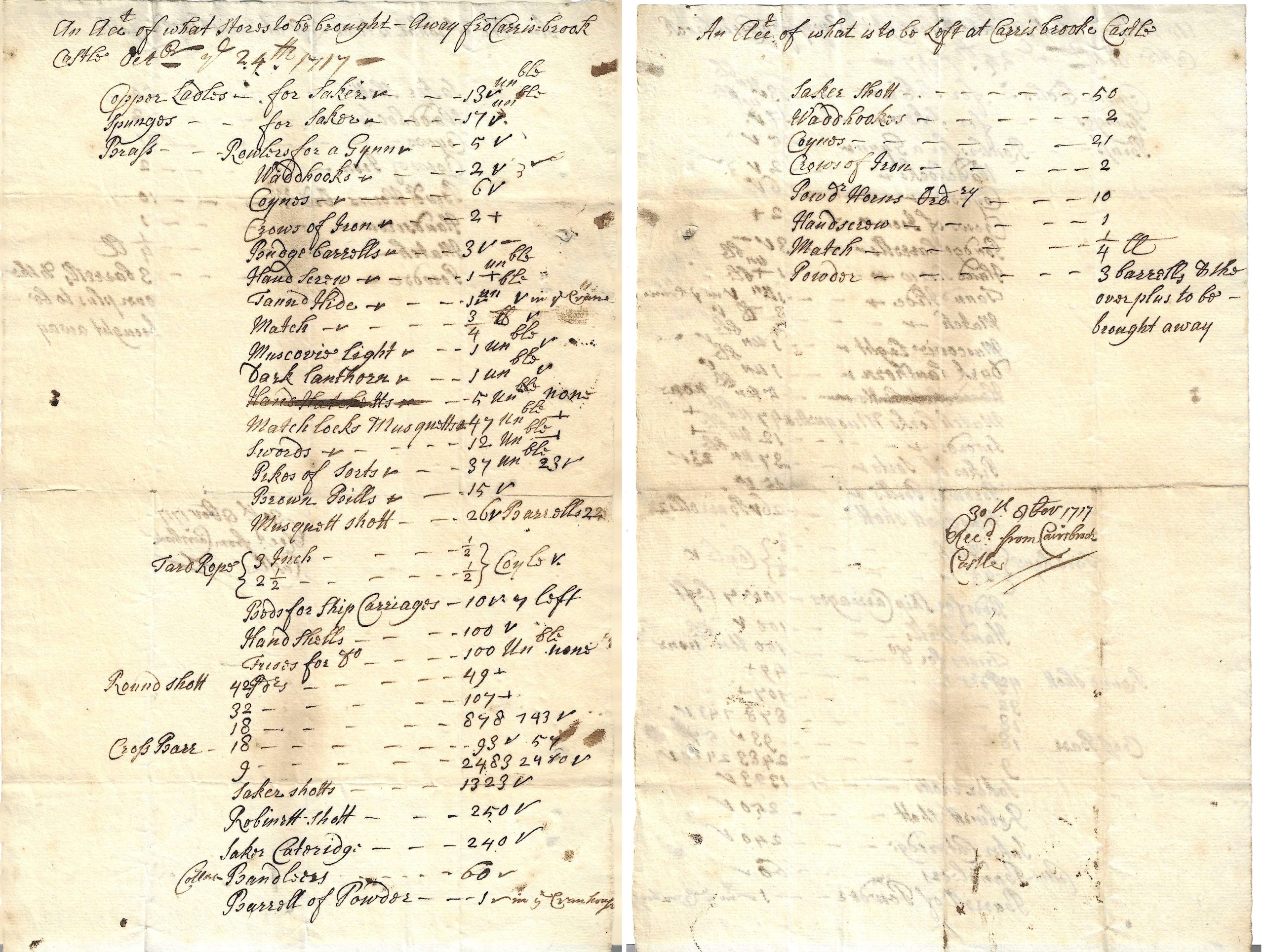
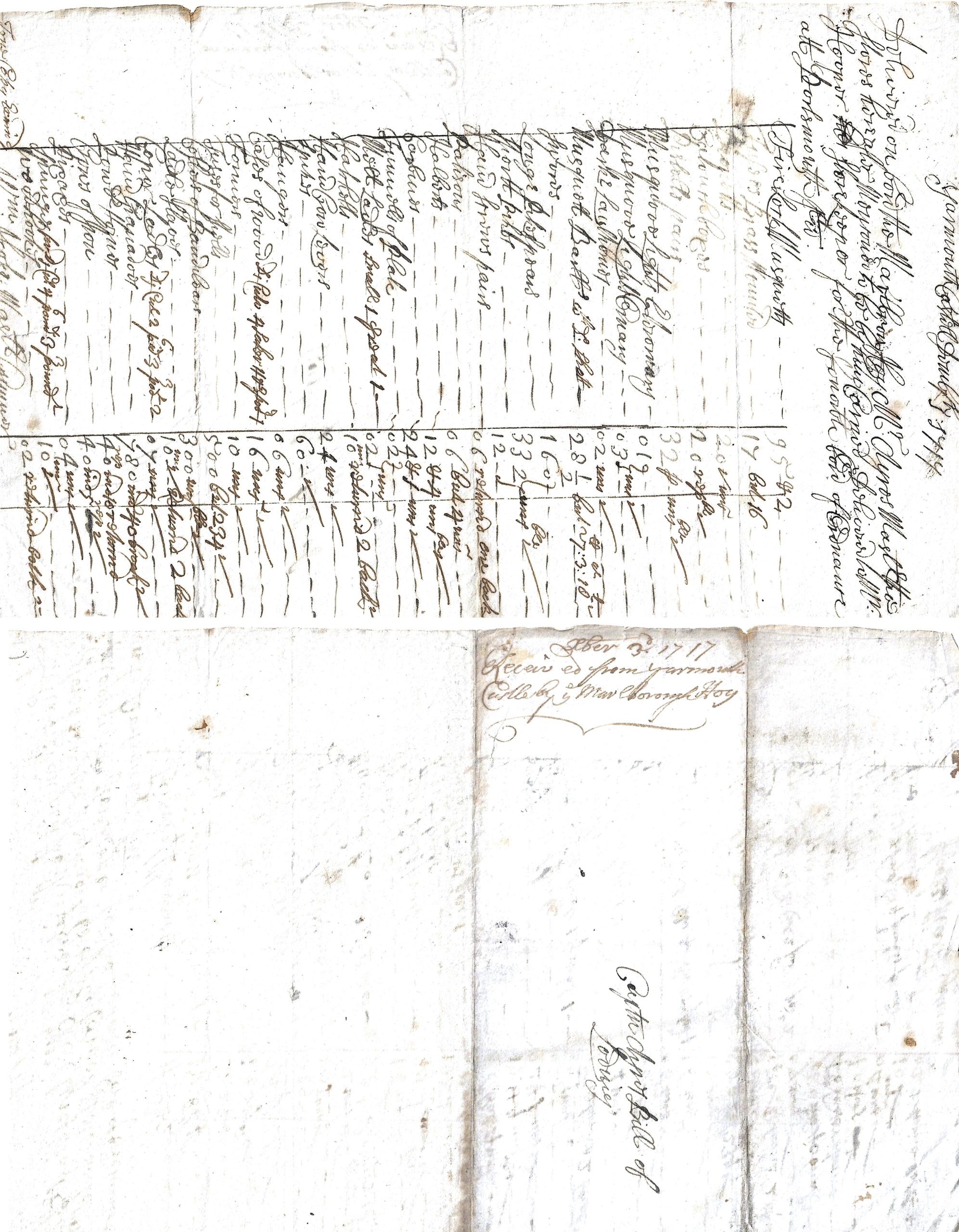
Both Yarmouth and Carisbrooke castles on the Isle of Wight return considerable amounts of stores on 24th October and 3rd December 1717, much of which appears to have been unusable. No reason for the returns is given, but by the 18th century it is said that the harbour at Yarmouth was silting up reducing the risk of invasion.
View in new tab:
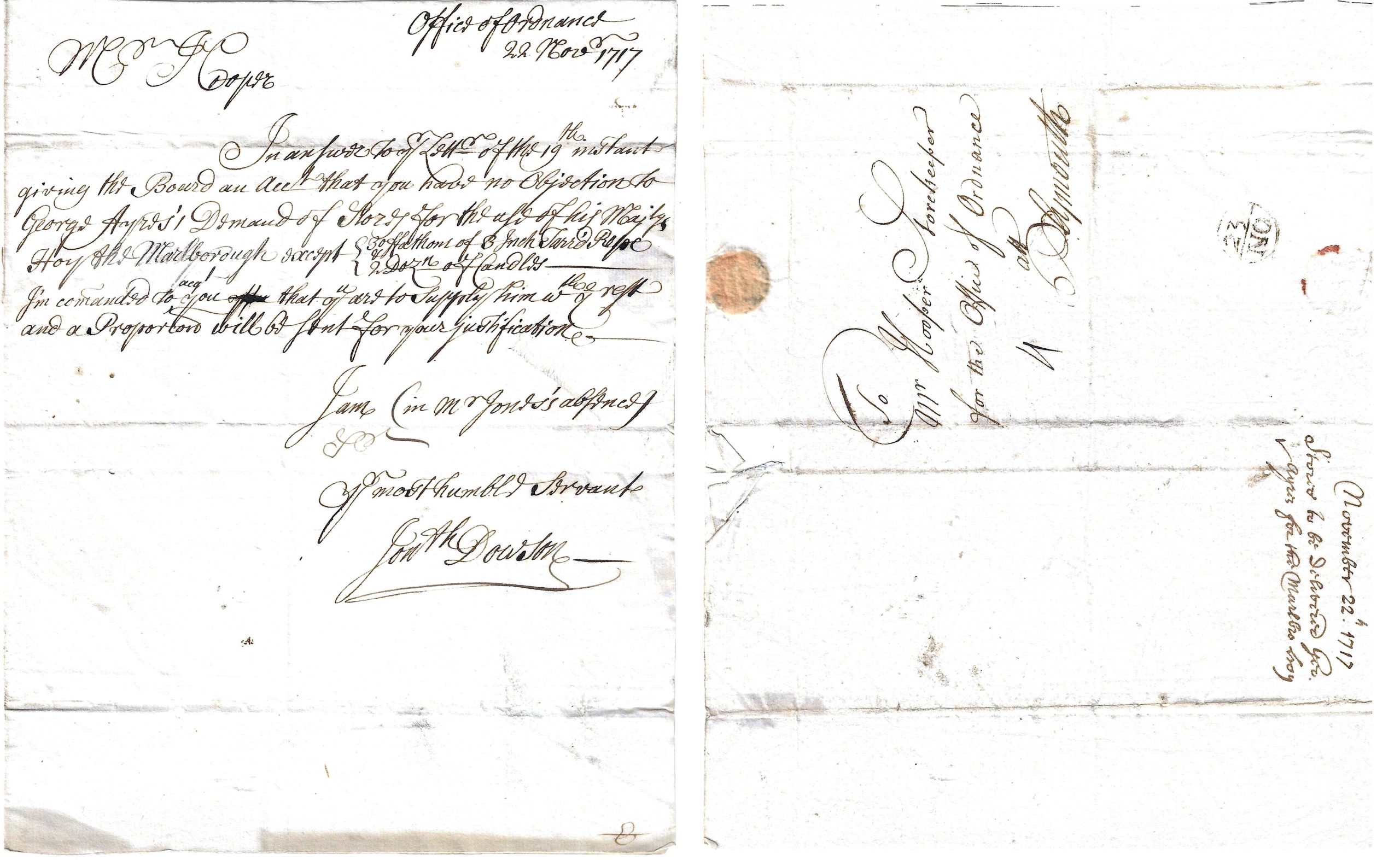
George Ayres, master of the Marlborough hoy requests rope and candles for use on board on 22nd November 1717.
View in new tab:
Here we see the return from Yarmouth Castle.
View in new tab:
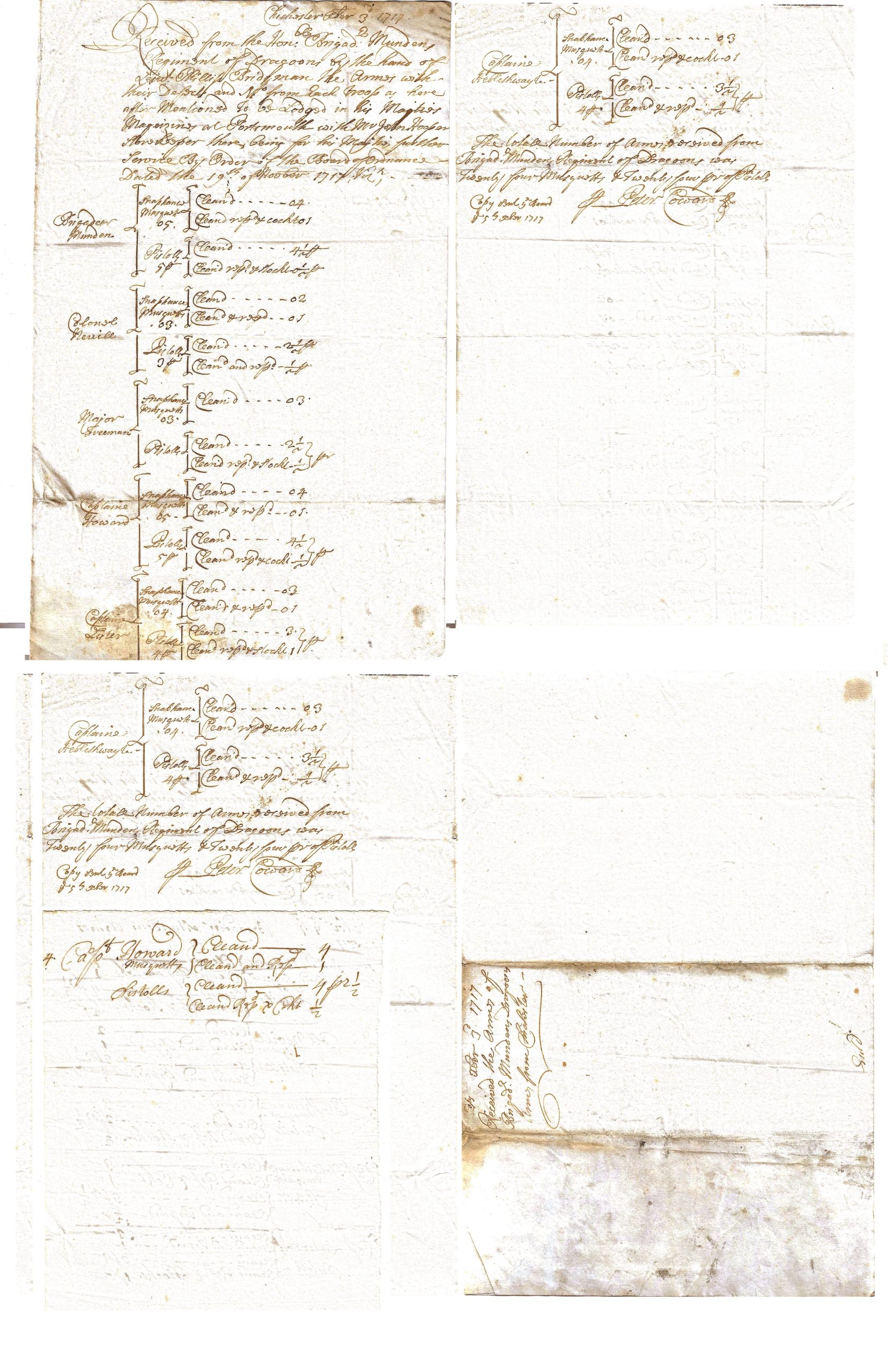
Brigadier Munden returns defective small arms, 24 muskets and 24 pistols, to the stores on December 3rd 1717, given into the care of Peter Coward.
View in new tab:
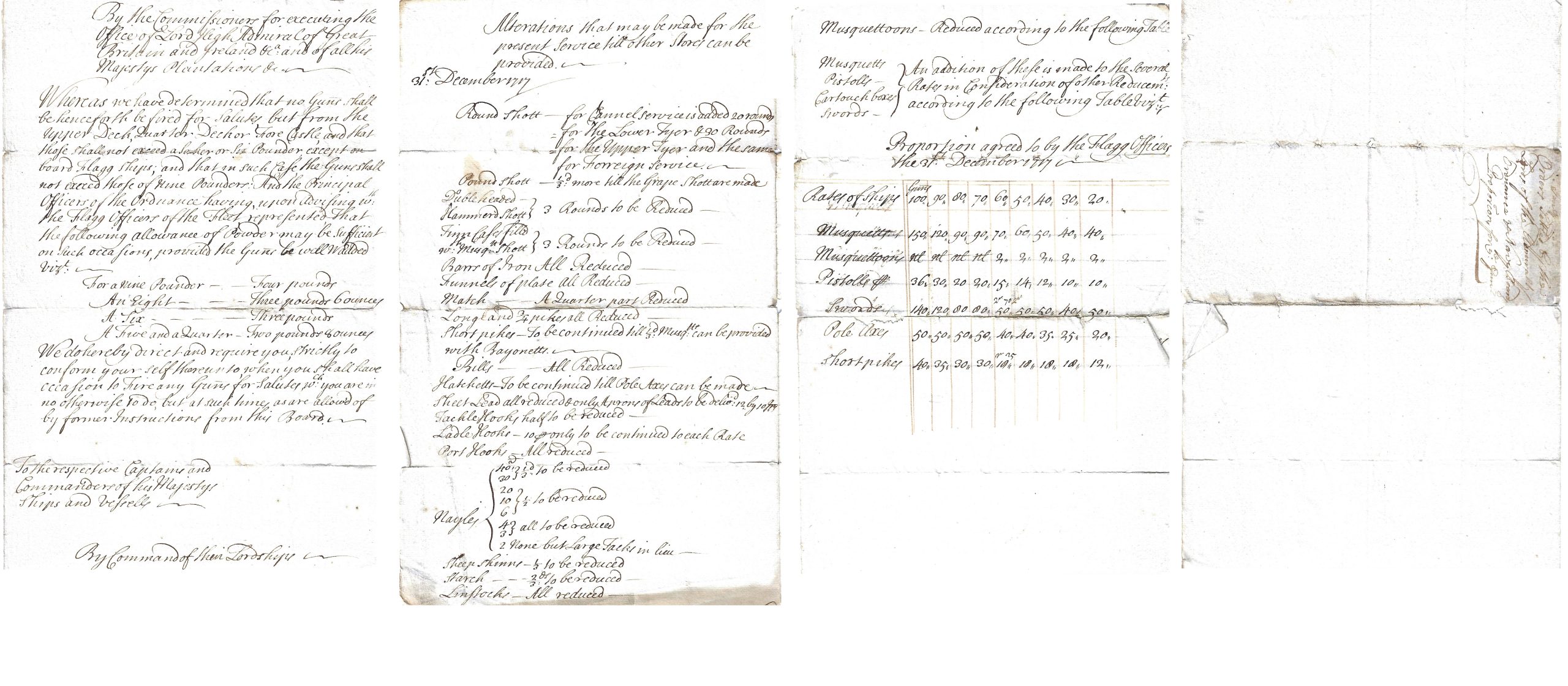
In January 1718 the Lords of the Admiralty issue a directive to reduce the quantity of powder to be expended in saluting. Not only do they instruct that only guns on the upper deck, quarter deck and forecastle be used for saluting, (smaller guns, therefore less powder), but they reduce the amount of powder used in the guns by about a third. With such a large fleet, this must have saved a considerable amount of powder. The letter of 9th January 1717 may have been a forerunner of the savings being made here.
I assume that this letter, precluding the order, was to be distributed to all flag officers and that this copy was for the information of the Ordnance Office at Portsmouth Dockyard.
View in new tab:
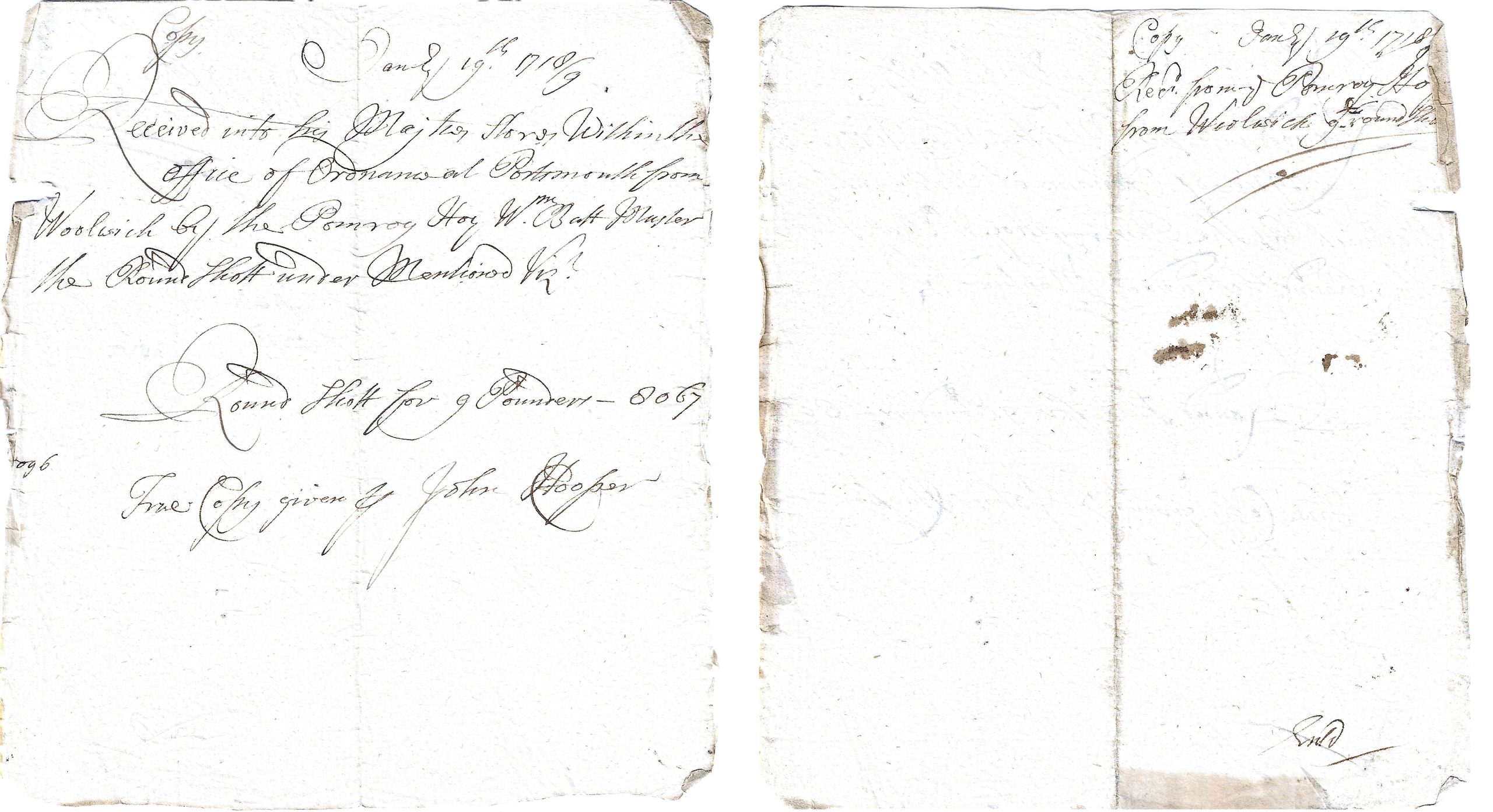
Our first document of 1818 is a run of the mill receipt for round shot delivered by the Pomeroy Hoy.
View in new tab:
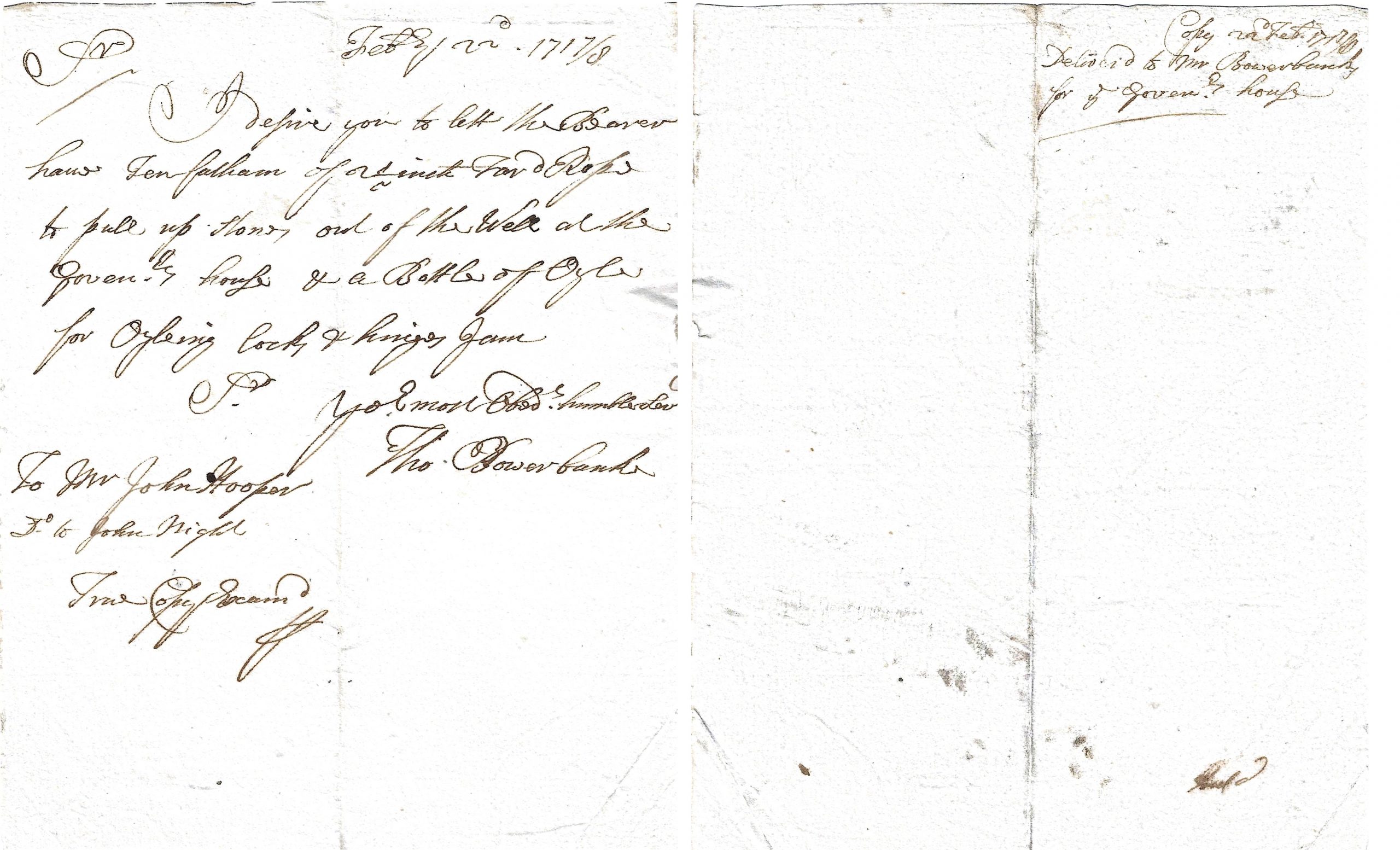
A note from Thomas Bowerbank on 22nd February 1718 asks for 10 fathom, 600 feet of ½ inch rope to “…pull up stones out of the well…”. This makes one wonder how the stones got there and why the bucket was not used to remove them.
View in new tab:
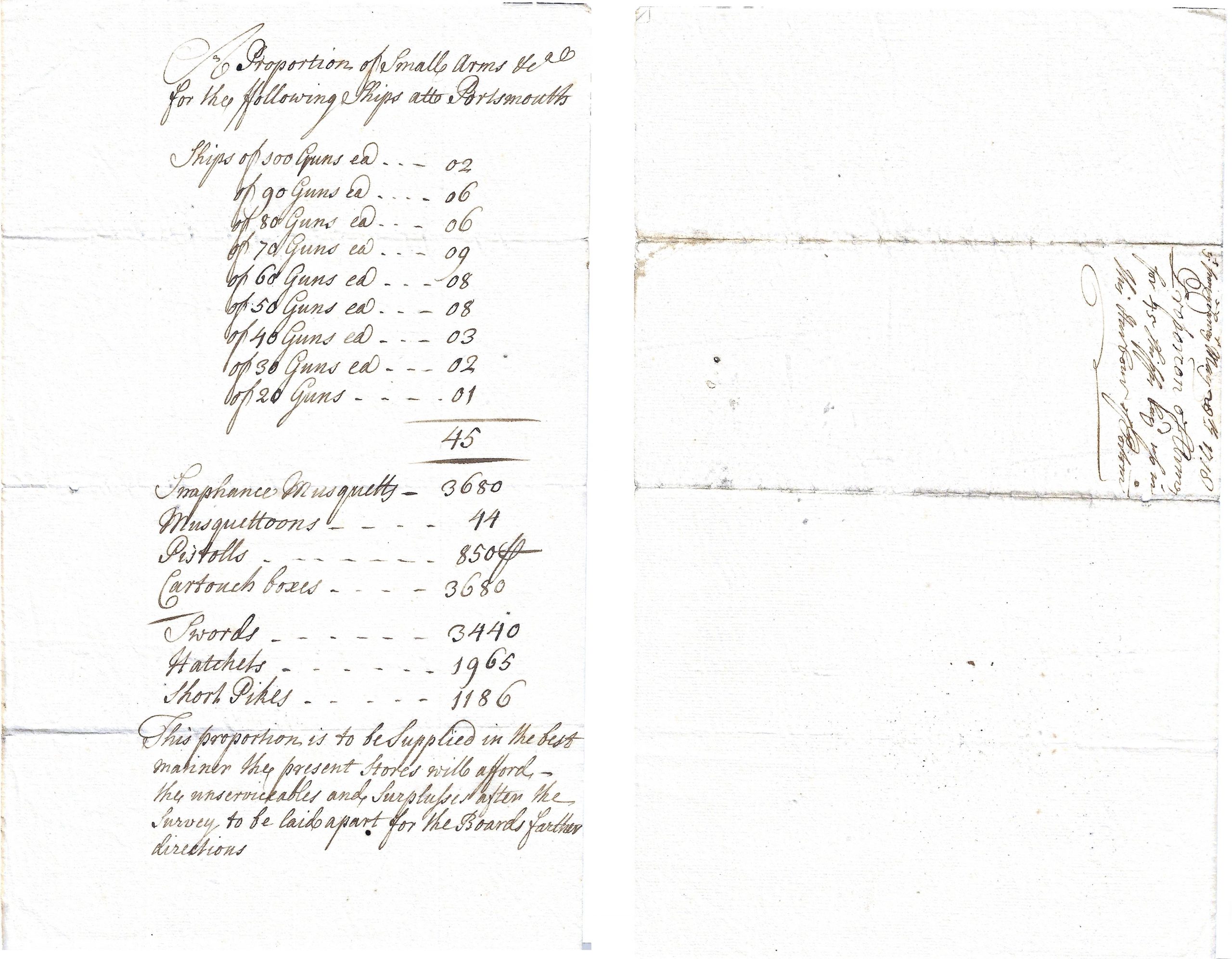
A document dated 28th May 1718 is a curiosity as it has no address nor seal or signatories, yet is written as would a letter from The Board. It mentions 45 ships, but with no names, and then lists a proportion of small arms to be distributed among them.
View in new tab:
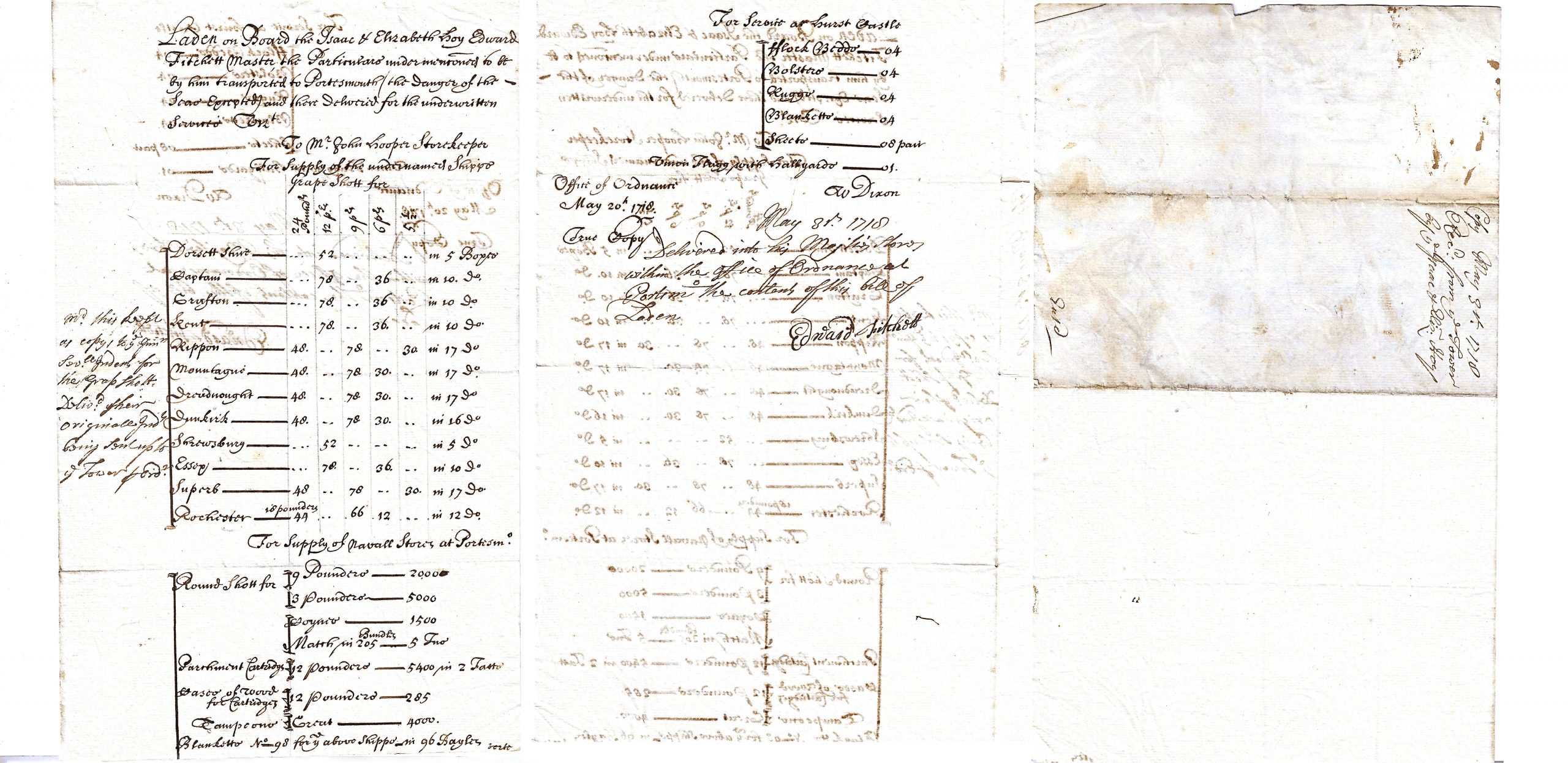
A detailed bill of laden for the hoy Isaak & Elizabeth commanded by Edward Fitchett. It lists gunners’ stores for a dozen ships, for the naval stores at Portsmouth and for Hurst Castle.
View in new tab:
On 31st August 1718 an account of stores for the ‘Fireworkers’ is unusual in that there has, up to now, been no mention of this trade. Looking at the list, it is clear that Fireworkers were those who made the gunpowder, fuses, cartridges and mortar bombs. Fireworkers worked in ‘the laboratory’.

View in new tab:
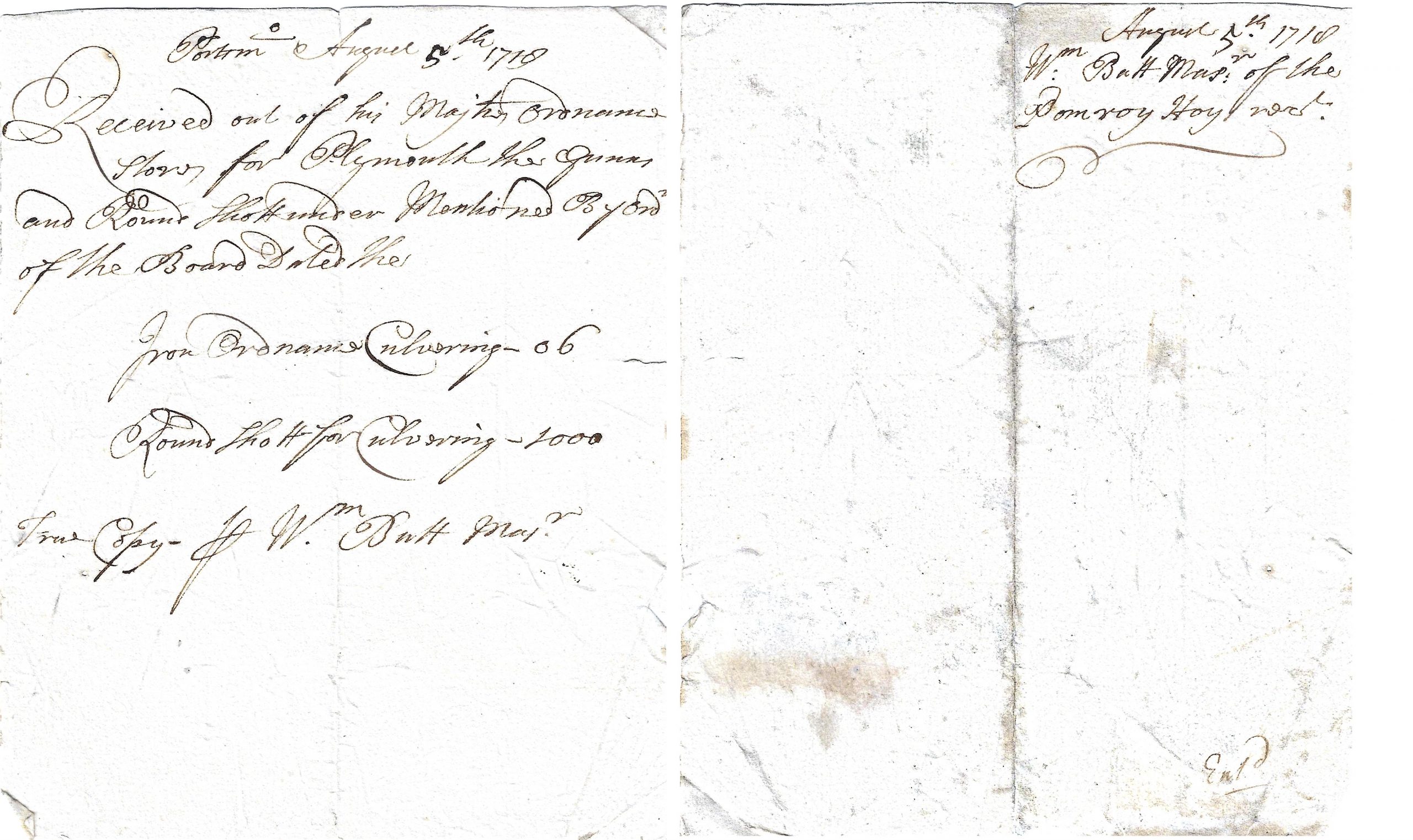
A brief bill of laden for the Pomeroy hoy commanded by William Batt for 6 culverings and shot for the same.
View in new tab:
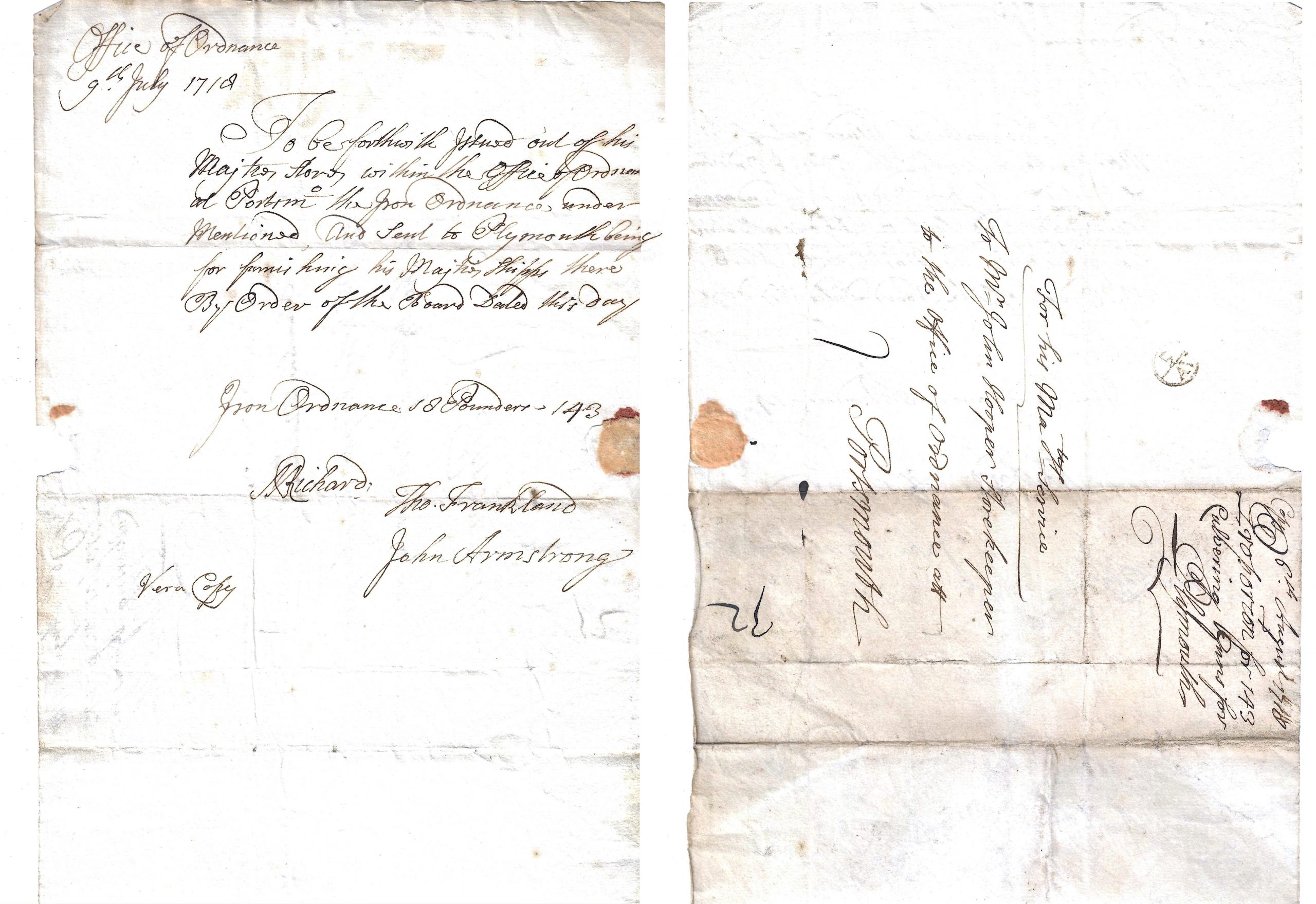
An instruction to provide 148 guns for Plymouth.
View in new tab:
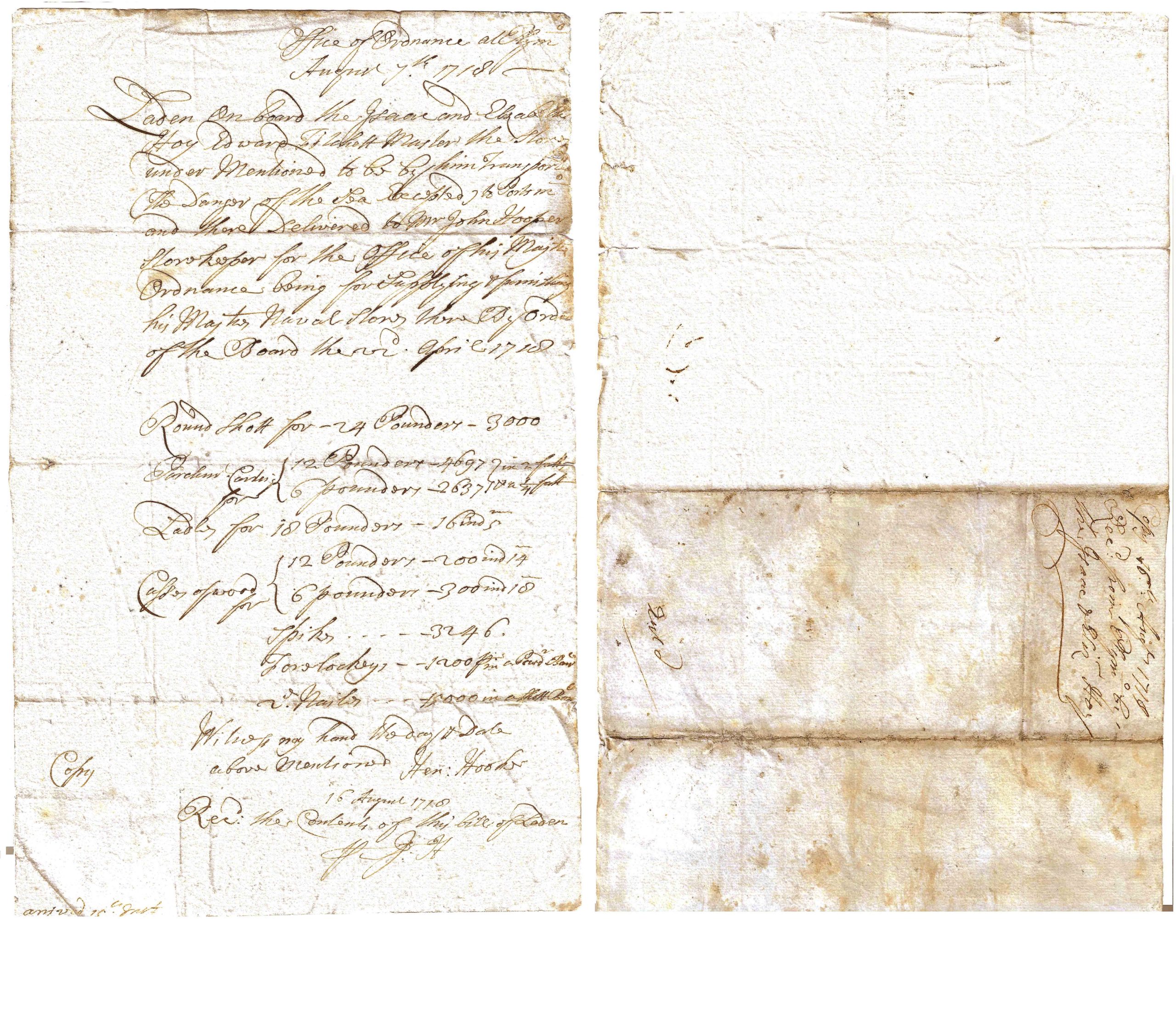
Should there be any doubt about the carrying capacity of a hoy, the bill of laden (16th August 1718) from Edward Fitchett master of the Isaac & Elizabeth gives us an idea of just how much she could carry. There is shot for 12 ships in 147 boxes, a huge quantity for the stores at Portsmouth, and more for Hurst Castle.
View in new tab:
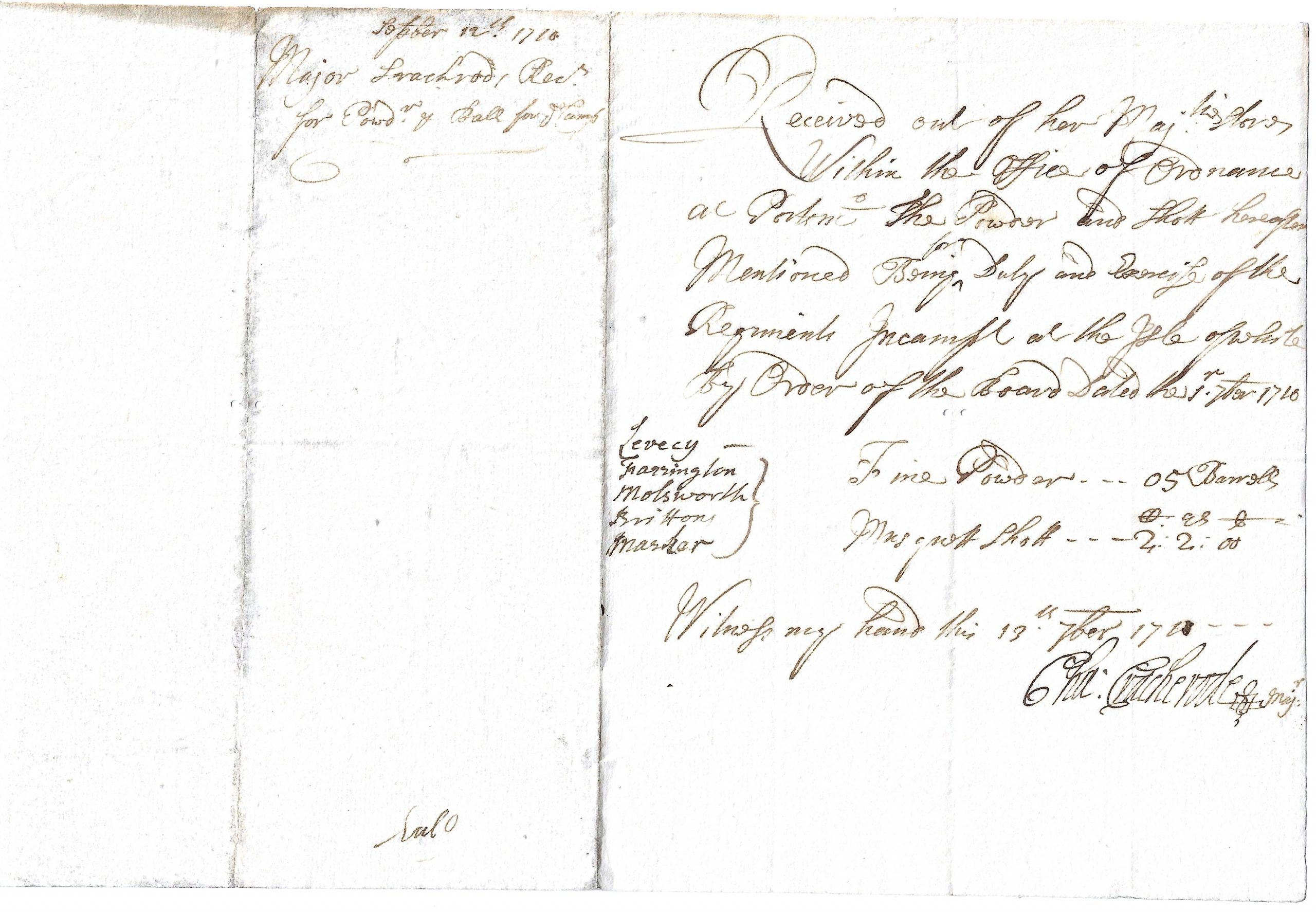
A receipt for powder and shot from Major Charles Cracherode.
View in new tab:
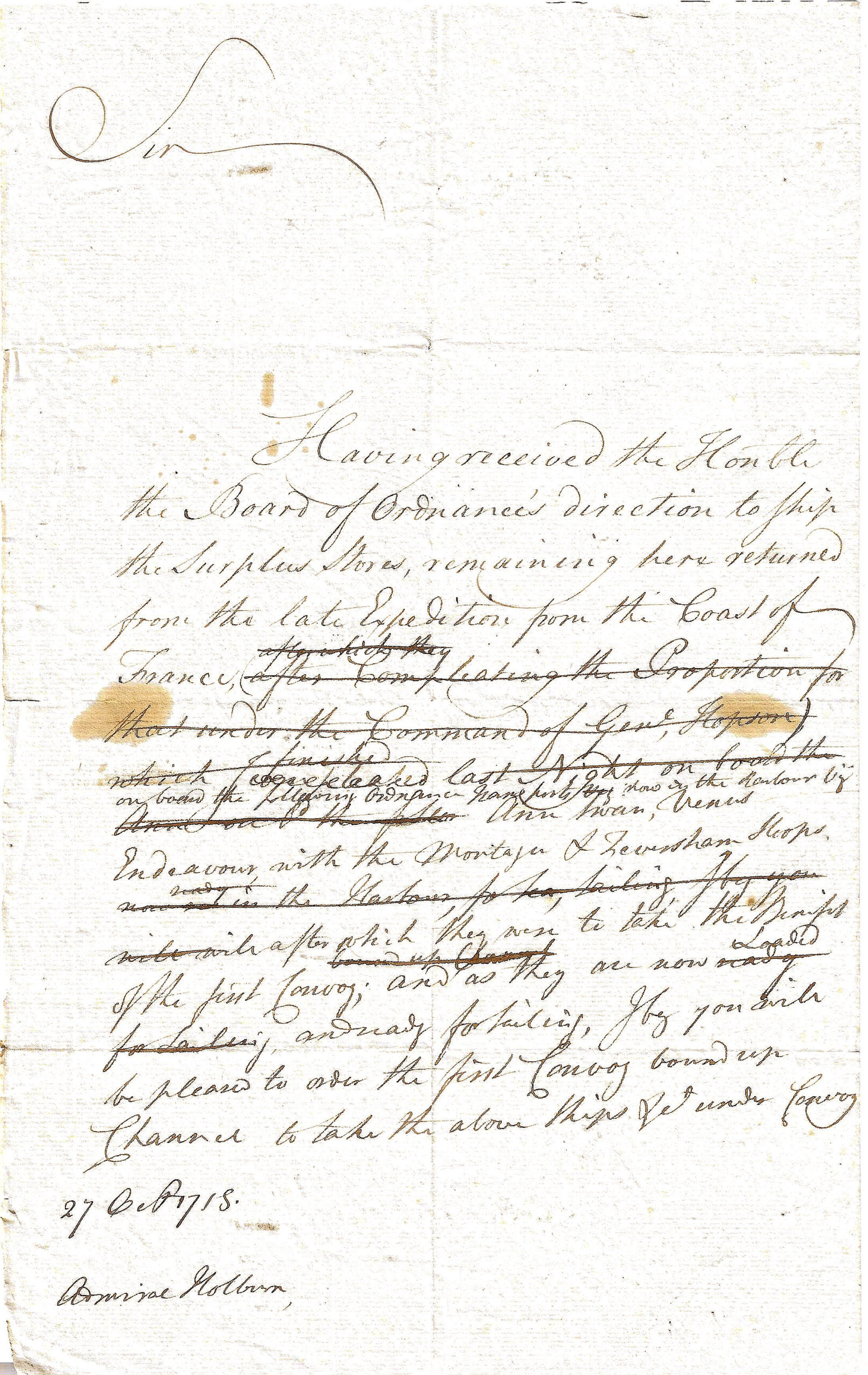
A faded note from Admiral Holburn, full of corrections and difficult to read, so I have to thank Philip Eley for his assistance once again in transcribing. Dated 27th October 1718, asks for a convoy to escort four merchant vessels ‘up Channel’. The note is not addressed, and it makes one wonder why it was in the Office of the Ordnance at Portsmouth when it would surely be the admiralty who control what vessels join a convoy. The term ‘up Channel’ infers that the destination is not Portsmouth but Woolwich or Greenwich.
Admiral Holburn was likely Sir James Holburn 1st Baronet.
View in new tab:
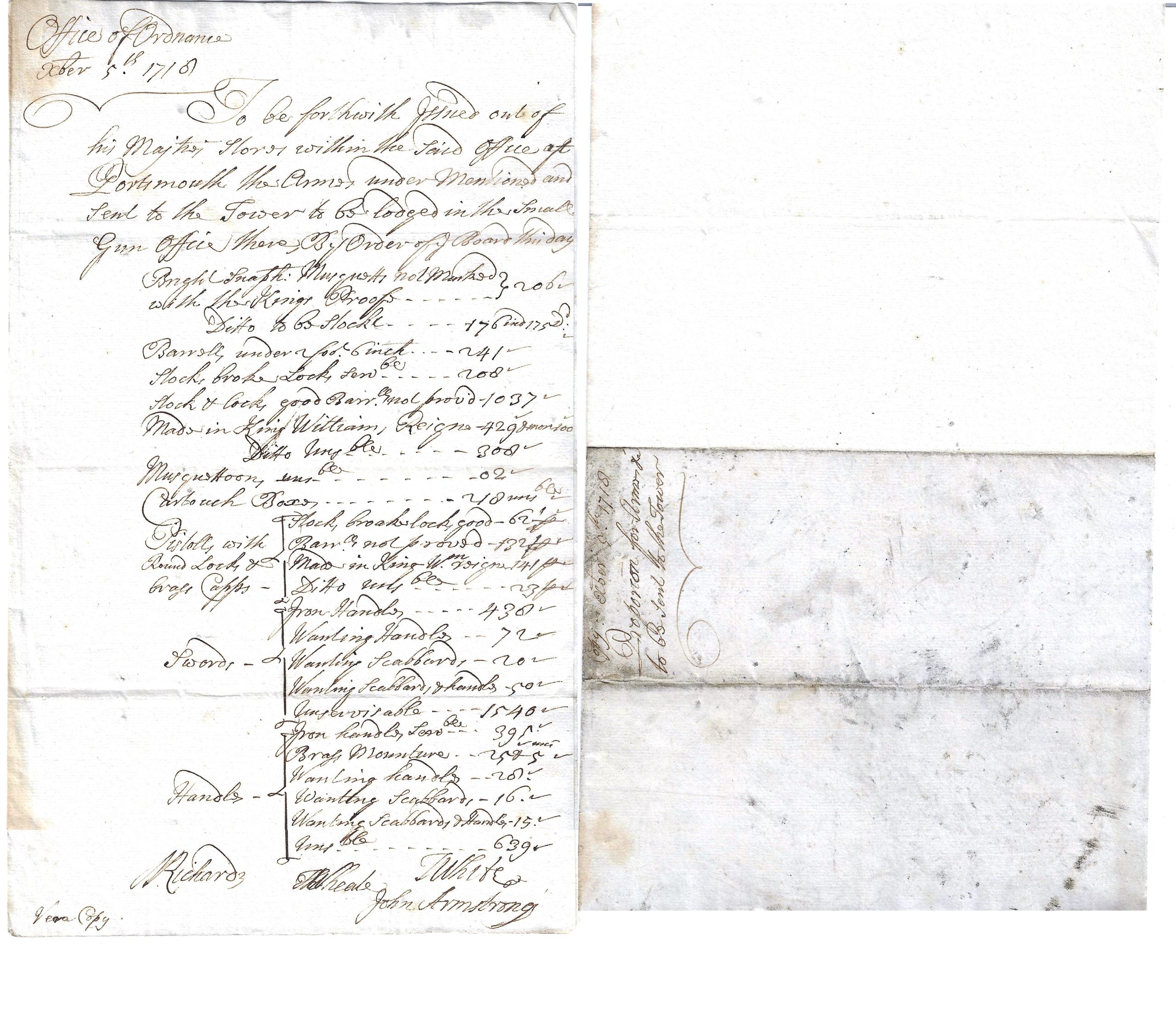
5th December 1718 a list of small arms being sent to The Tower. Most of them seem to be old and/or unserviceable.
View in new tab: