You will find download buttons for the scans and transcripts, or you can view them online by clicking the links where it says “View in new tab:”.
It was not a happy new year for Mr. Maxwell Junior, blacksmith at Portsmouth Dockyard who has evidently been slow in performing his duties. So much so that The Board write on 2nd January 1719 demanding he find two people to support him with security of £500. Note that The Board members sign themselves ‘your loving friends’.
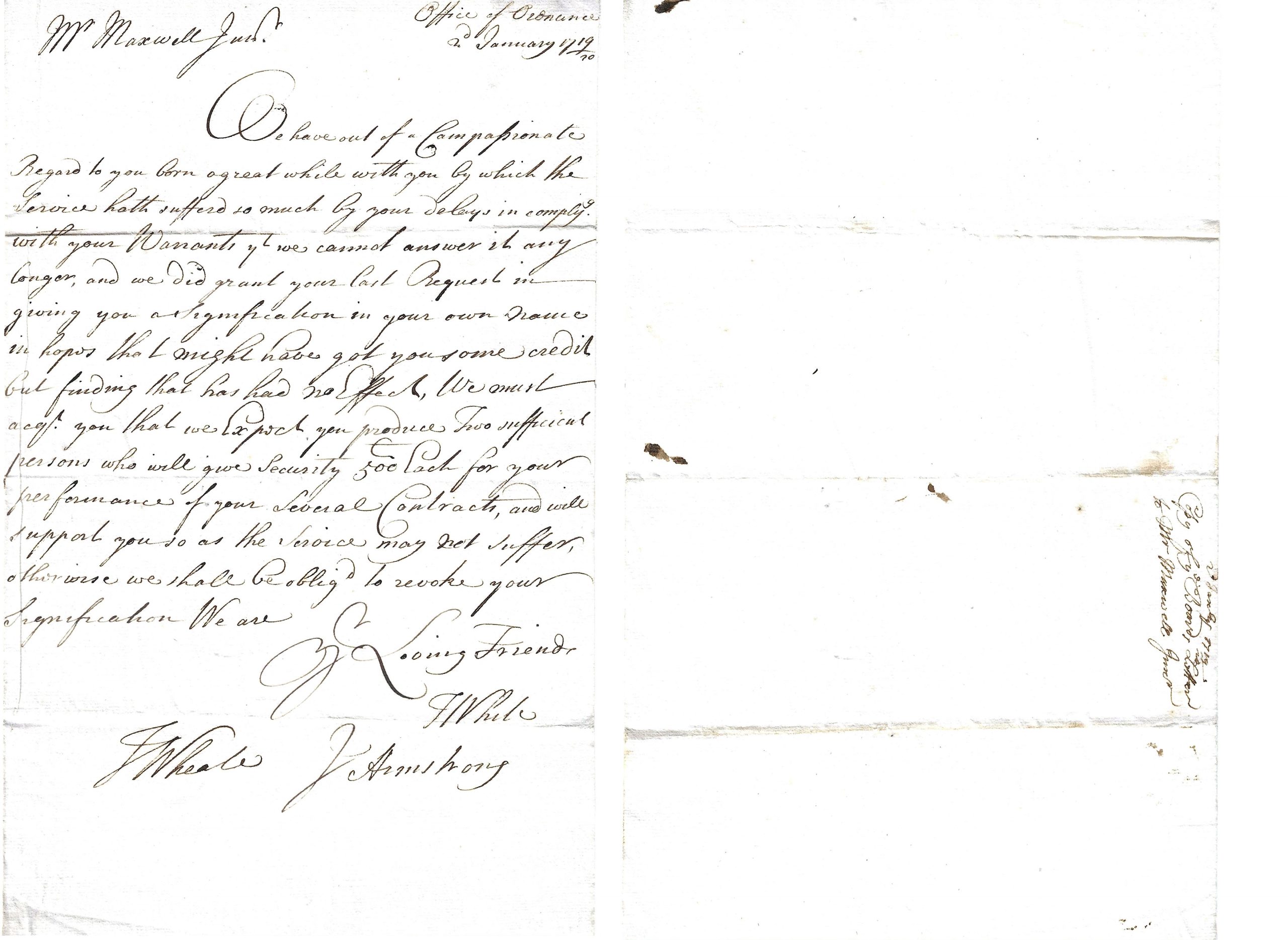
View in new tab:
January 5th, 1719, Bell Jones writes to ask that Messers Hooper and Baxter, and Captain Pattison assess shot and shells, that were ‘condemned and seized’, to ensure that they meet the new regulations. This is the first letter addressed not only to Mr. Hooper but also to Captain John Baxter. Possibly the workload was building, or Captain Baxter was in training under Mr. Hooper.
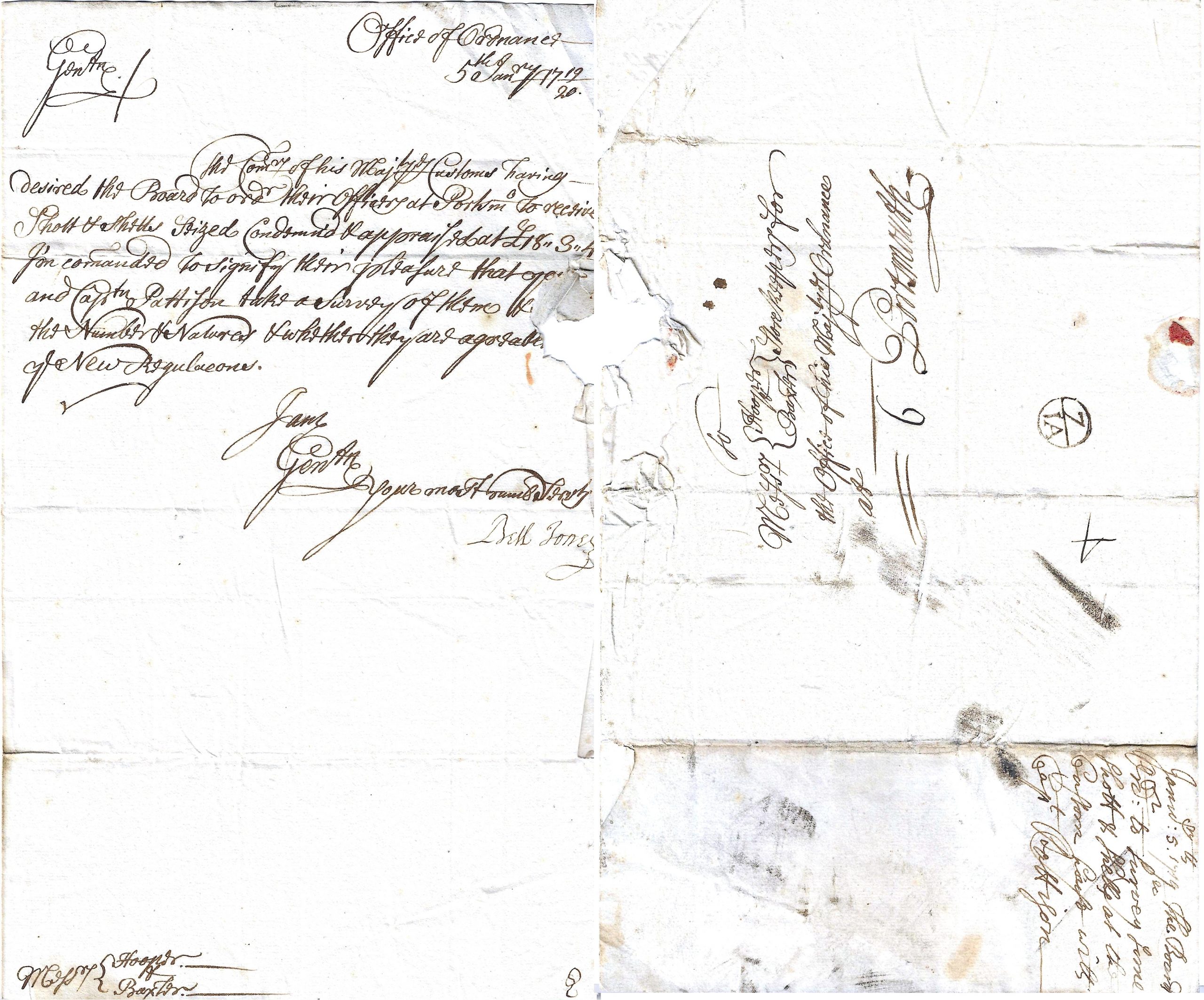
View in new tab:
A note on 17th January 1719 contains a request, and a receipt for sheet lead and cisterns for work on the new barracks and the gun wharf. This is followed on the 20th by a similar request.
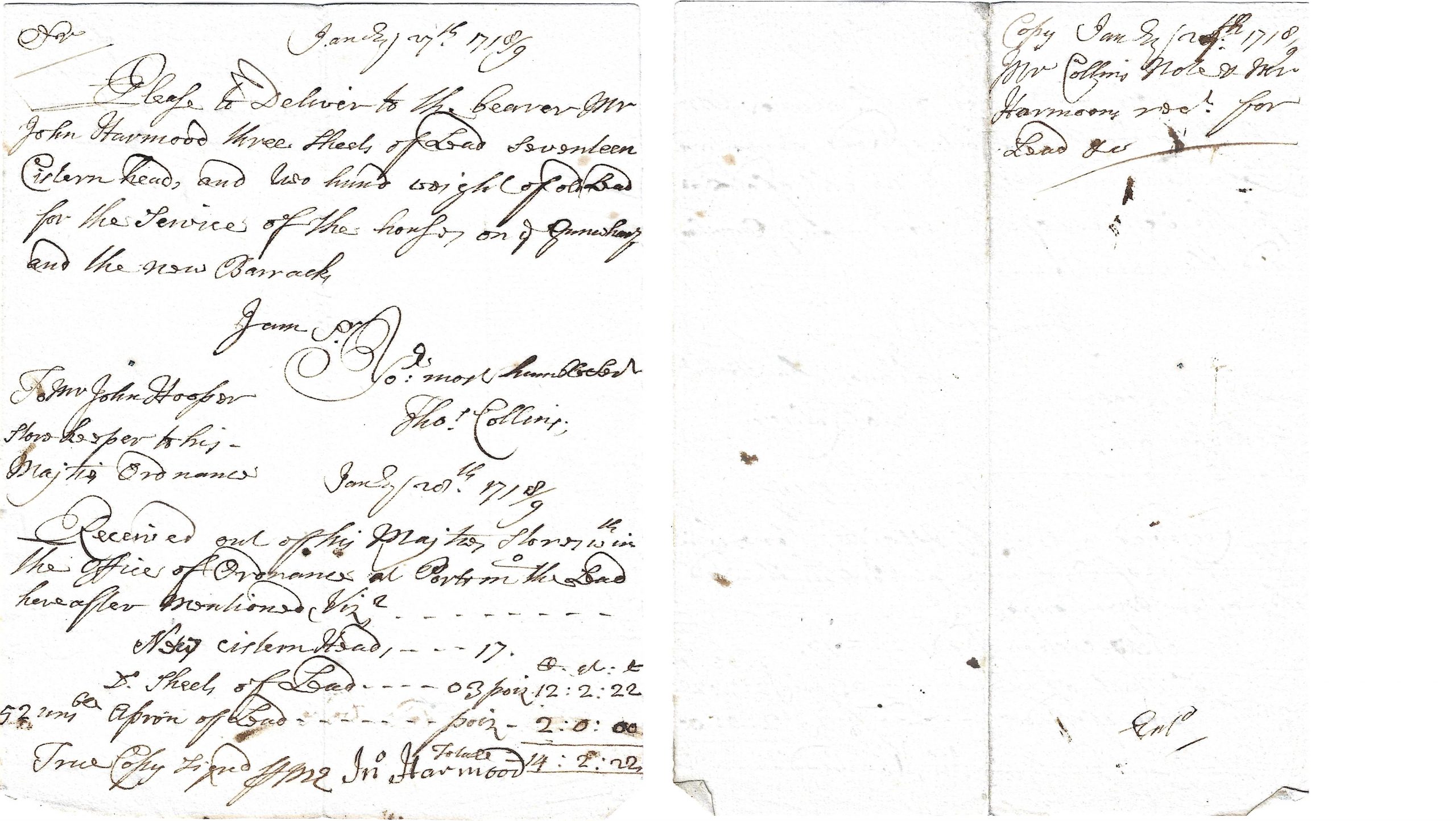
View in new tab:
Whoever wrote the precis for this note clearly misread Mr. Bowerbank’s name as ‘Bowerband’.
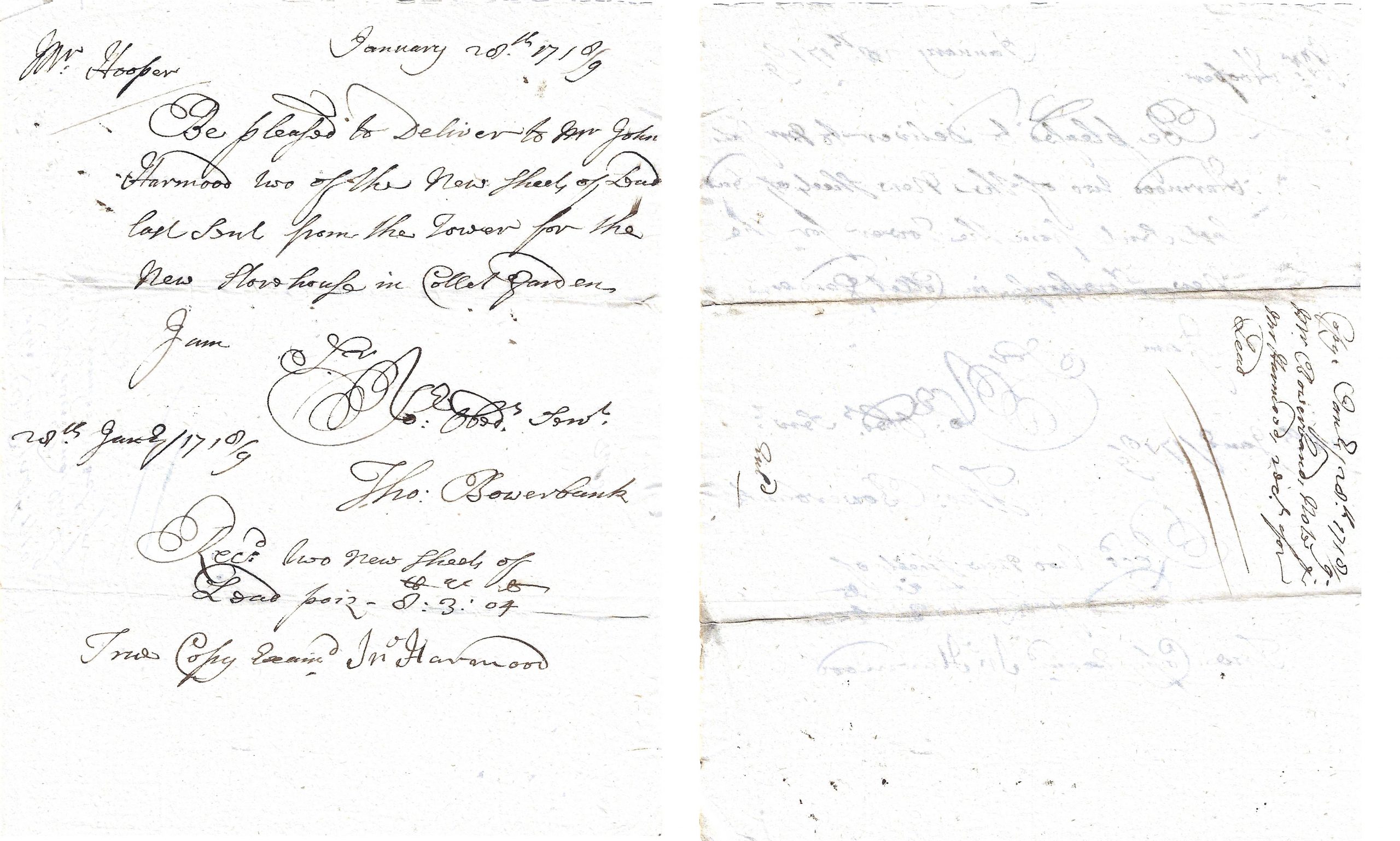
View in new tab:
This note lists gunners’ stores returned from HMS Boyne. This was the vessel preceding the ship of the same name that famously exploded at Spithead in 1795.
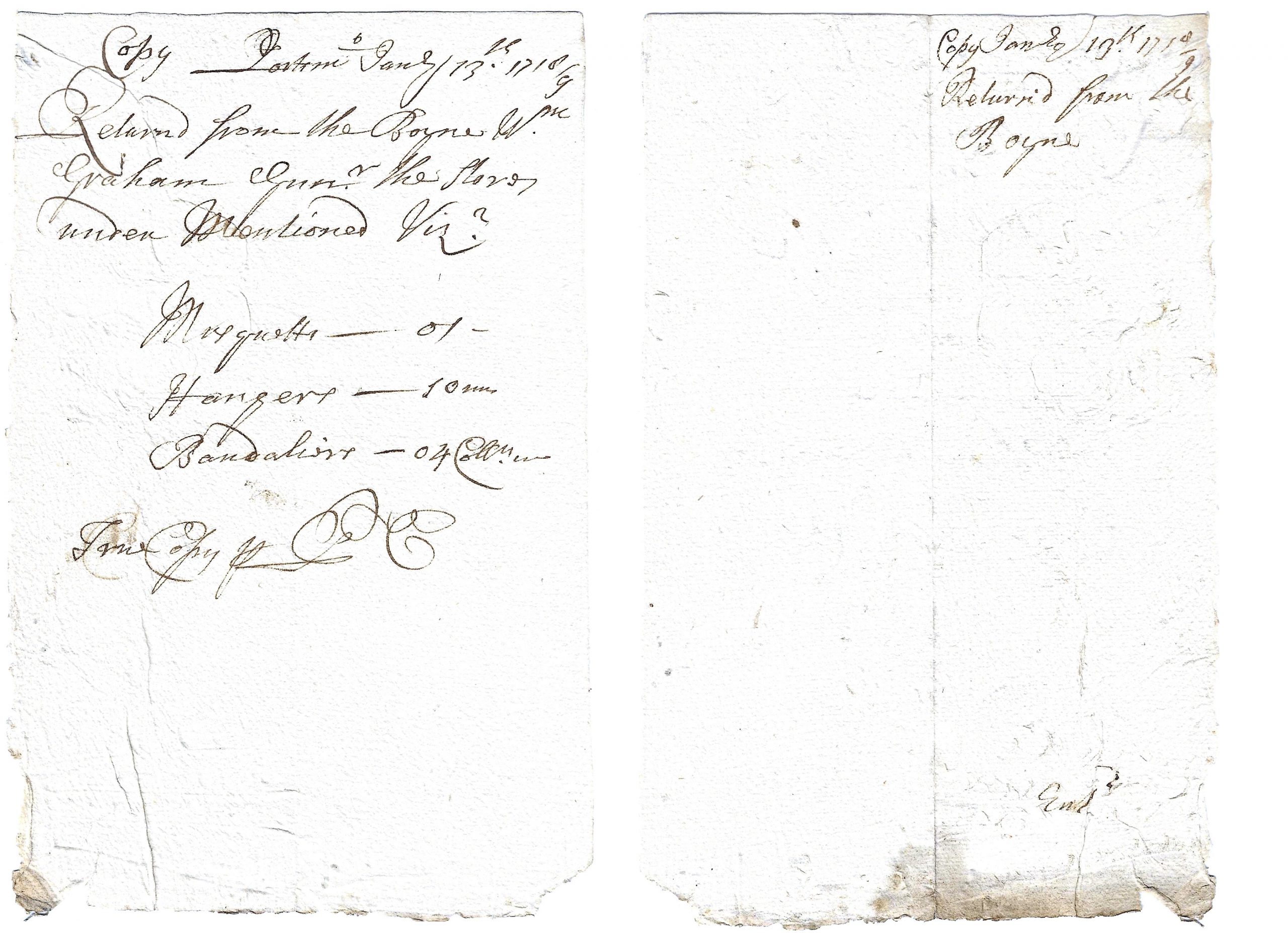
View in new tab:
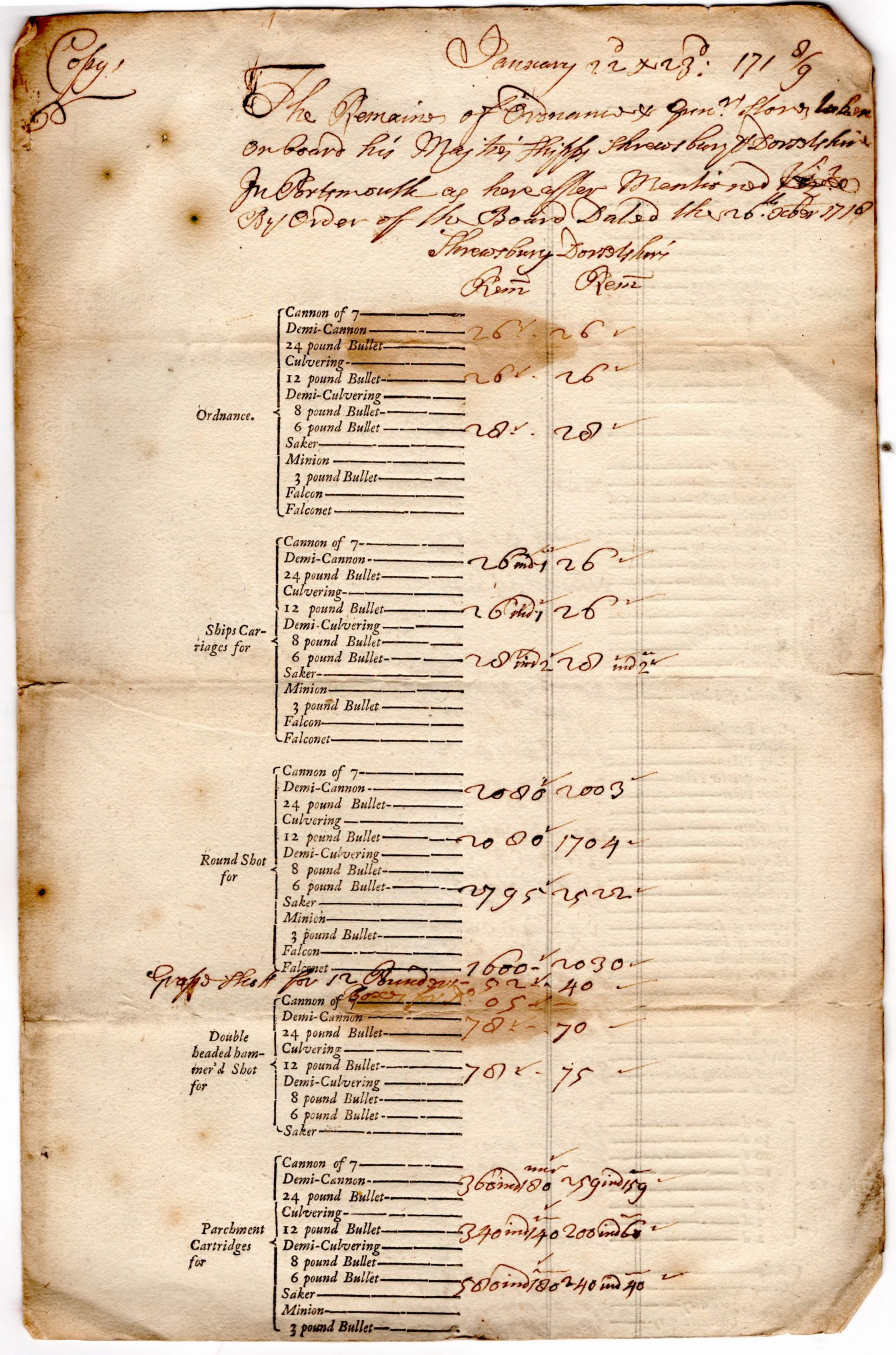
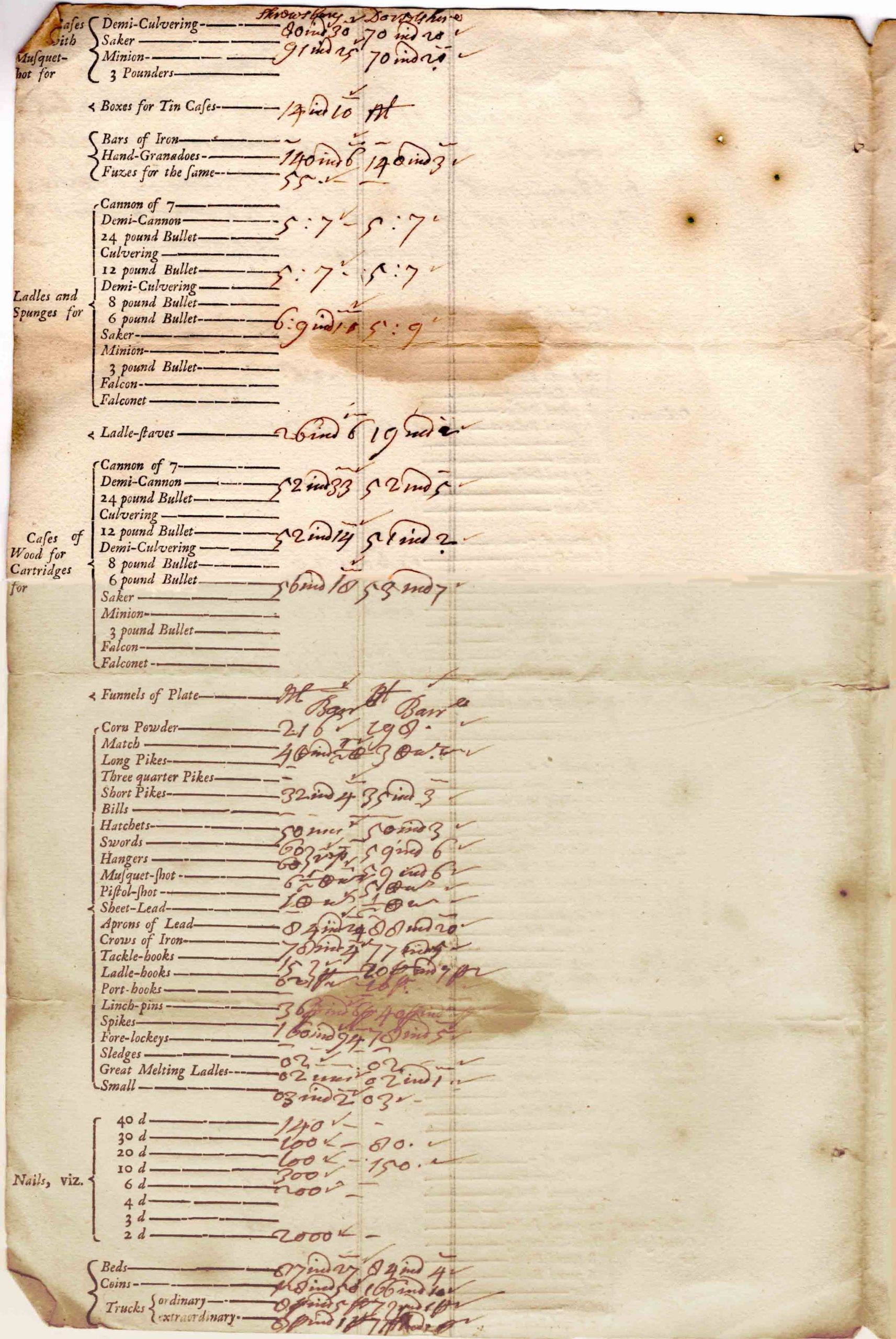
22nd January 1719 we get to see the remains taken from HMS Shrewsbury (1758) and Dorsetshire (1694), both 80-gun ships. This would appear to be a complete audit of their Ordnance and gunners’ stores showing us exactly what they carried.

View in new tab:
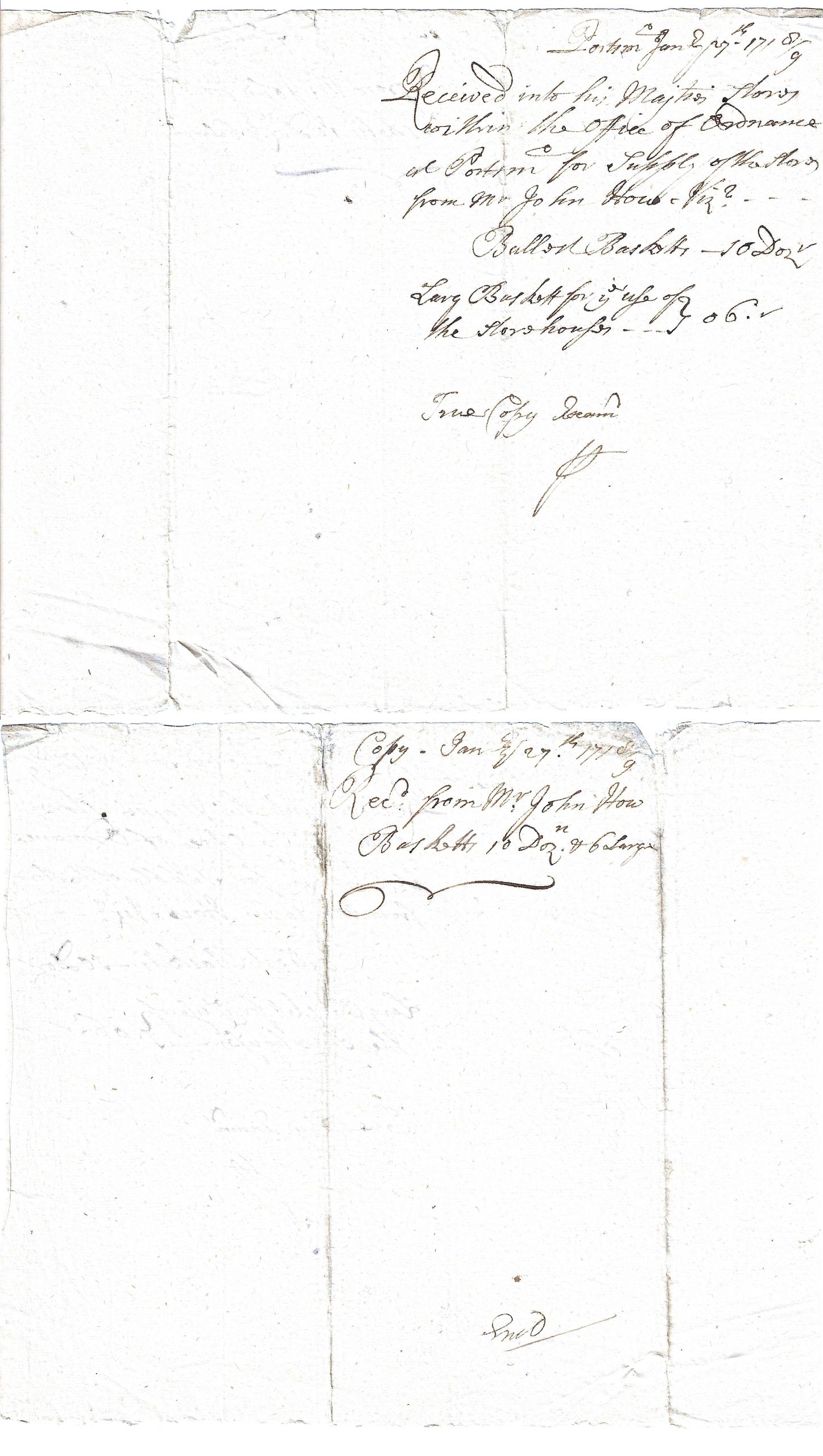
A receipt for ballast baskets from Mr. John How on 27th January 1719. These would have been baskets to hold weighty items such as stone or gravel to put in the bottom of a ship to correct the trim of the vessel. Pig iron was also used for this purpose.
View in new tab:
Mr. Baxter has evidently written to The Board regarding the state of the powder in the stores, because on 6th 1719 February he receives news that there is to be a ‘proof of powder’. This was to validate its suitability for use to the service. Proofing was performed on all Ordnance and proof marks would be stamped on the gun barrel. Powder was also tested to prove its suitability for its intended purpose. Powder barrels would be marked to indicate the type of powder they contained.

View in new tab:
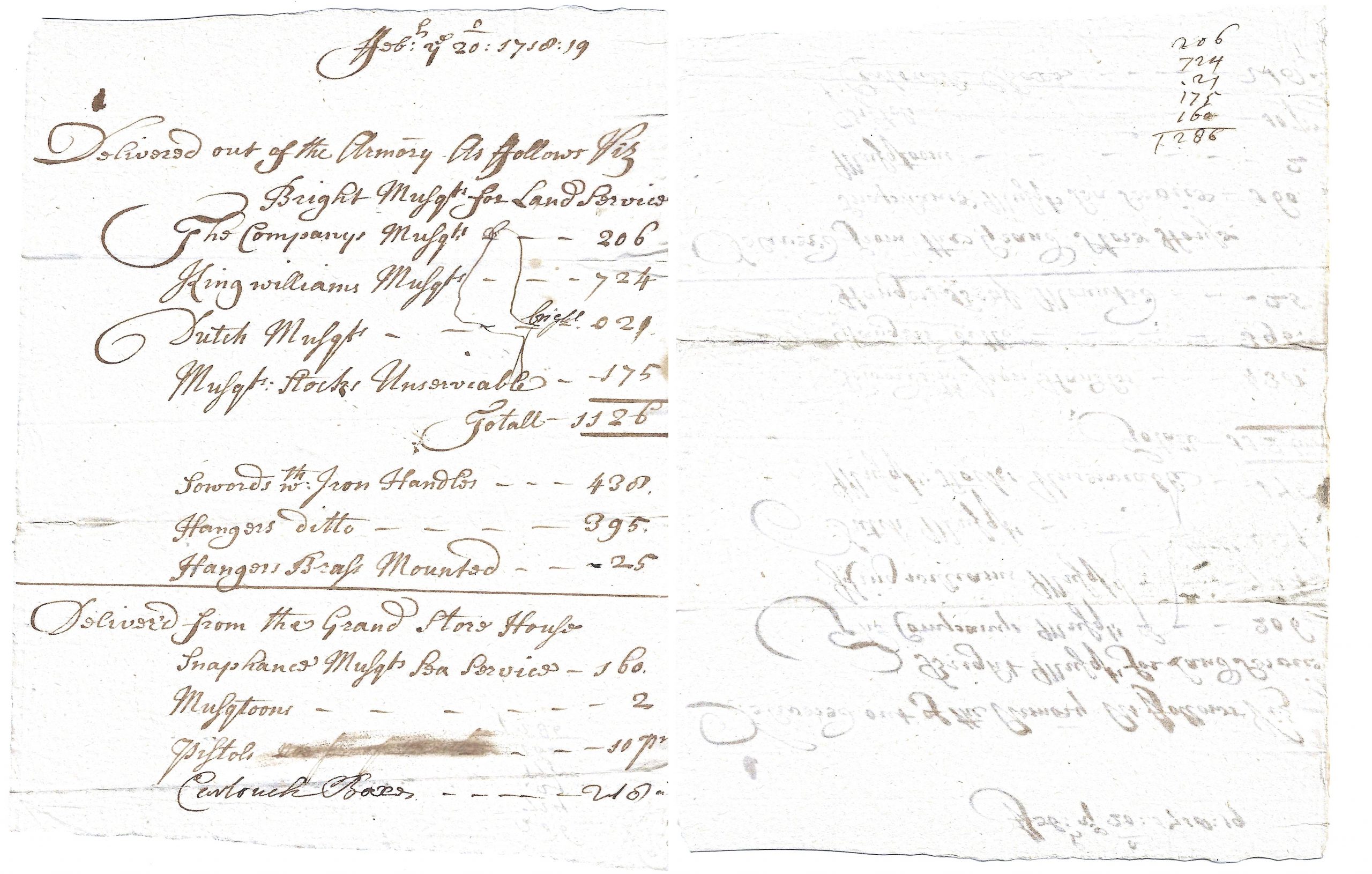
On 20th February 1719 a note lists small arms delivered from the armoury and the Grand Storehouse. Among those from the storehouse are Musketoons, these were short muskets.
View in new tab:
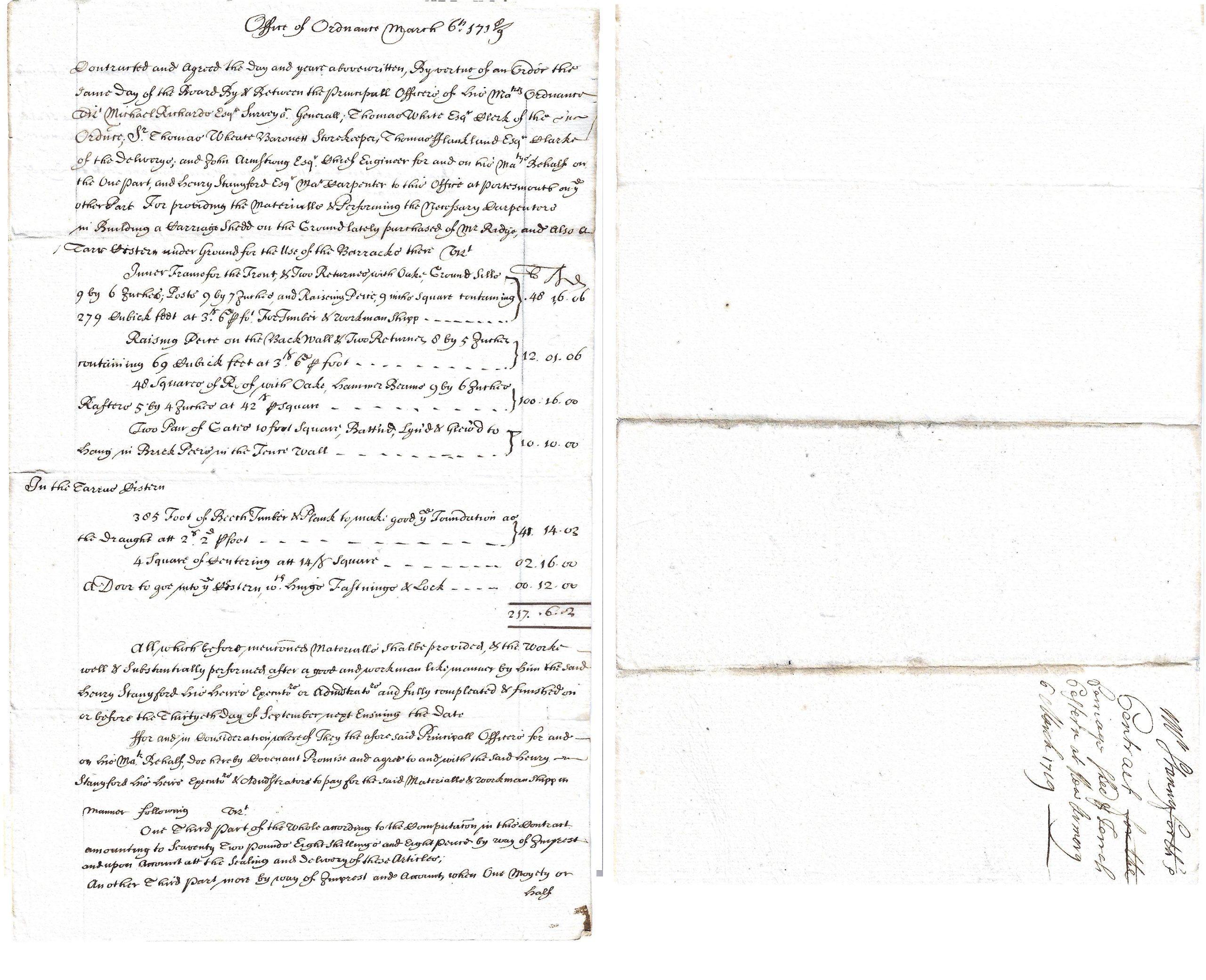
On 6th March 1719 Mr Stanyford is presented with a contract to build a carriage shed and a cistern. A really tidy looking document, but somewhat challenging to read in places. One word in particular presents a problem. In the precis we see possibly: Terrah, Terral or Terras followed by cistern. In the text body, near the end of the first paragraph, the word appears again but only ‘Tar’ is properly intelligible. Later, as a title to the third paragraph, we see Tarras, again followed by Cistern. The word ‘Terral’ means ‘ground’. In the text we read that the cistern is to be under ground, so, it looks as though we are talking of a terral cistern.
View in new tab:
The note from the master of the hoy Content, John Edmonds, on 29th December 1719 states that he will be transporting a number of standing carriages (land carriages as opposed to ship carriages) to William Dixon, the storekeeper at Plymouth. The dates can be confusing: in the text it says “6th March 1718/9” which means 6th March 1719, and the date at the bottom of the note (Xber 29th 1719) means December 29th 1719.
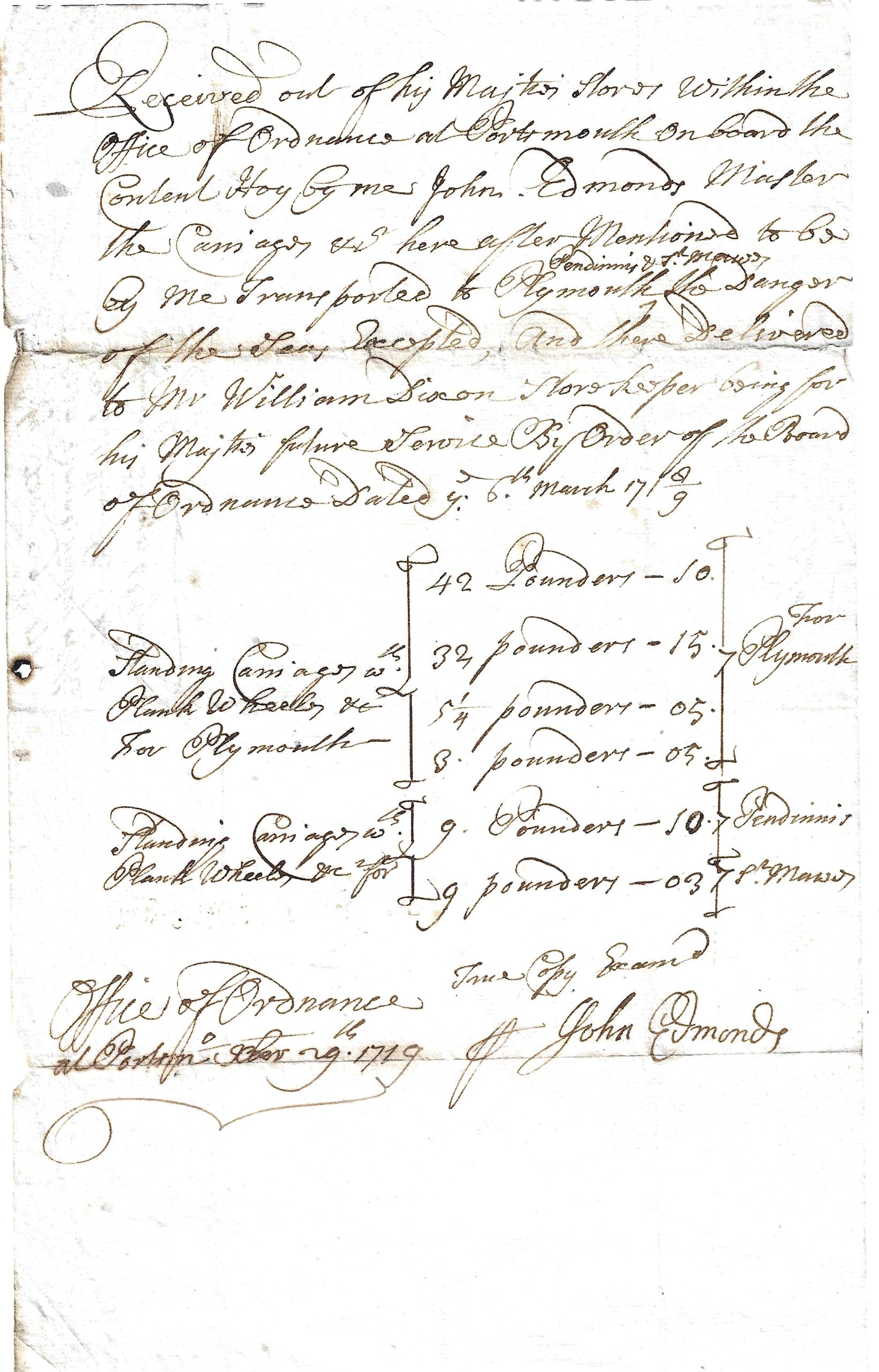
View in new tab:
Captain Bell Jones writes on 11th March 1719 to Captain Baxter advising that the Admiralty wished HMS Prince Frederick (1679) to be furnished with ninety-seven barrels of powder. This is in preparation for an expedition to the Baltic commanded by Sir John Norris.
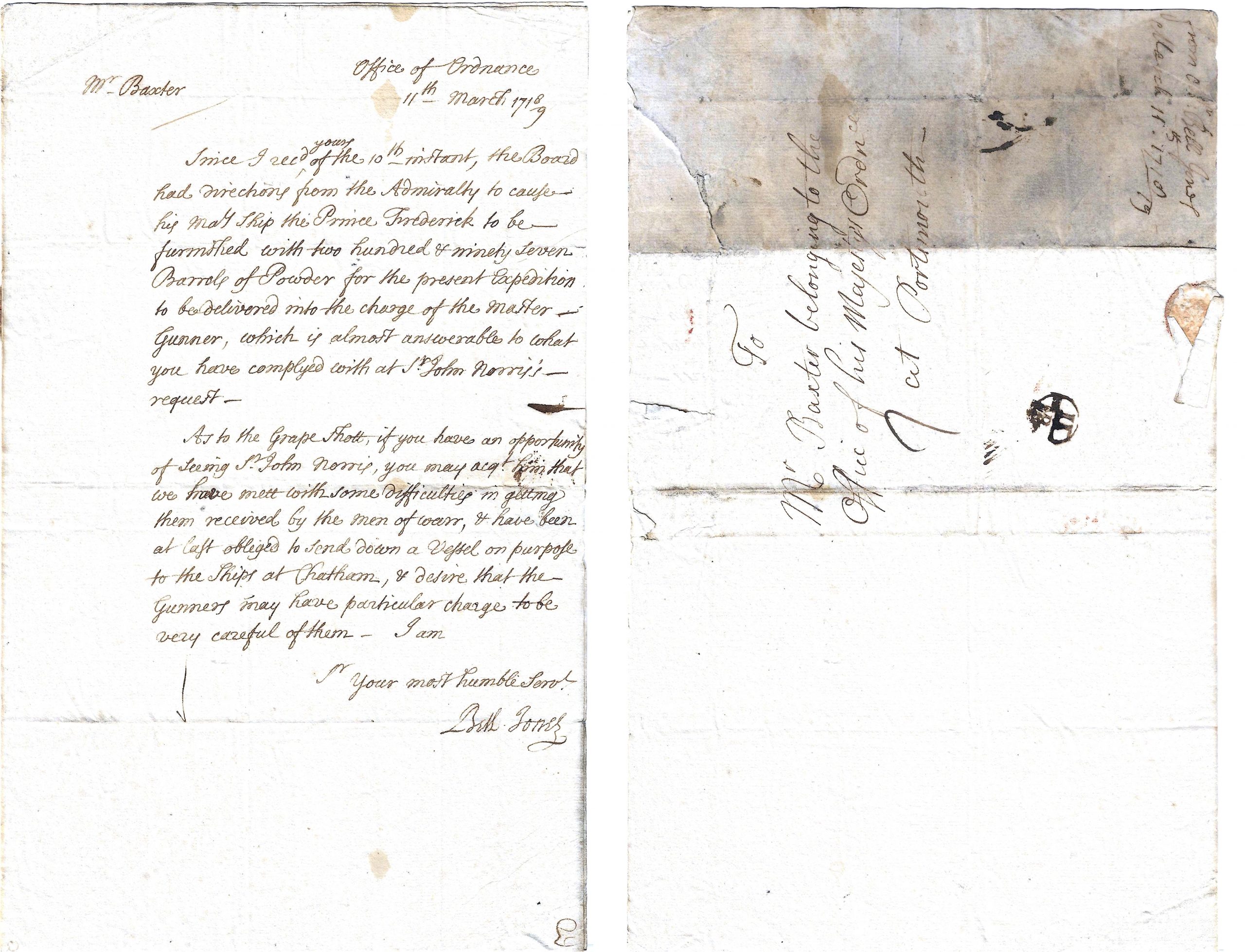
View in new tab:
Two letters regarding accommodation follow. The first agrees to Peter Coward taking up residence in a house built for him on the Gun Wharf before Lady Day, 25th March. This was the first day of the new year using the Julian calendar.
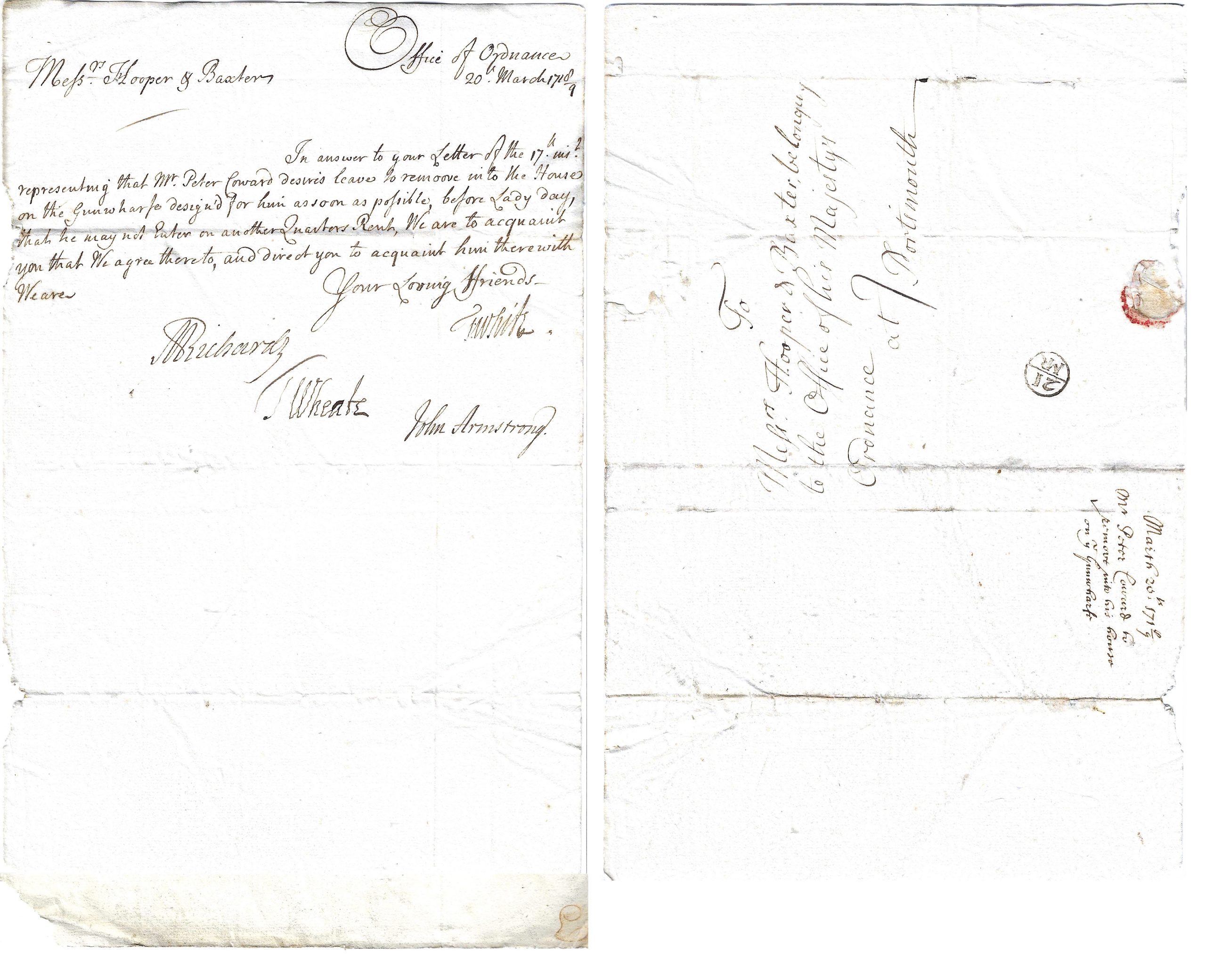
View in new tab:
Although initially about accommodation for clerks, this note also advises that 700 muskets are to be supplied.
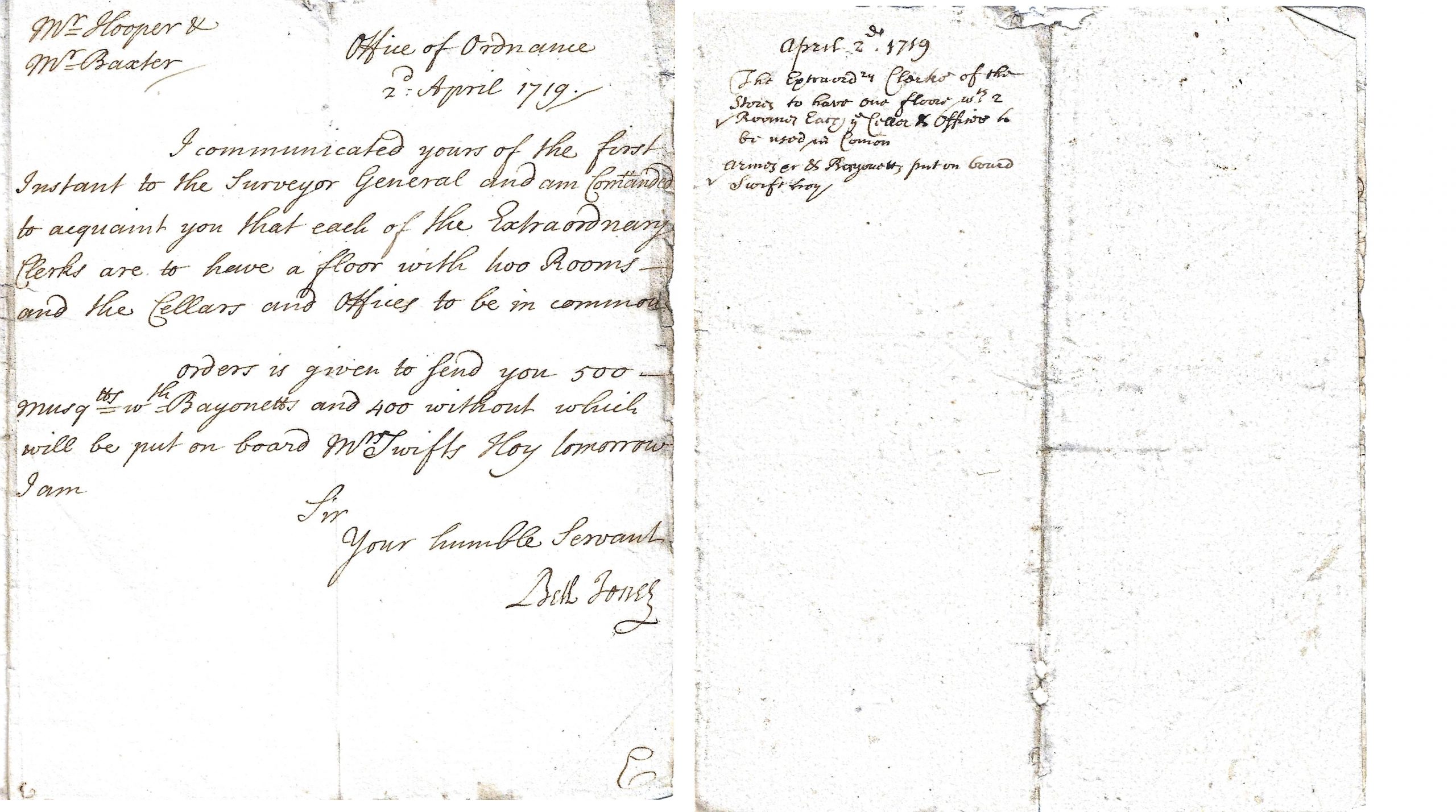
View in new tab:
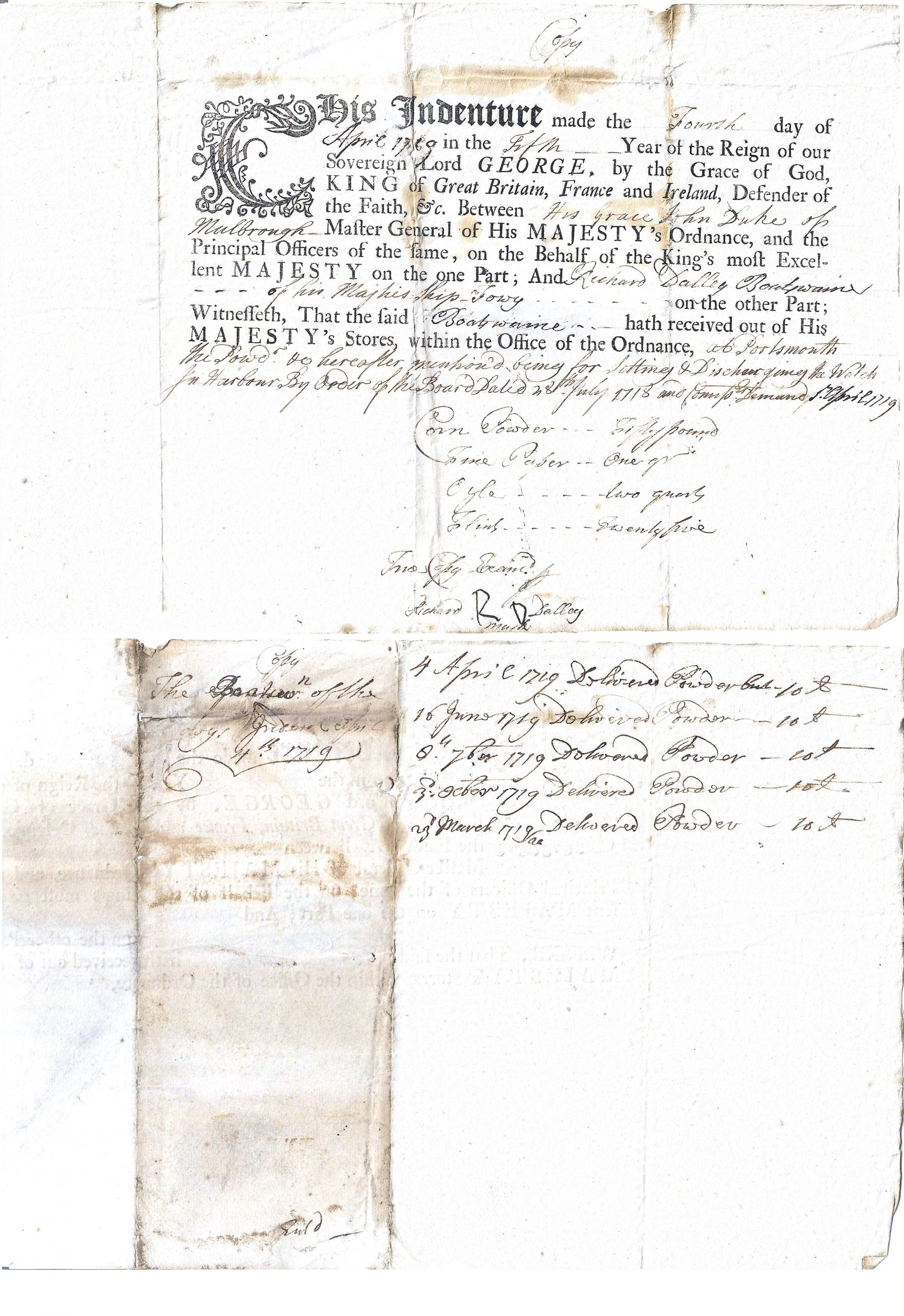
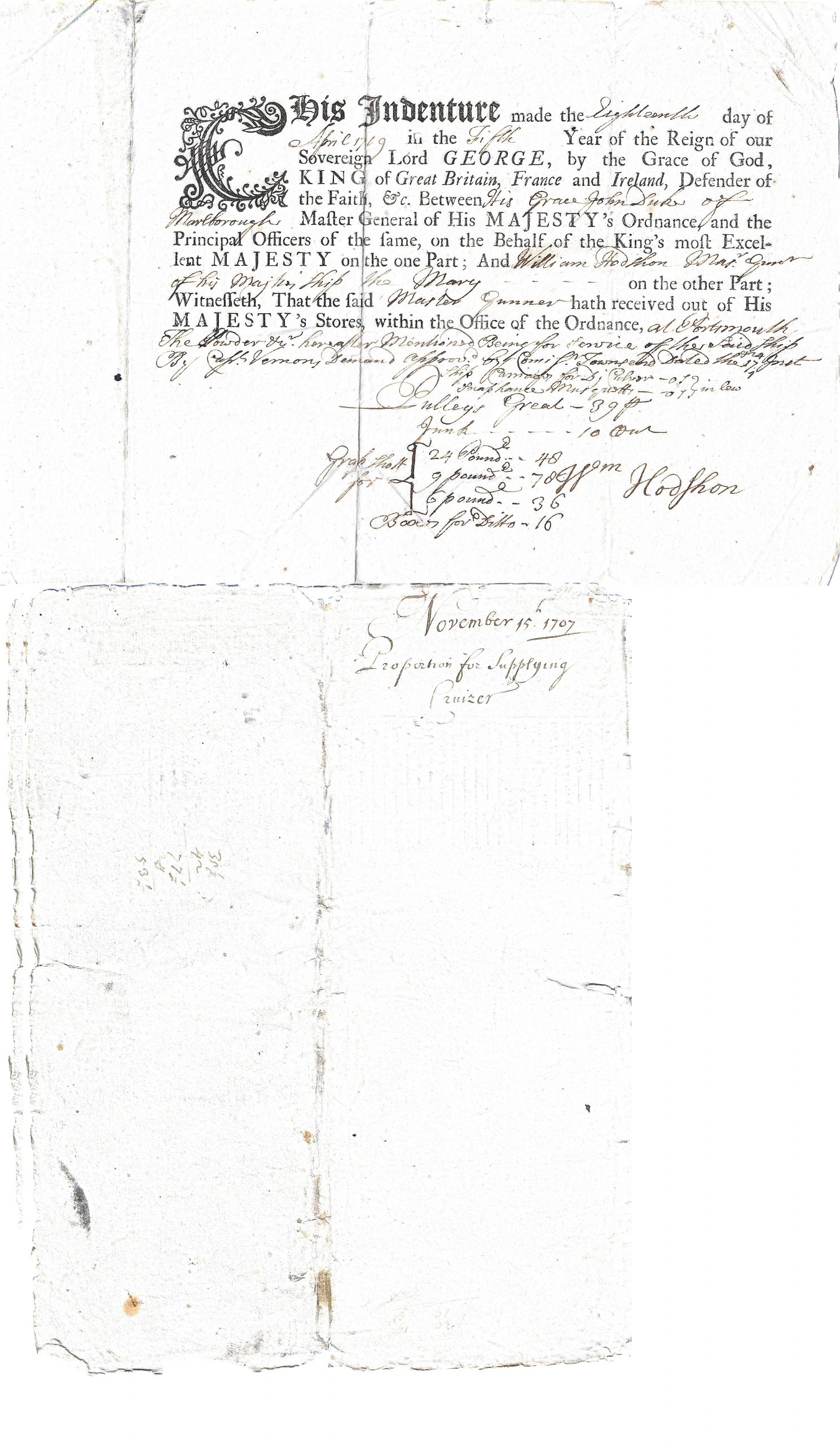
On April 4th and 5th indentures for HMS Towy and Mary. Usually indents for gunners’ stores are between The Board and the master gunner of a vessel, but the indent for Towy is with the boatswain. It is for fifty pounds of powder which is delivered in ten-pound instalments between April and March 1720. The indenture for Mary follows convention and is with the master gunner.
I think it is fair to assume that Boatswain Richard Dailey could not sign his own name as we can see that he left his ‘mark’ in the form of his initials. A boatswain was in charge of the ship’s rigging.
View in new tab:
Indentures are usually fairly run of the mill and of minimal interest. This one, for HMS Mary, is no different until one notices the name of her captain: Edward Vernon, later to be promoted to Admiral. He gained the nickname ‘Old Grog’, so named after the grogram coat that he favoured. It was he who ruled that the sailors’ rum should be diluted with water, he also suggested that they add sugar and lime juice to make it more palatable. It was this mix, known as Grog, that proved the cure for scurvy.
View in new tab:
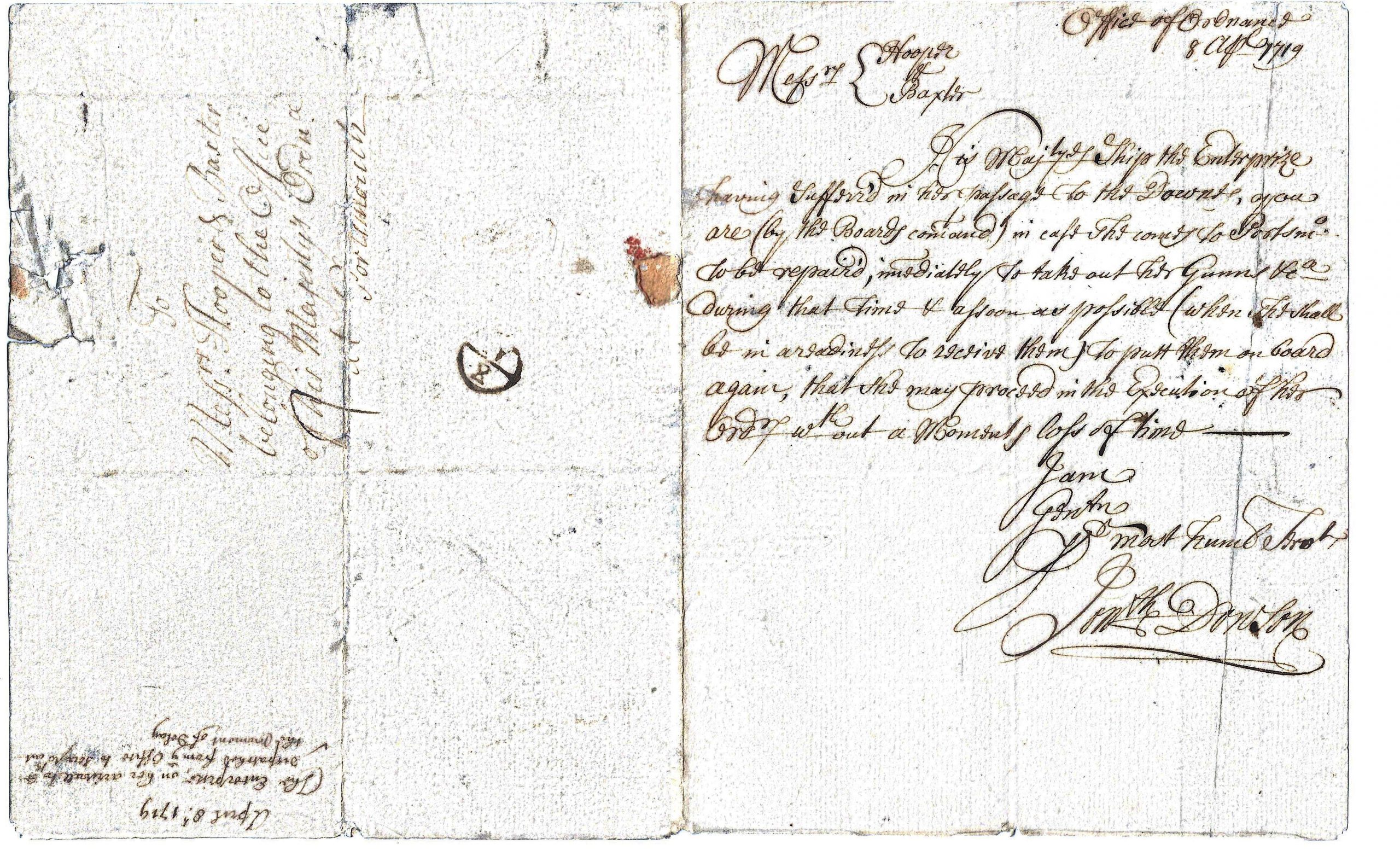
HMS Enterprise (1709), having suffered damage, needs to put into port for repairs. On 8th April 1719 Messrs Hooper and Baxter are advised that, should Enterprise come into Portsmouth, they are to take out her guns and stores for the period and return them when she is ready for them. Unfortunately, the letter is badly faded.
View in new tab:
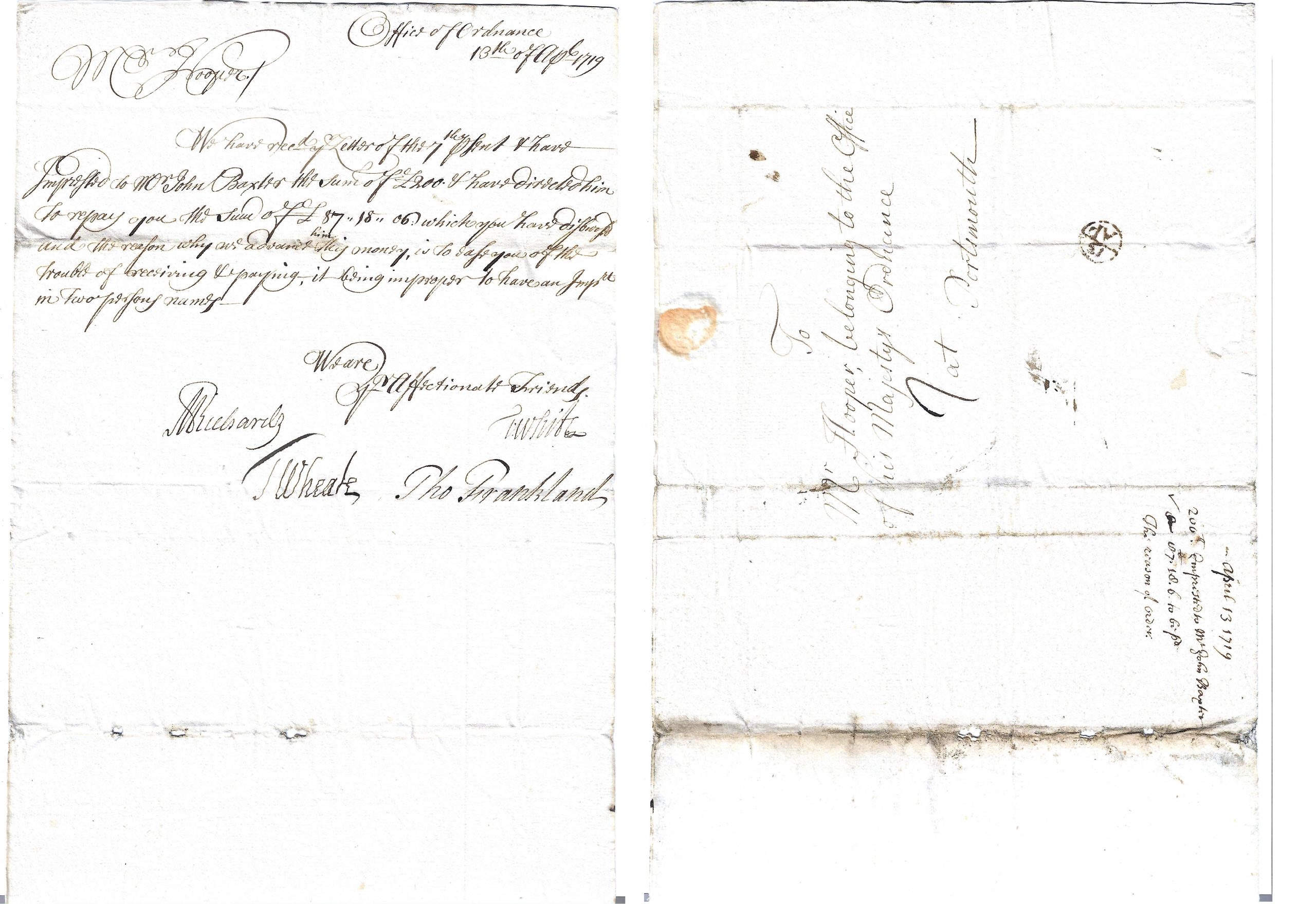
A letter of 13th April 1719 gives us an example of how different people denoted the pound sterling. In the precis it refers to an imprest of 200lb using the symbol usually used for a pound in weight, whereas in the text of the letter the £ sign is used. The letter advises Mr. Hooper that the £200 has been paid to John Baxter and that he is to repay £87/18/6 to John Hooper.
View in new tab:
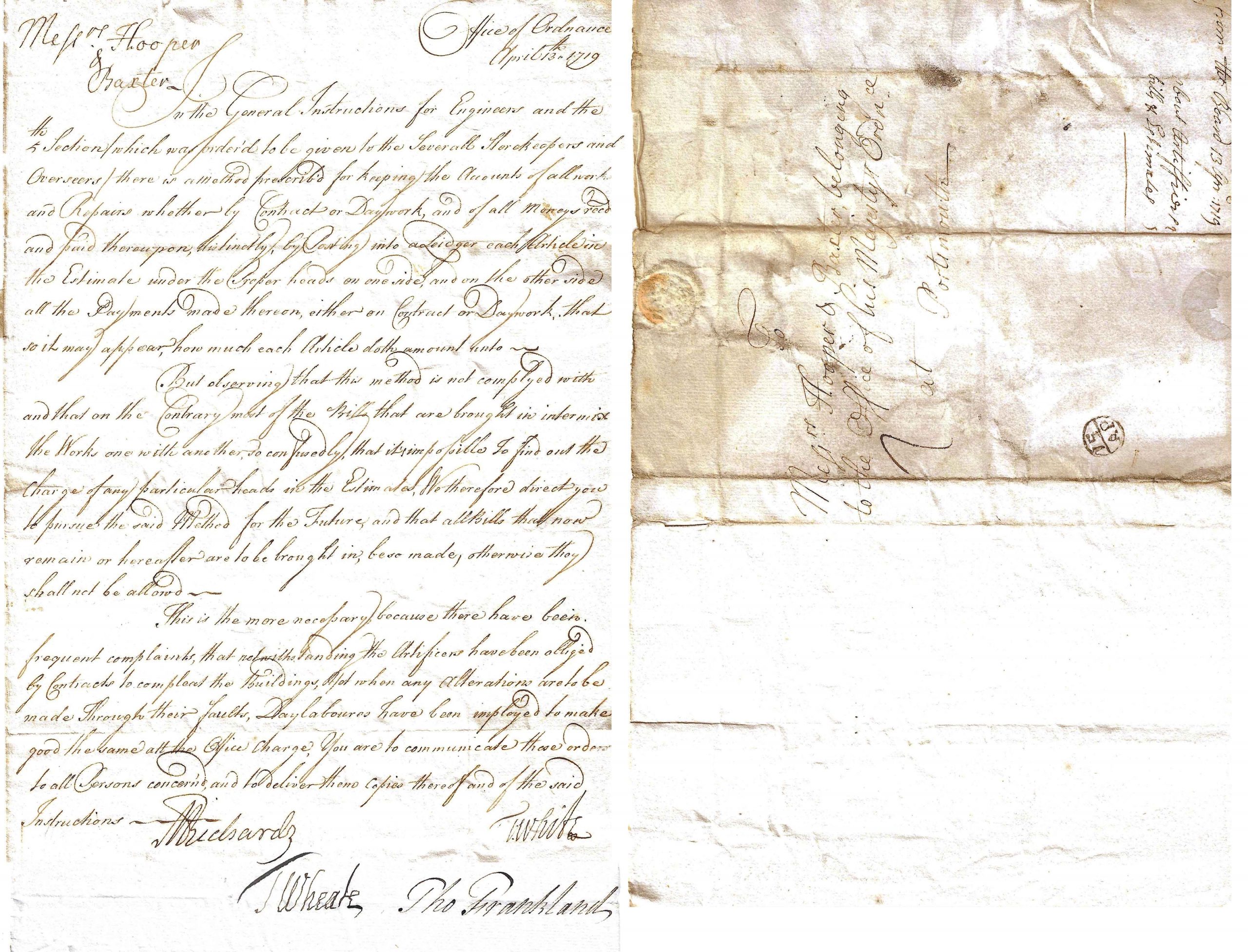
On 13th April we see another letter of complaint about the method of book keeping employed at Portsmouth Dockyard. It seems that apart from confusing ‘day labour’ work with contracts in the ledger, day labourers are being employed to redress defects in work done by contractors.
View in new tab:
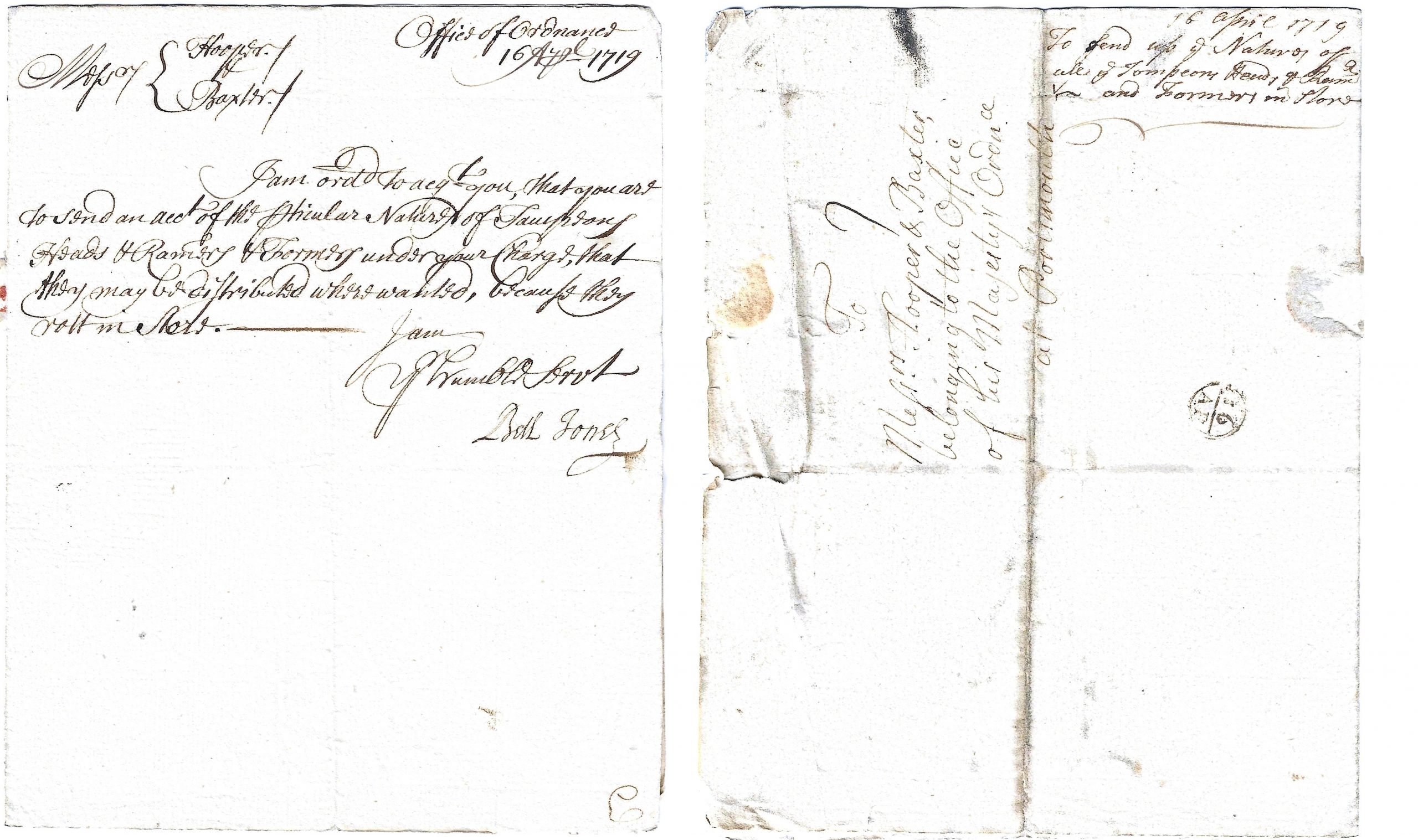
The Board ask, on 16th April 1719, for an account of tampeons, heads, rammers and formers, all made of wood, as they ‘rot in store’. One wonders why, if stored properly, in a dry storehouse, they should rot.
View in new tab:
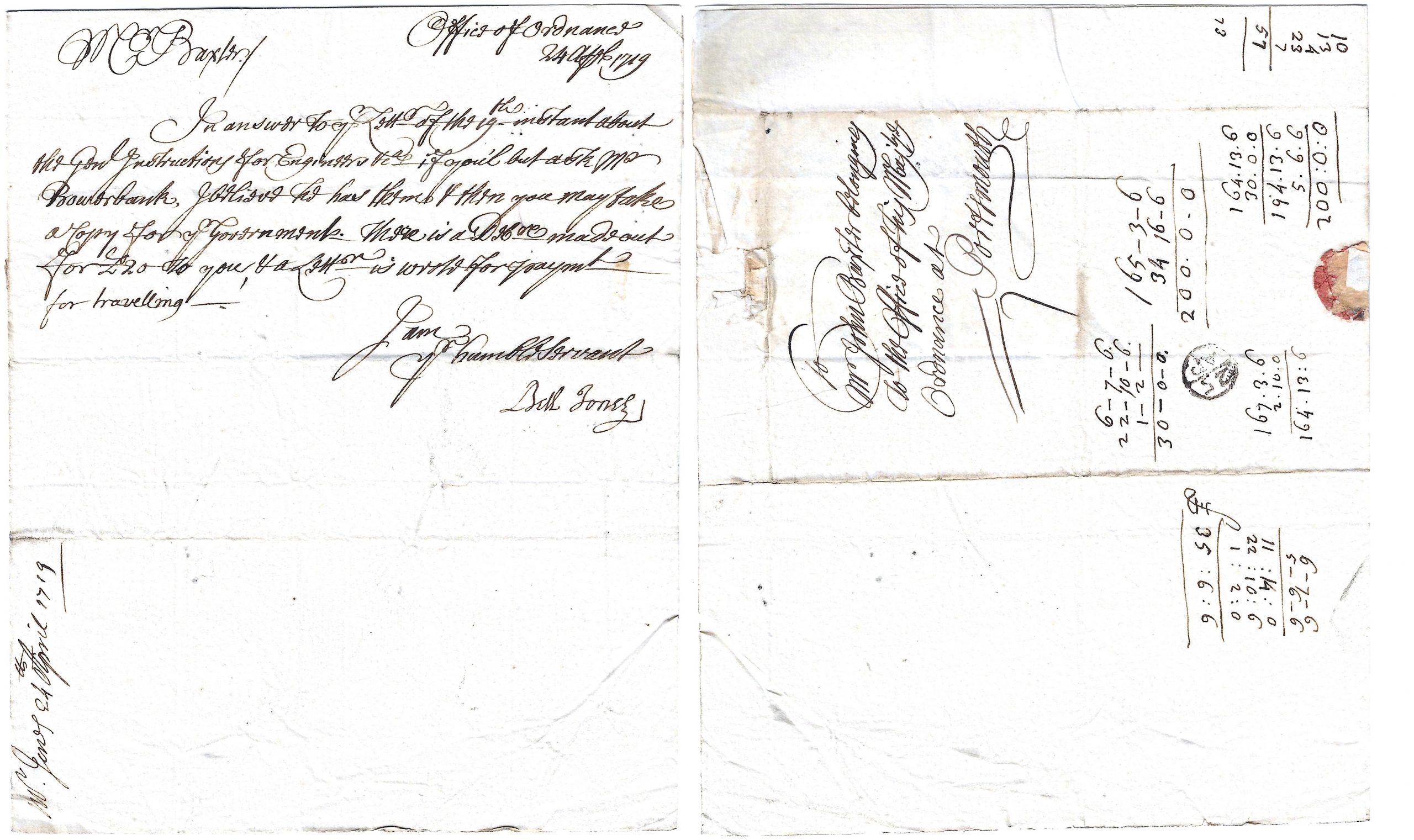
It is not really clear what this letter is about. Mr. Baxter has obviously written to The Board regarding instructions for the Royal Engineers. He is advised to obtain the instructions from Mr. Bowerbank and infers that he has been provided with funds for travel.
View in new tab:
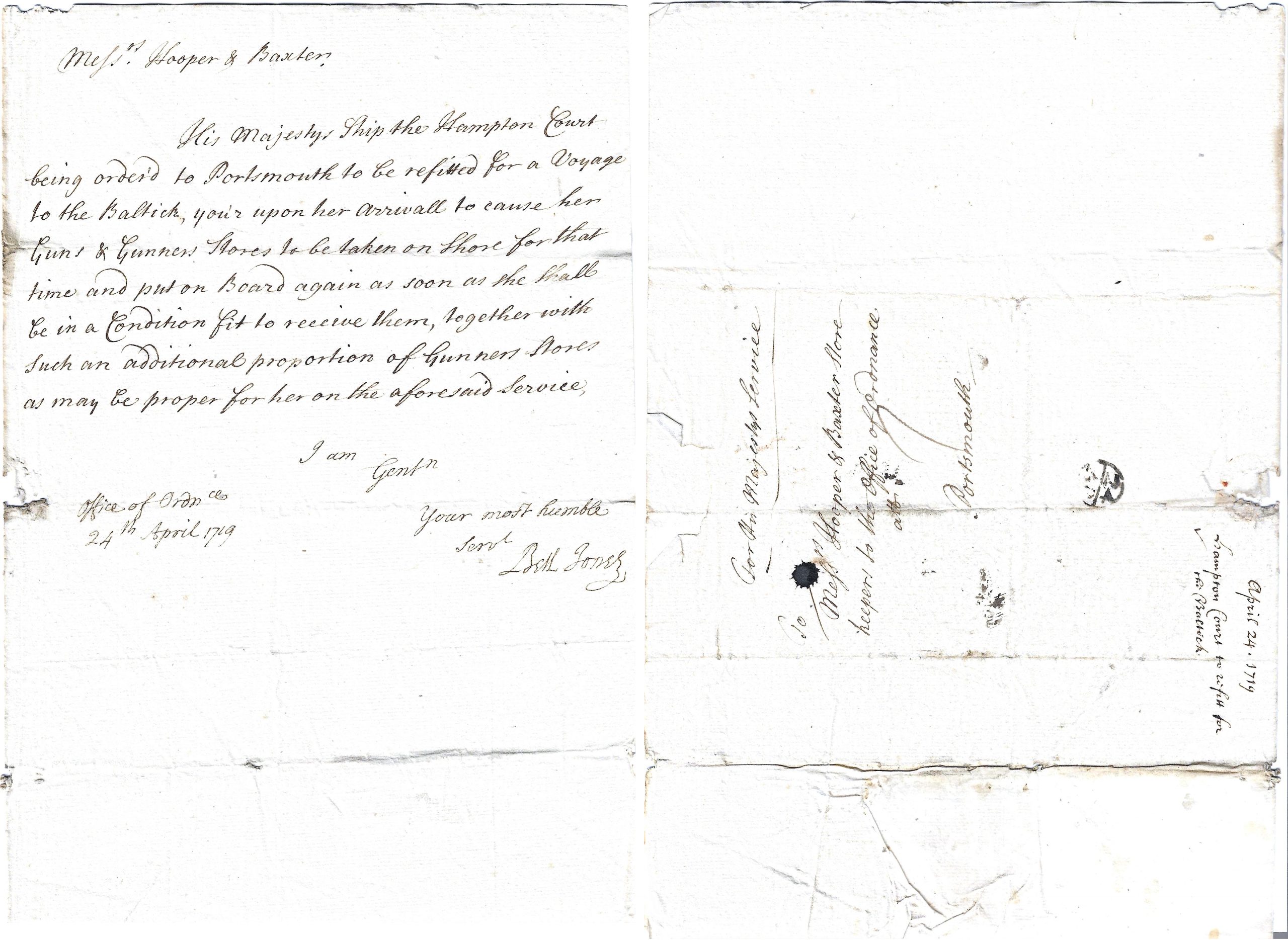
On 24th April 1719 the, 70 gun, HMS Hampton Court (1709) is to be refitted for a Baltic expedition, presumably the same expedition to be commanded by Sir John Norris.
View in new tab:
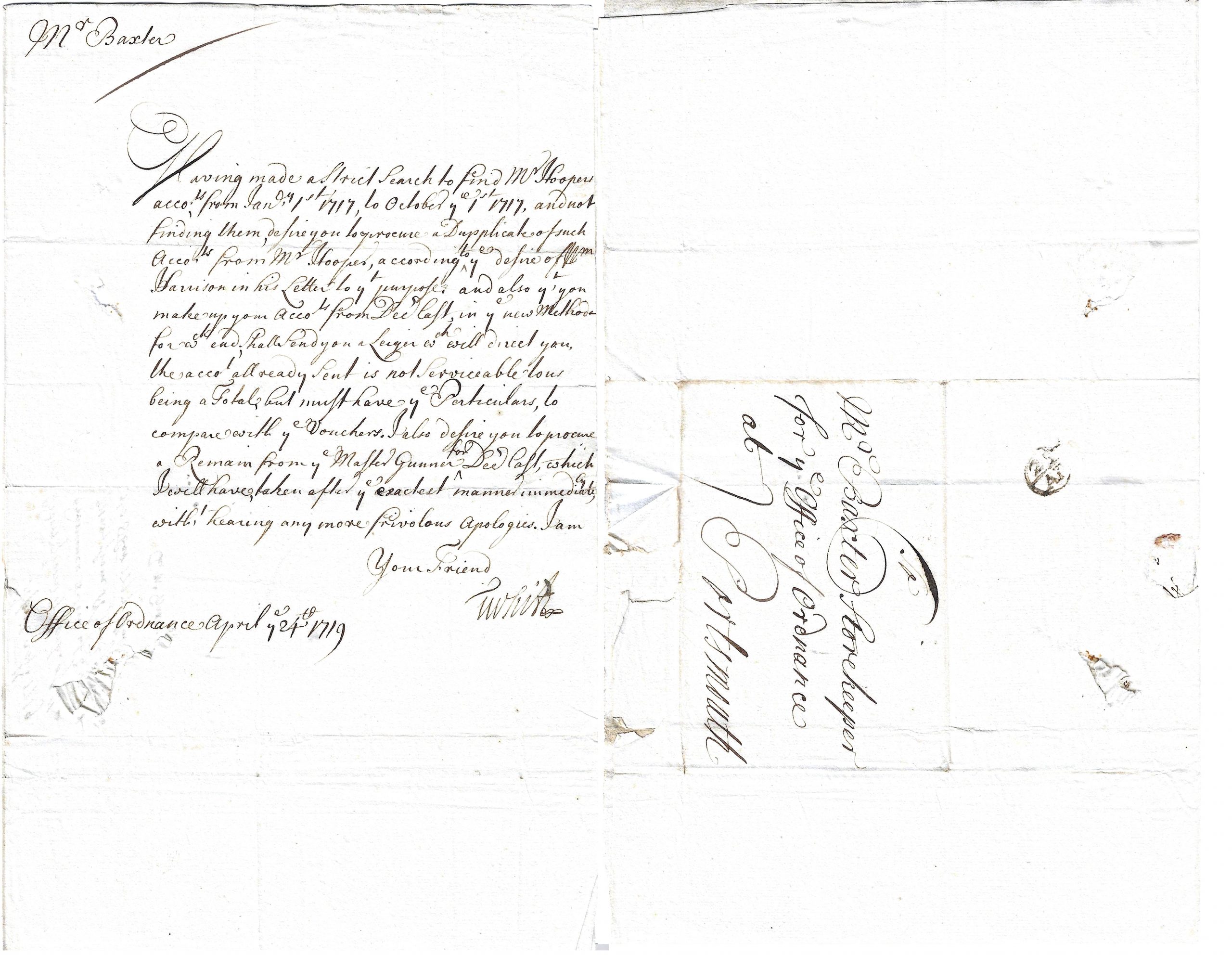
Again, on the 24th of April 1719, another letter of complaint from The Tower at the instigation of William Harrison, addressed solely to Mr. Baxter, demanding duplicates of Mr. Hooper’s accounts from 1717 which he is unable to find. He also reiterates the need for accounts to be made in ‘the new method’ and insists on the December accounts to be re-submitted. He finishes by asking for no further ‘frivolous excuses’.
One has to wonder why, if looking for Mr. Hooper’s two year old accounts, the letter is addressed solely to Captain Baxter.
View in new tab:
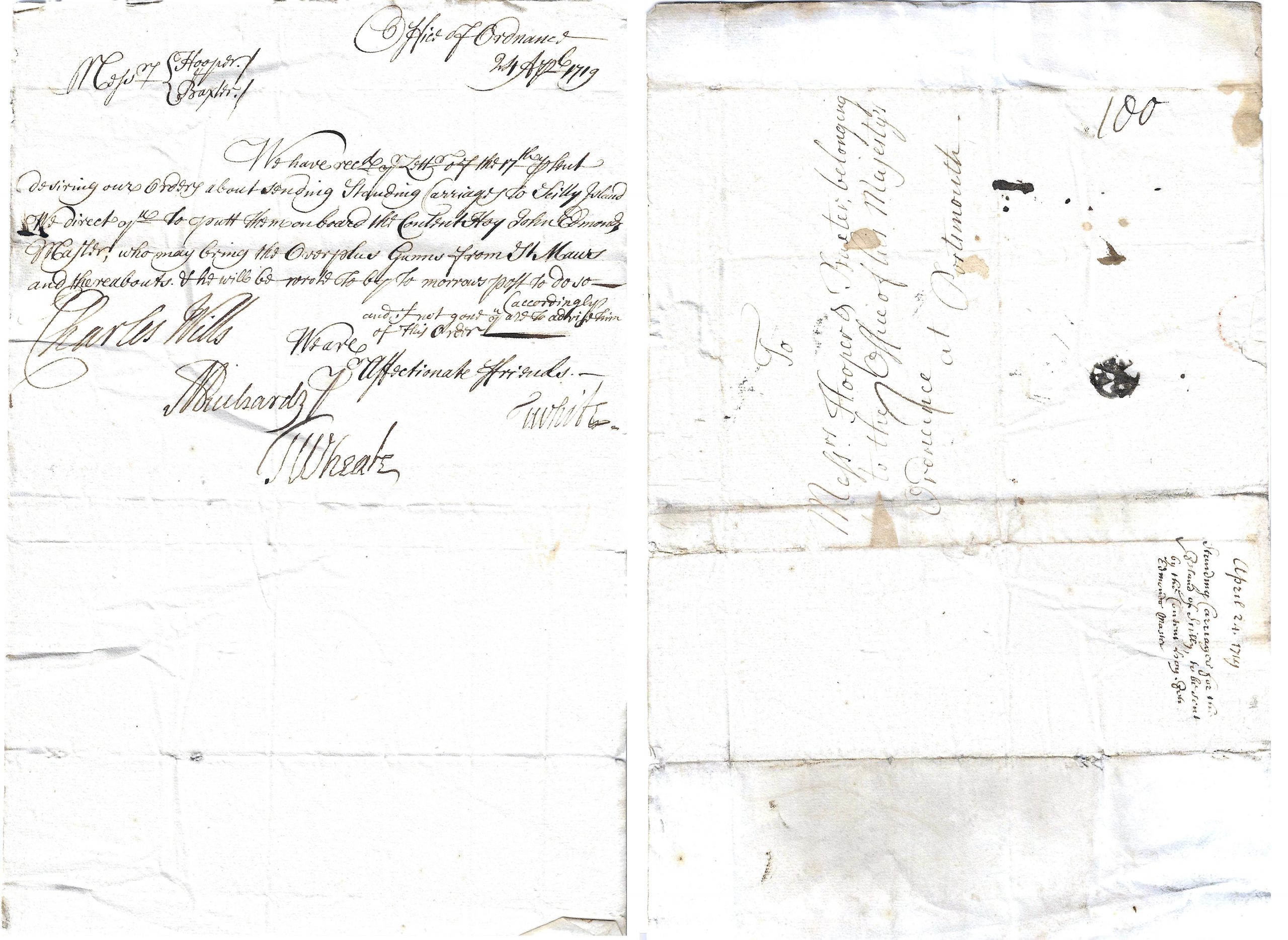
The final letter of 24th April refers to ‘standing carriages’. These were carriages for guns used on land, not ships’ carriages.
View in new tab:
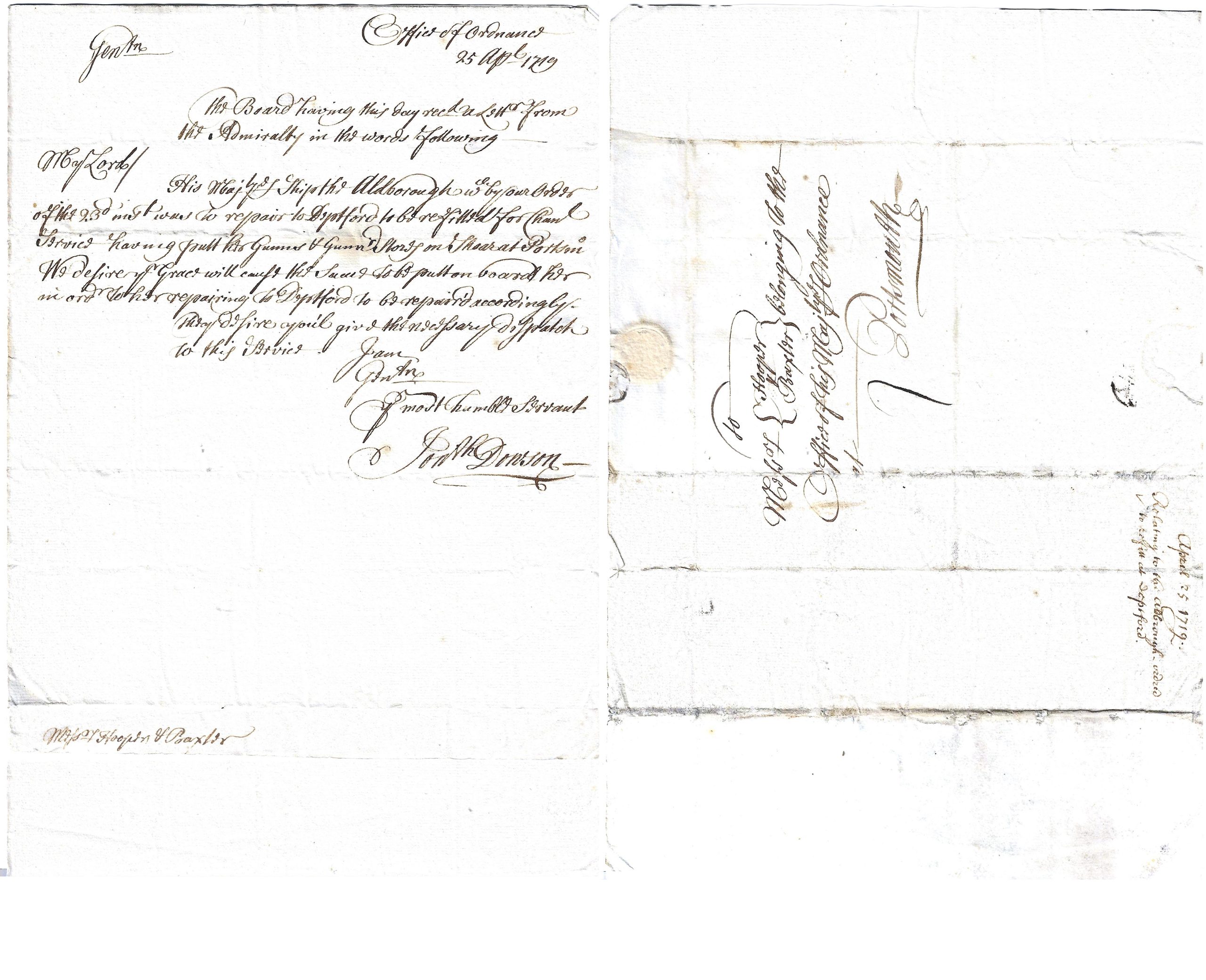
A letter of 25th April 1719 gives us sight of the order of command exercised: HMS Aldborough (1706), currently in Portsmouth Dockyard with her guns and gunner’s stores removed, has been ordered to Deptford for a refit. The Admiralty, writing to The Board of Ordnance, ask that the guns and stores be returned to the ship so that she can make her way to Deptford yard. So, we can see that the Admiralty, could not issue orders directly to the dockyards and that the yard at Portsmouth would not respond to orders from anyone but The Board.
View in new tab:
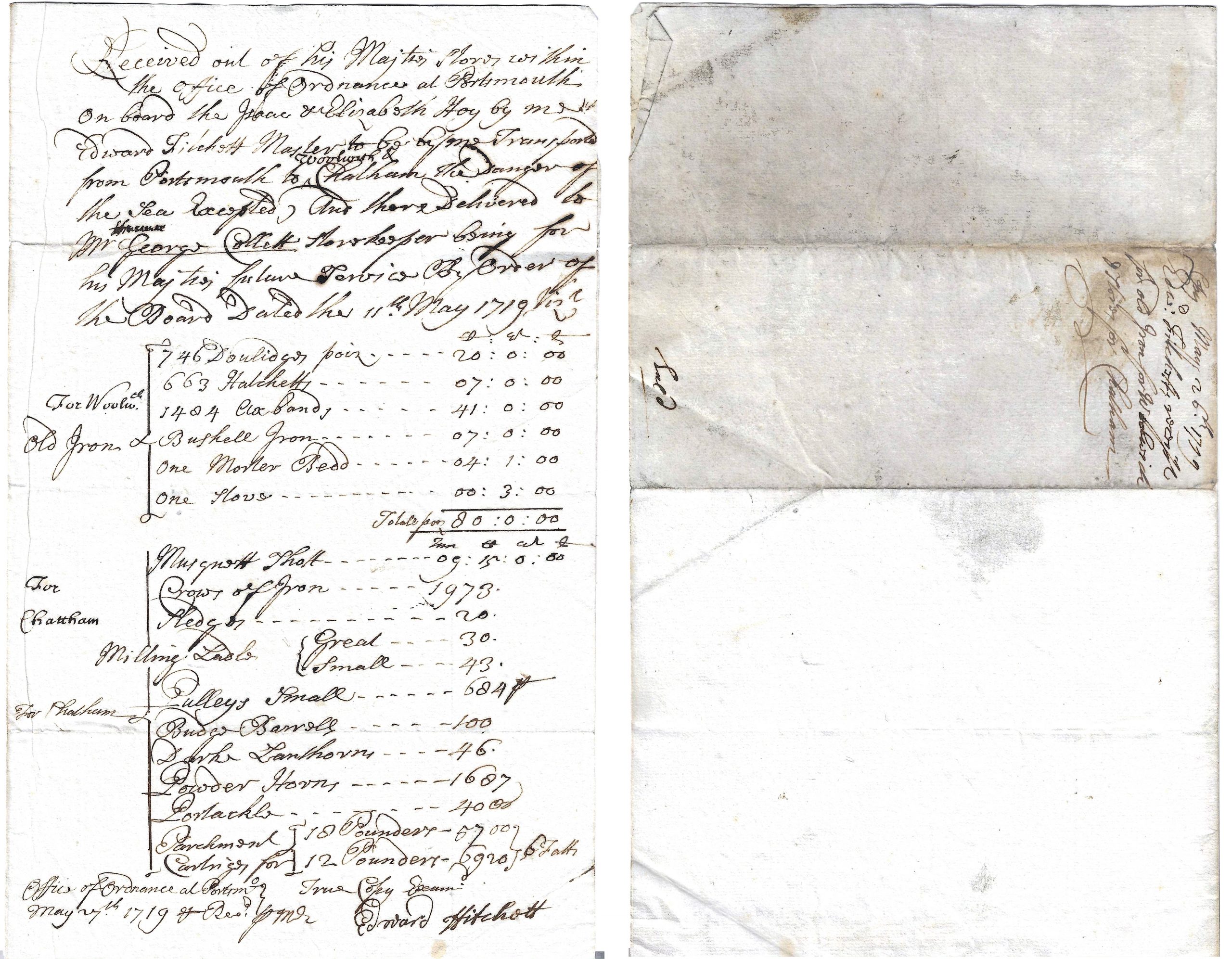
On 11th May 1719, Edward Fitchett, master of the Isaac & Elizabeth hoy makes an appearance with a bill of laden. He introduces us to Mr. George Collett, storekeeper at Chatham and some of the items being transported are particularly interesting. We start with old iron for Woolwich, and ‘Doulidges’, which were the iron plates that strengthen the wooden trucks (wheels) of gun carriages. There is ‘Bushell Iron’ which was miscellaneous scrap iron. The word ‘poiz’ also appears here, read this as ‘weight equalling’.
For Chatham there are crows of iron, which we would know as crowbars, ladles, which were used for disarming a gun, budge barrels, which were small powder barrels with no lid and a rope handle. These little barrels, which had canvas or leather covers, would have been used to transport fine powder, for priming the guns, from the magazine to the gun deck. Portacks were the tackle used for raising and lowering the gun ports.
View in new tab:
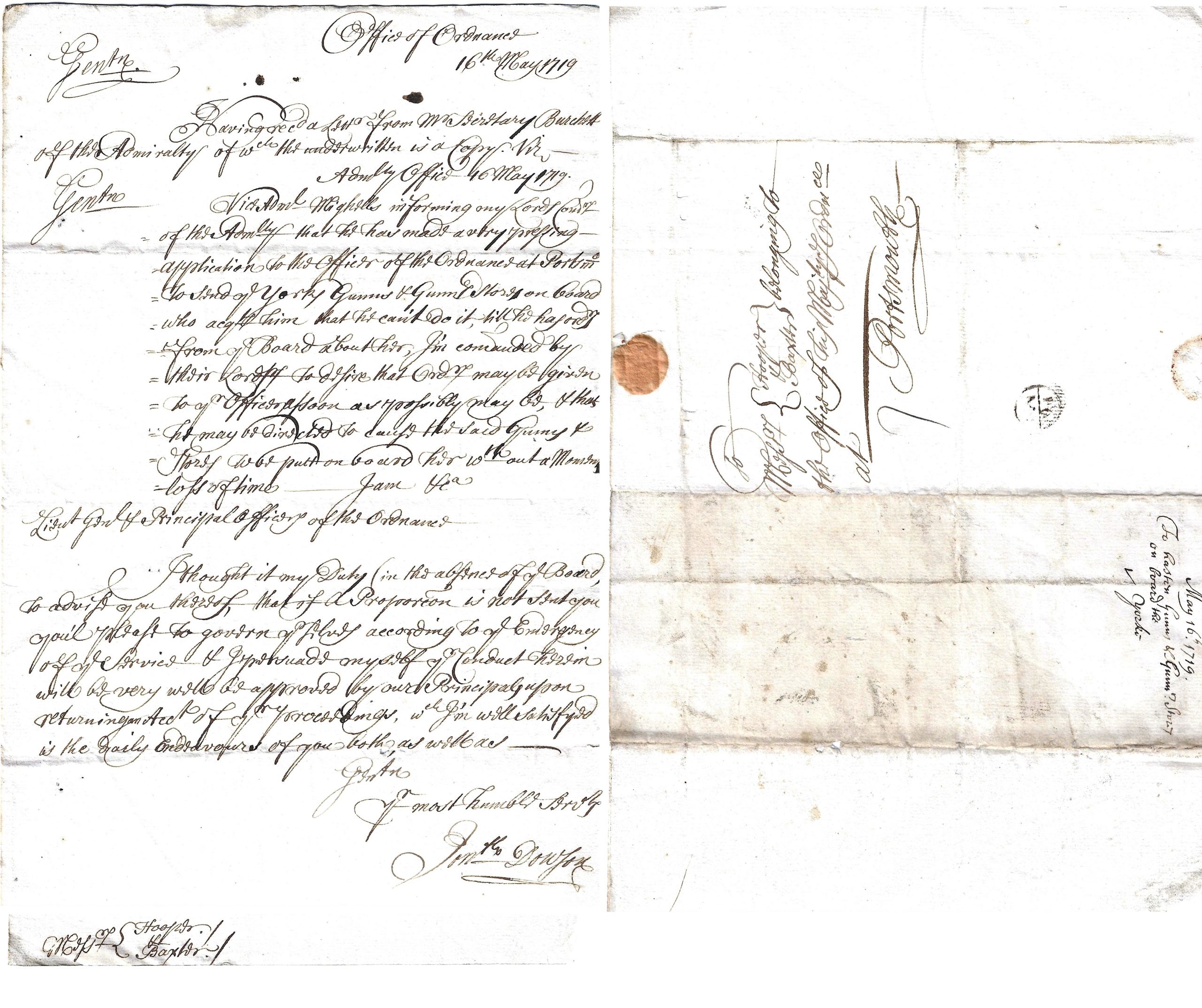
Confirmation of the approved chain of command is again underlined in a letter from Jonathan Dawson of the Ordnance Board on 16th May 1719 where he reminds the storekeepers that an admiral may not order them to restock a ship without the instruction of The Board.
View in new tab:
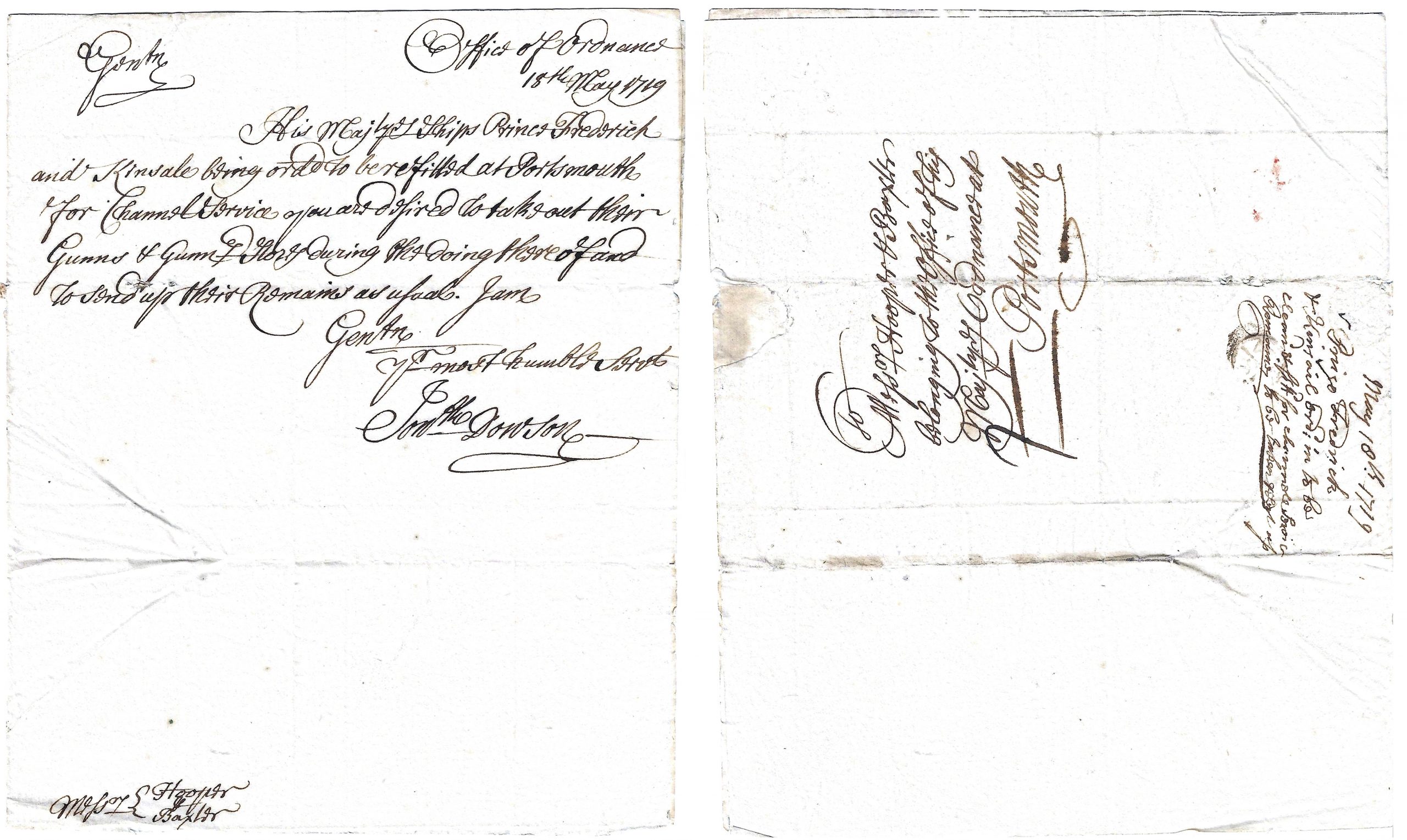
On 18th May HMS Prince Fredrick & HMS Kinsale are to be refitted for Channel Service.
View in new tab:
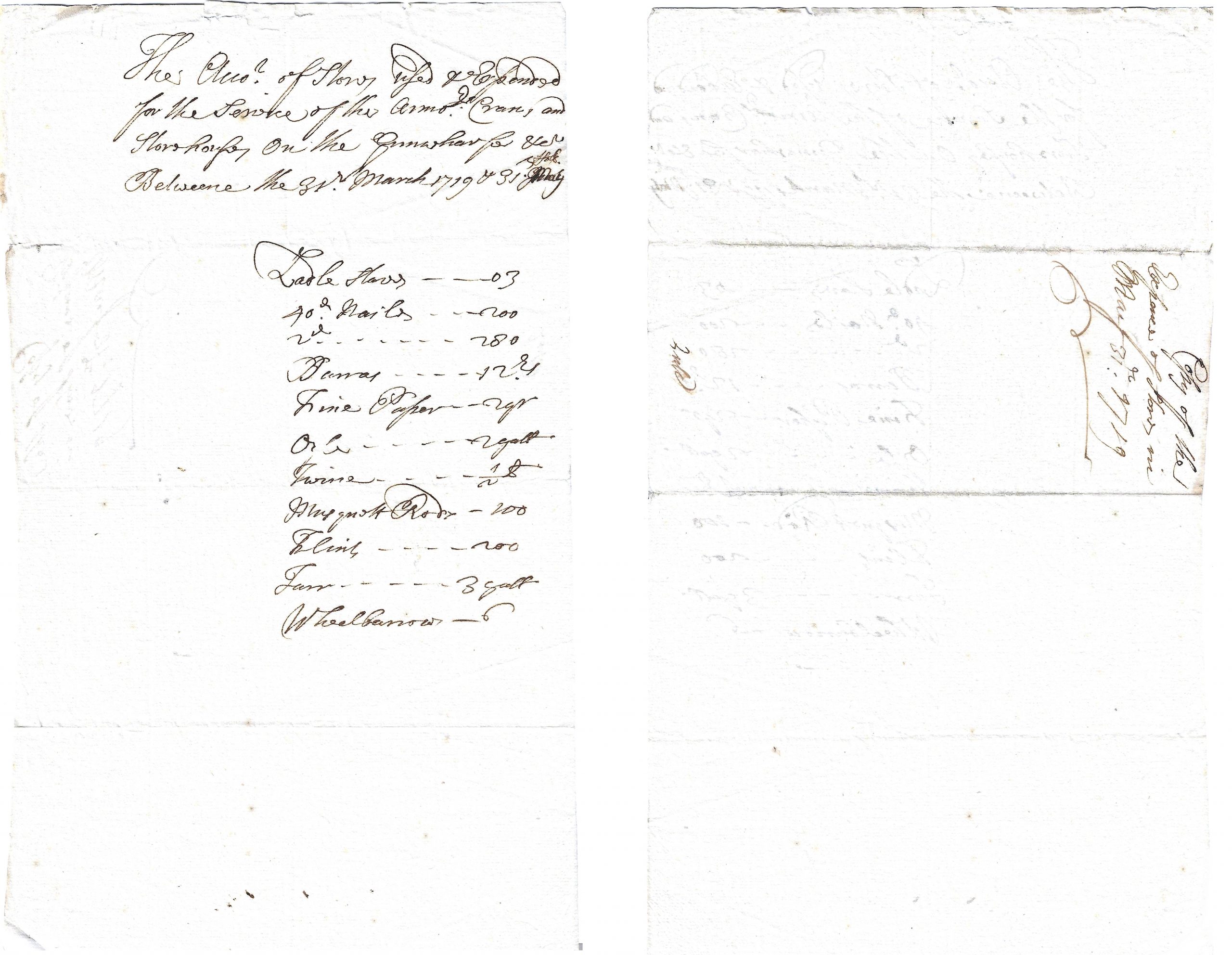
At the end of May 1719 we see an account of expenditure for cranes and storehouses on the Gunwharf.
View in new tab:
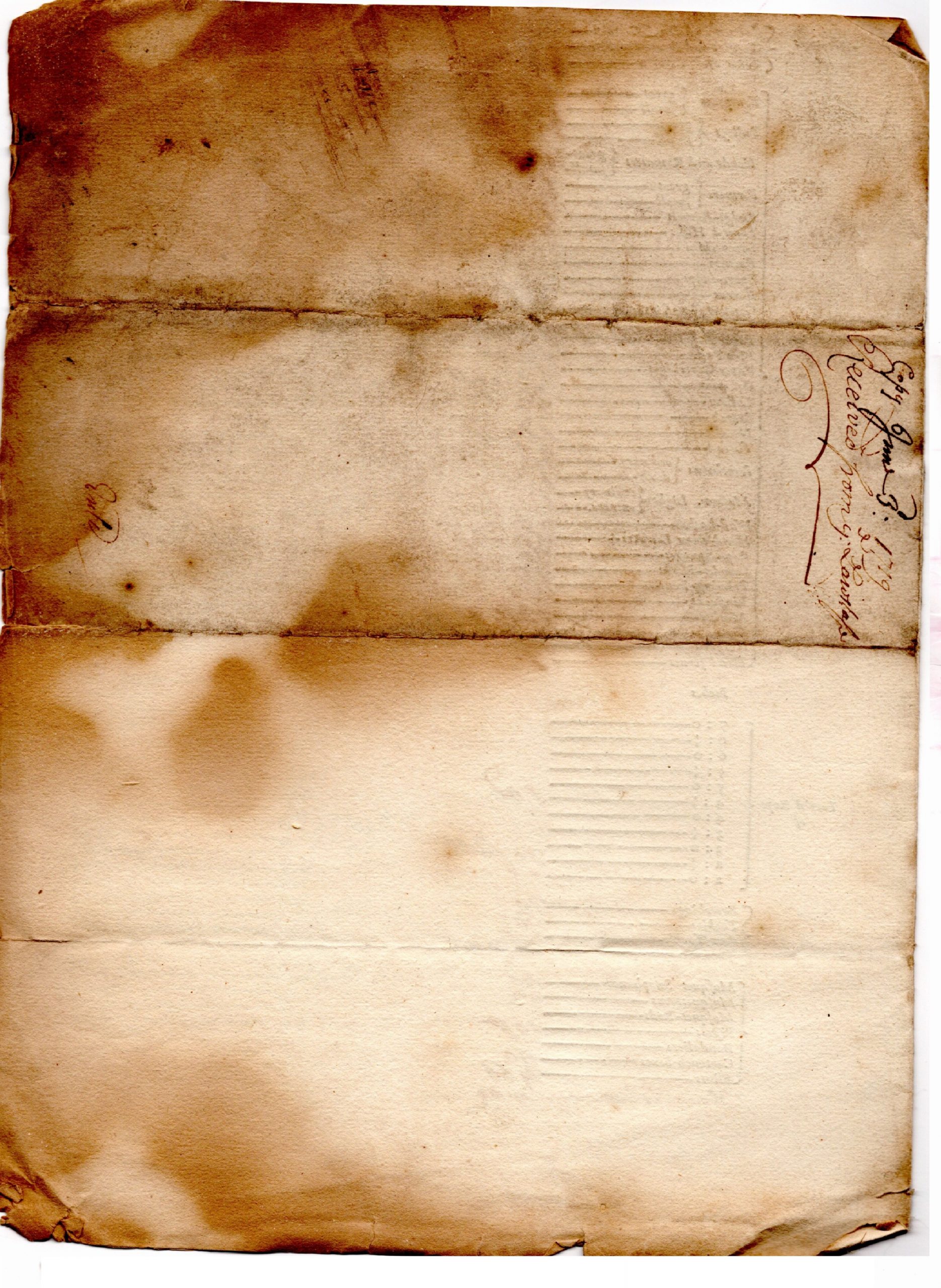
On 3rd June 1719 a list of the guns and stores returned from HMS Lowestoft (1697), which in Wikipedia is listed as a 28, or 32-gun ship, shows us that she actually carried 30 guns. 8 demi culverins on the lower gun deck, 20 6 pounders on the main gun deck and 2 minions on the quarterdeck.
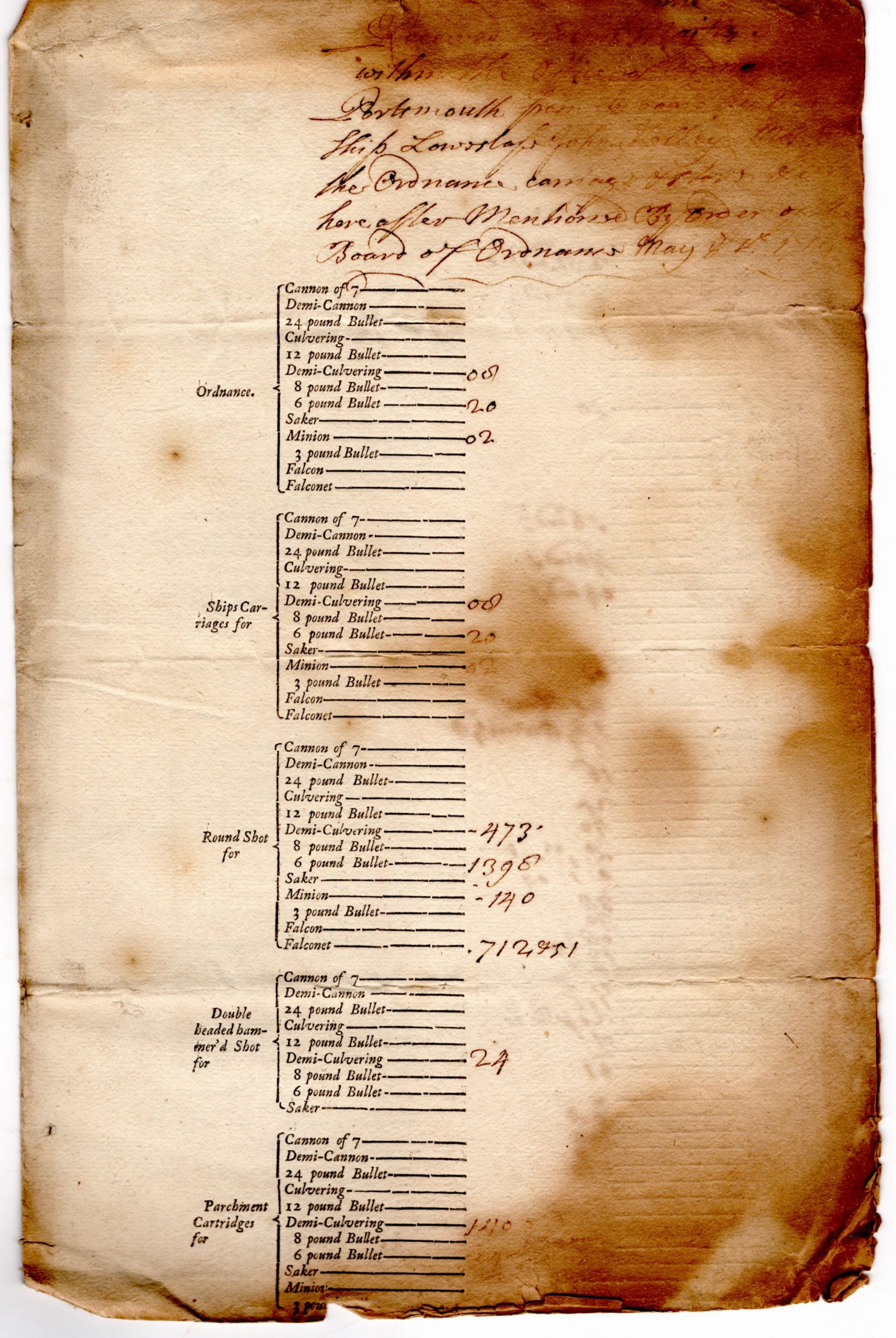
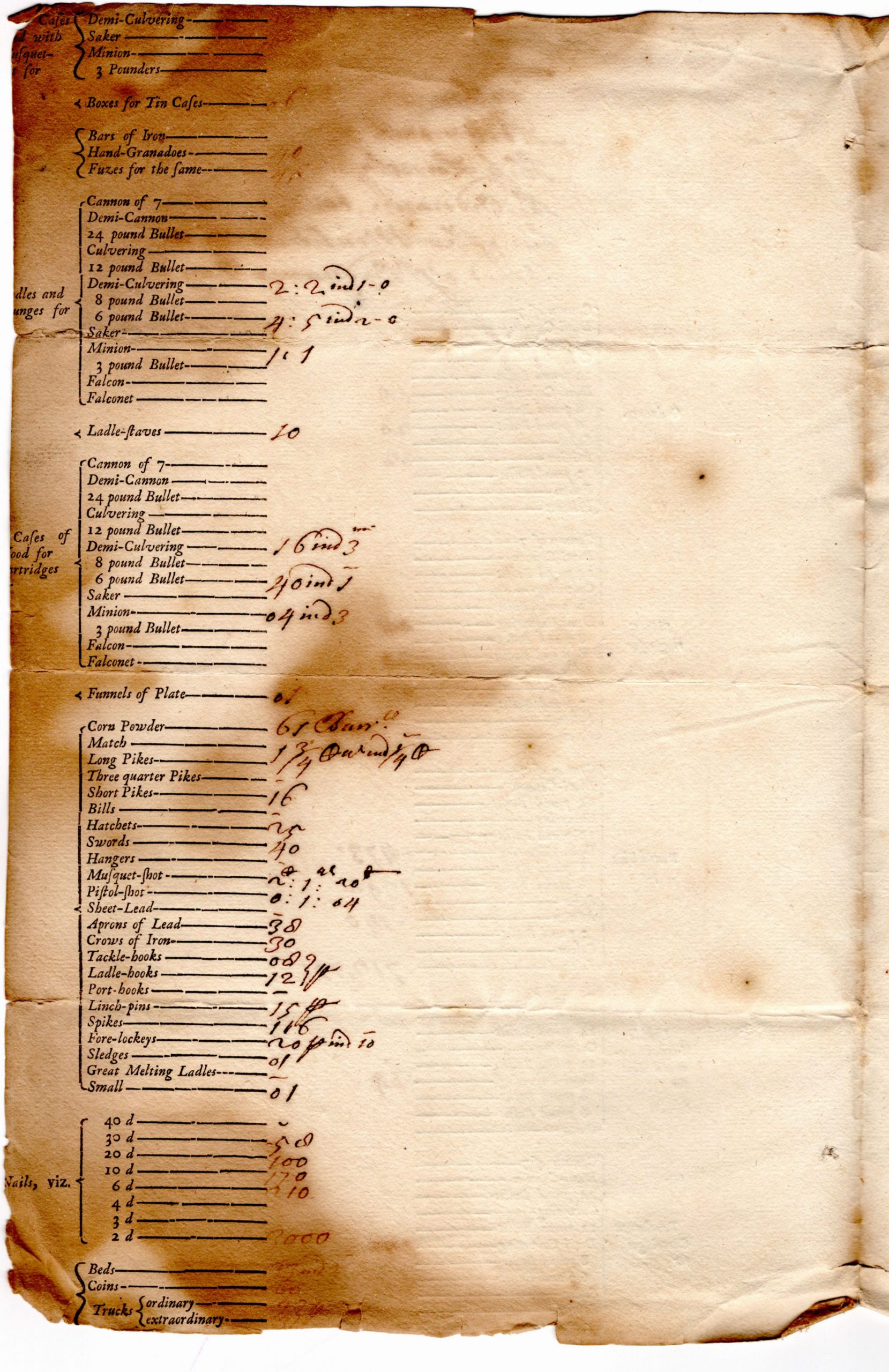
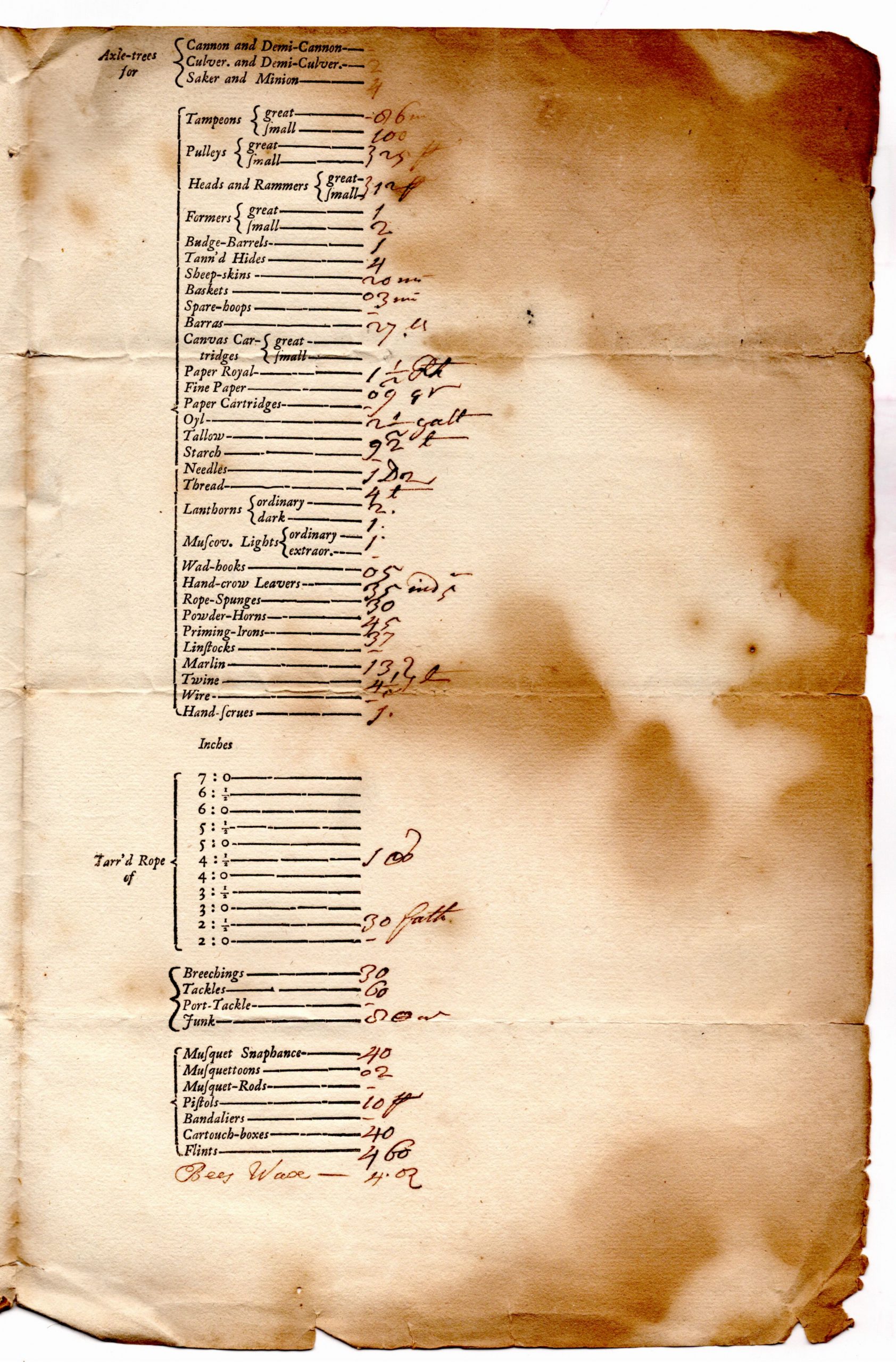
On June the 4th 1719 there is another chapter in the ‘discussion’ between Portsmouth and The Tower regarding ledgers. Rowland Gibson writes from Woolwich, it would appear that he has supplied an example of how Mr. Harrison wants to see the accounts made out. Clearly there has been some discussion between Woolwich and Portsmouth on the subject and Mr. Gibson is trying to help his colleagues.

View in new tab:
We saw earlier (9th January 1717) that gunners’ stores were being removed from Burrough Fort in Gosport, also known as Fort James. On 10th June 1719 we now see that sheets of lead recovered from there are being reused.

View in new tab:
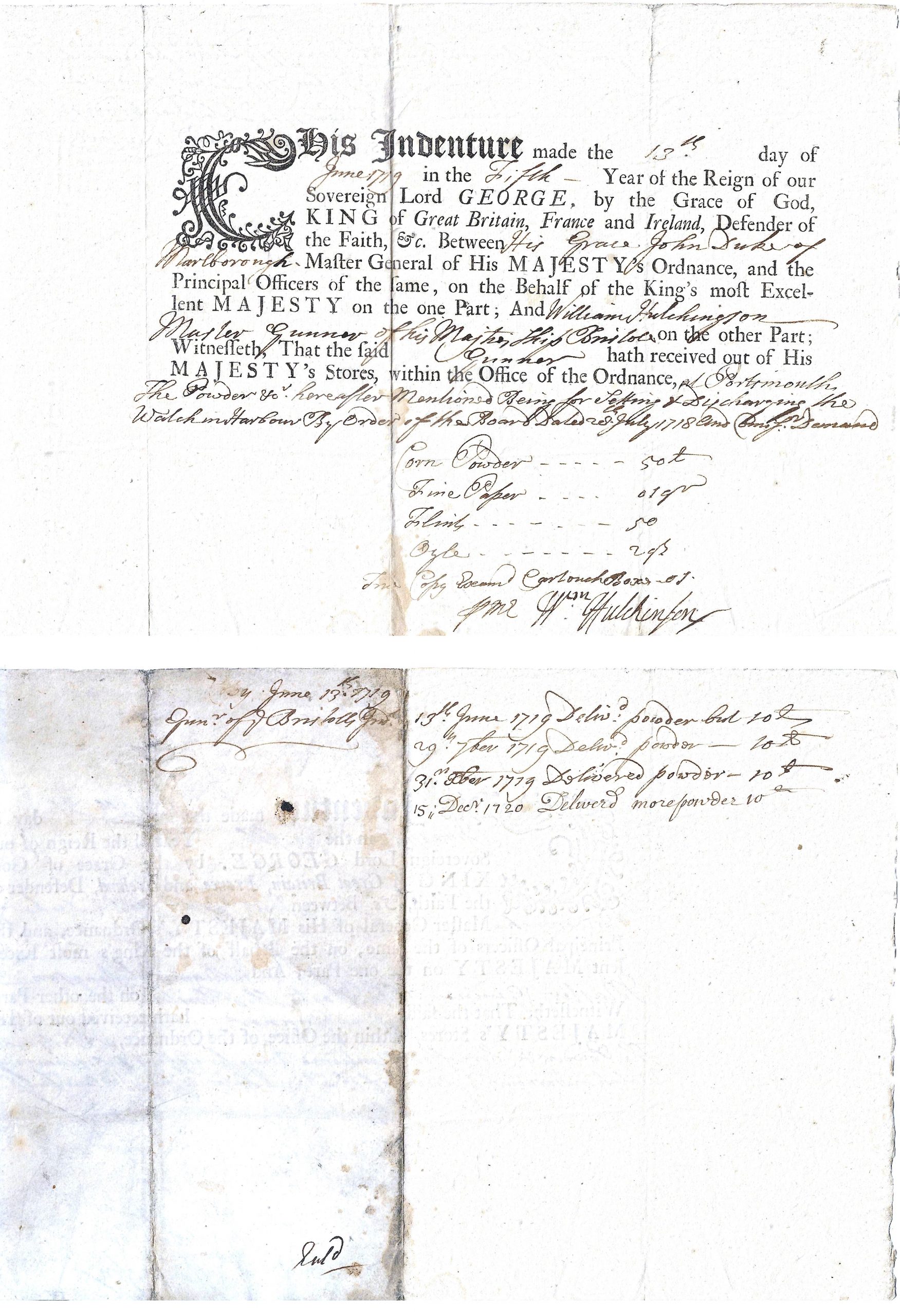
On 13th June 1719 we see an an indent for HMS Bristol for powder, paper, flints and oil.
View in new tab:
22nd June 1719, Rowland Gibson writes again offering help to Captain Baxter in meeting William Harrison’s requirements, and on 26th William Harrison himself writes asking for more accounts.

View in new tab:
Another episode in the battle between Mr. Harrison at the tower, and Captain Baxter at Portsmouth.
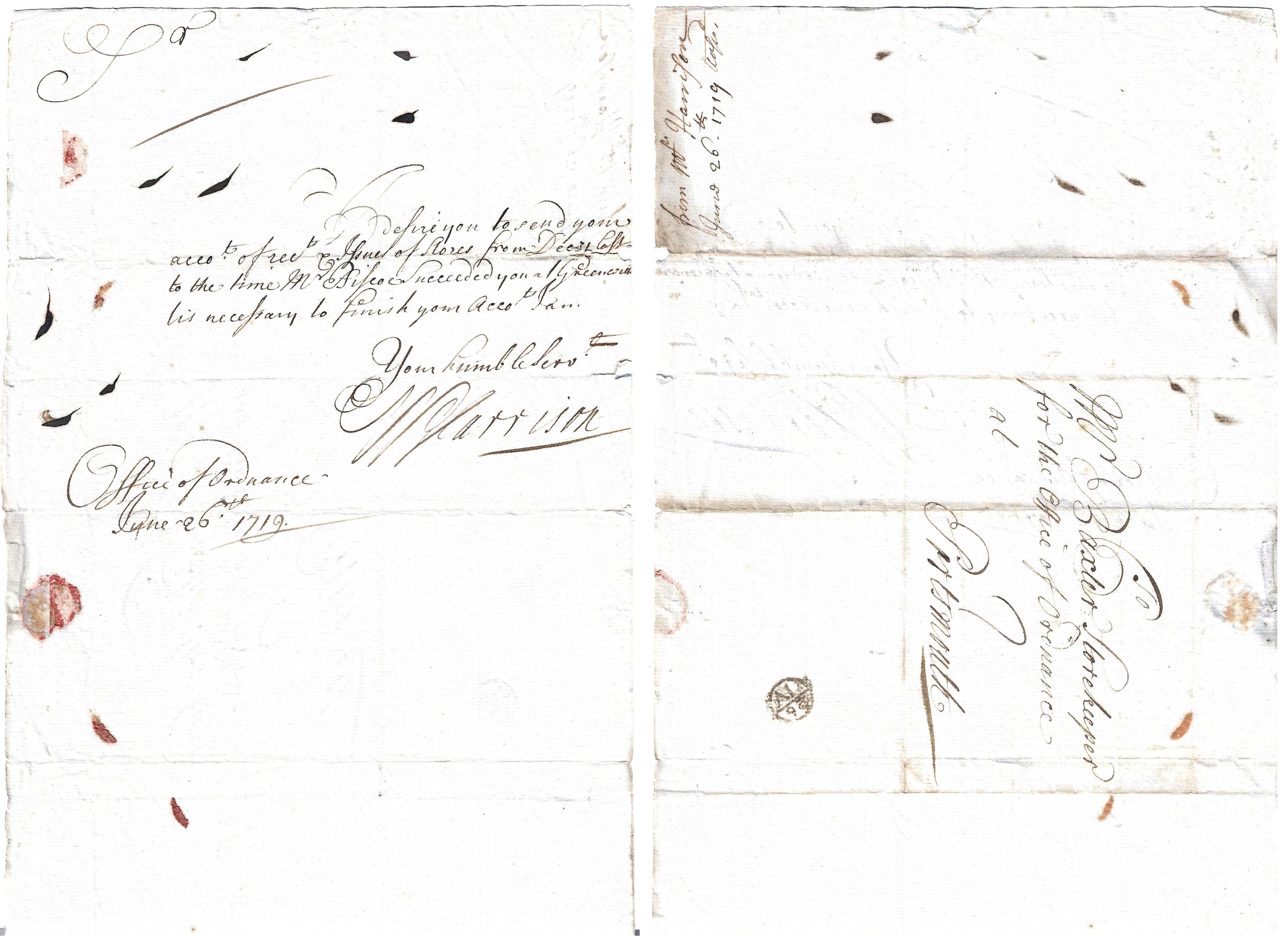
View in new tab:
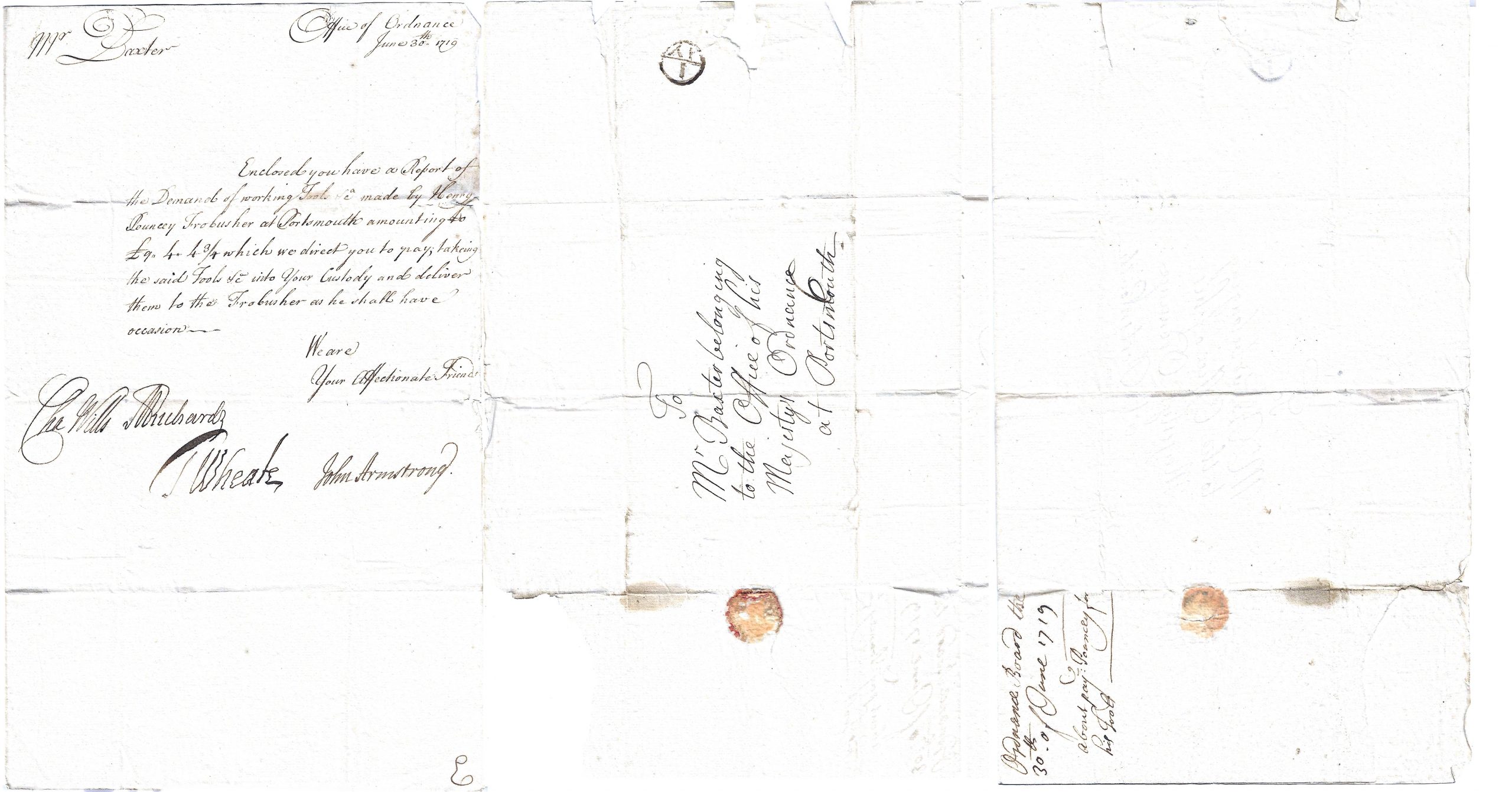
On 30th June 1719 we learn a new word: ‘frobusher’. A frobusher was a metal polisher. This letter speaks of tools made by Henry Pouncy to the value of £9/4/4 3/4.
View in new tab:
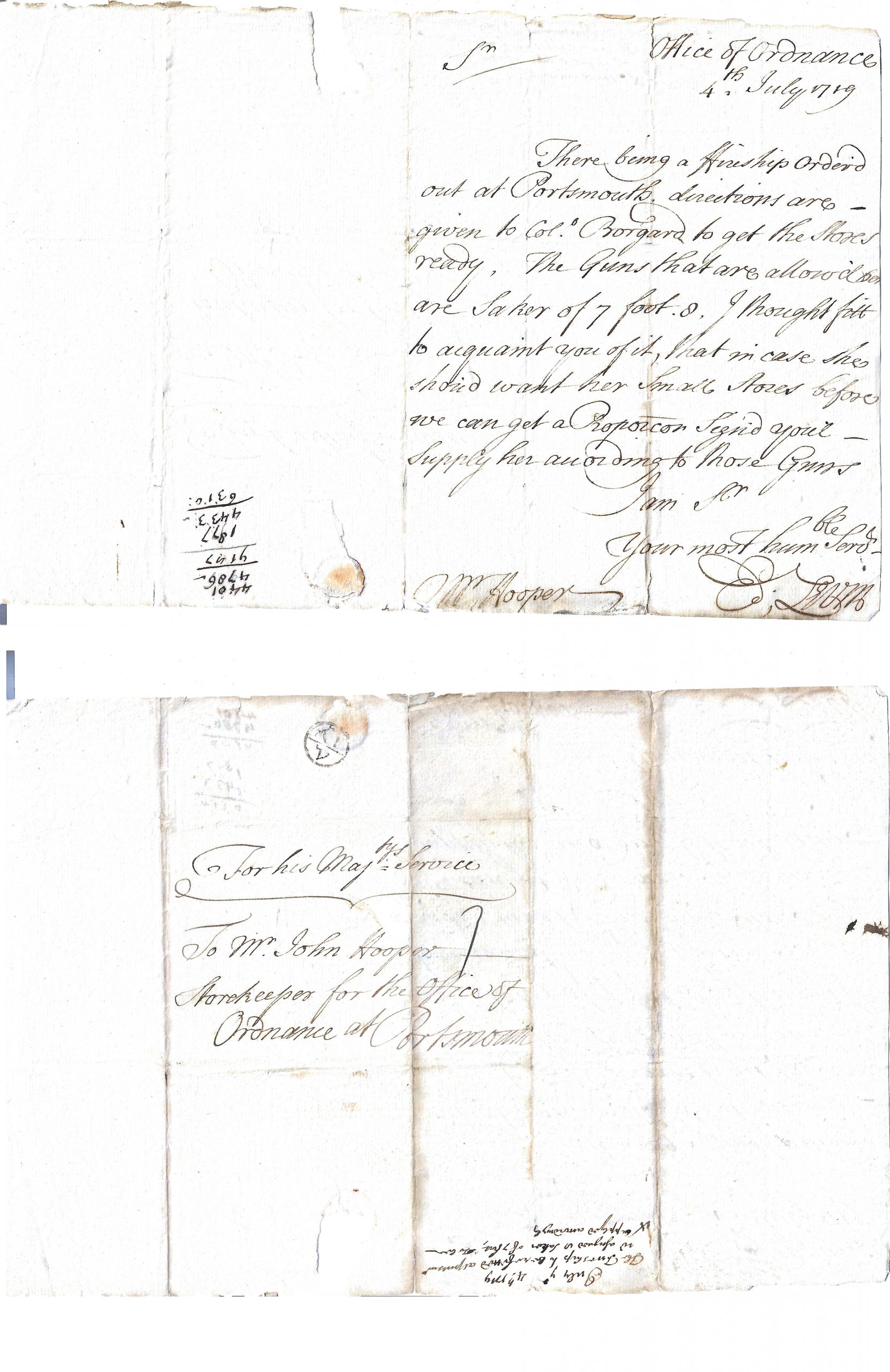
A letter of 4th July 1719 we are introduced to Colonel Borgard. Of Danish origin, he established himself in the service of Britain on a number of occasions specialising in ‘fireworks’ he fought in a number of battles, was captured, injured and left for dead. His legacy was the formation of the Royal Artillery. His last expedition was in 1719 when he commanded the artillery in an expedition to Vigo. This letter is clearly in preparation for this expedition.
View in new tab:
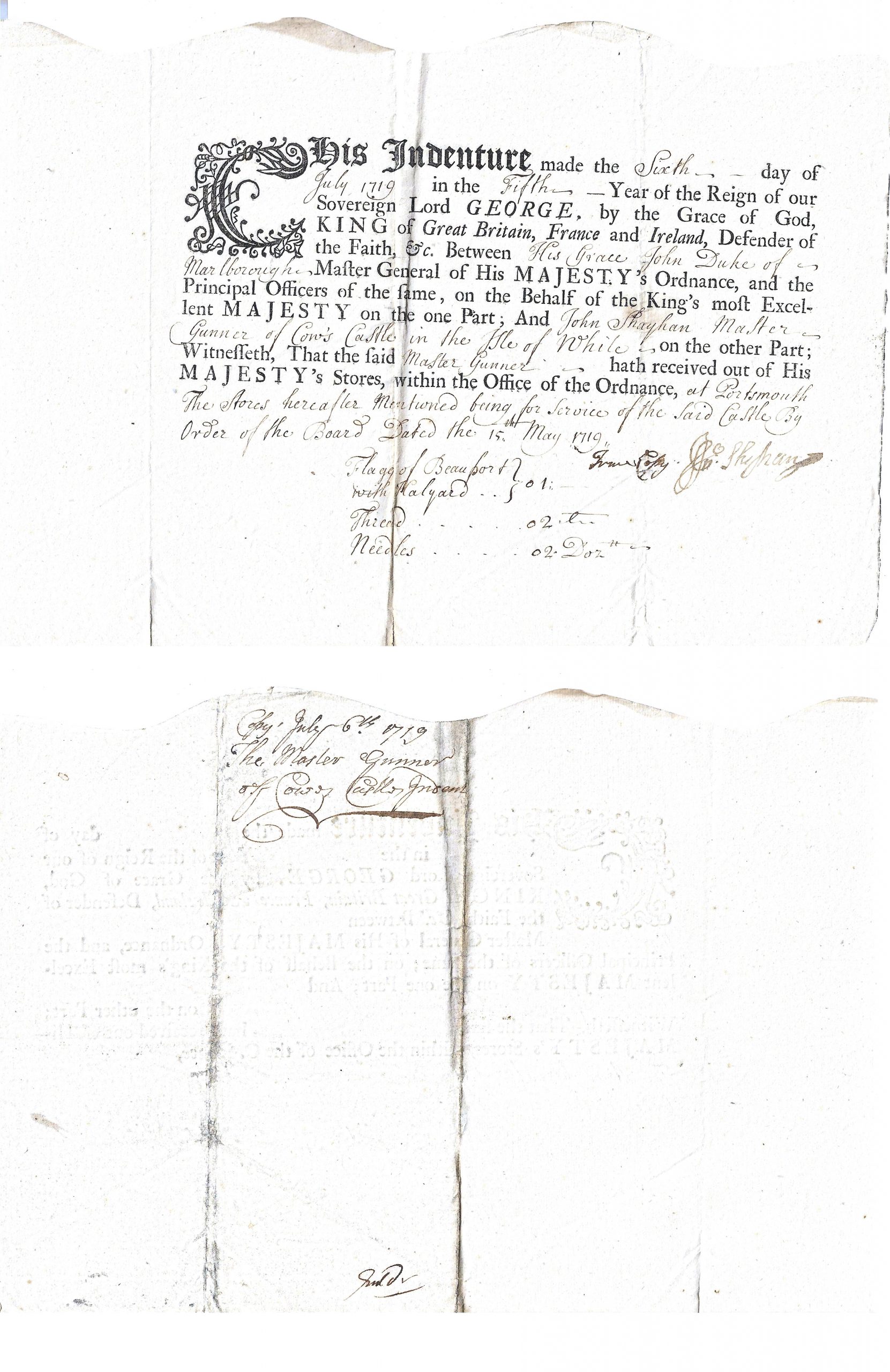
Another indent on 5th July 1719, this time for Cowes Castle for a flag,, needles and thread.
View in new tab:
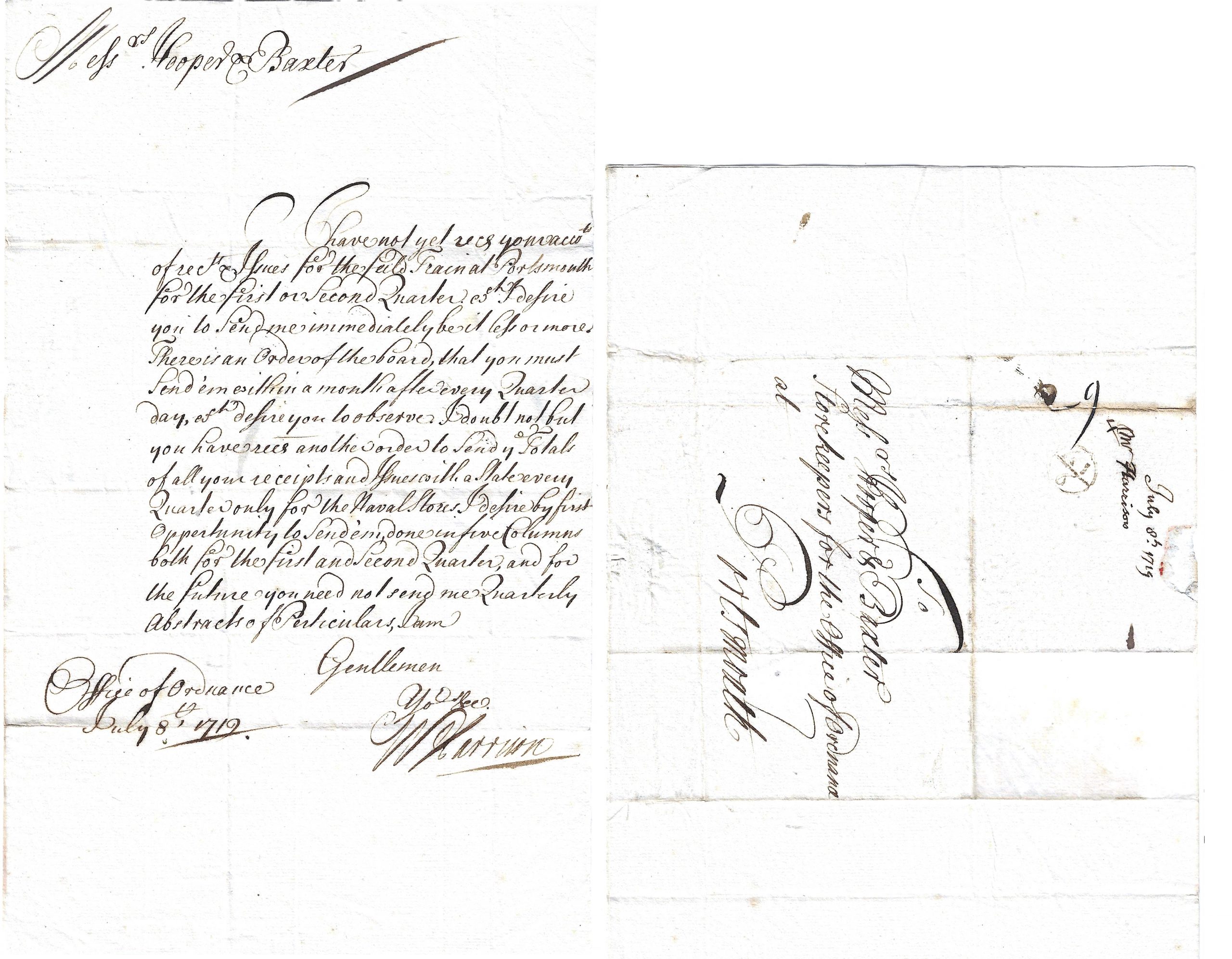
Clearly persistent, Mr. Harrison writes from The Tower on 8th July 1719 demanding that Messrs Hooper and Baxter submit their accounts for the previous two quarters. He does seem rather put out. On the face of it, it looks as though Messrs Hooper and Baxter have been lax, however, we saw no letters of complaint until William Harrison arrived on the scene. Such a shame that we cannot see the replies to Mr. Harrison’s letters.
It may be indicative of the thoughts of the clerk in that he simply precis the letter “Mr. Harrison” with no comment on it’s content.
View in new tab:
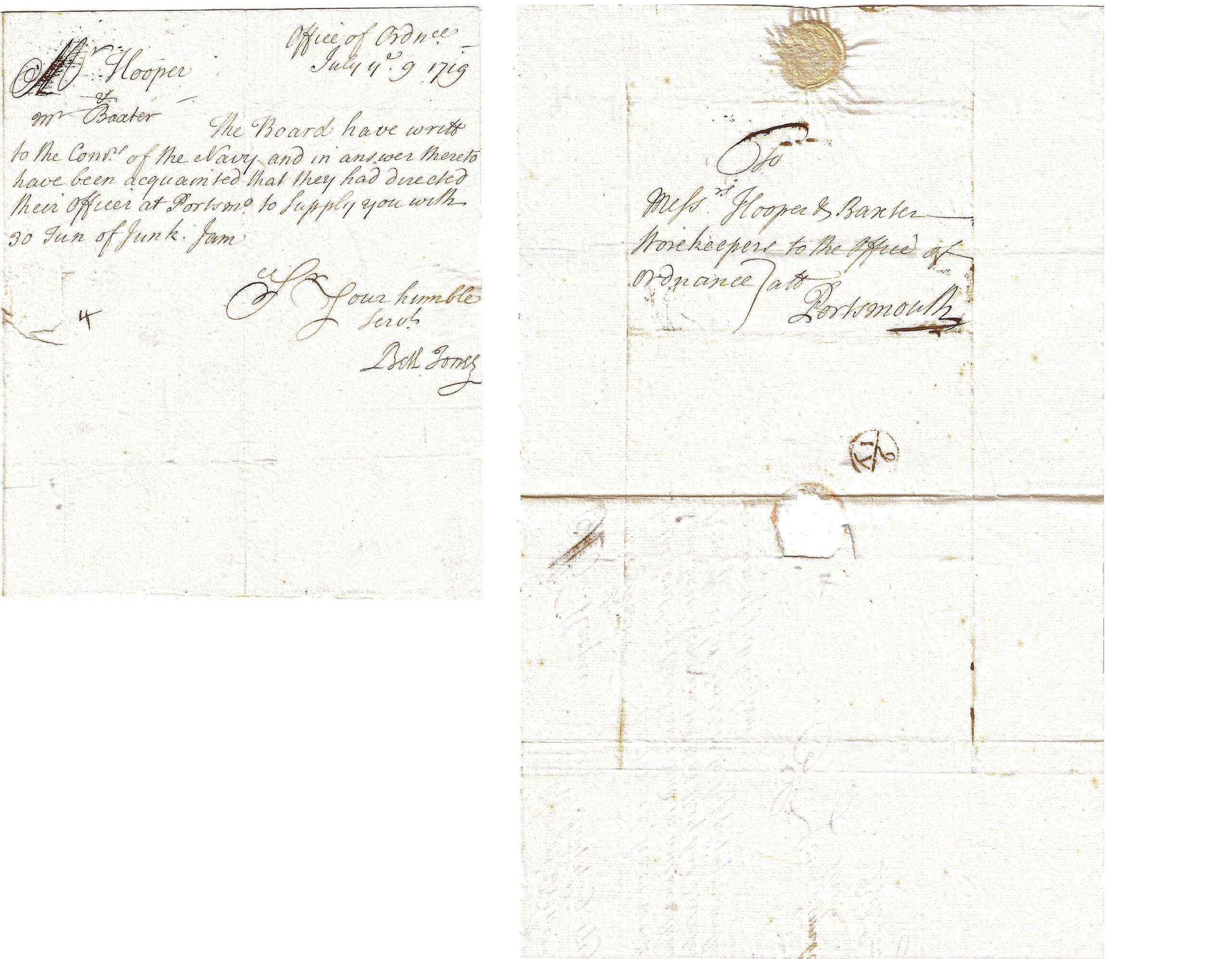
Two letters from Captain Bell Jones on the 9th and 13th July 1719 advising that they have instructed the dock office to transfer 30 tons of junk to the Office of the Ordnance. Junk was old rope ends and left overs from rope making it was used as wadding when loading the guns.
View in new tab:
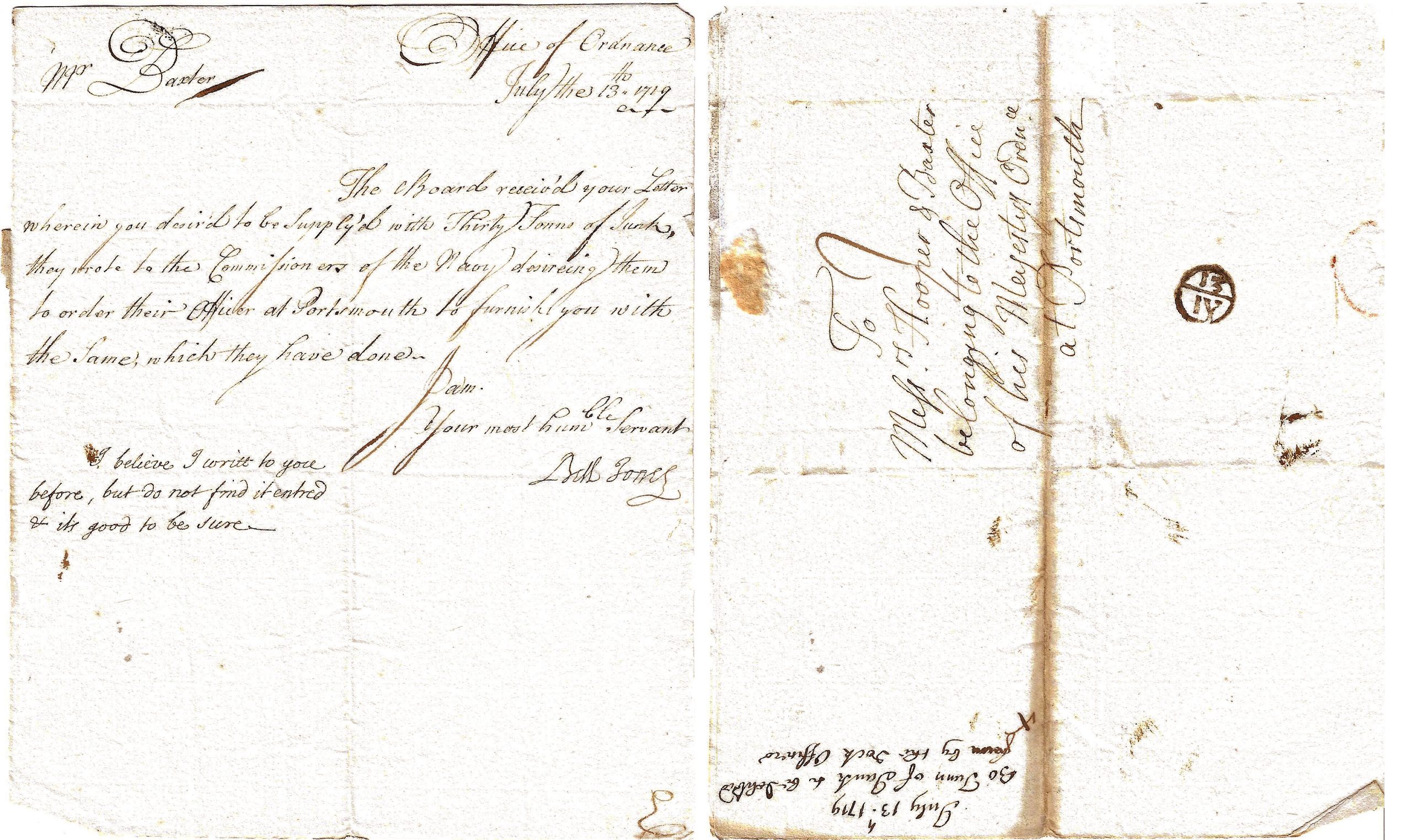
On July 13th 1719 Bell Jones writes to Mr. Baxter regarding 30tons of junk that has been supplied. Junk was old rope used for making wadding, as caulking, &c.
View in new tab:
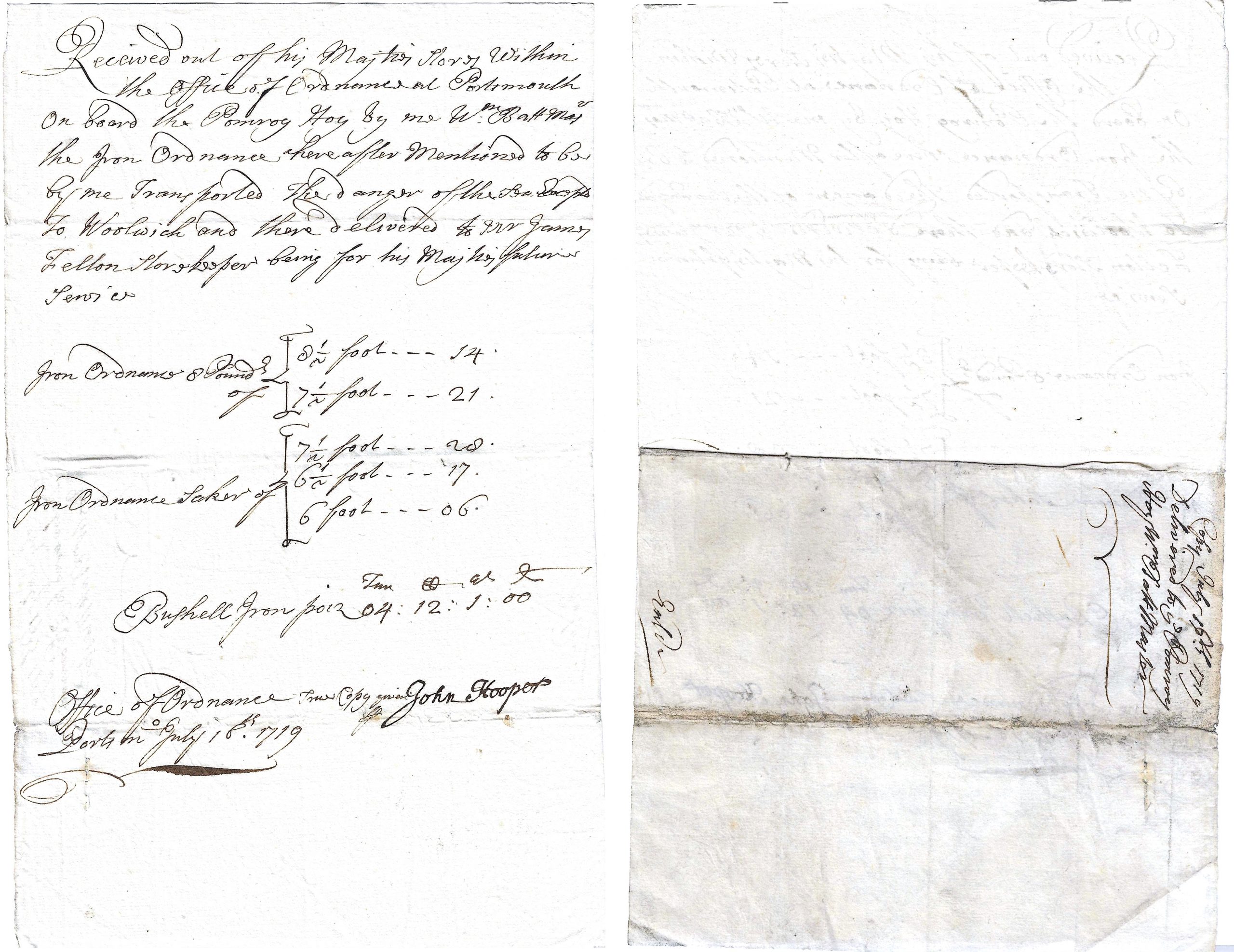
A bill of laden from William Batt, master of the Pomroy hoy arrives on 14th July 1719 in a beautiful hand well laid out and containing uncommon contractions: he uses the elaborate capital ‘P’ for ‘per’ or ‘by’ and ‘men‾cond’ for ‘mentioned. This note also gives us sight of the size of guns he is carrying: 8 pounders 7 ½ and 8 ½ feet long and sakers of 6, 6 ½ and 7 ½ feet long including the weight thereof. In addition, he is carrying almost five tons of ‘bushel’ iron (scrap). We see this receipted on 16th July.

View in new tab:
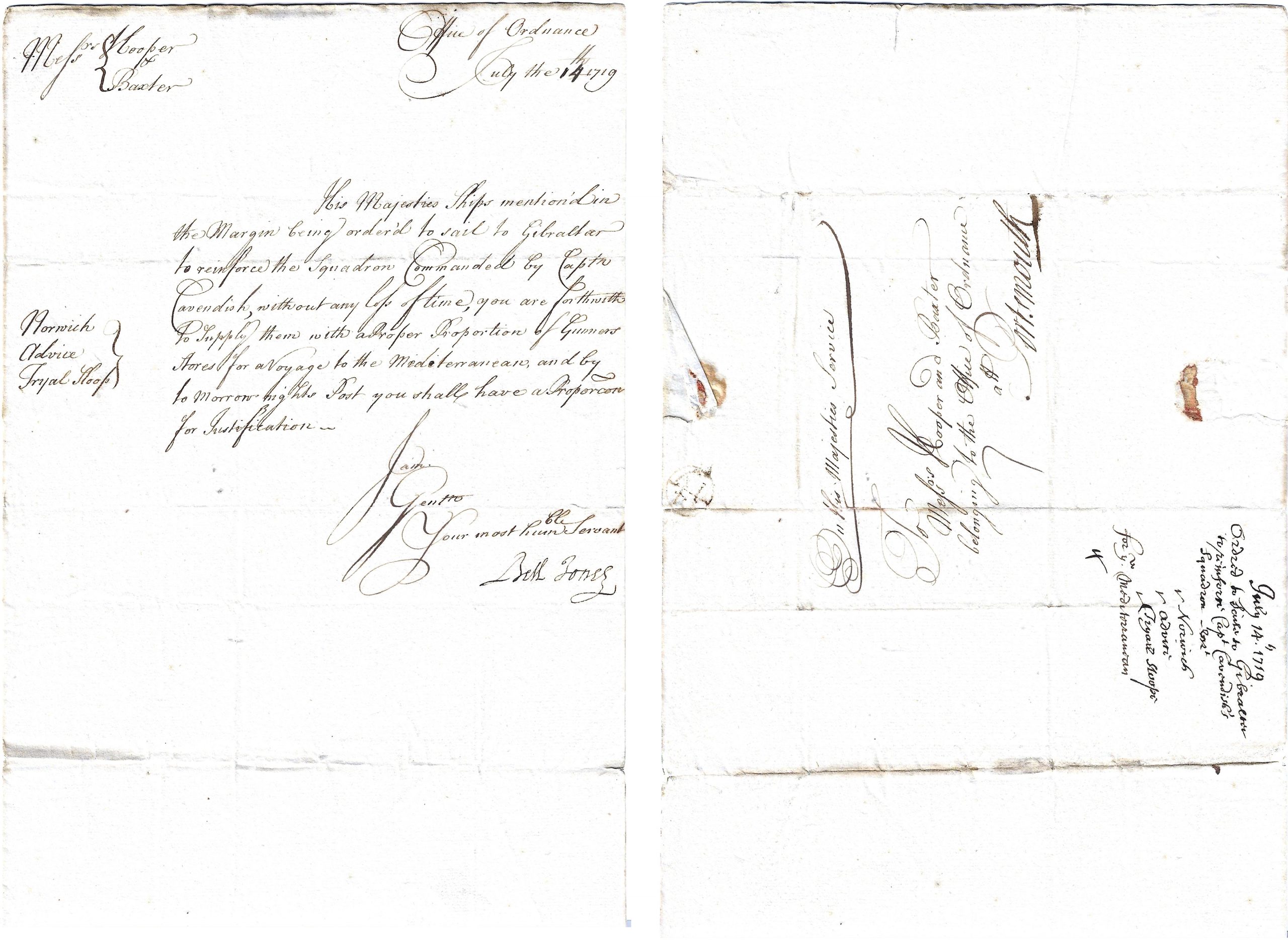
The Battle of Cape St Vincent was fought in December of 1719. A squadron, under the command of commodore Philip Cavendish. On 14th July 1719 we see three ships, Norwich, Advice and Trial sloop being prepared to join the squadron.
View in new tab:
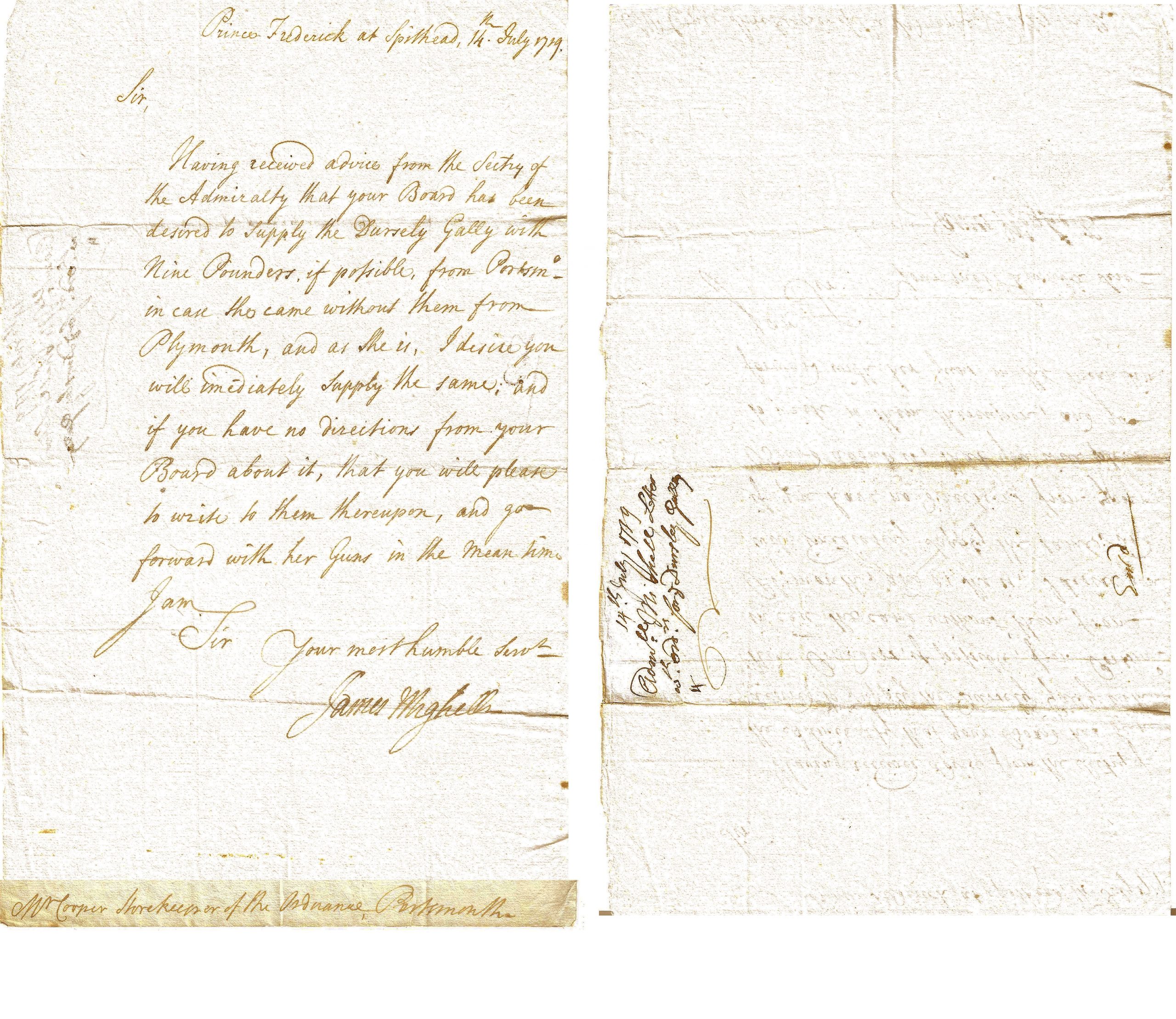
Also, on the 14th of July comes a note from Admiral James Mcghells from his flagship Prince Frederick, moored at Spithead, asking that Dursley Galley be supplied with nine pounders should they not have been supplied at Plymouth. This is a somewhat unorthodox request, as all requests for ordnance should come from The Board and not the admiralty or naval Officers. However, the admiral has covered his back by a degree in saying that if The Board have not ordered the supplies, that Mr. Hooper should seek confirmation. This was almost certainly in preparation for the retaliatory raid on Vigo in Spain.
View in new tab:
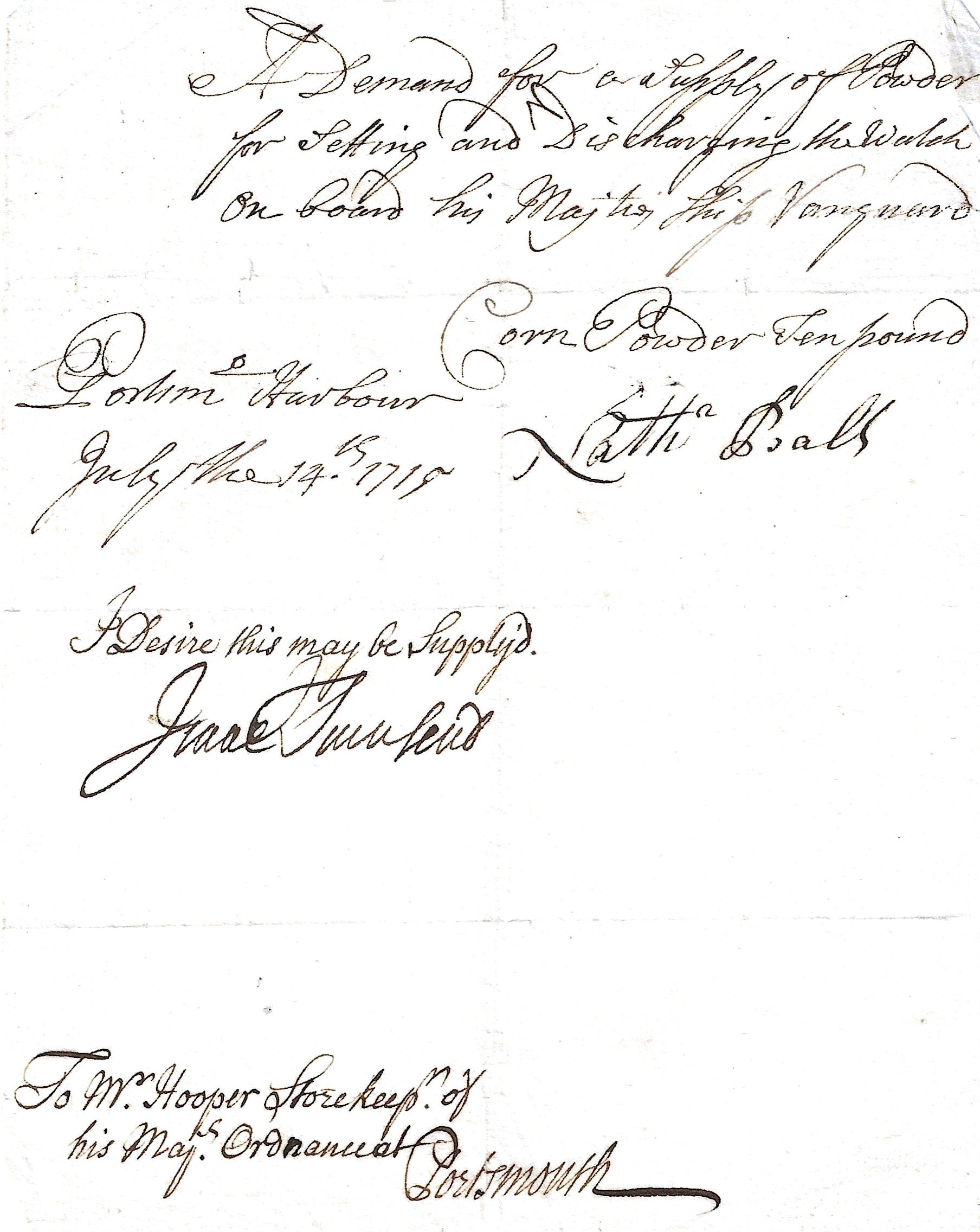
Another demand for powder, this time for HMS Vanguard (1678)on the 14th, this time approved by Isaac Townsend, so all in order. The history of Vanguard is interesting to say the least.
View in new tab:
17th July 1719, a bill of laden from William Batt, master of the Pomroy, who is to deliver 8 pounders, sakers and 4 tuns, 12 cwt, 1 quarter of iron. The receipt is endorsed by John Hooper.
View in new tab:
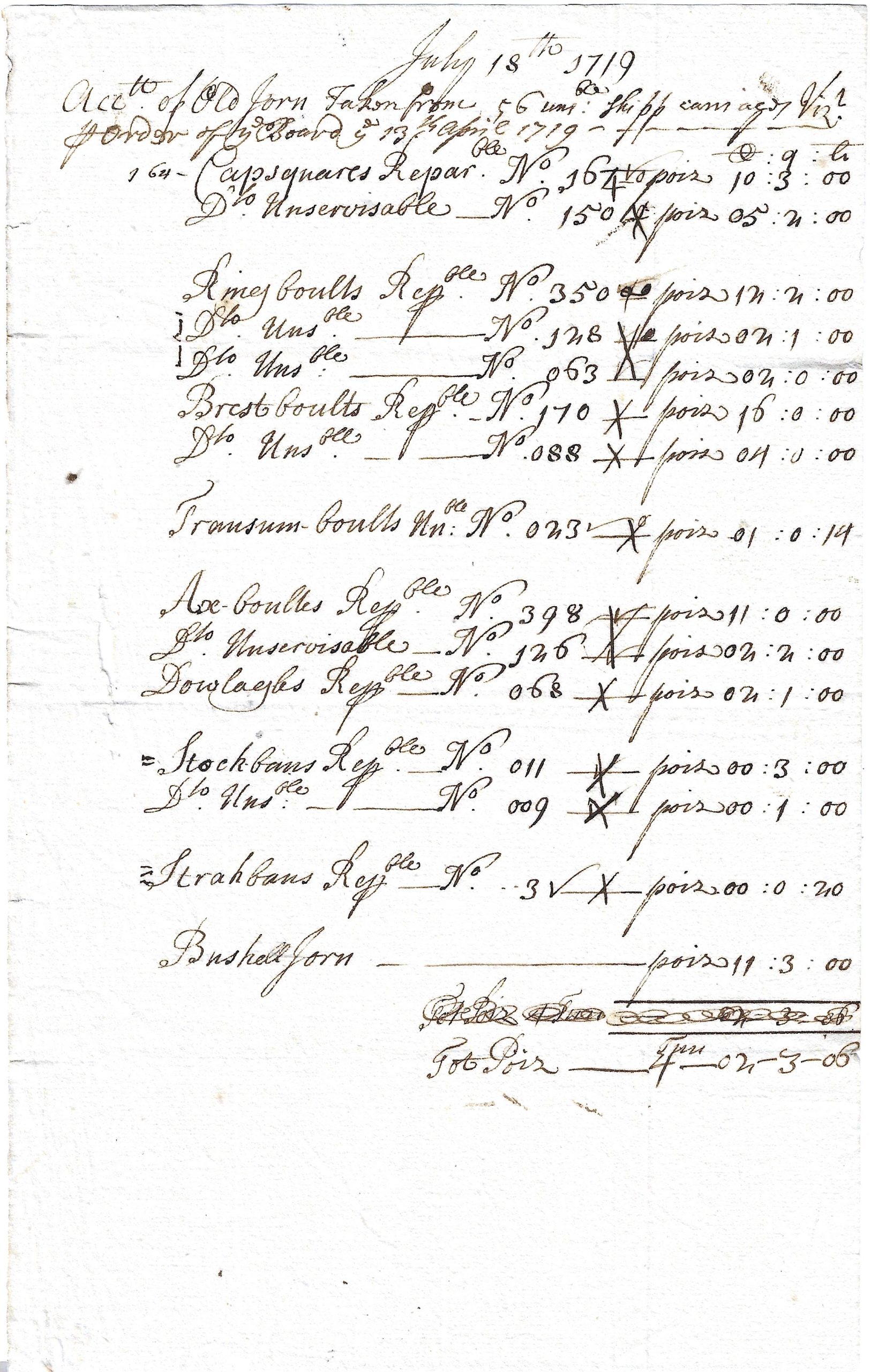
This document is missing any form of introduction. It lists scrap, unusable iron taken from old gun carriages.
View in new tab:
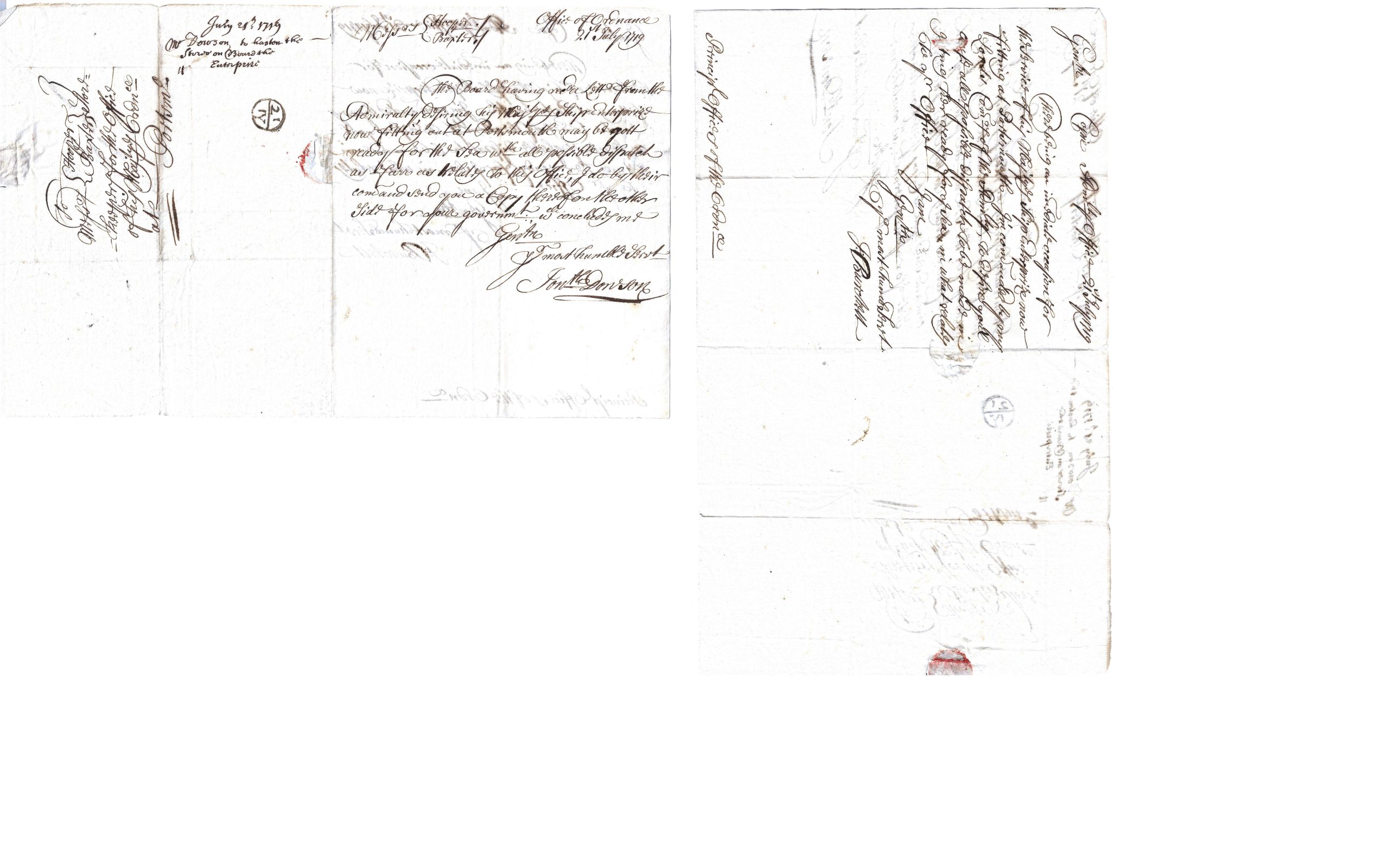
21st July 1719 we see another rushed request to prepare Enterprise for sea, almost certainly to join Admiral Mcghells in his expedition to capture Vigo. Unfortunately, having been written on fine paper, the ink has passed through to the reverse side of the paper making the letter difficult to read.
View in new tab:
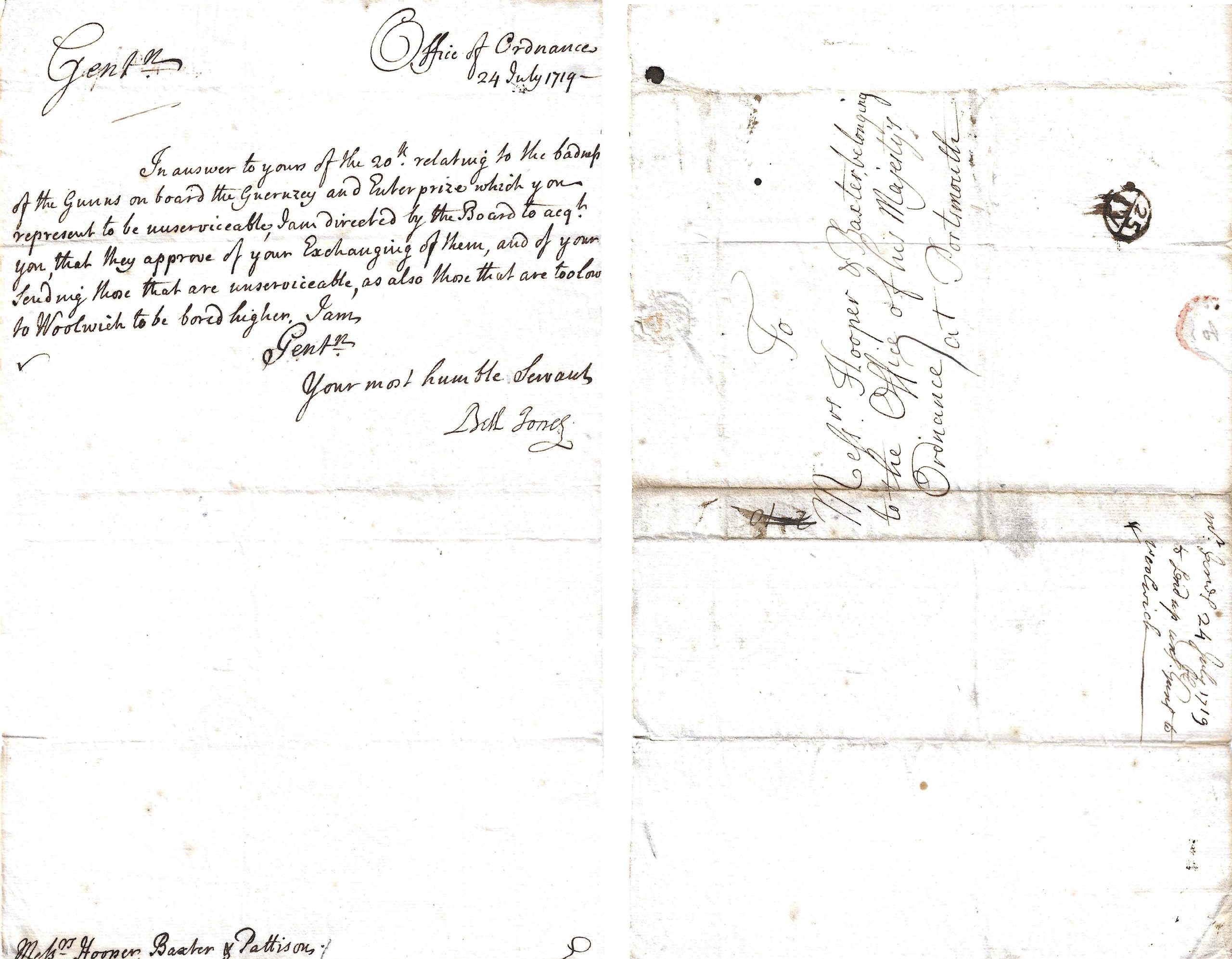
The letter from Bell Jones of the 24th July 1719 is in response to a suggestion of Messrs Hooper and Baxter that new guns should be issued to Enterprise (1709) and Guernzy as theirs are defective and in need of reboring. One thinks of these people as storekeepers, but this indicates that they were much more. Again, all this must have been in preparation for the taking of Vigo.
View in new tab:
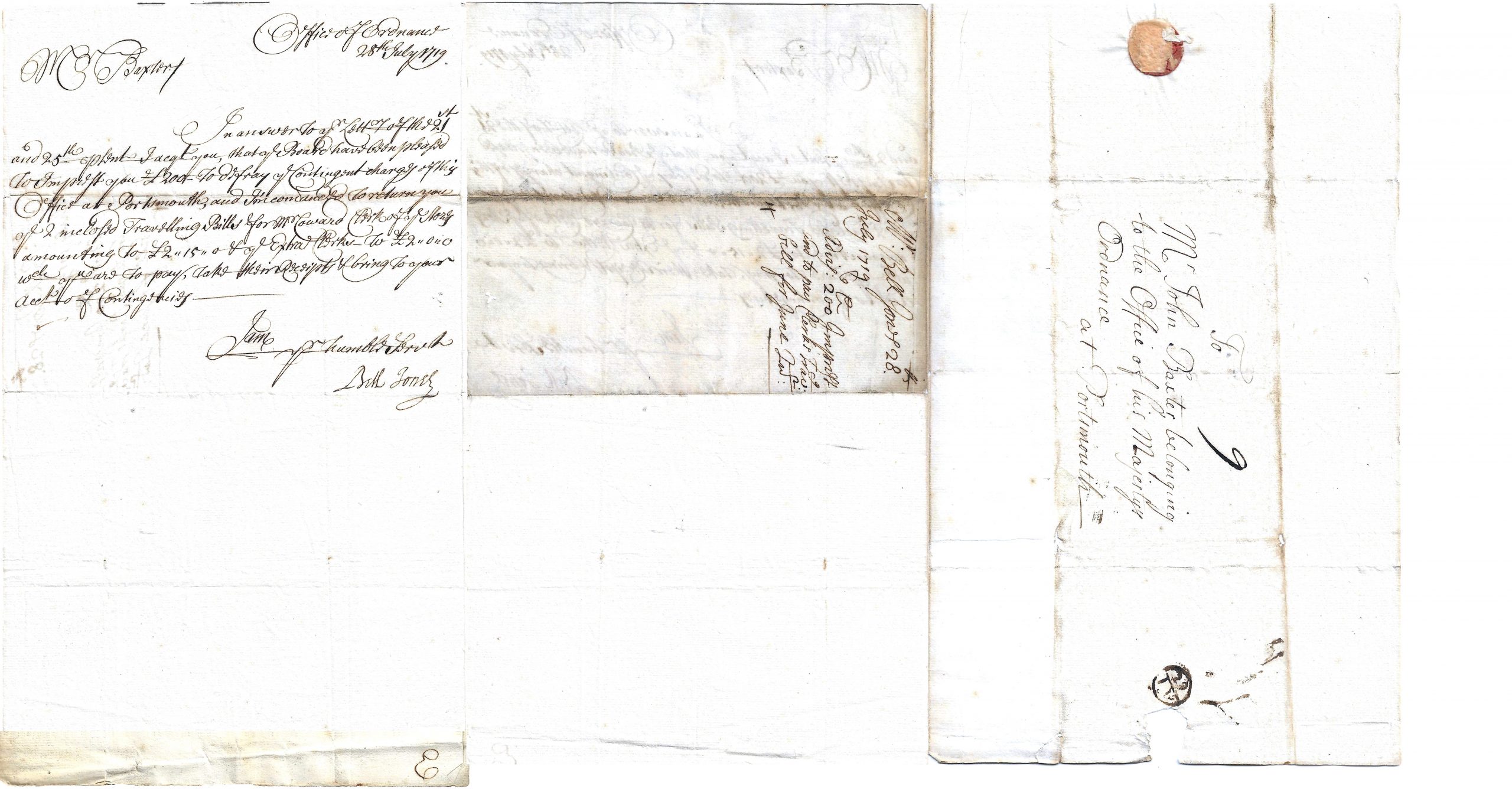
On 28th July 1719 Bell Jones wrote to John Baxter advising that he was issued an imprest of £200 to be used as a contingency fund and that he should pay travel costs to Peter Coward, clerk.
View in new tab:
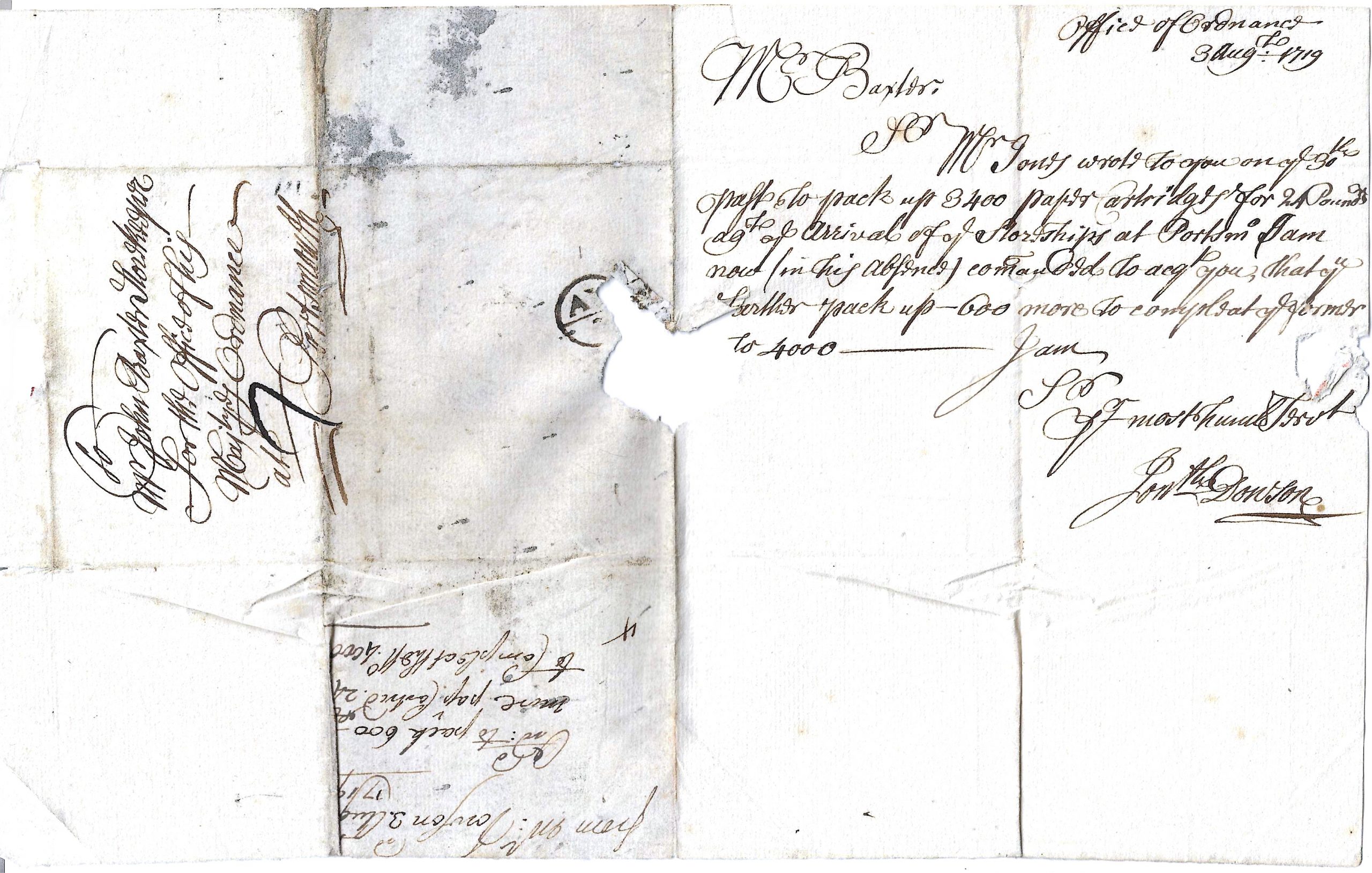
Johnathan Dawson writes on behalf of Bell Jones on 3rd August 1719 with a somewhat amusing message. Referring to a recent request to supply 3400 paper cartridges, he writes “…you better pack up 600 more to complete the number to 4000.”
View in new tab:
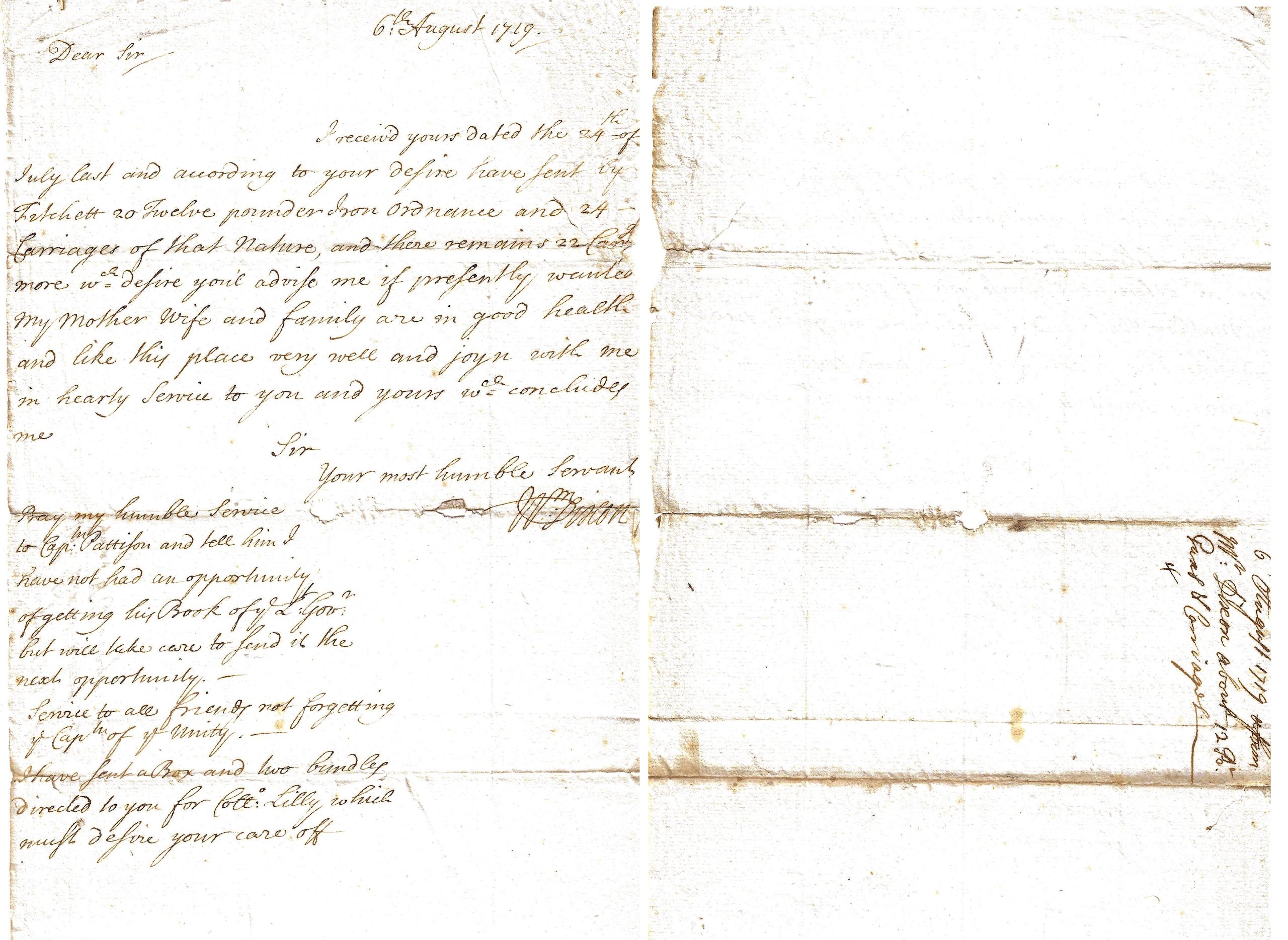
A letter from William Dixon on 6th August 1719 is missing its address, so we must assume that it is to Mr Baxter or Mr Hooper. It starts by discussing guns and carriages, but concludes with a personal note sending the best wishes of his family, and with a post script aimed at Captain Pattison regarding a book and sending best wishes to other friends.
View in new tab:
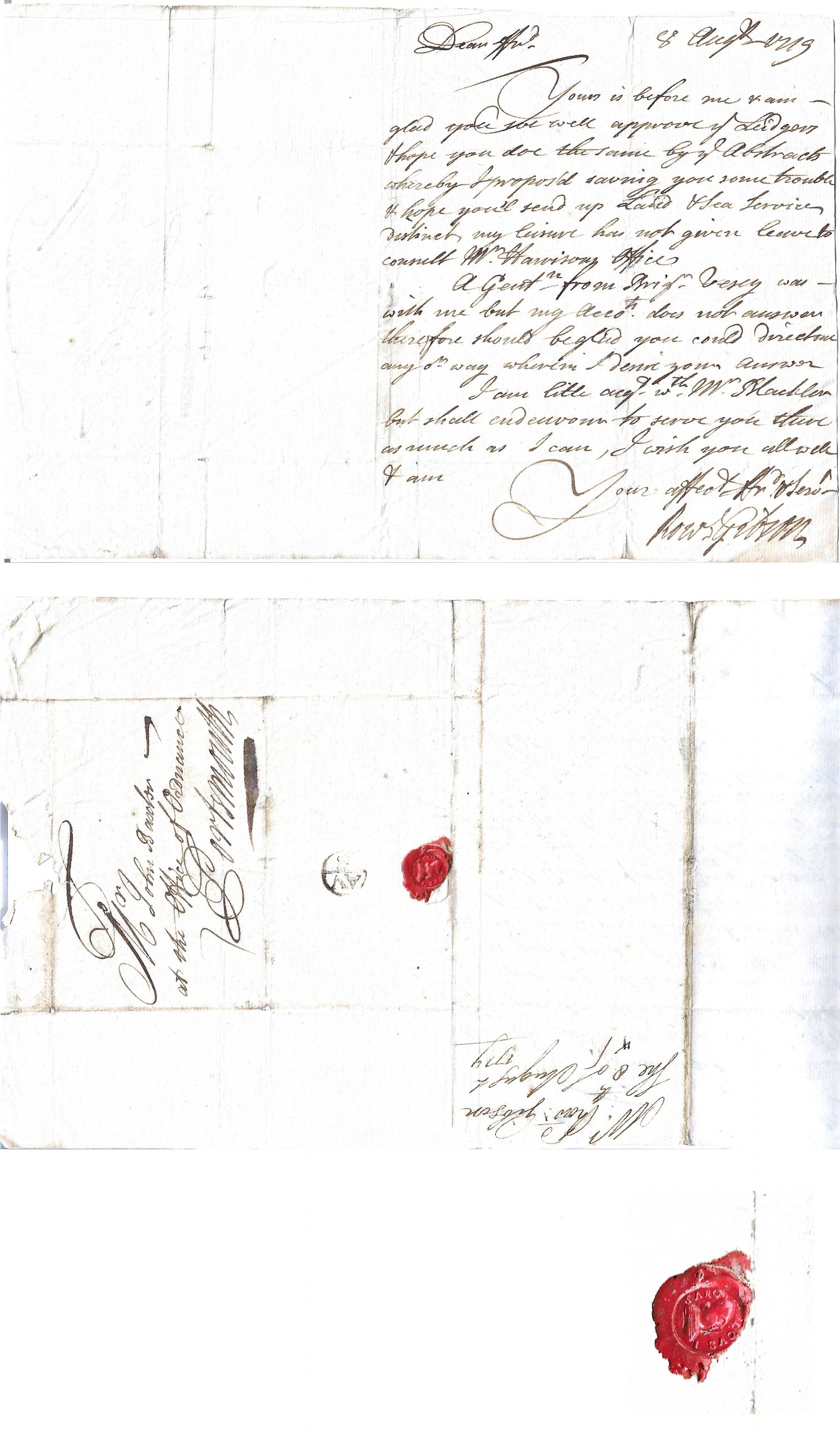
On 8th August 1719 Rowland Gibson’s letter to Captain Baxter retains its seal depicting Charles 1st raising the question “Why?” as Charles 1st was beheaded in 1649. The letter itself appears to be another episode in the ongoing saga of Mr. Harrison of the Office of the Ordnance, and the accounts submitted by Captain Baxter.
View in new tab:
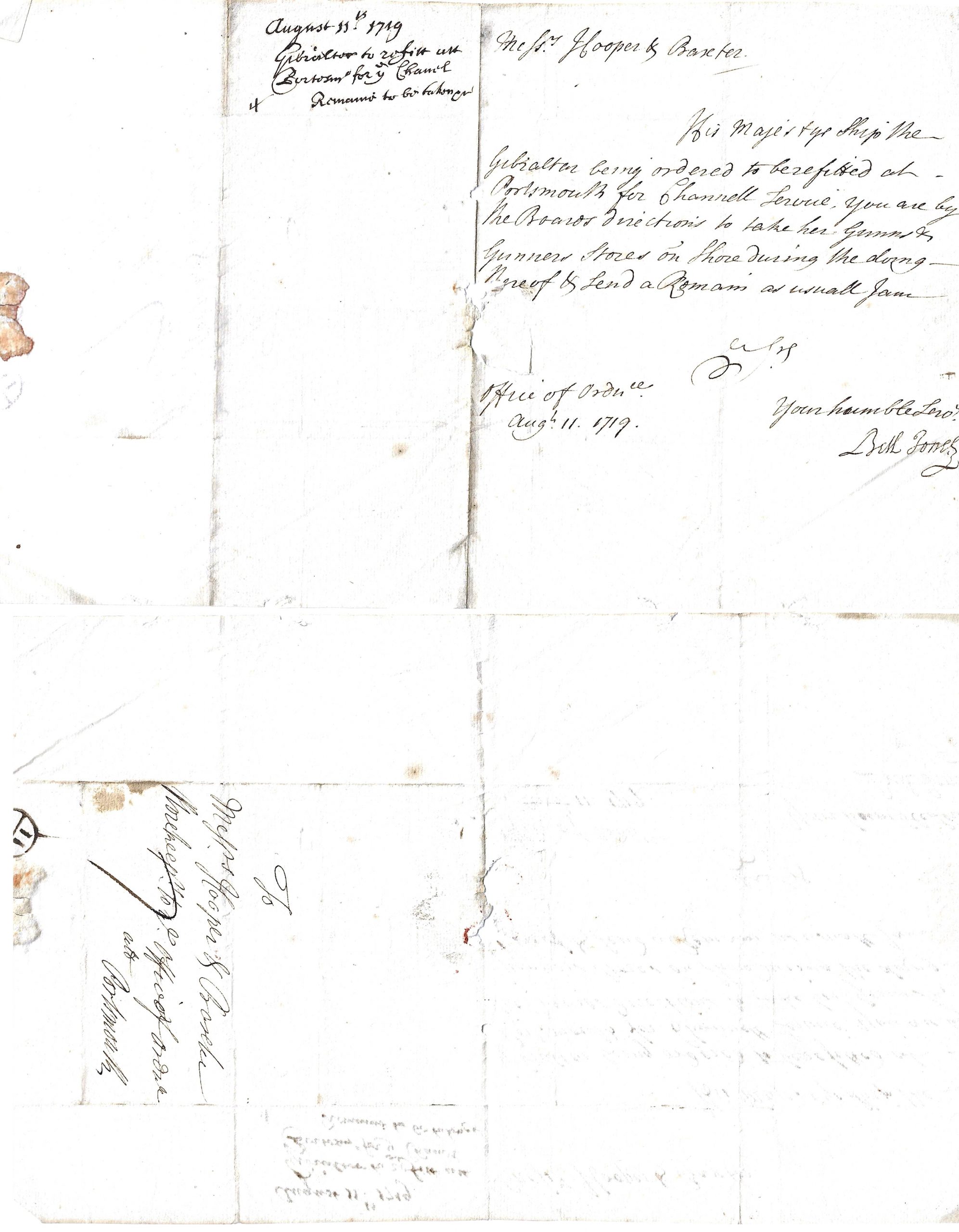
HMS Gibraltar is to be refitted for Channel Service on 11th August 1719.
View in new tab:
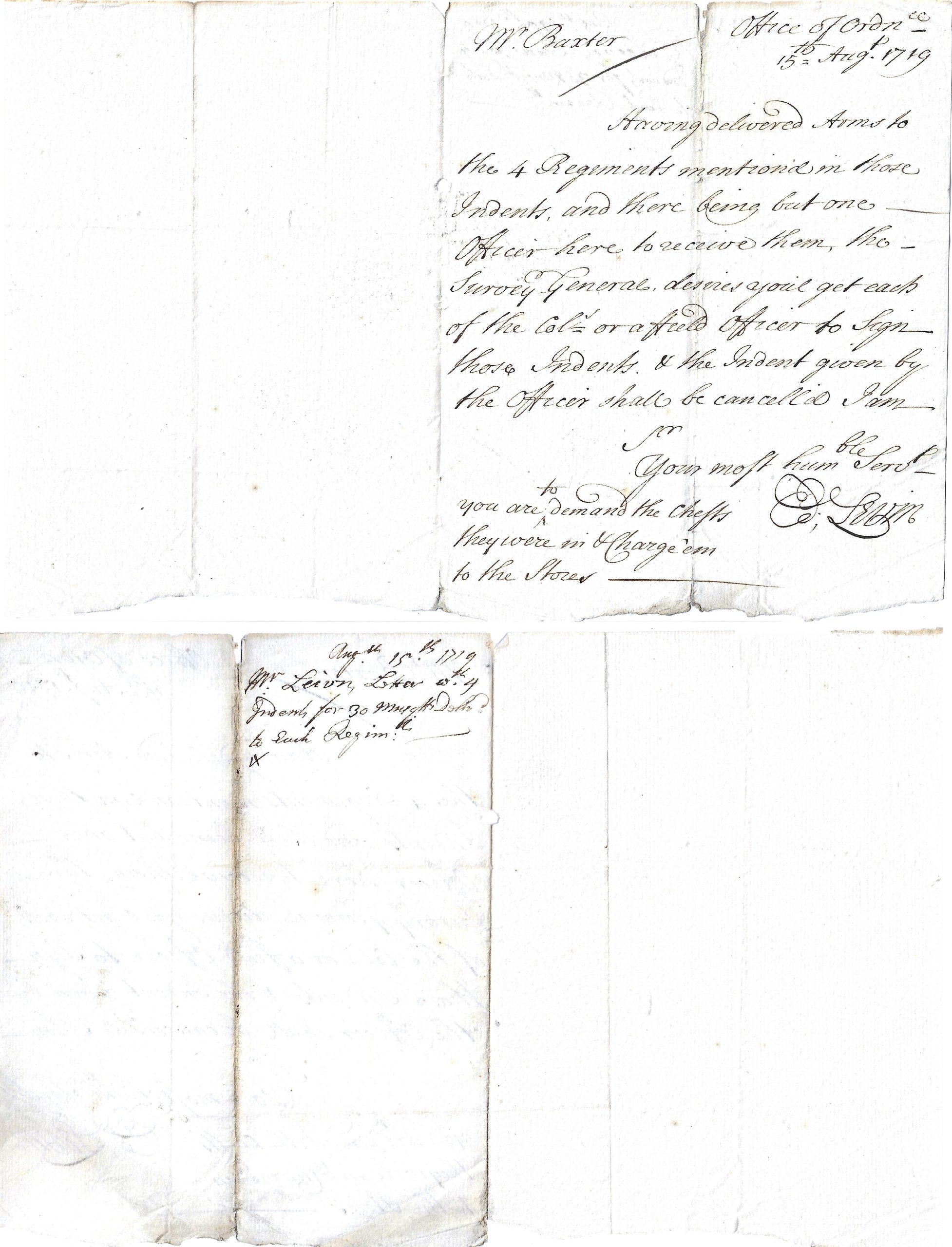
A note on August 15th 1719 demands that Mr. Baxter has four indents for small arms signed by field officers, and for the chests, in which the guns were supplied, be returned.
View in new tab:
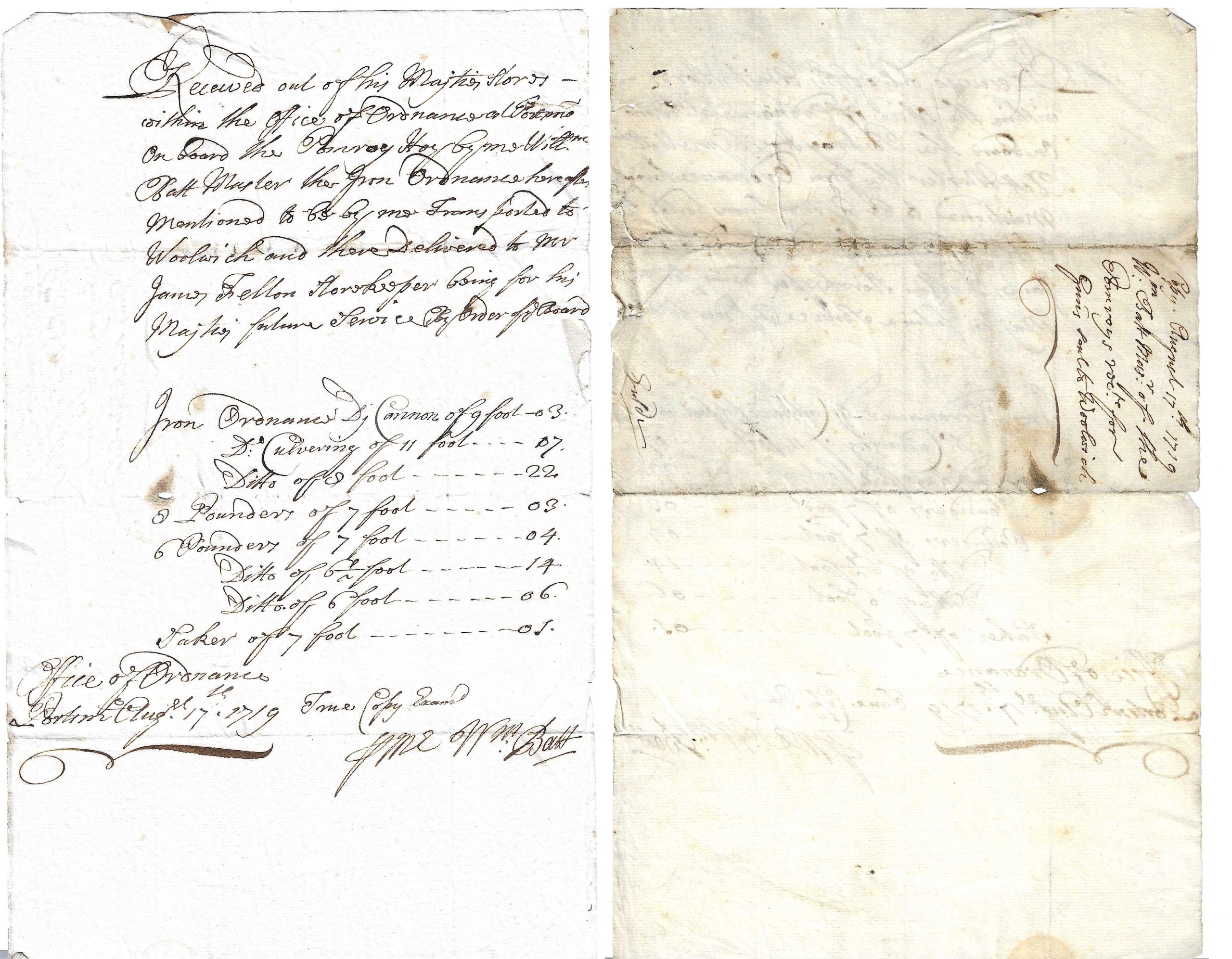
17th August 1719 William Batt, master of the Pomroy hoy lists the guns he has received to take to Woolwich. The following day more guns are received on the Isaac & Elizabeth commanded by William Fitchett.
View in new tab:
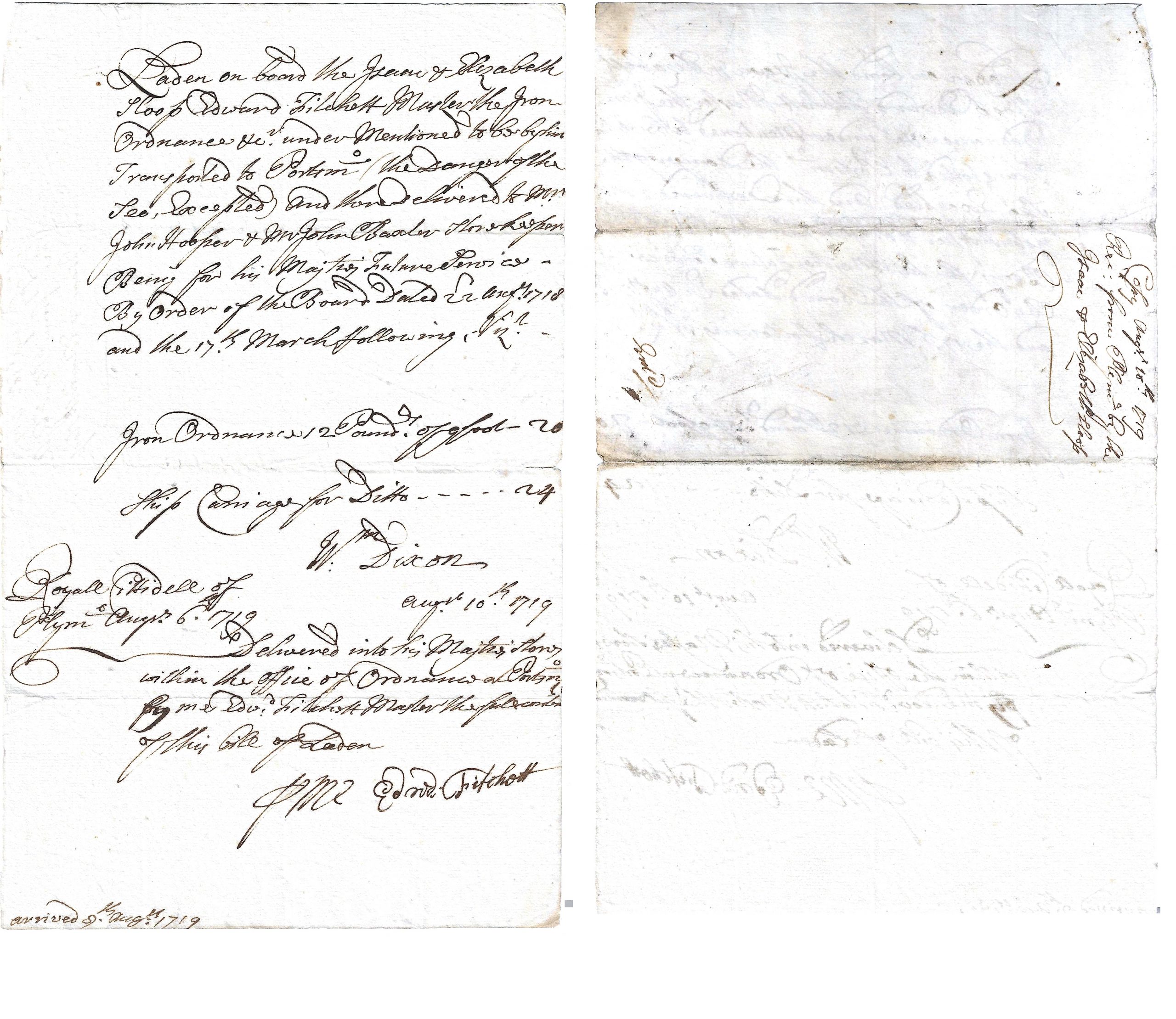
A bill of laden on 18th August 1719 from Edward Fitchett who is transporting guns and carriages from Plymouth to Portsmouth.
View in new tab:
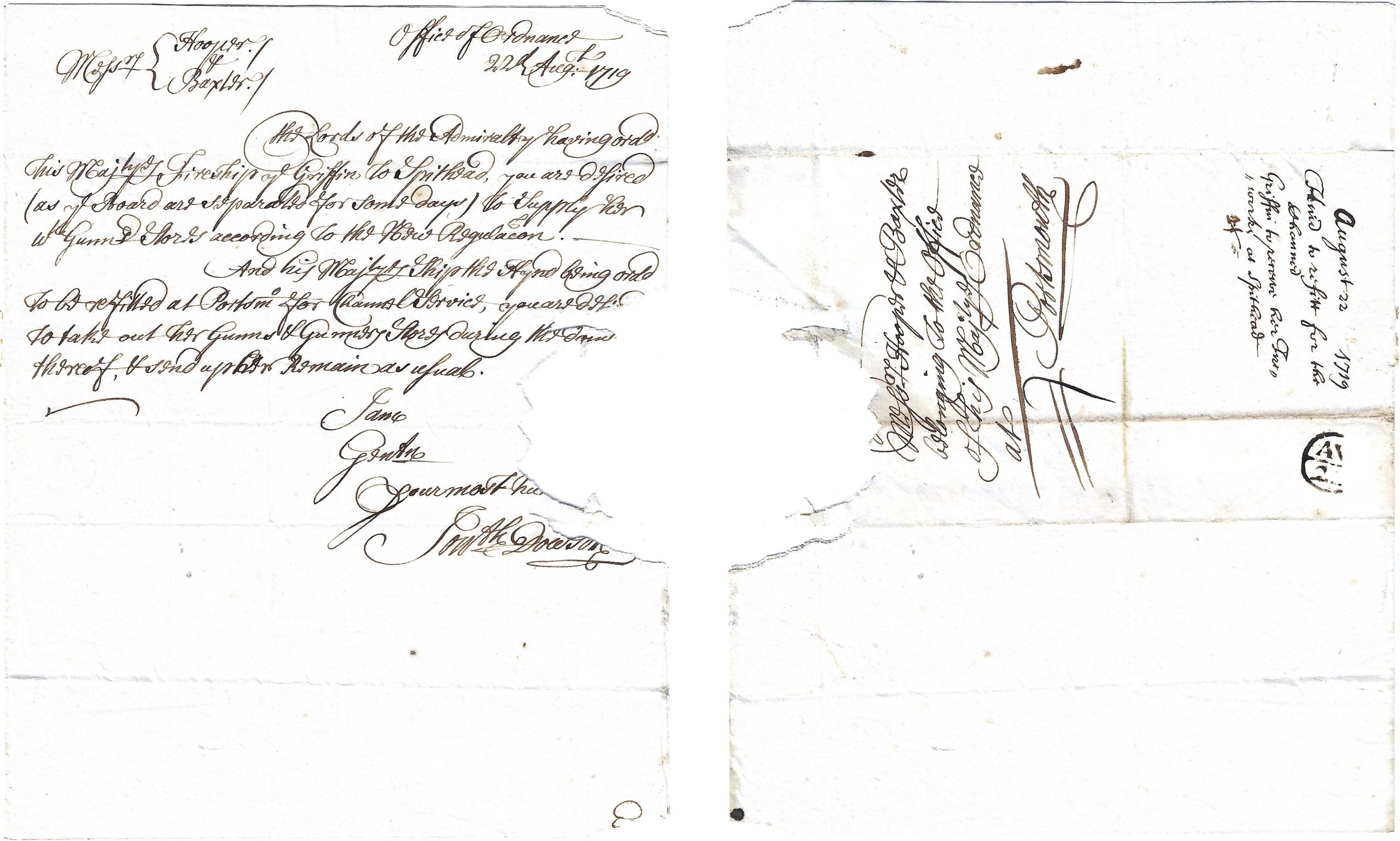
Although damaged, Johnathan Dawson’s letter of 22nd August 1719 is still beautifully scripted. It announces the arrival of HMS Griffin (1712) at Spithead where she is to be restocked with gunner’s stores while HMS Hind (1711) is to be refitted.
View in new tab:
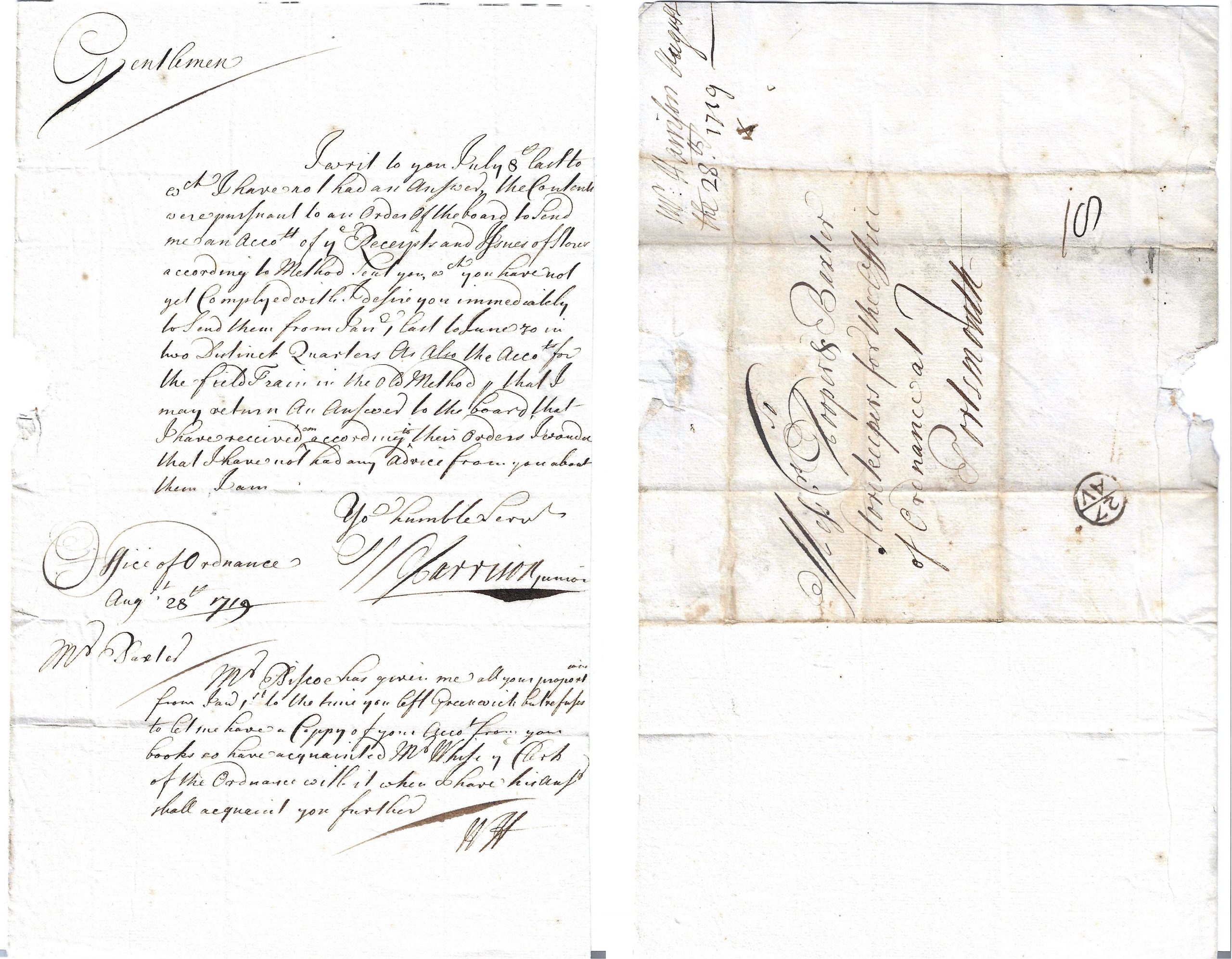
Mr. William Harrison adds another chapter to the story of Captain Baxter’s accounting work. On 28th August 1719 he is again complaining that he has not received accounts, yet at the same time says that he has received a copy from Mr. Bisco.
View in new tab:
On 29th August 1719 Jonathan Dawson writes to advise that Lively is to be refitted and that he is in receipt of a letter regarding the Griffin (1712).

View in new tab:
On 31st August 1719 an account of ‘laboratory stores’, these were fuses, cartridge cases &c. The Laboratory was where the cartridges, grenades and other ammunition was made up.
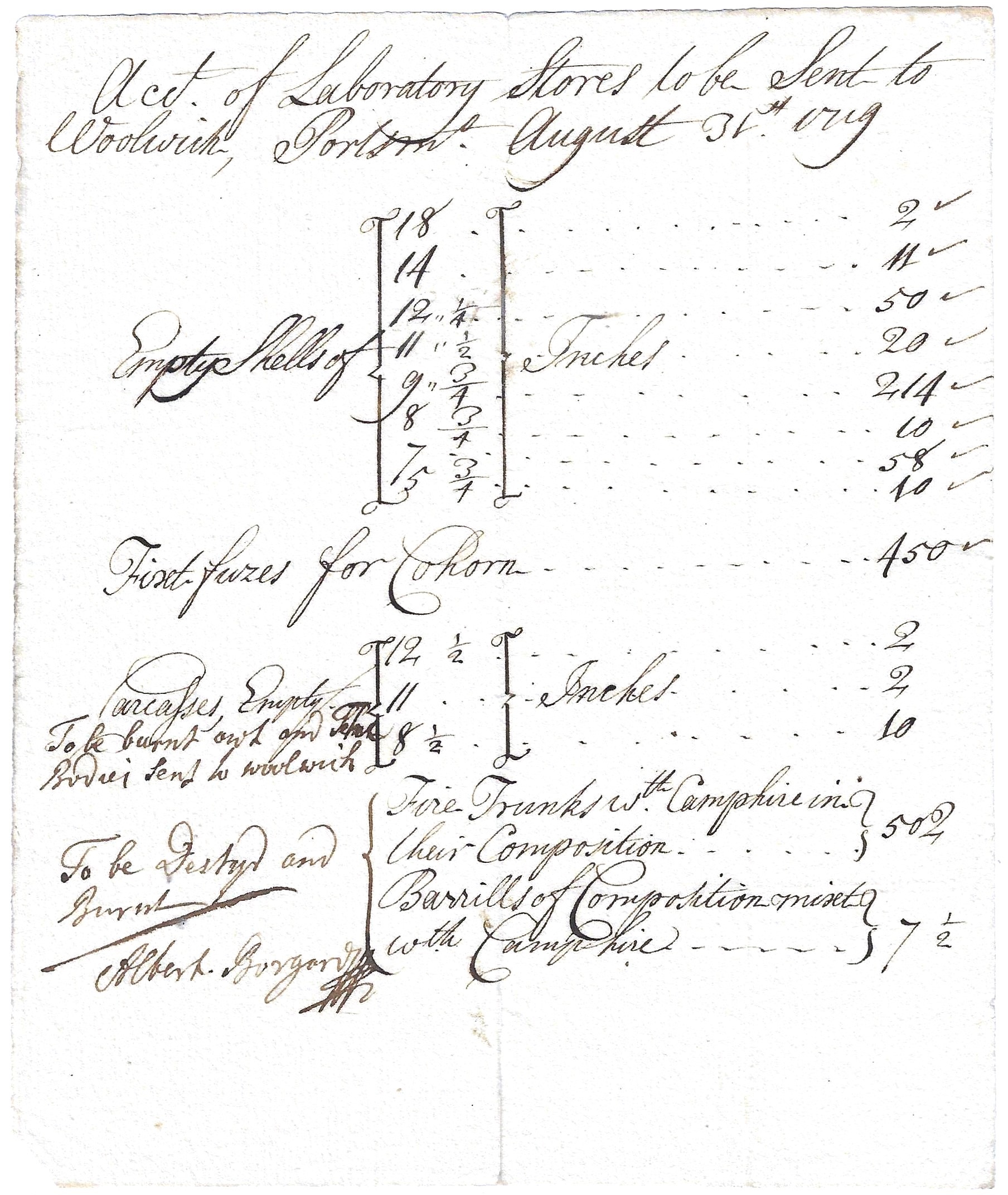
View in new tab:
A number of receipts, dated 1st September 1719, all written by the same clerk, but signed by various army officers. for powder, flints, pikes, shot and introducing us to the ‘chevaux de frise’ a spiked, wooden obstacle designed to impede infantry and cavalry. These receipts were all pinned together.
I have only included one of these as they are all very similar.
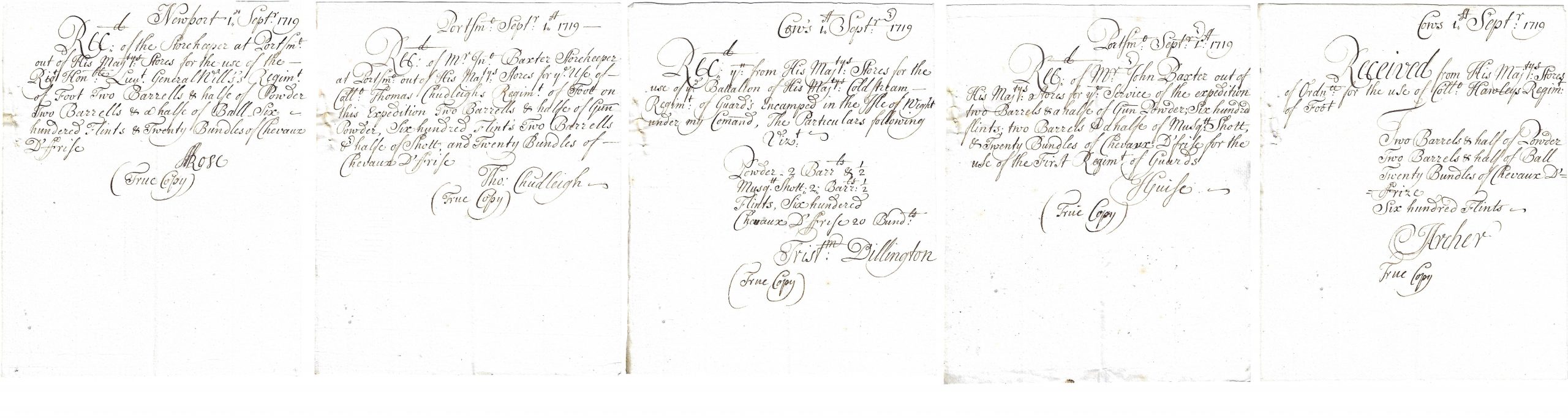
View in new tab:
This letter of 10th October 1719 is a little confusing. It is addressed to Mr. Baxter, from John Blake Junior, yet begins ‘Dear Namesake’. Maybe they were friends and this was a private joke? Who knows.
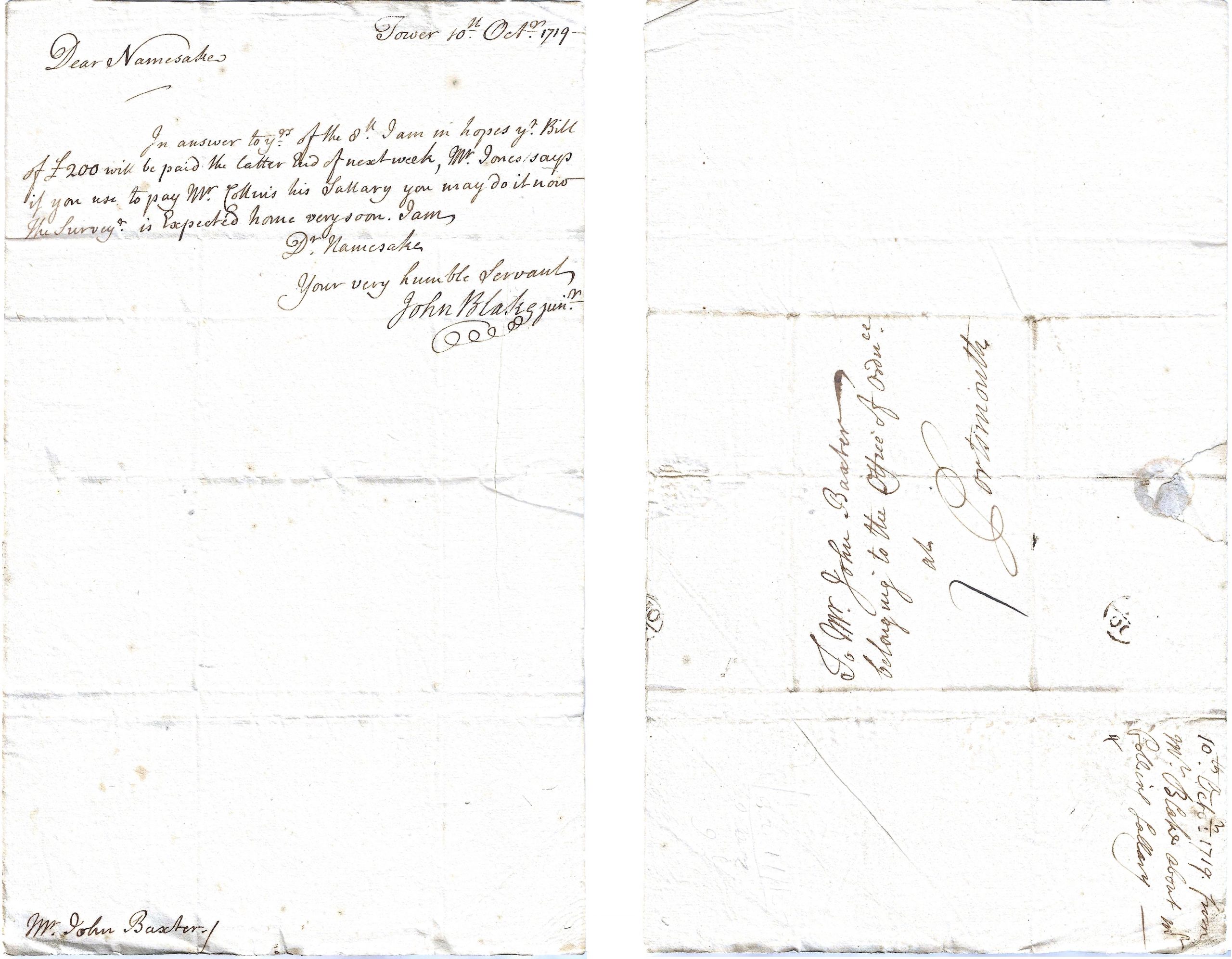
View in new tab:
Another document, transcribed by Philip Eley, this time a personal letter from Richard Veal (a Richard Veal, likely to be the same person, was one of the storekeepers in the mid 1700s). Unfortunately the document was not placed correctly in the scanner and some lines have been clipped. Philip has made a best guess where there are missing letters which he has indicated with square brackets.
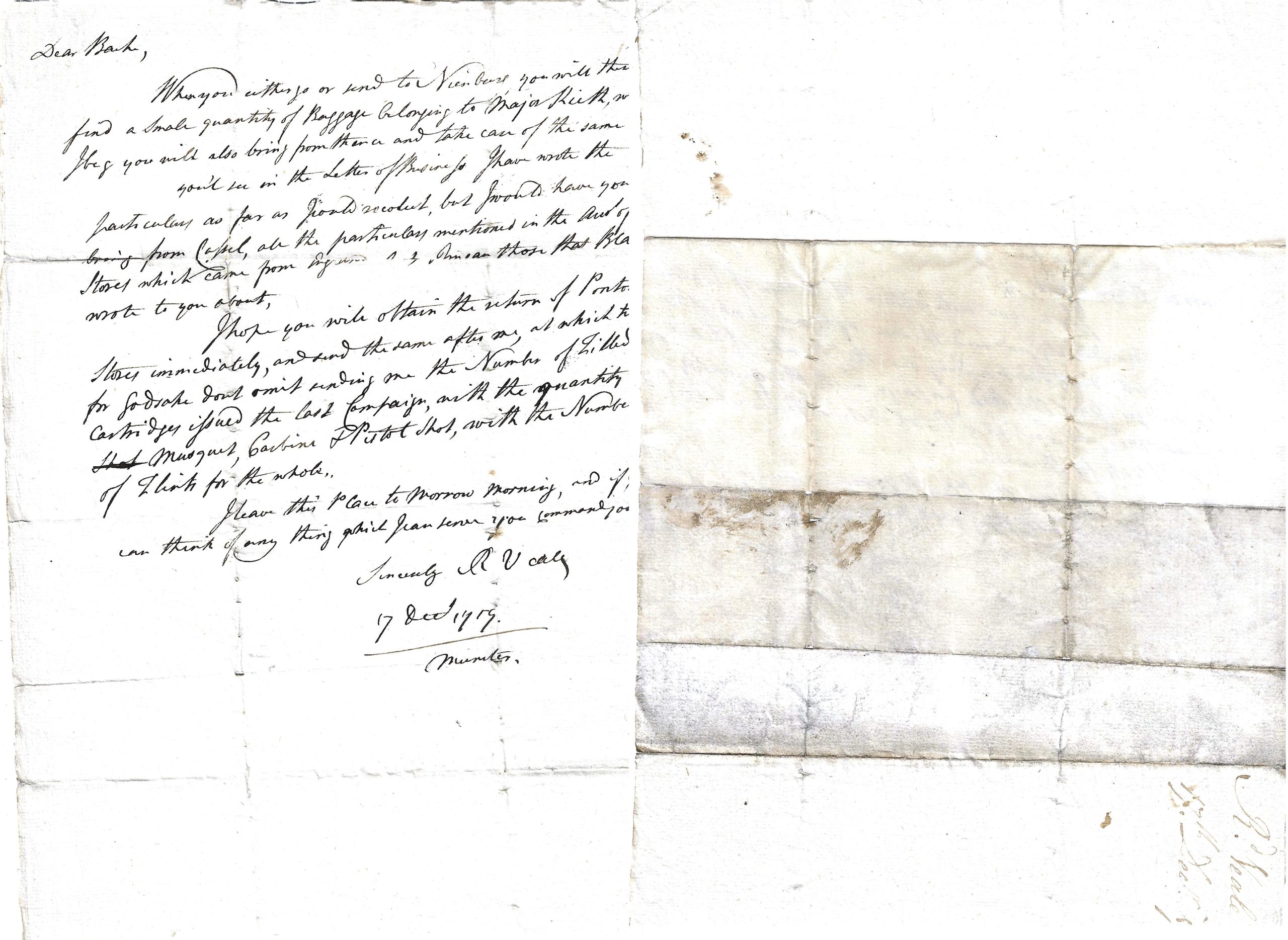
View in new tab
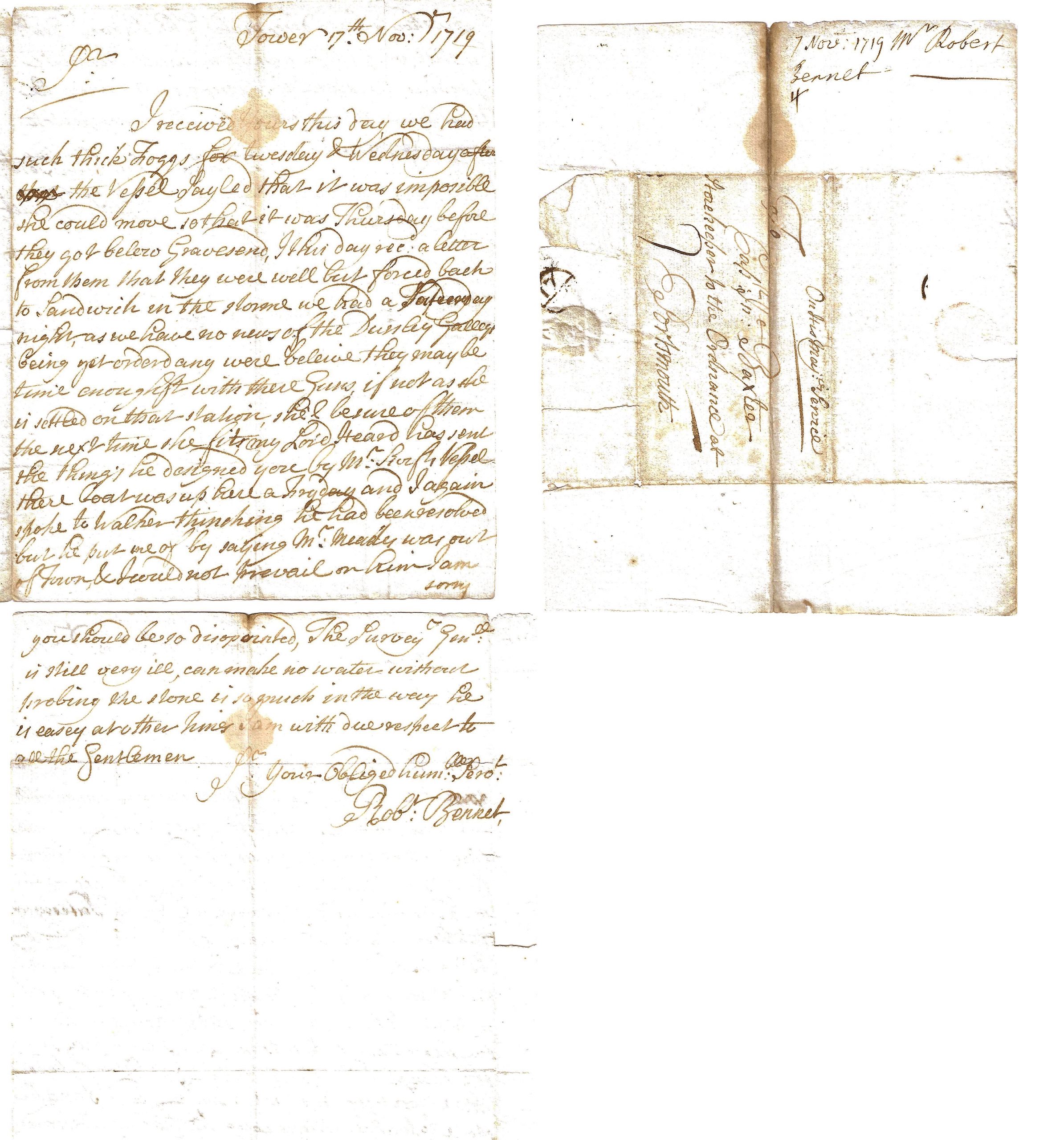
On 17th November 1719 a letter from Rob Bennet tells a story of fog and storms impeding the shipping between Greenwich and Portsmouth. It also tells of the poor health of the Surveyor General, Sir Michael Richards.
View in new tab:
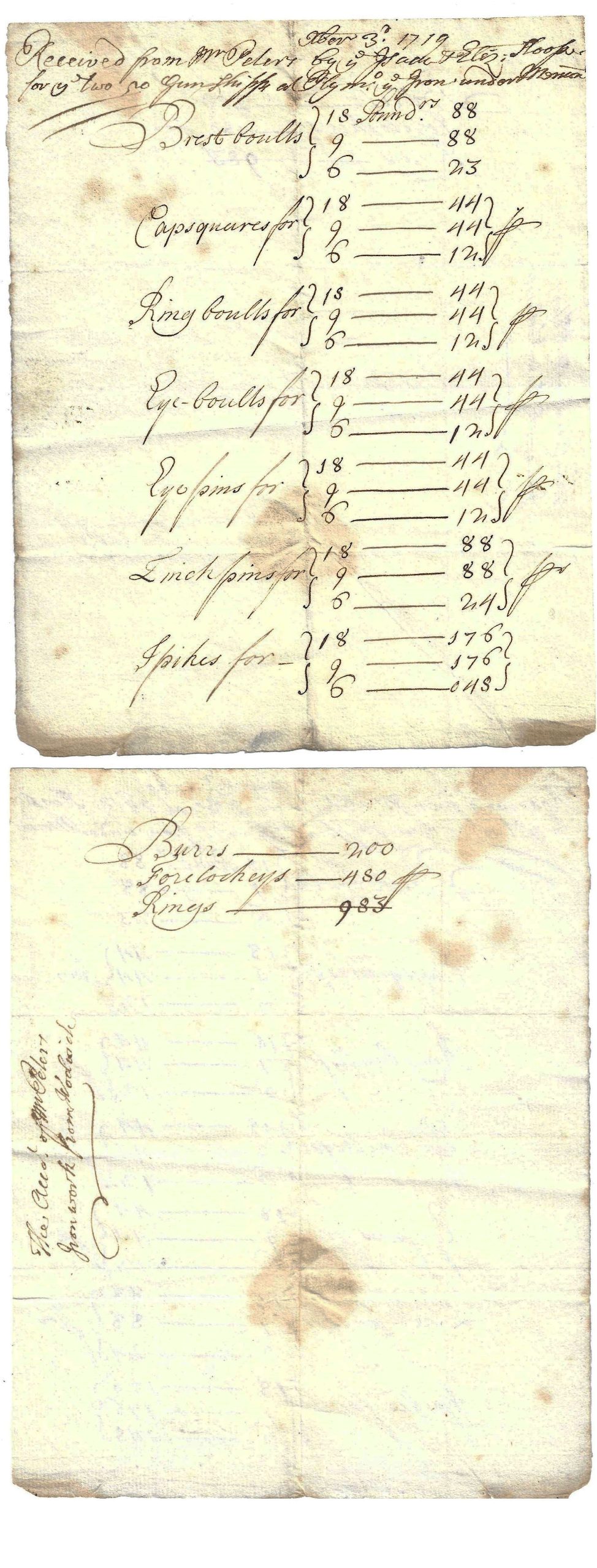
A bill of laden, dated 3rd December 1719, for the Isaac & Elizabeth hoy lists iron carriage parts being transported from Woolwich to Plymouth. The hoy made a stop at Portsmouth and the parts were transported onward to Plymouth as is borne out by the accompanying letter dated the following day.
View in new tab:
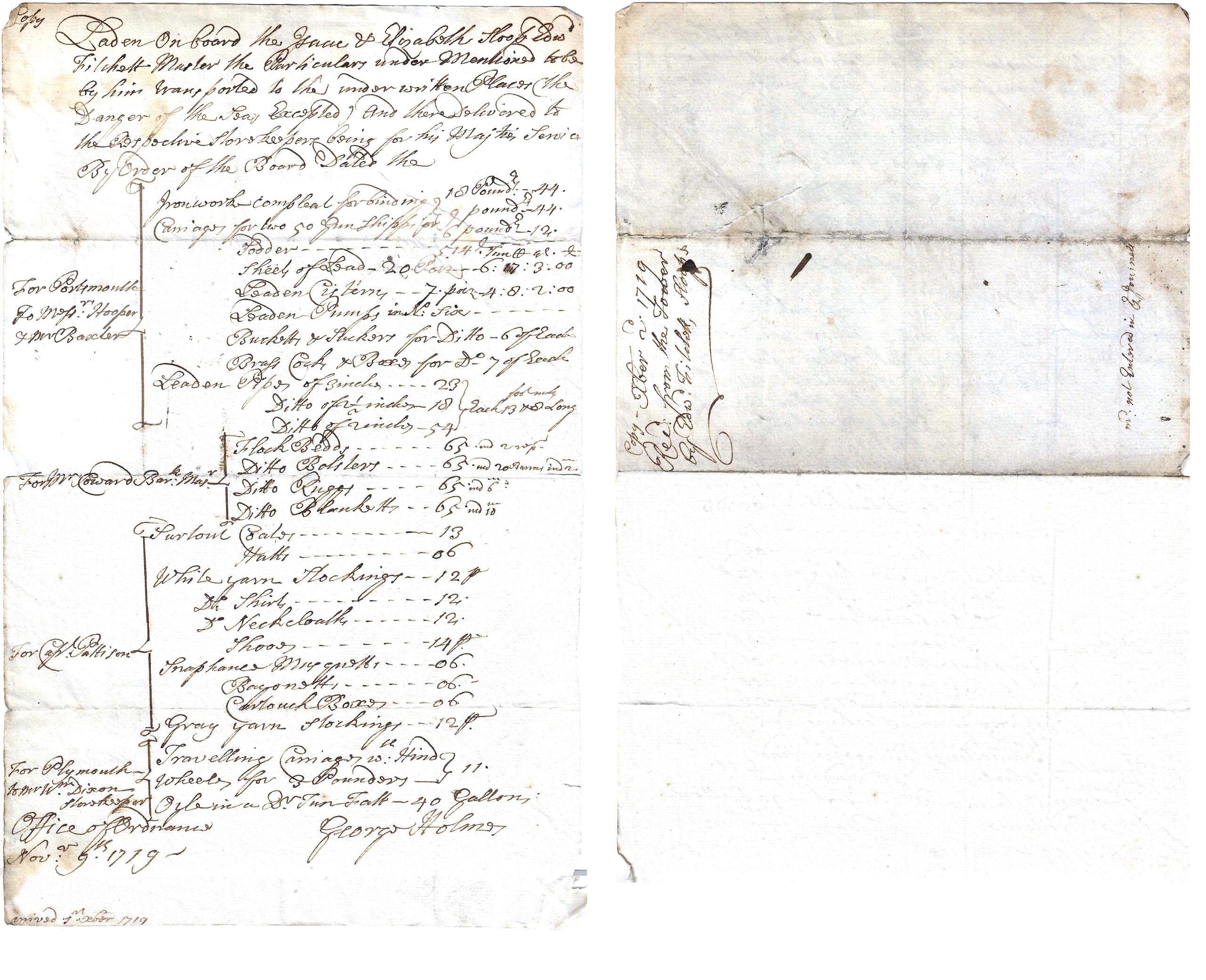
On 7th December 1719 a bill of laden for the Isaac & Elizabeth hoy lists stores to be transported to Messrs Hooper and Baxter at Portsmouth, Bedding for Peter Coward, clothing for Captain Pattison, and carriages and oil for William Dixon at Plymouth. The oil is supplied in a 2 tun fault. This was a large container holding 9 bushels.
View in new tab:
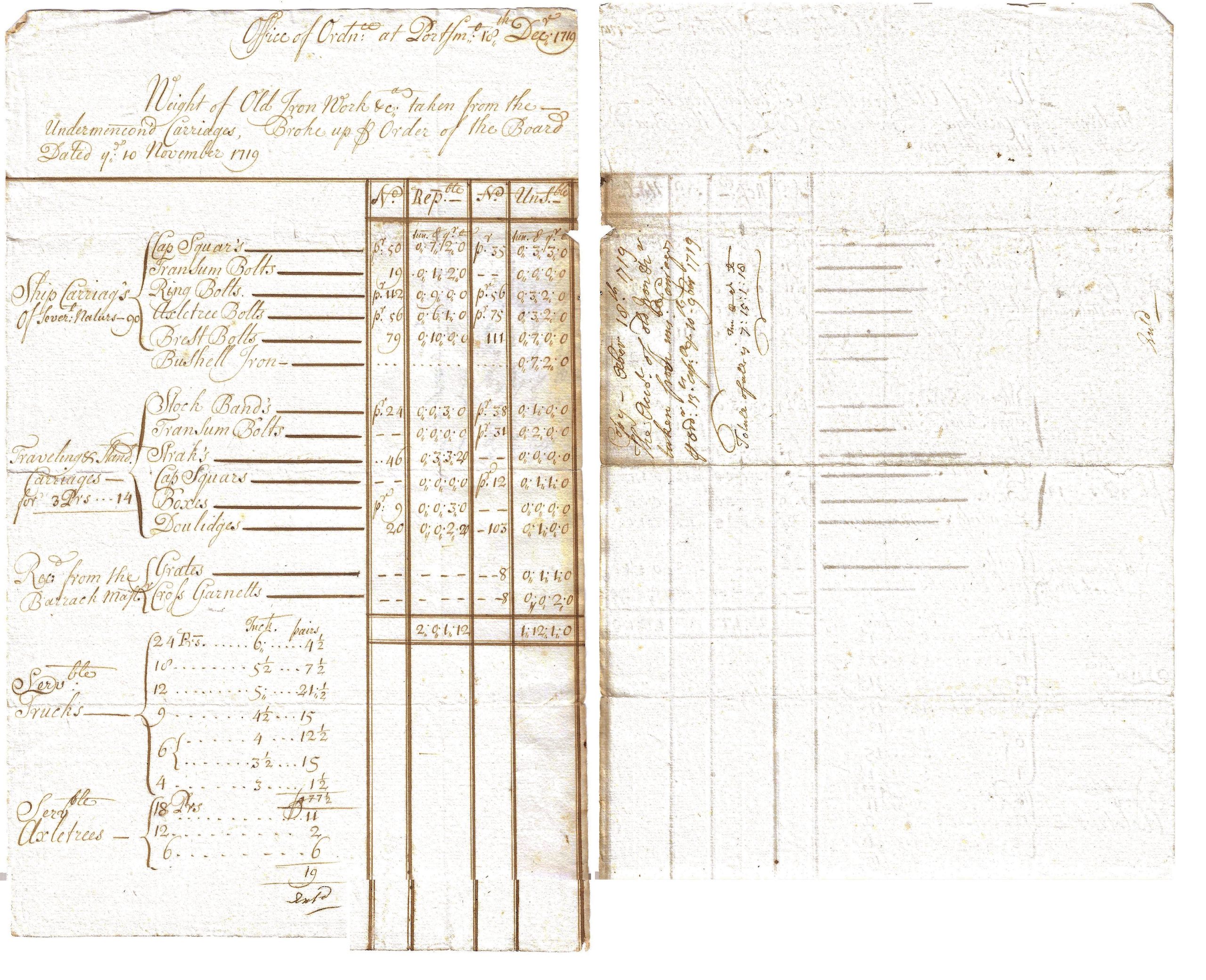
18th December 1719 an account of old iron &c gives us an insight into the iron parts of a gun carriage. Parts such as cap squares, that held the trunnions in place and doulidges, the metal plates that held the wooden parts of a truck (wheel) together.
View in new tab:
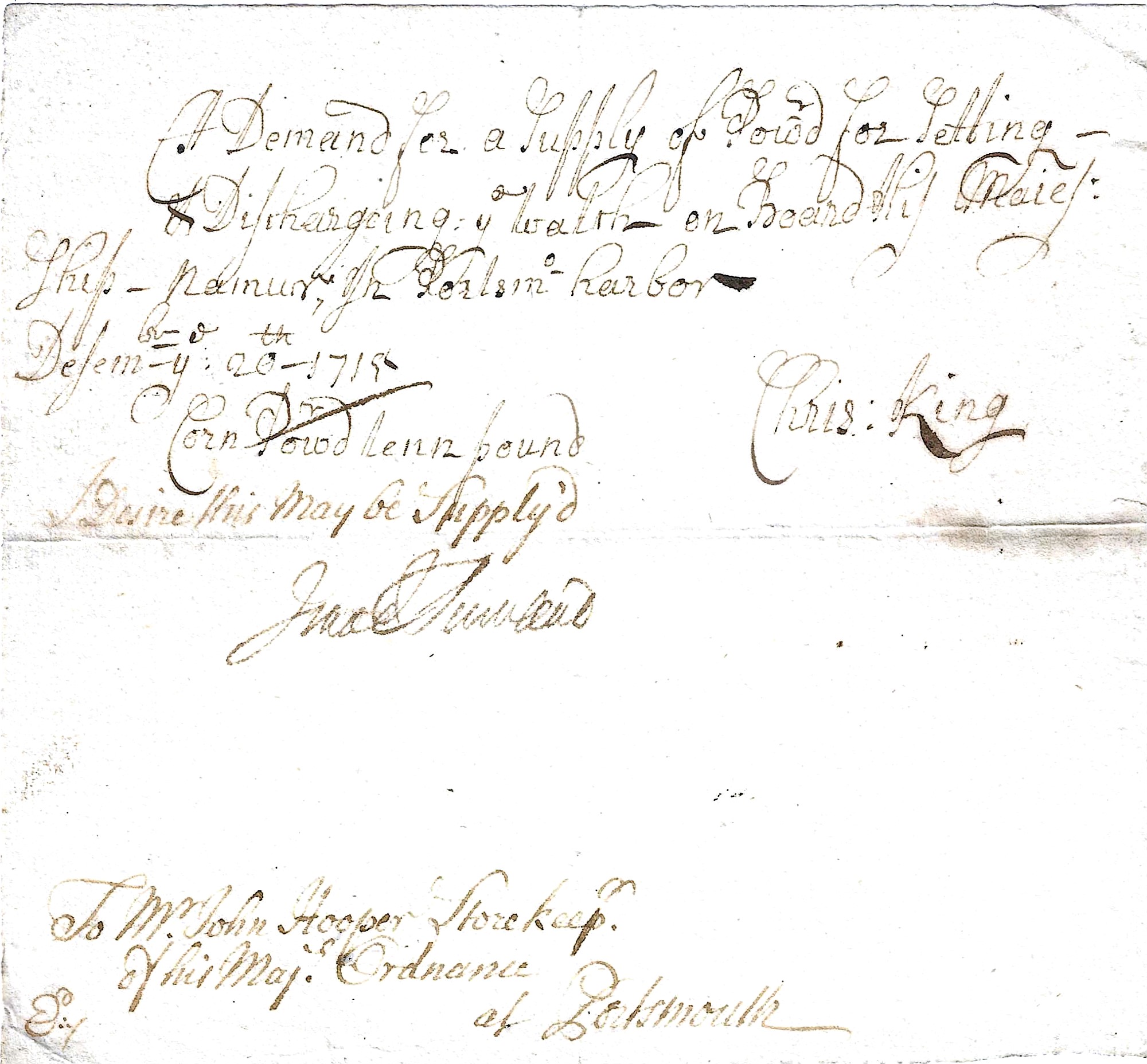
20th December 1719 a demand for powder for HMS Namure (1697) from Chris King and endorsed by Isaac Townsend.
View in new tab: