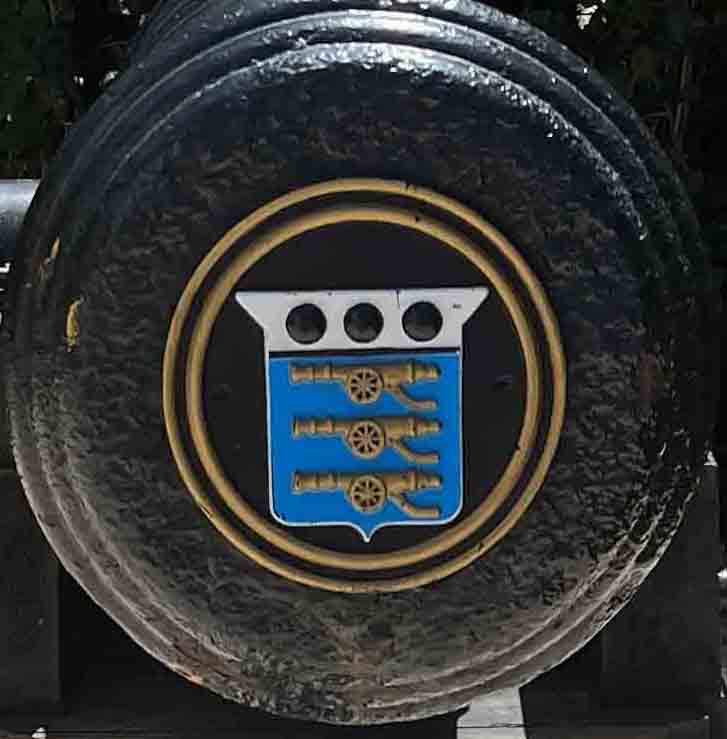
You will find download buttons for the scans and transcripts, or you can view them online by clicking the links where it says “View in new tab:”.
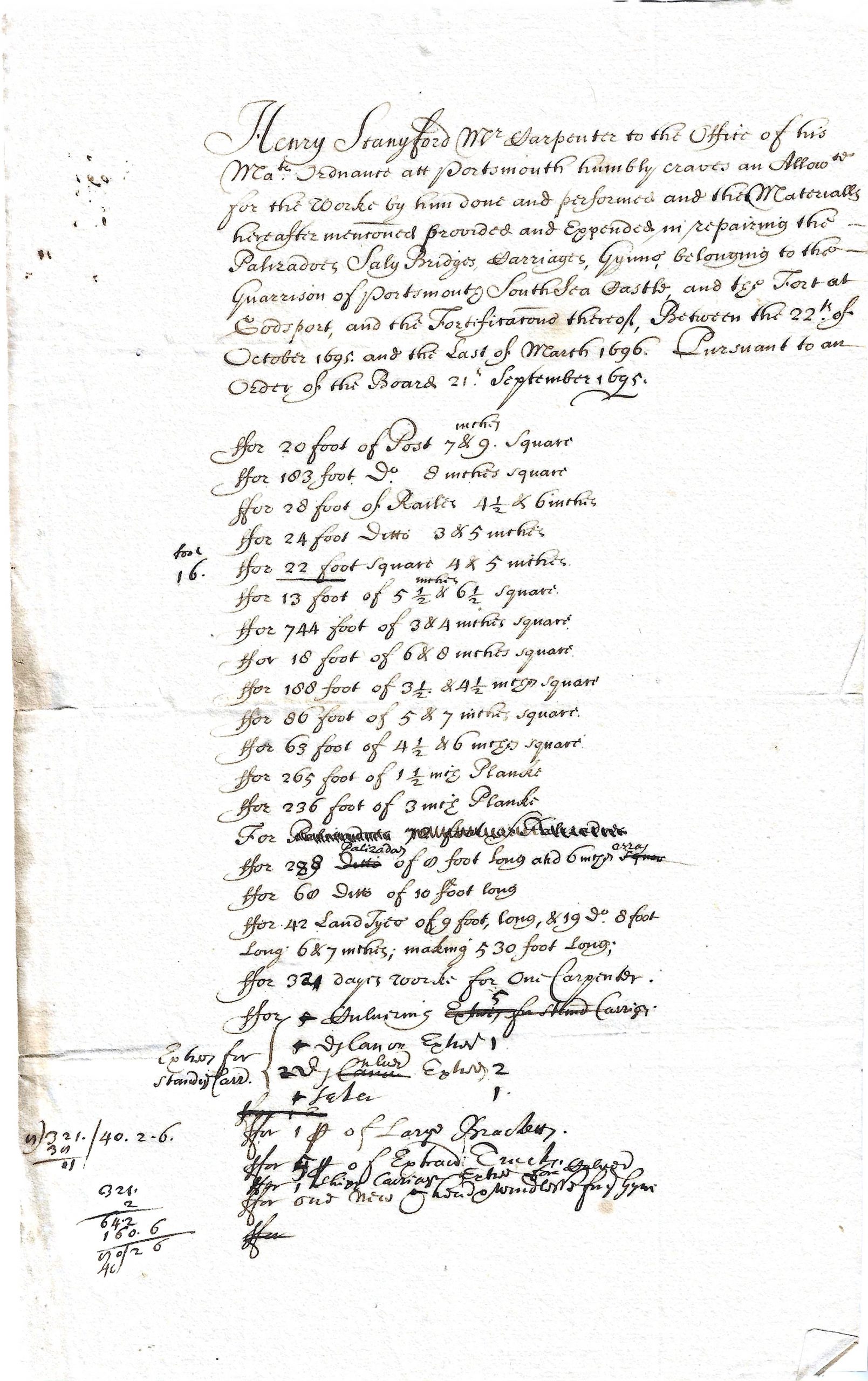
Our introduction to life in Portsmouth Dockyard in 1695 is from Henry Stanyford, Master Carpenter for the Office of the Ordnance, and captain of the militia formed out of the inhabitants of Portsmouth. A document that starts well written, but deteriorates toward the end, It is requesting an allowance for timber and the repair of the footbridges at Southsea Castle and ‘The Fort at Gosport’.
We are not told which fort at Gosport, but at the time it could have been Blockhouse, at the harbour entrance, or one of the two small square towers: Fort Charles, at the north east end of the High Street (Near to where The Castle Tavern now stands), or Fort James on Burrough Island (now also known locally as Rat Island), both forts are gone now, although there are remnants of Fort James on the island. In later documents we will witness the recycling of some materials from Fort James.
Note that, in this document, Gosport is spelt ‘Godsport’. There is often discussion as to the origin of the name, some say it was called Godsport and others Gooseport. Here we see a vote for the former.
View in new tab:
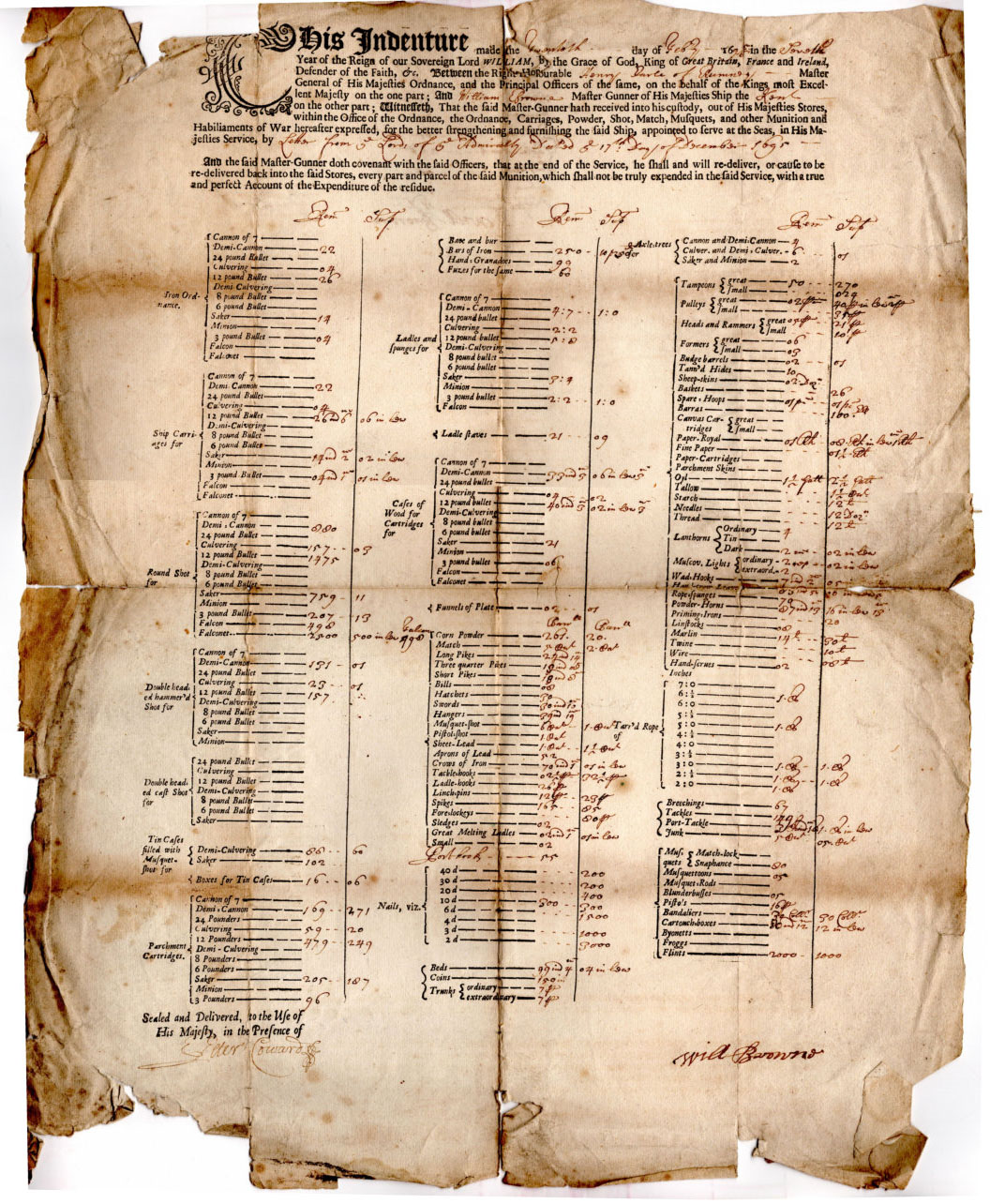
An Indenture is a legal document detailing an agreement between two parties. Often they will be in two parts, divided by a unique wavy cut such that the two parts of the document will only fit one another.
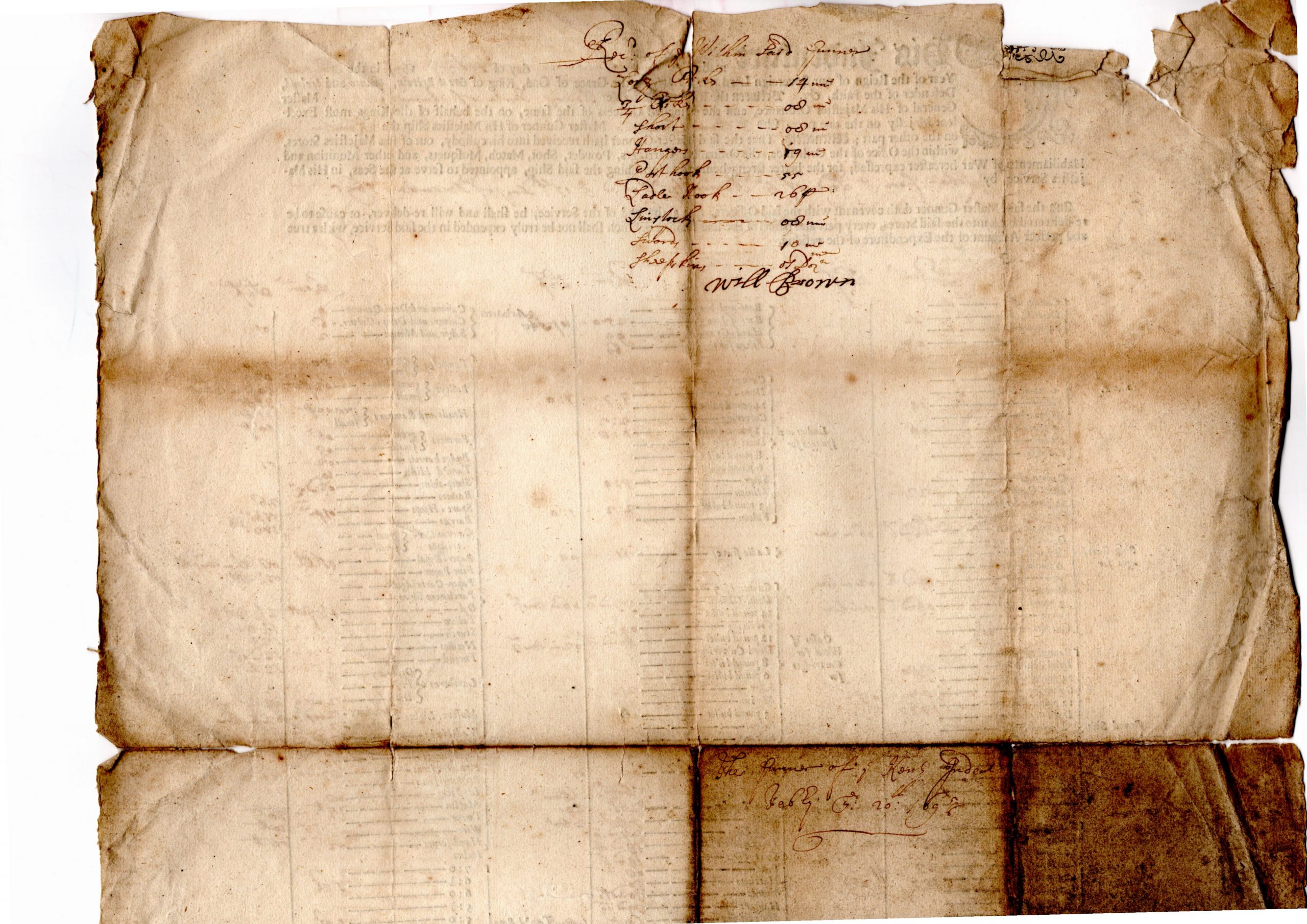
This indenture was for for HMS Kent (1679), a 70 gun, third rate ship which later went on to participate in battles at Barfleur, Cape Passaro, Vigo and Velez-Malaga. Initially looking relatively easy to read, it presents real issues in transcribing. The document, mostly printed, lists the ordnance stores carried by such a ship. The printed items are clearly written, but understanding their purpose is not so easy to determine. Who would imagine that ‘junk’ was old or waste rope used to make wadding for loading the great guns? This document is also our first sight of the many symbols used to describe weights and measures that are very difficult to define without the volume of information contained in the rest of these documents. You can make use of the Glossary’s Weights & Measures and the Items Terms and Abbreviations pages to help in understanding this document.
View in new tab:
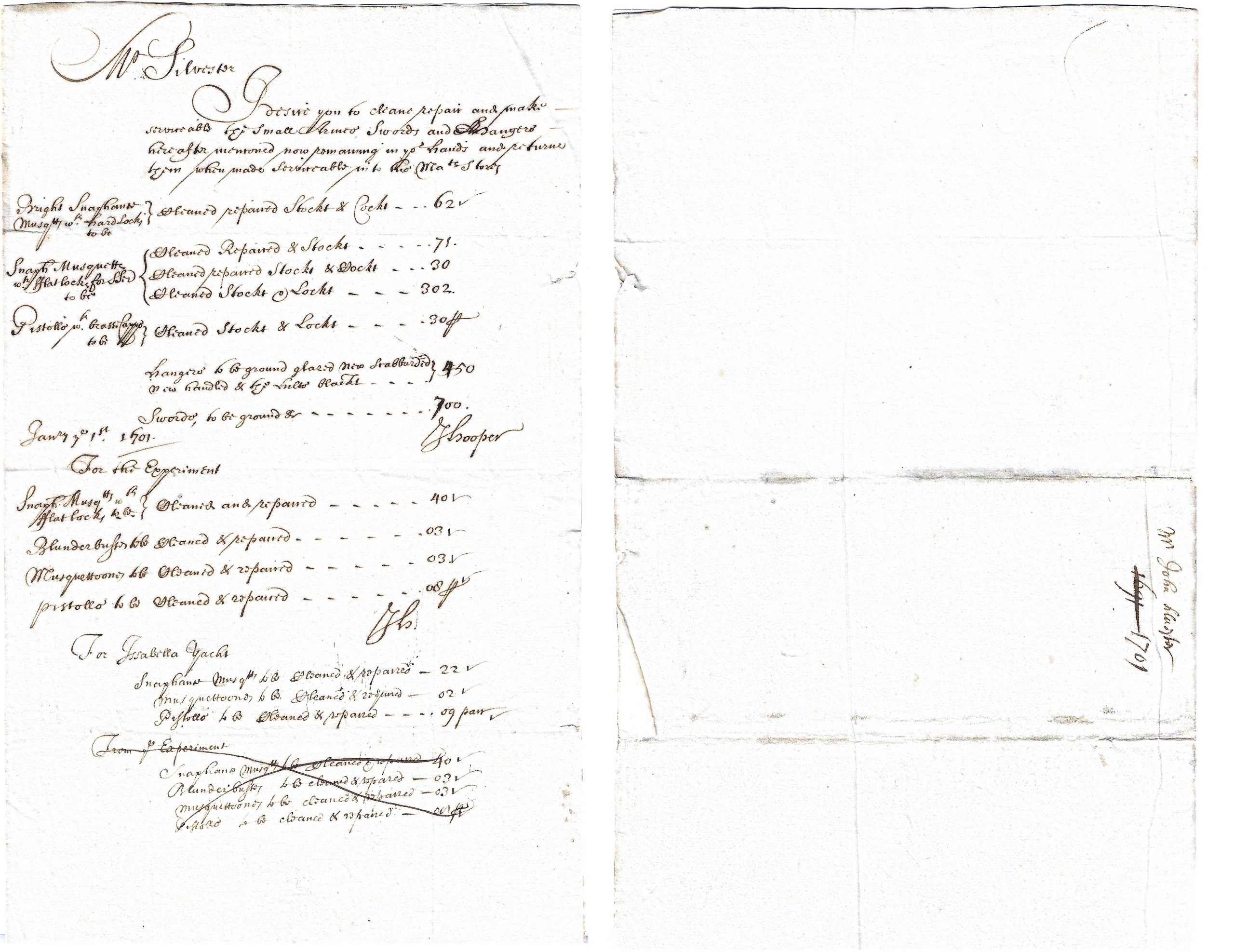
On 7th January 1701 we are introduced to two characters that will become familiar: Mr. John Hooper, the head storekeeper at Portsmouth, to whom the majority of the letters from ‘The Tower’ (Tower of London, headquarters of the Ordnance Board) are addressed, and Mr. John Silvester, the armourer. Here, Mr. Hooper, probably in his own hand, is asking the armourer to refurbish small arms to make them serviceable. Some are for specified vessels: HMS Experiment (1689) a 32 gun frigate, and for HM Yacht Isabella. From this we learn that the Navy were still using snaphance muskets (see the Glossary for a description) with two types of lock, and pistols with brass caps.
View in new tab:
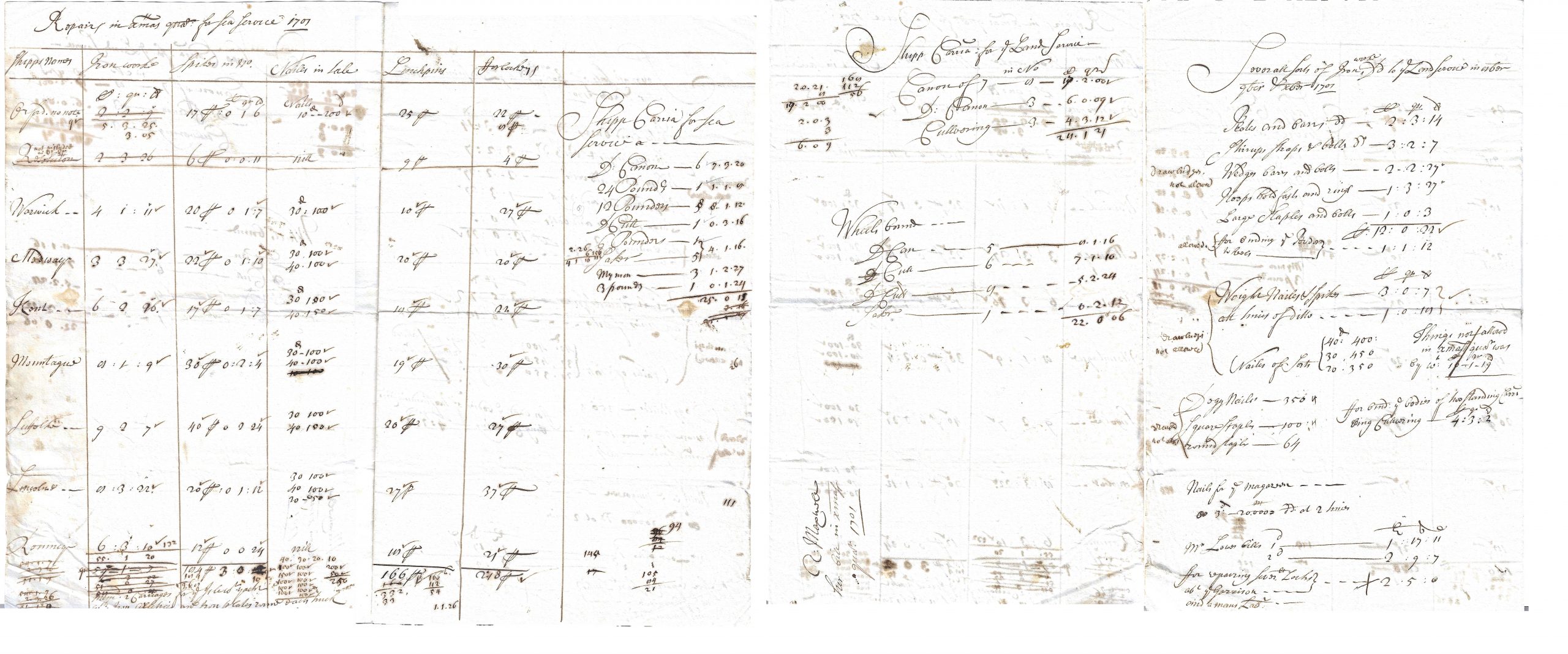
A quarterly account at the end of March 1701, from Henry Silvester, master blacksmith and presumably a relative of John Silvester, begins our appreciation of the finer parts of a gunner’s equipment: spikes, used to aim a gun, linchpins that hold the trucks (wheels) onto the axletrees, forelock keys that retained the capsquares which, in turn, retained the trunnions onto the carriage. We also see the term Poiz, in this case spelled ‘poys’, a term used to preclude a quantity by weight. In this case hundredweights, quarters, and pounds.

View in new tab:
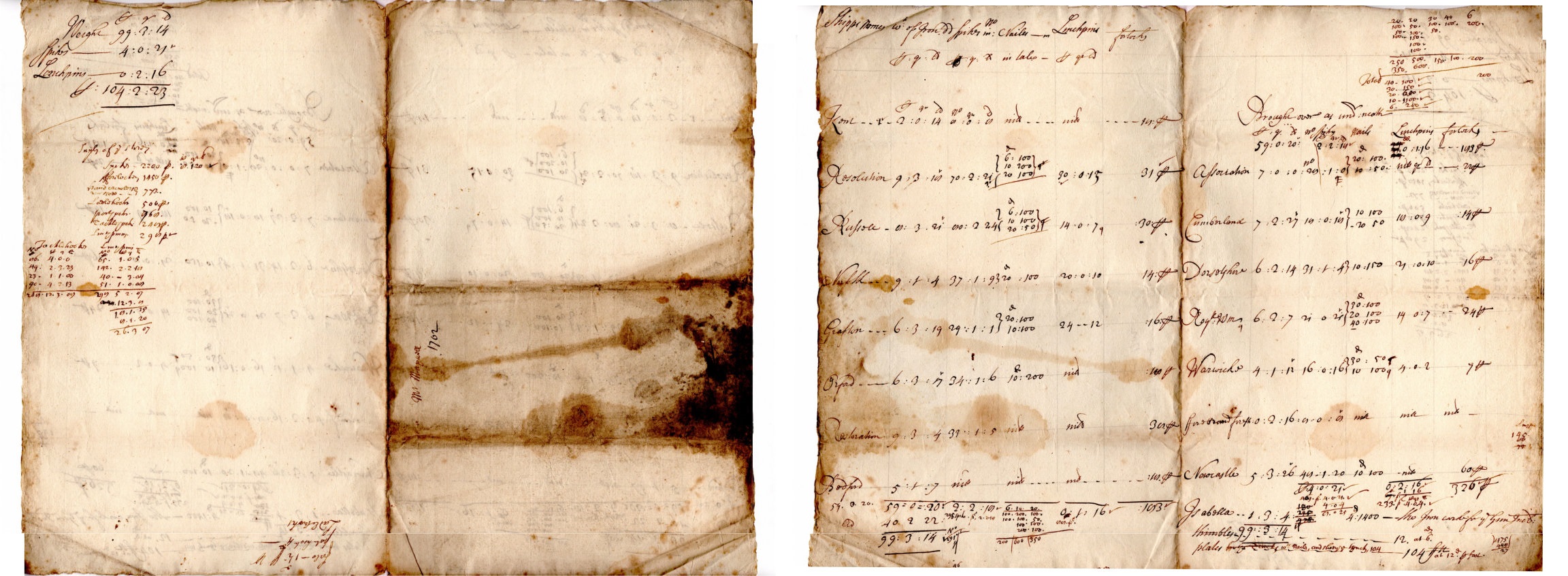
It is in the two bills submitted by Archibald Maxwell, another blacksmith, we start to appreciate the volume of work performed in the three months leading up to Christmas 1701 and in the next bill for a period in 1702. Numerous ships and tons of ironwork are listed along with the associated guns of varying sizes.
View in new tab:
In this bill Mr. Maxwell lists ironwork that would be found around the gun ports. Hooks for the port tackle (used to raise and lower the gun ports), Ladlehooks for hanging the ladles above the guns (ladles were used to unload a gun), Linchpins which held the trucks, or wheels on the axels of carriages. I am unsure what Handscrews were, if you know, please enlighten me.
View in new tab:
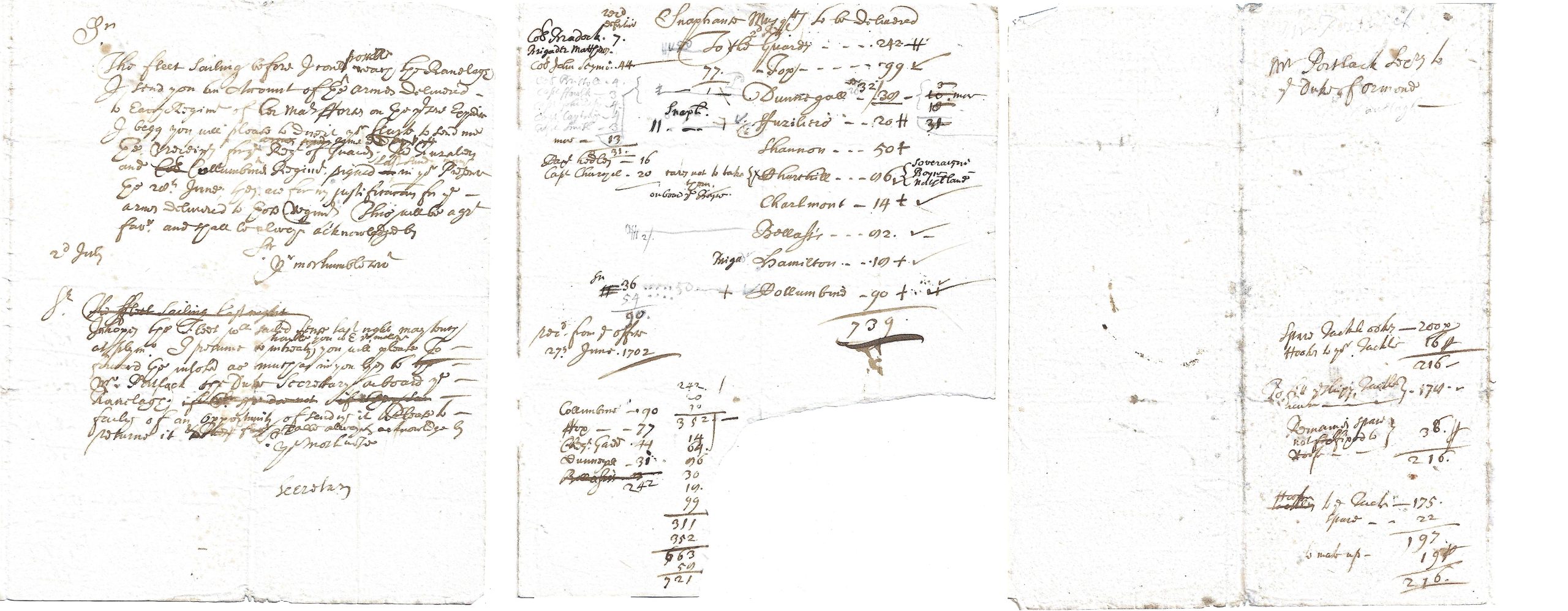
This document, transcribed by Philip Eley, is regarding the transportation of small arms for various army regiments. We can assume that this was in preparation for part of the War of Spanish Succession, and refers to a fleet sailing for Spain and The Battle of Vigo which was a great victory for the allied fleets.
View in new tab
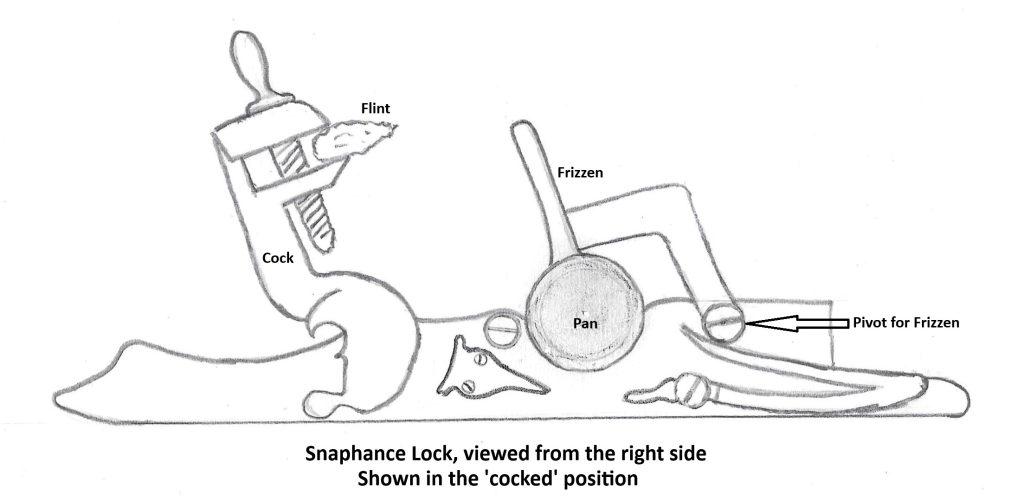
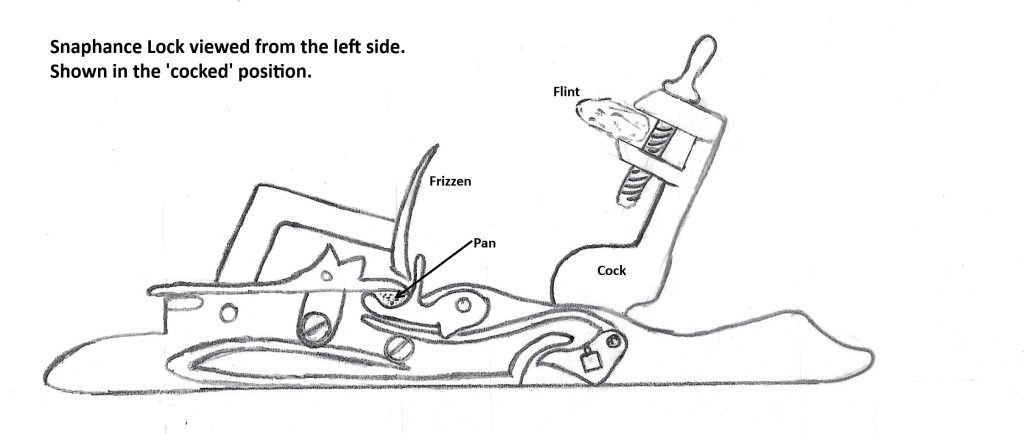
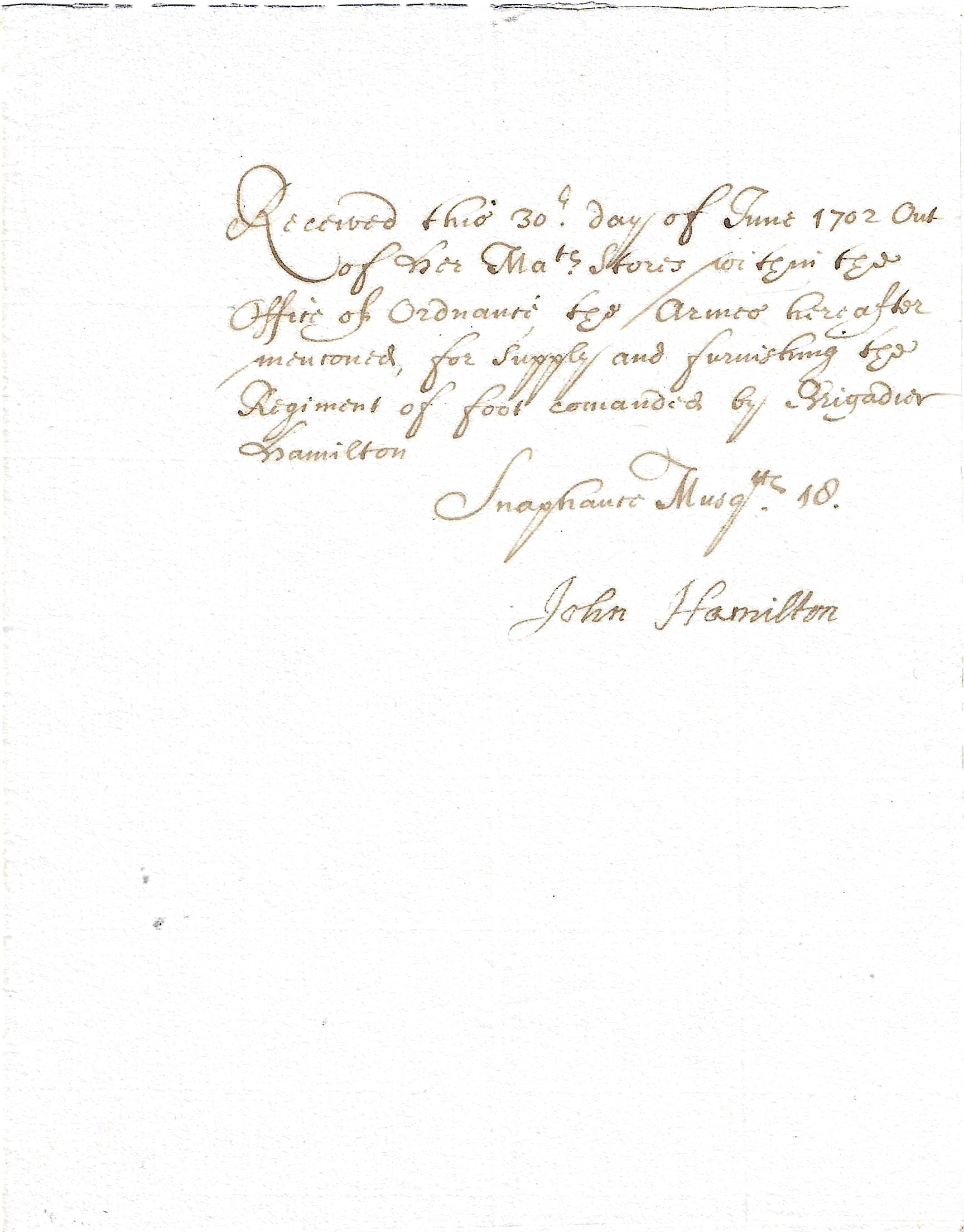
On June 30th, 1702, we see the first two of many notes from the army. Generally, these are simple notes, contrite and devoid of niceties. They request stores or acknowledge receipt thereof. Both appear to have been written by the same clerk, probably at the same time. These were for snaphance muskets. Snaphance refers to the type of lock which used a flint striking a steel plate to produce sparks to ignite the priming powder.
View in new tab:
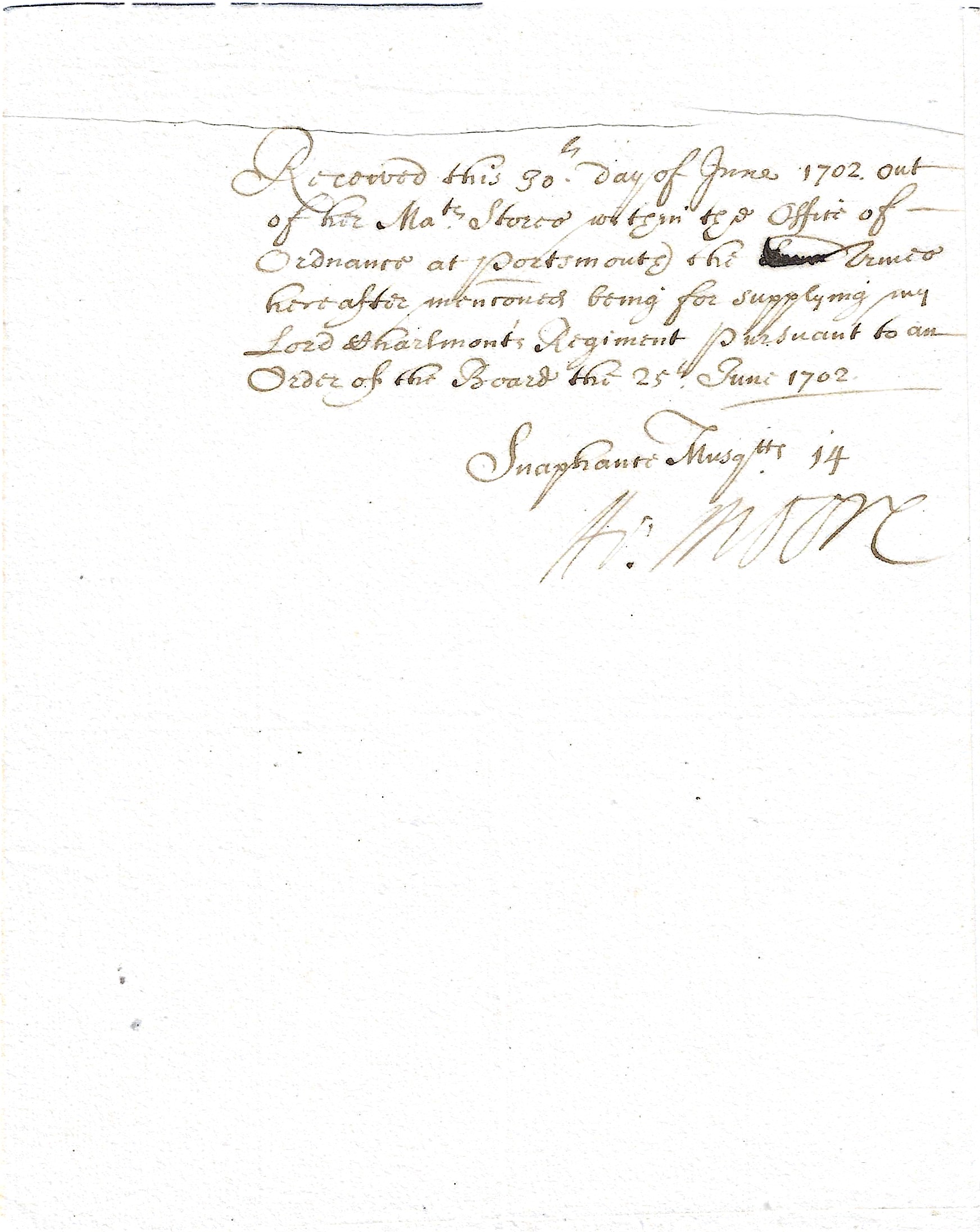
On June 30th 1702 a receipt from H Moore of Lord Charlmont’s regiment for 14 Snaphance muskets.
View in new tab:
The first note on 1st July 1702 refers to firelock muskets which used smouldering slow match instead of a flint. Eighteen Snaphance muskets were also received, these were an early version of flintlock muskets, look in the Glossary for more information.
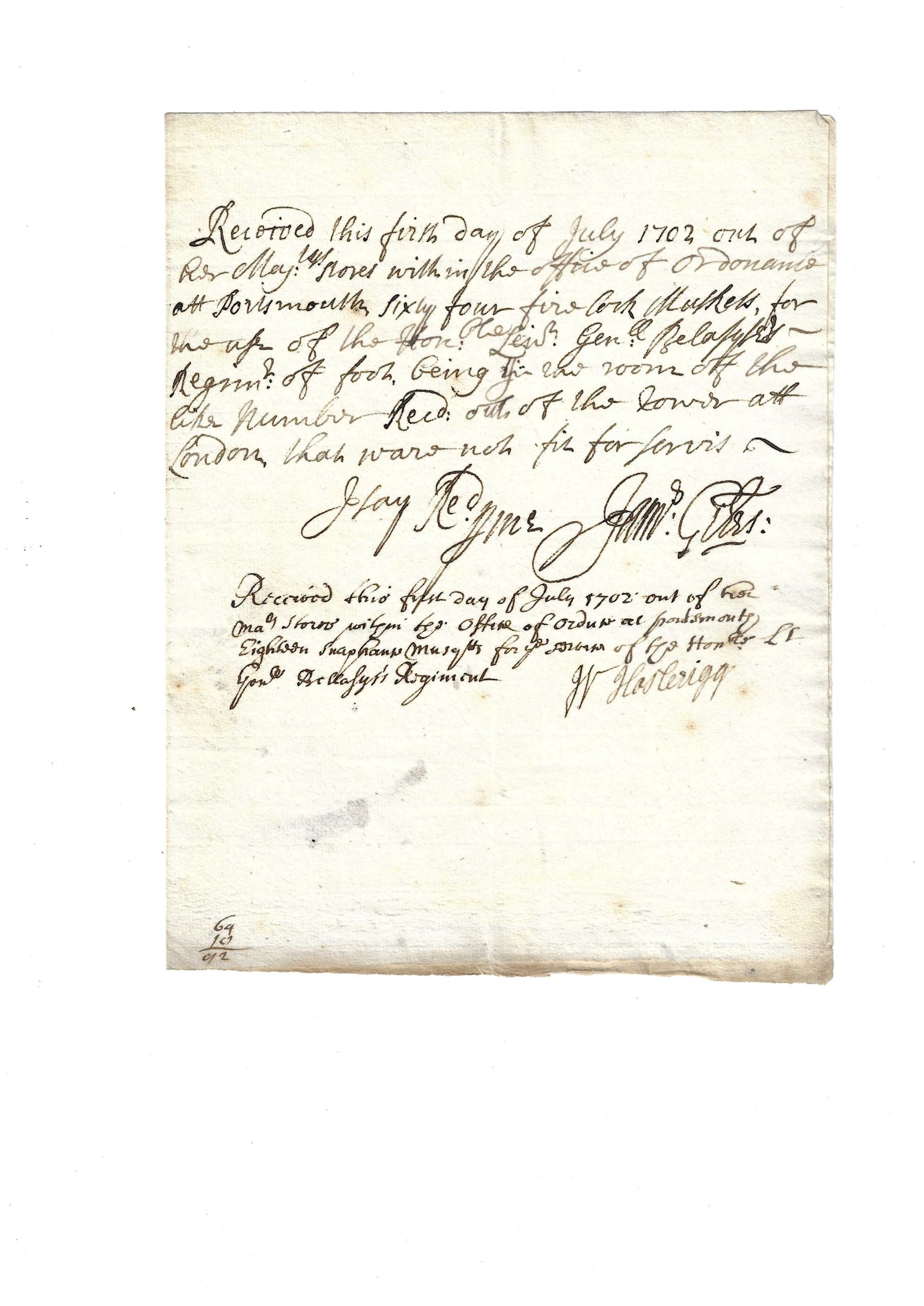
View in new tab:
The second document on 1st July 1702 is for the receipt of more snaphance muskets.
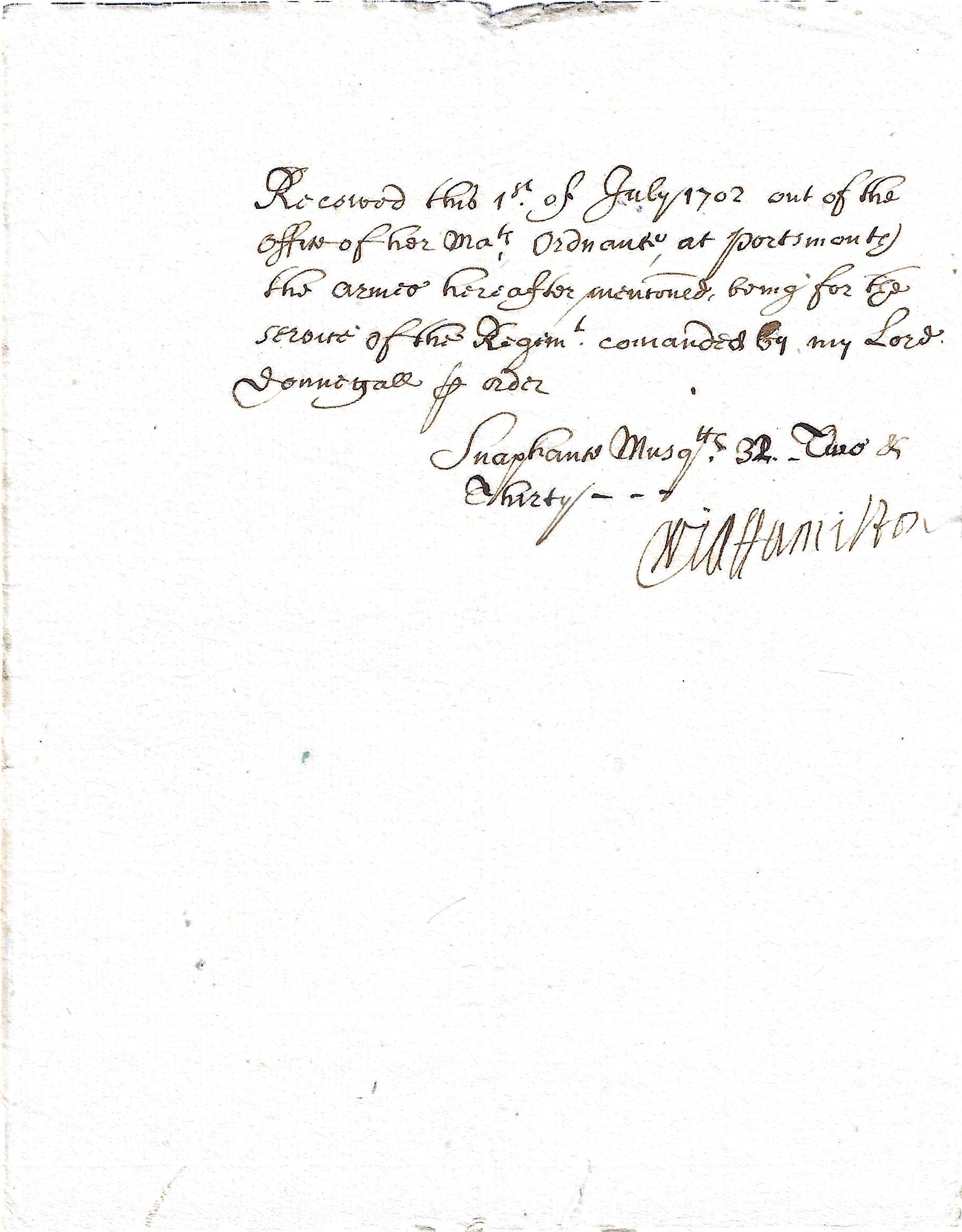
View in new tab
This document, transcribed by Philip Eley, starts by listing returned small arms from Lt. General Churchill’s regiments and then goes on to discuss new gun carriages to be supplied to Southampton town. The poor quality of the document is a symptom of using fine paper rather than paper royal: cartridge paper.
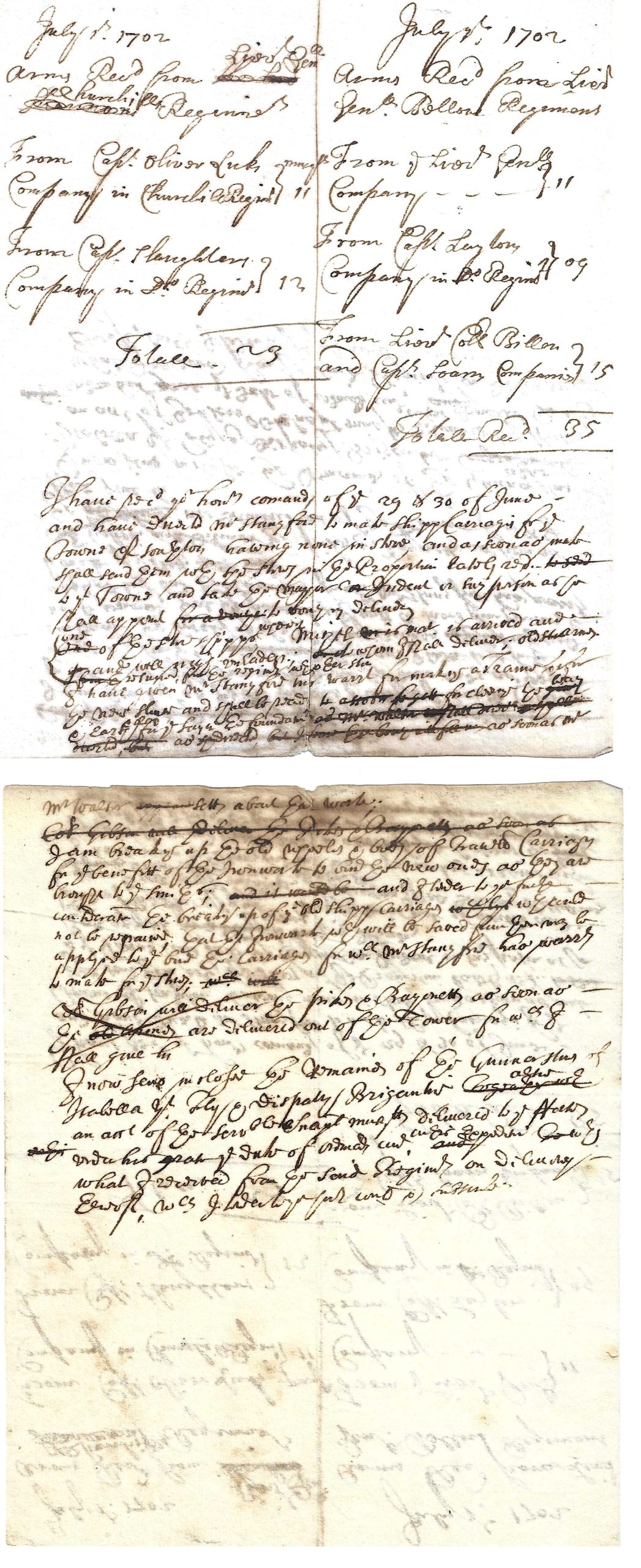
View in new tab
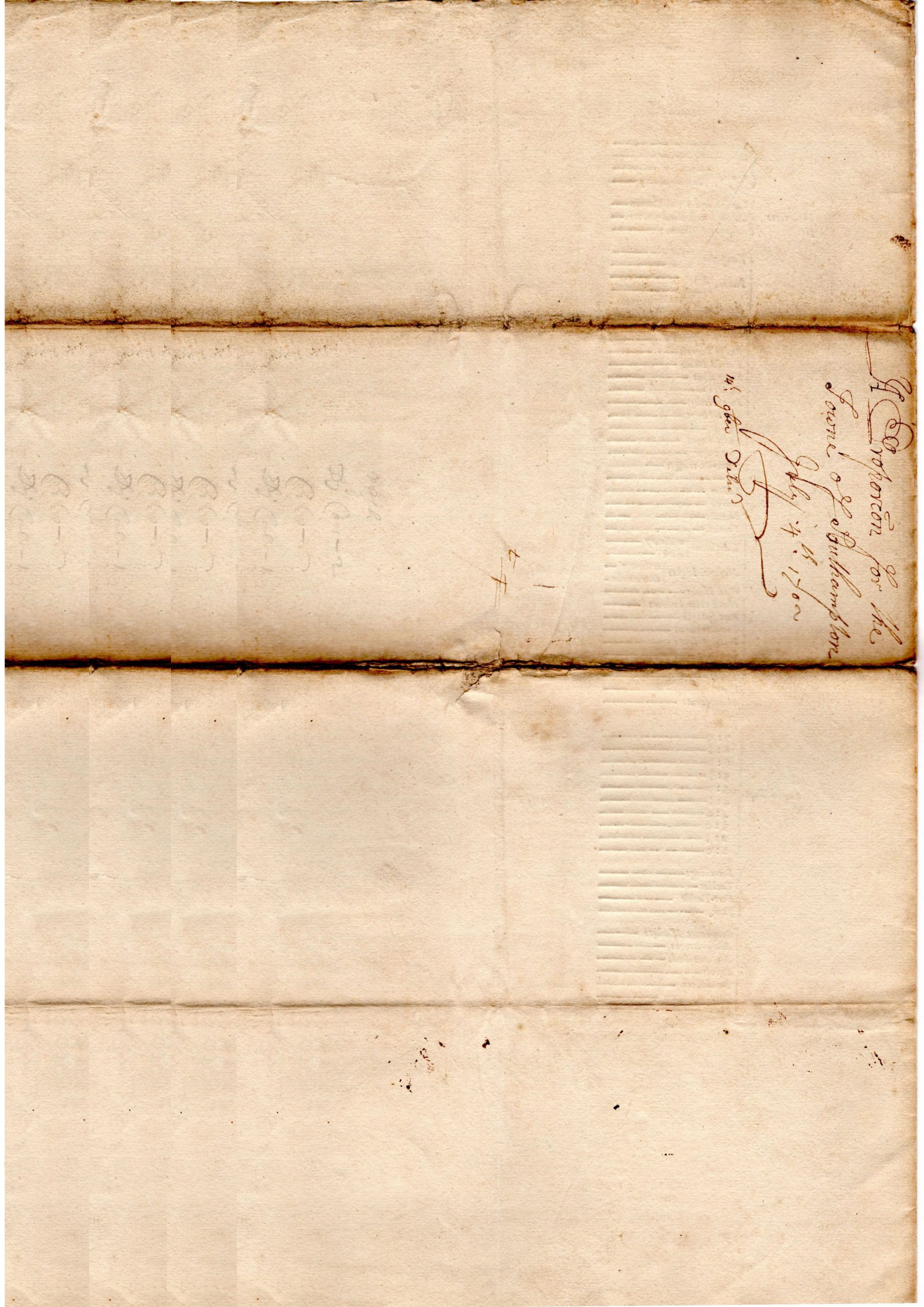
The ‘Proportion of Ordnance’ document of 2nd July 1702 gives an item-by-item list of ordnance for Southampton town. It starts with the ‘Iron Ordnance’ (guns). It lists both the remaining stores, and those supplied. At the top of the list, we see ‘Rem/Sup’ each word having a strike above it. This strike indicates that it is a contraction, so we are looking at ‘Remains’ and ‘Supplied’. When we get to the first entry for Culvering – ‘1’ we see another contraction above which is either ‘CrSs’ or, more likely ‘C&Ss’, the jury is still out on what this means. Notice also that where a double ‘S’ appears, the first is written as a capital with a serif, and the second is in lower case. This is almost invariably the case.
The list of guns begins with the largest, Cannon of 7, and works down in size to Falcon. It then goes on to list the accompanying stores: shot, carriage parts (beds, coins, trucks) notice the elaborate ‘P’ a contraction for ‘pair’, for pairs of trucks, ordinary and extraordinary. Heads and rammers also come in pairs. Going down the list we see paper royal (cartridge paper) is measured in quires and that starch, marlin, twine and wire are measured in pounds with the ‘L’ struck through symbol.
Carriage wheels were referred to as ordinary, for the rear of the carriage, and extraordinary for the front. This ensured that the carriage remained level on the curved deck of a ship.
The document is endorsed by: Hyram Mes, James Lowther (1673 –1755), Christopher Musgrave (1664–1718) and William Bousher. These officials were based at the Tower of London and represented The Board of Ordnance.
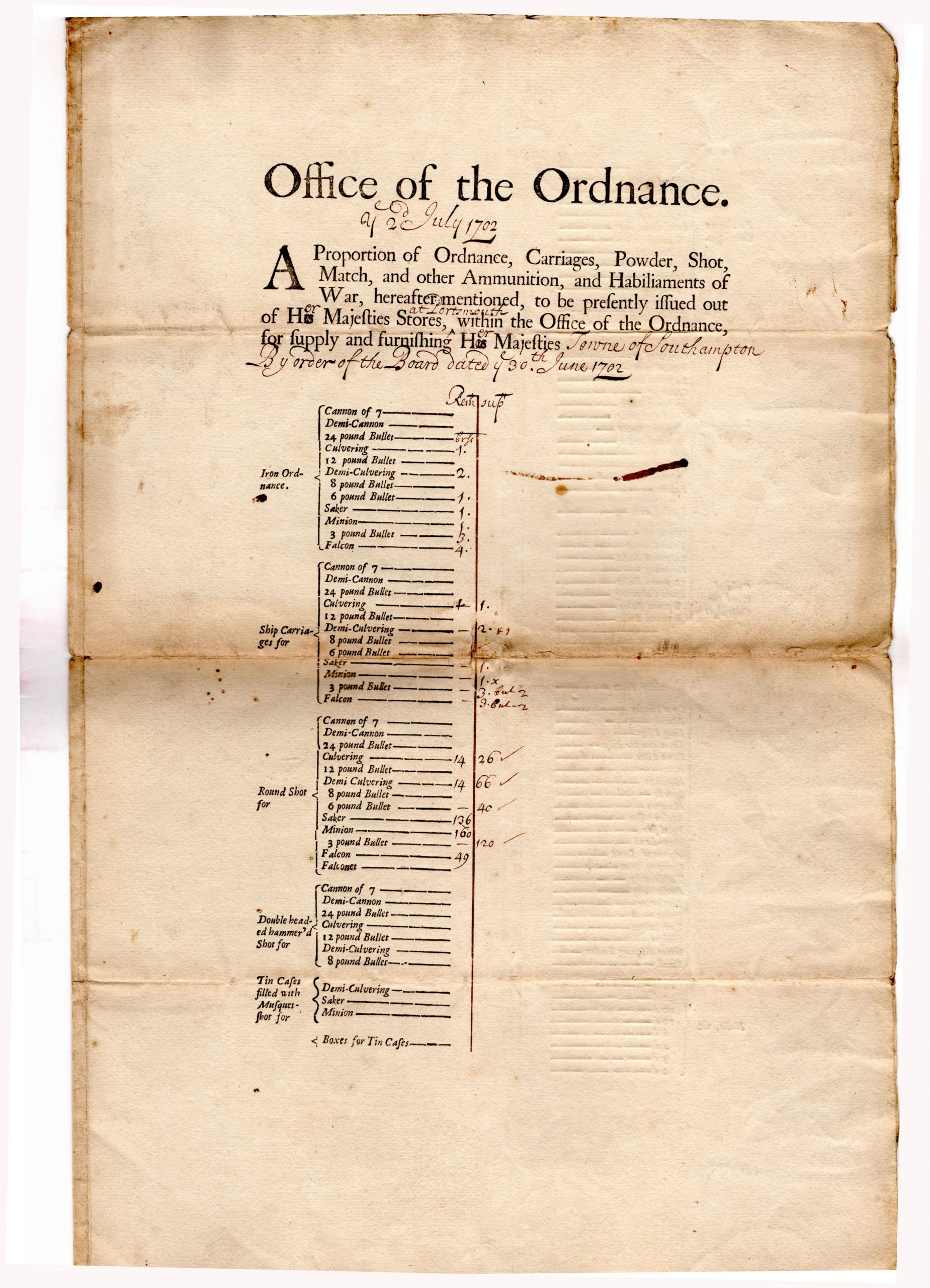
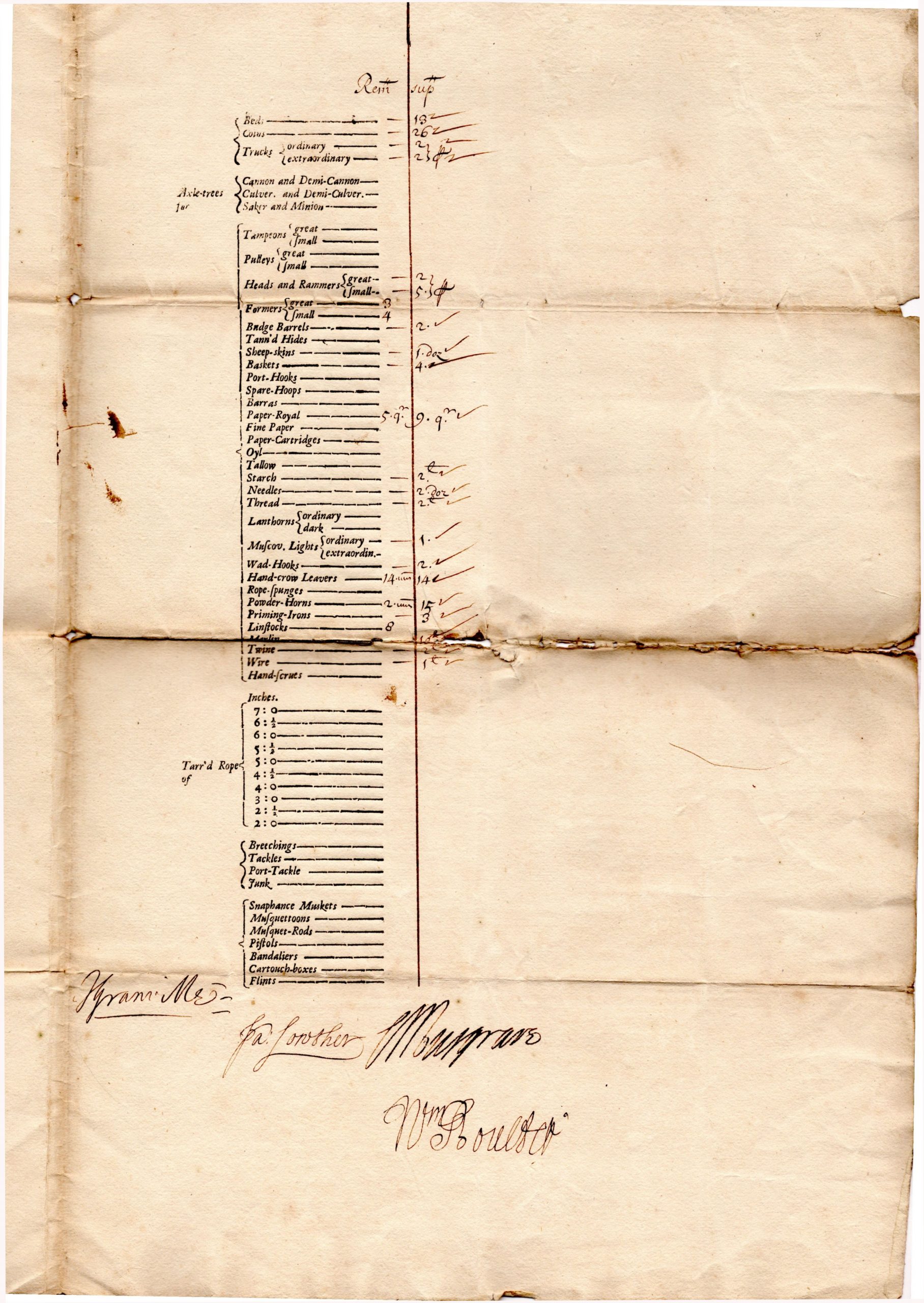
View in new tab:
Henry Stanyford’s carpentry bill of 31st July 1702 is for the building of a new ‘flower’ at the magazine. Given the amount and type of timber, I am guessing that he is referring to a new floor. This would have been at The Square Tower (built in 1494) which remained the powder magazine until the 1770s when a new magazine was built at Priddy’s Hard in Gosport.
This bill gives us an insight into the cost of timber, and we can calculate that a carpenter was paid about 2/10 (2 shillings and 10 pence, or almost 15p) per day.
For those not familiar with pounds, shillings and pence: Four farthings made one penny, twelve pennies made one shilling, twenty shillings made one pound, twenty one shillings made one guinea.
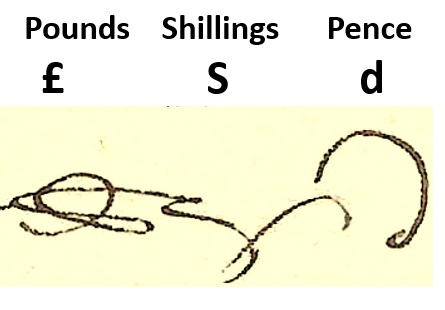
Oh, and yes, his figures do add up correctly.
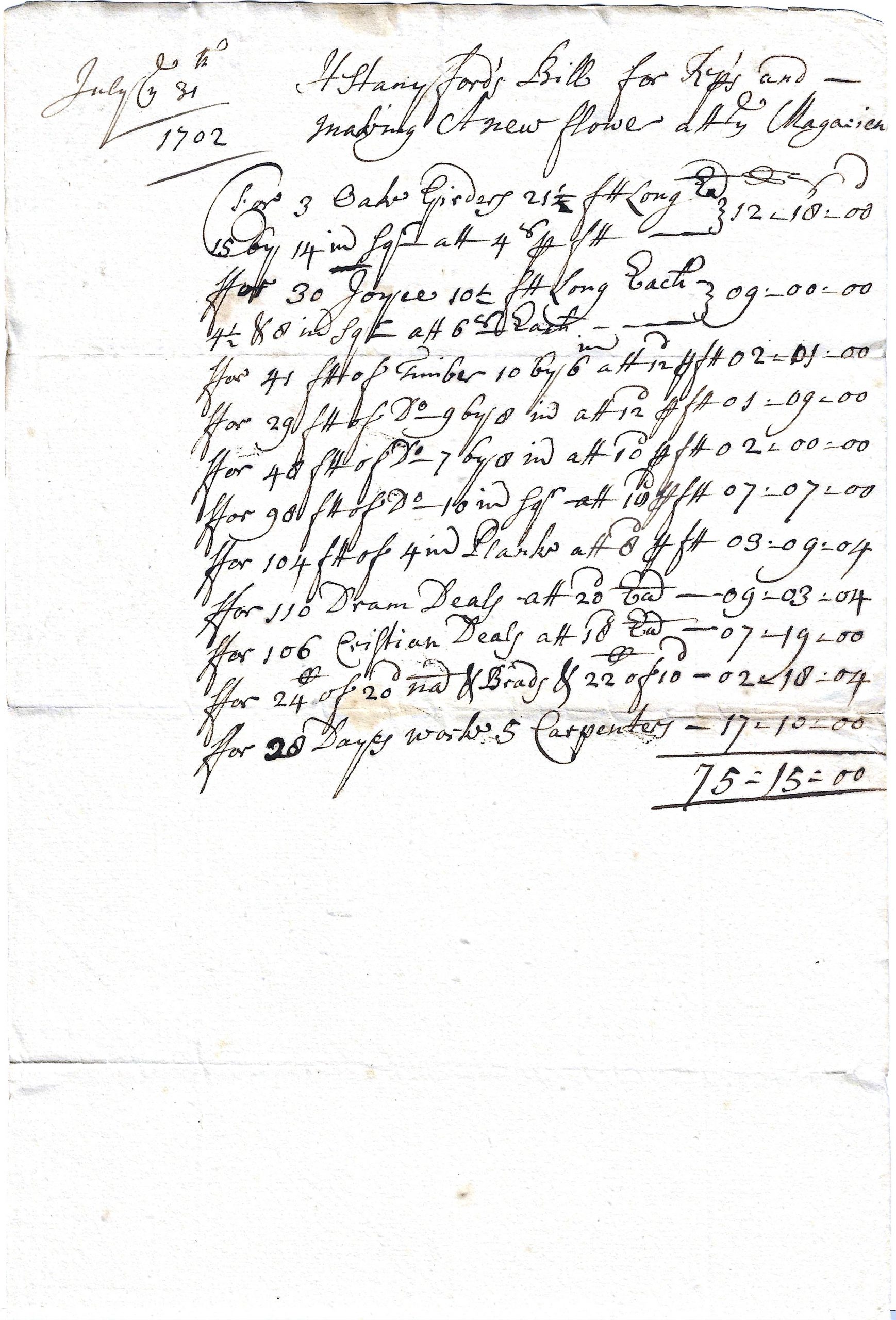
View in new tab:
A year later, in July of 1703 we see that two prize ships from the battle of Vigo Bay in Spain are to be resupplied. This battle was a huge success for the Royal Navy. HMS Assurance Prize was formerly the French ship Assuré, a 66-gun third-rate ship of the line, built in 1697, captured in 1702 and broken up in 1712, and HMS Moderate, previously French Fourth Rate 64 gun ship of the line ‘Le Modéré’ (1685).
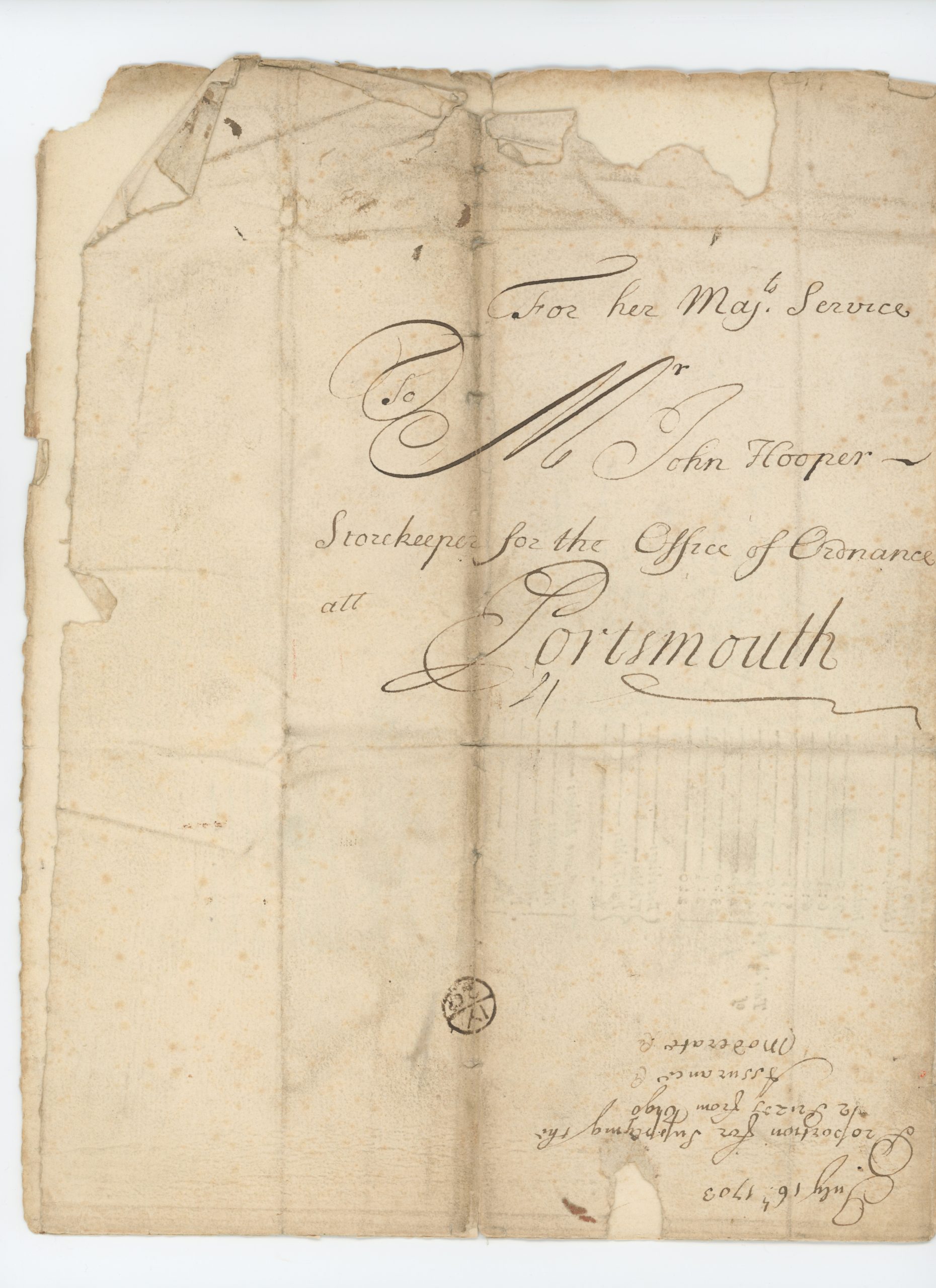
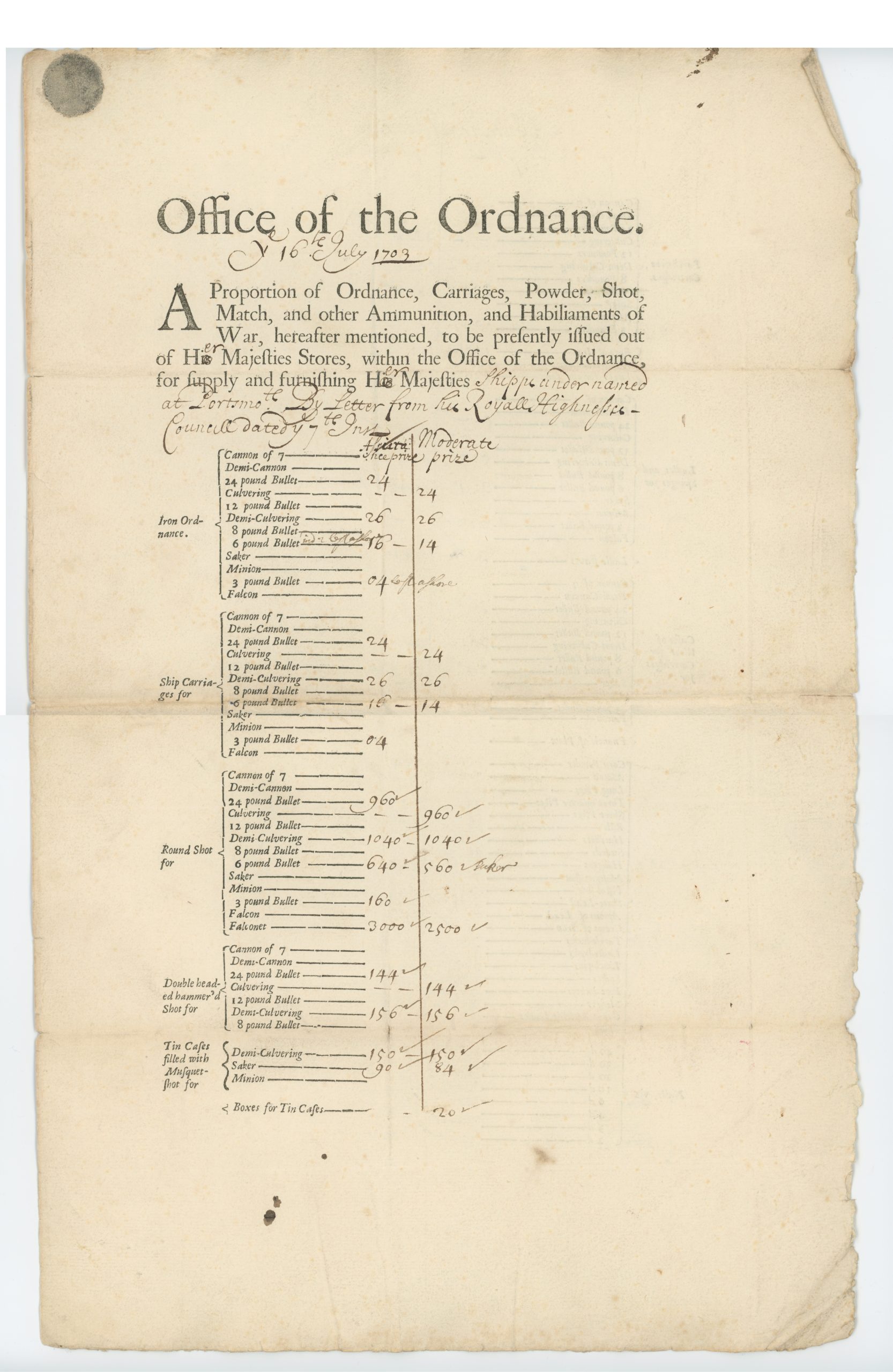
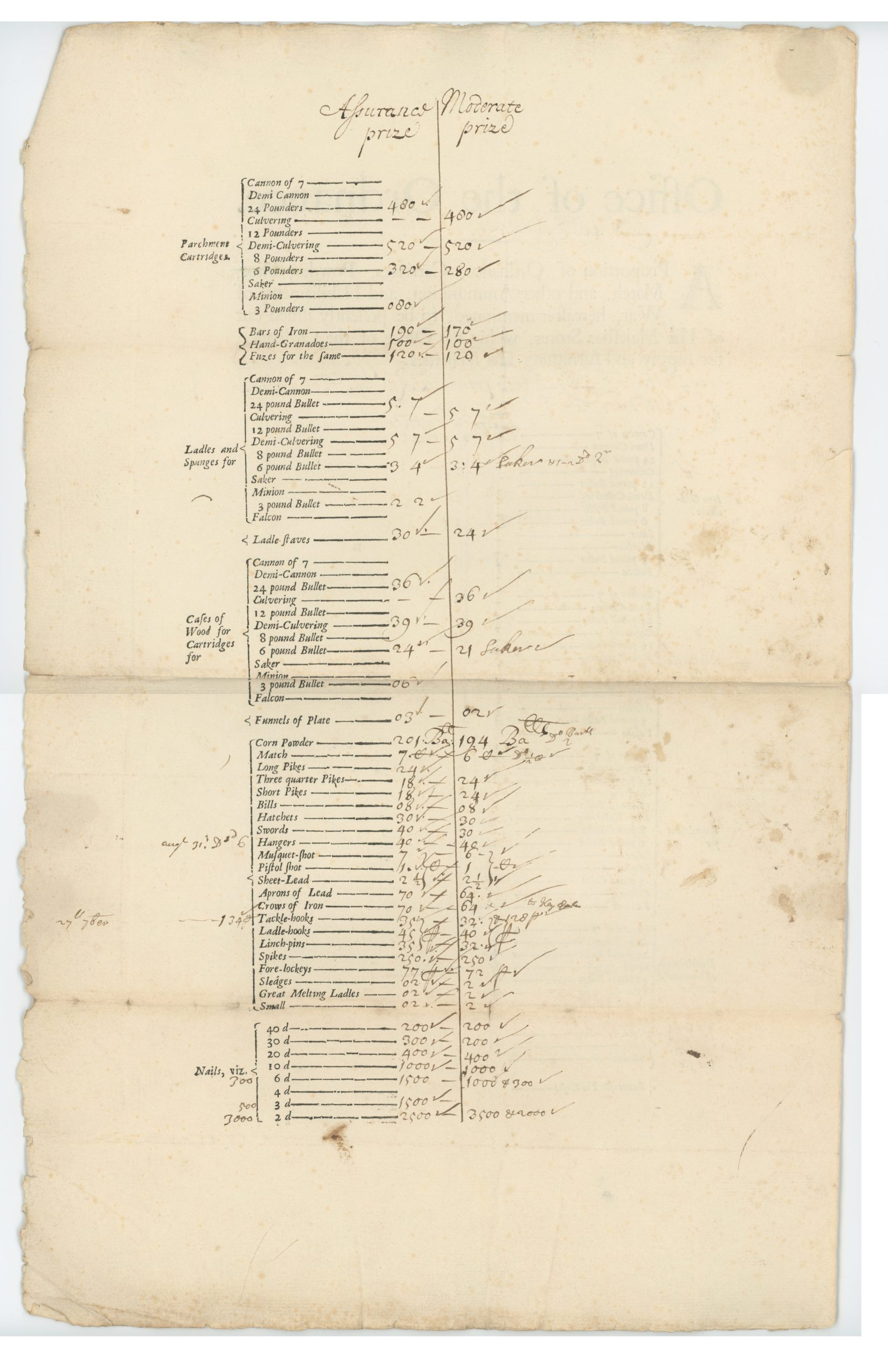

View in new tab:
View in new tab:
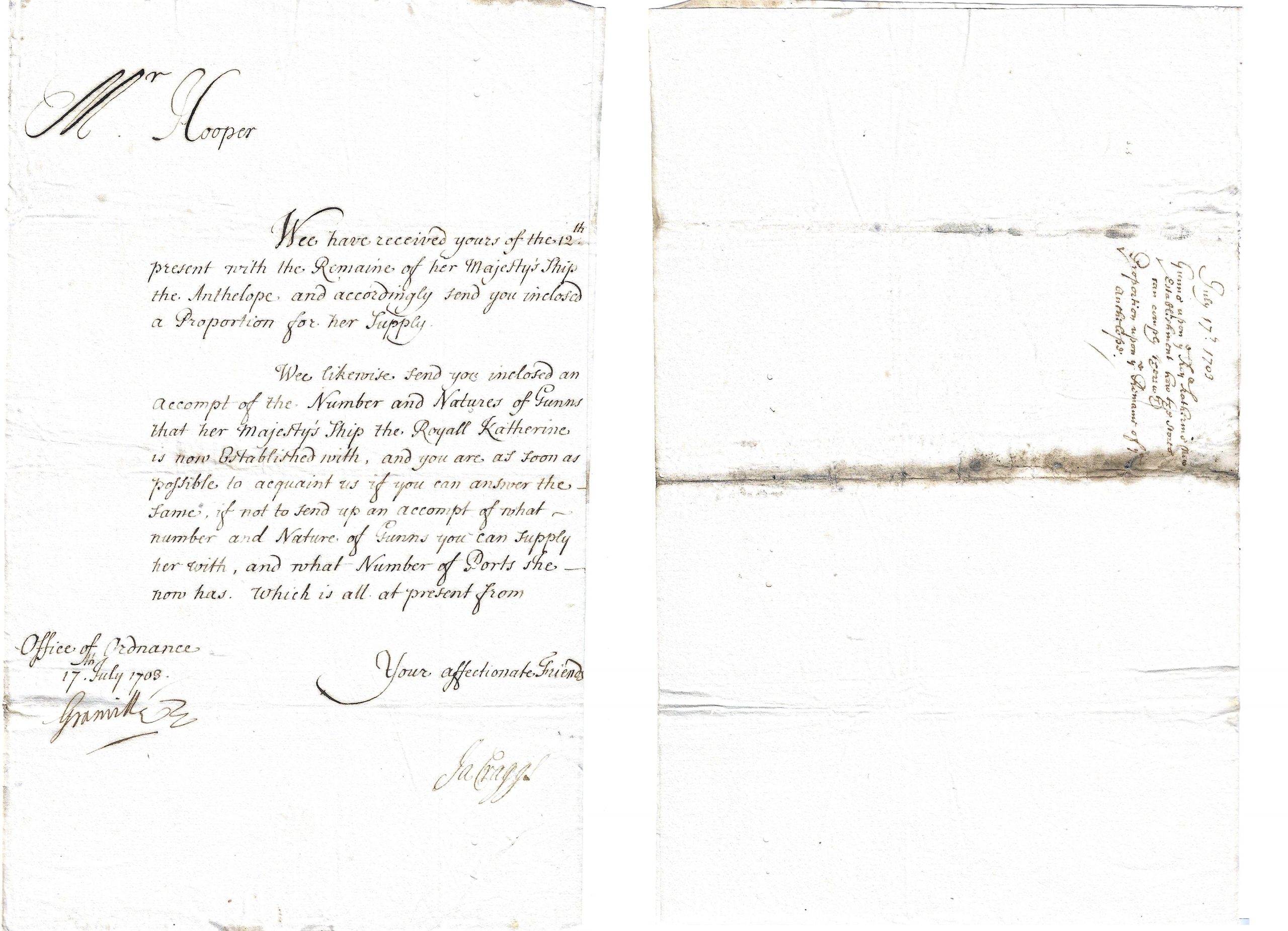
A beautifully scripted letter from The Tower, signed by James Craggs (1657-1721), an intermediary of John Churchill, Duke of Marlborough (1650 – 1722), acknowledges receipt of remains from HMS Antelope (1703), and enquires on the ability of Portsmouth to supply the Royal Katherine, an 84-gun ship, with guns. It also asks how many gun ports Royal Katherine now has; I find it amusing that the board do not know already.
Curiously this one has no sign of having been sealed, no address, or Bishop mark, yet it does have a precis an. However it does refer to an enclosure of a proportion for the supply of Antelope, so presumably the proportion document, being much larger than a letter, would have included this as an enclosure and so had the address, bishop mark, and was sealed. One might think that the use of ‘inclosed’ for enclosed was a spelling mistake, and today it would be, but at the time this was perfectly acceptable.
View in new tab:
The receipt for powder from John Rolloe, 20th December 1703, master Gunner of HMS Defiance is in stark contrast to the previous letter. Written on fine paper, faded, and difficult to read, it acknowledges receipt of unusable corn powder (coarse gunpowder used for the charging of guns of making cartridges).
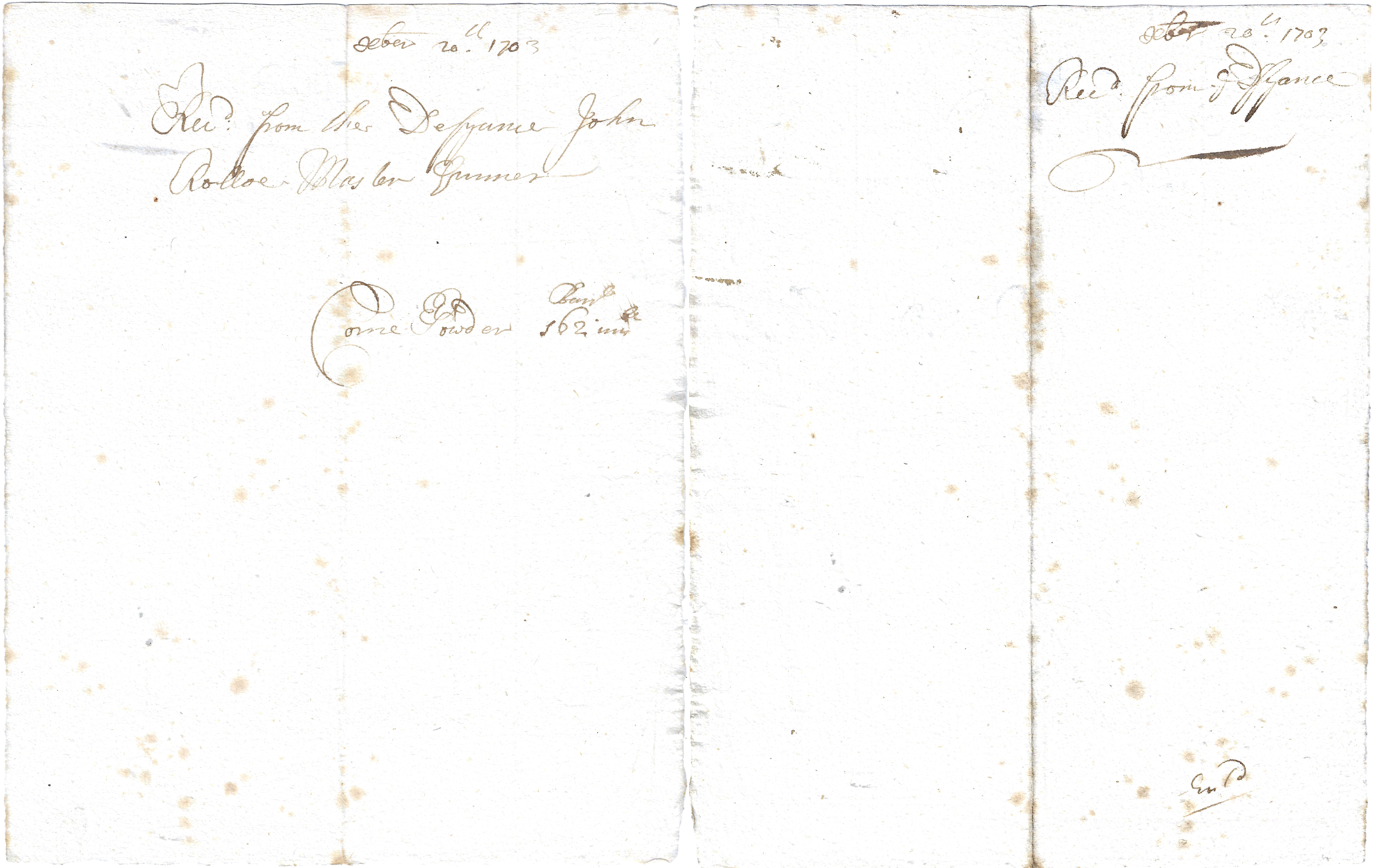
View in new tab:
The next document, a request from John Hooper, written in his own hand, asking John Silvester to repair small arms, has no date, but, looking at the history of the ships named, it was likely to have been some time in 1704.
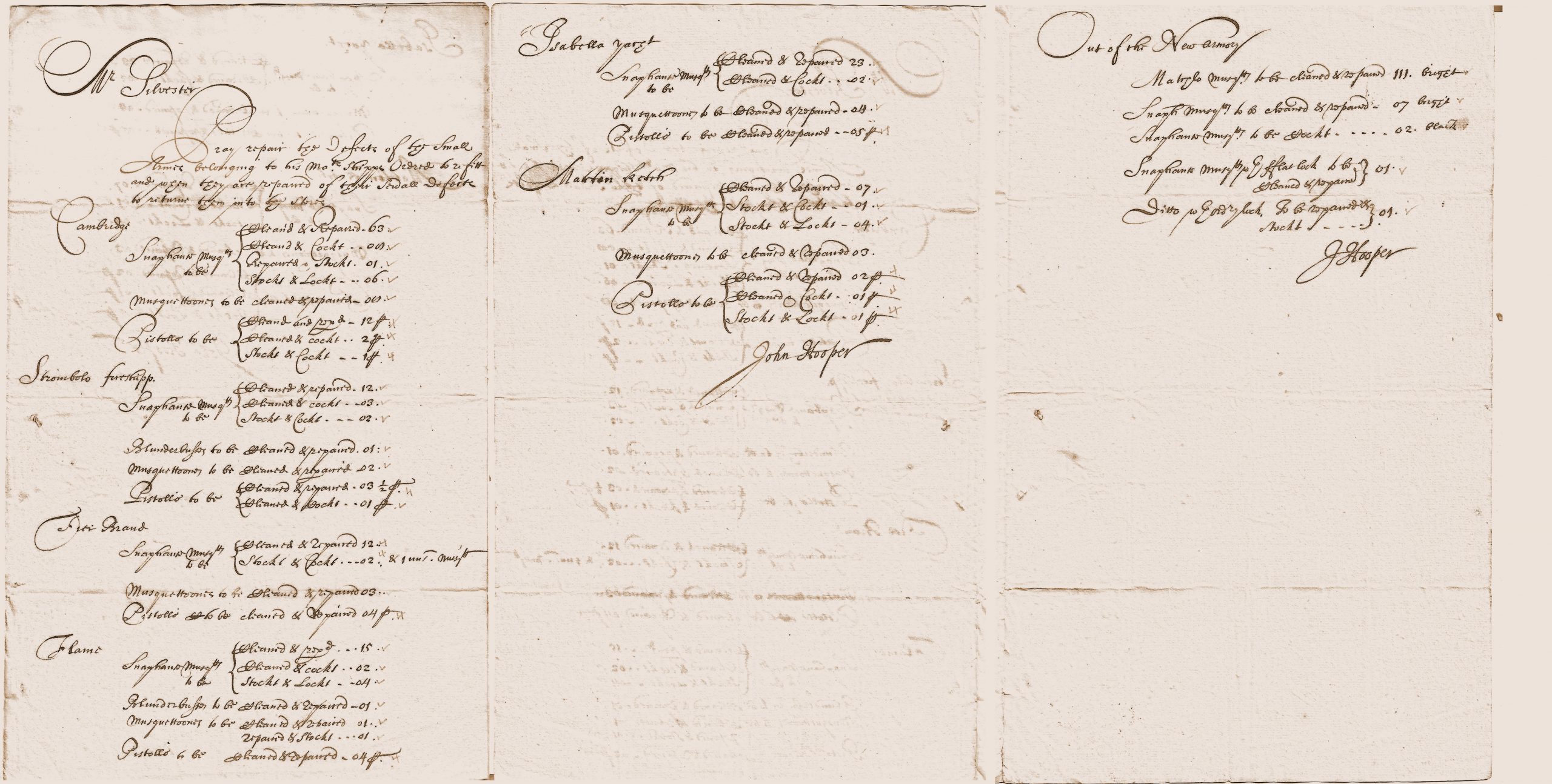
View in new tab:
This document is in two parts. Firstly, endorsed by Mr. Hooper himself, stating that 63 muskets were received in February 1704. Secondly, it states that the guns were returned in July 1704.
Notice that the date for 24th February is written as 1703/4. This is because two calendars were in use at the time: the Julian, and the Gregorian that we use now. In the Julian Calendar, the year began on Lady Day (March 25th) and so, in this example, it would have been 1703 until March 24th. This confusion was resolved by the Calendar (New Style) Act 1750. My thanks to Fraser who pointed this out in the ‘Discussion’ page.
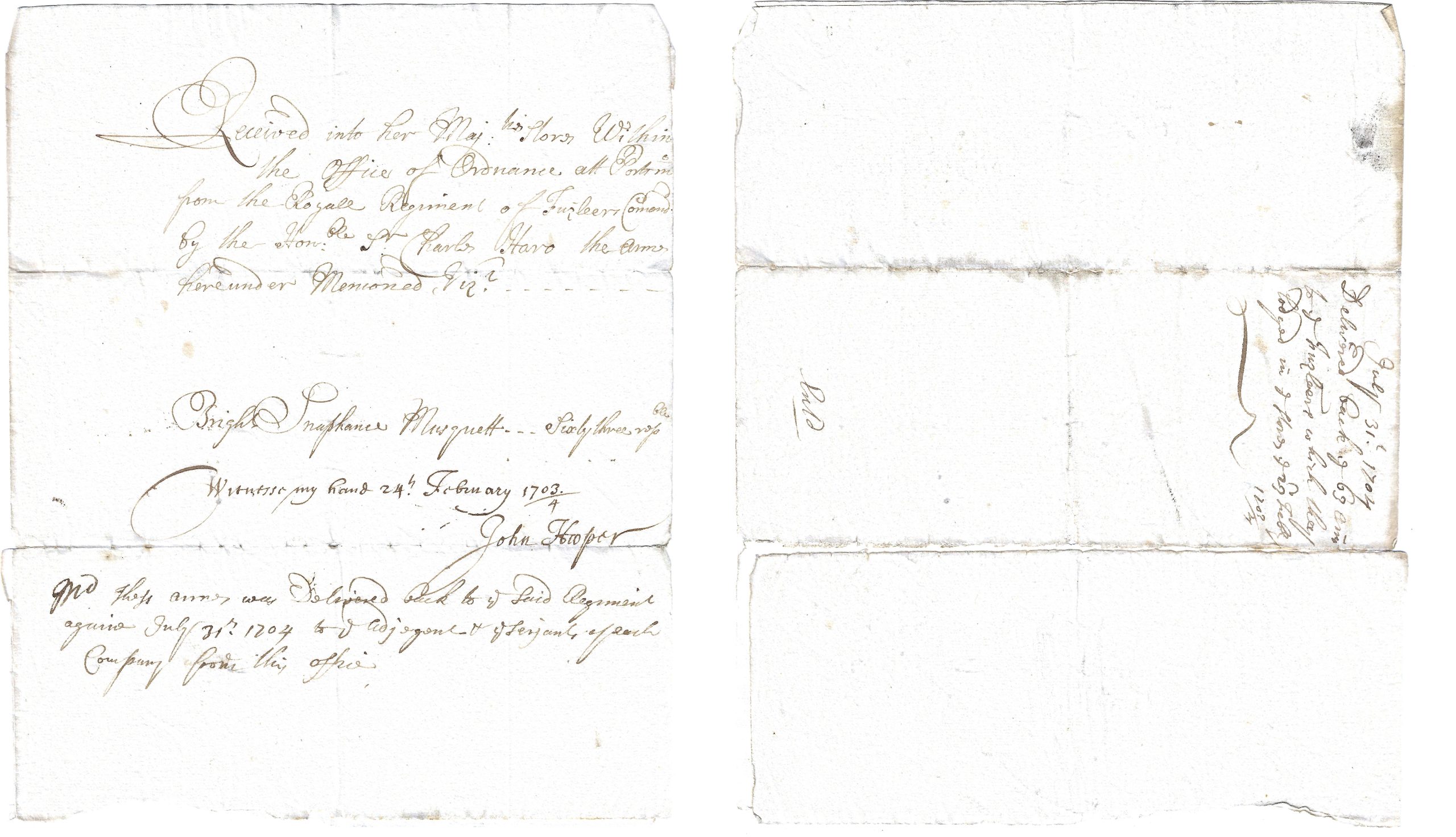
View in new tab:
This note, acknowledging receipt of muscovy lights appears to have been written & signed by Peter Coward. The word ‘muscovy’ has been contracted to Musco–‘. Muscovy lights, as opposed to Lanthorns, used mica as the transparent medium instead of horn. Horn would distort with the heat from the flame, whereas mica did not.
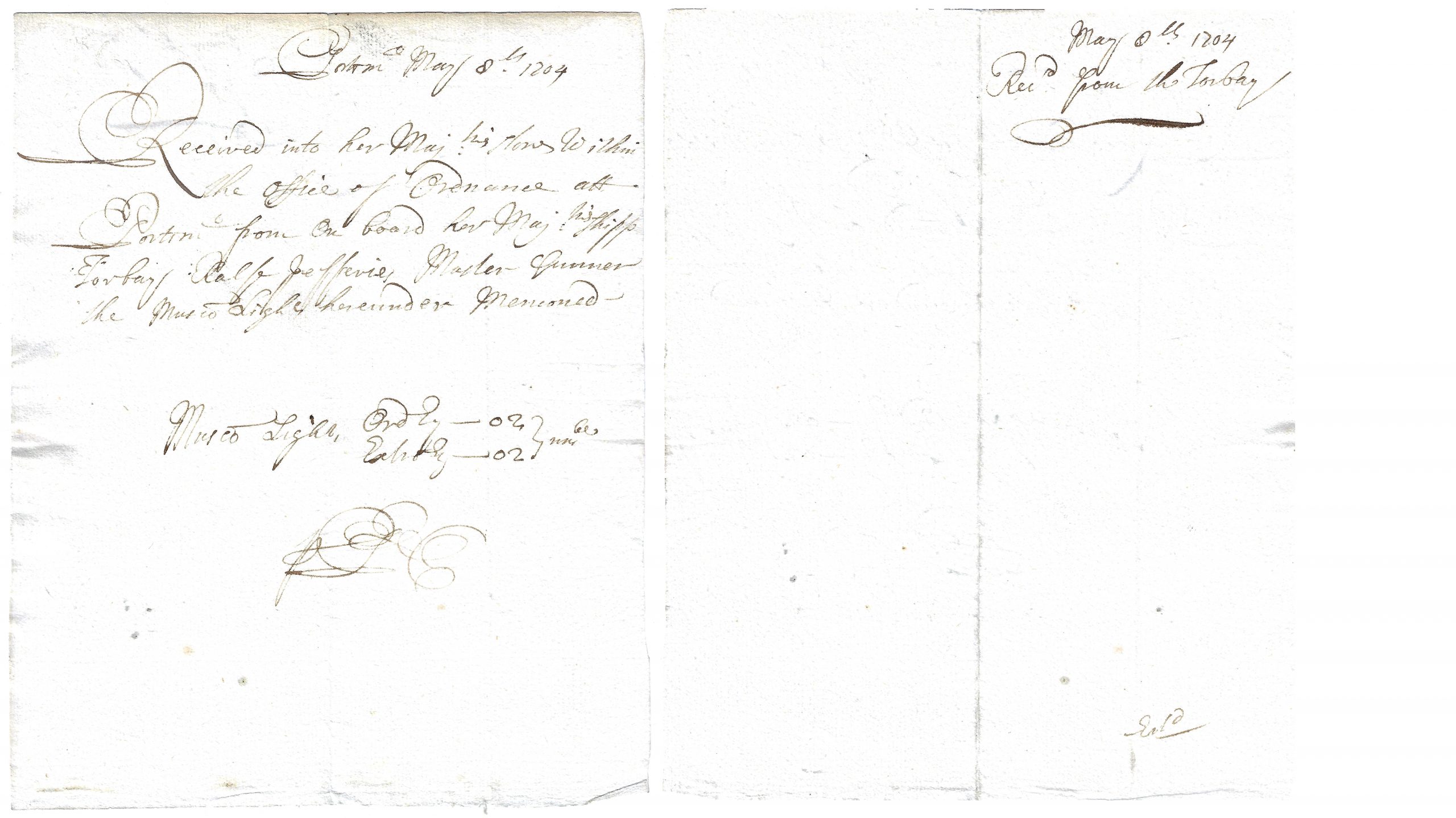
View in new tab:
This account, written on crumpled, fine paper and listing gunners’ stores remaining on HMS Namur is very faded making it difficult to read. It mentions ‘aprons of lead’. These were large flat pieces of lead with extensions either side looking somewhat like the tapes on a butcher’s apron. The apron would have been placed over the breach of a gun to cover the touch hole. The extensions would have been folded under the gun to secure the apron to the breach thereby protecting the gun from the ingress of moisture.
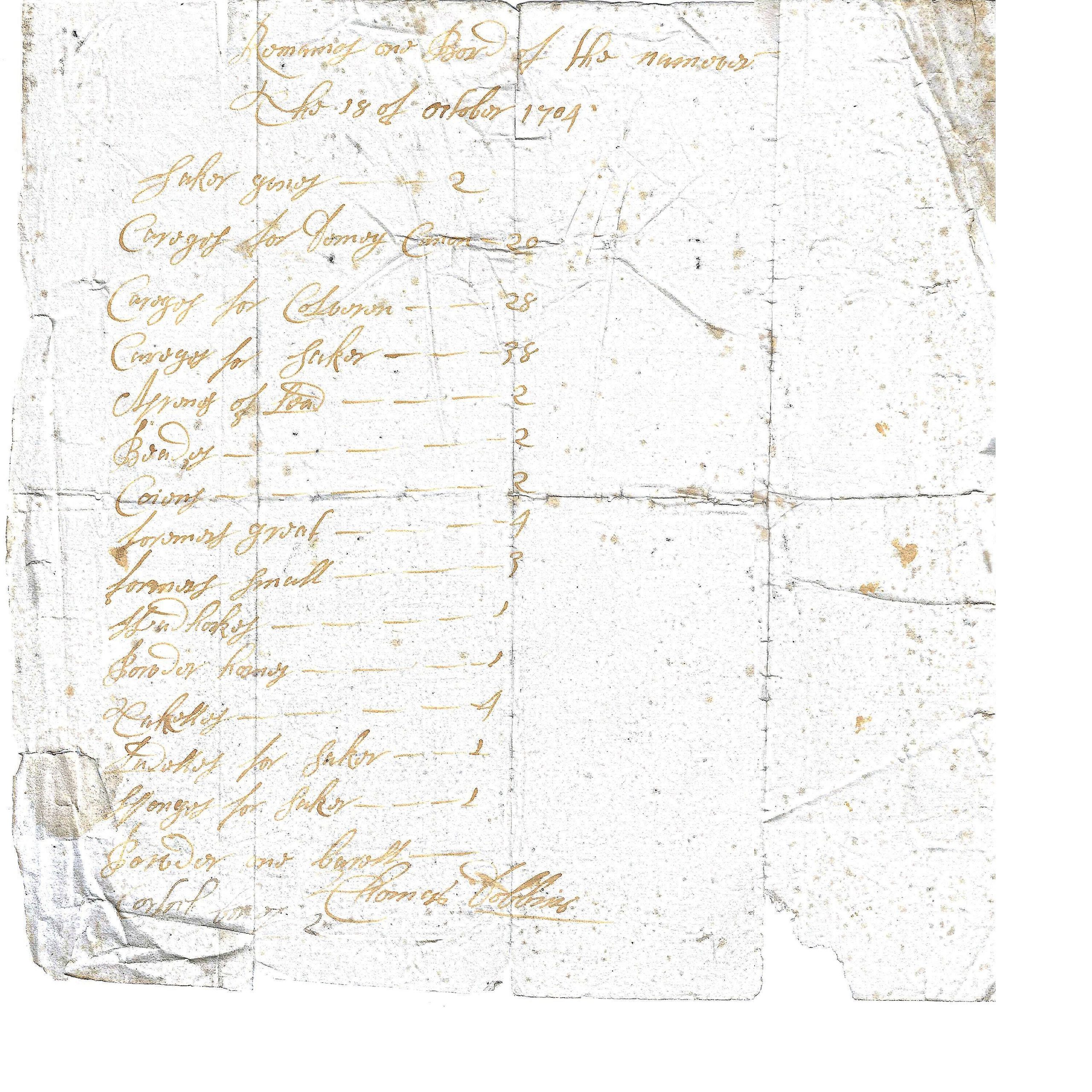
View in new tab:
In 1705 we see a letter from The Tower. Although the 20th of January, the year stated is 1704/5. This is a convention that was followed for the first three months of every year. The letter is advising John Hooper that an ‘imprest’ of £200 (notice that the letter says both 200lb and £200) has been granted. It goes on to request a quarterly statement of account explaining where the money is being spent. It may be of interest to also note that the three signees refer to themselves as ‘Your loving friends’. They clearly were friends as we will see in later correspondence.
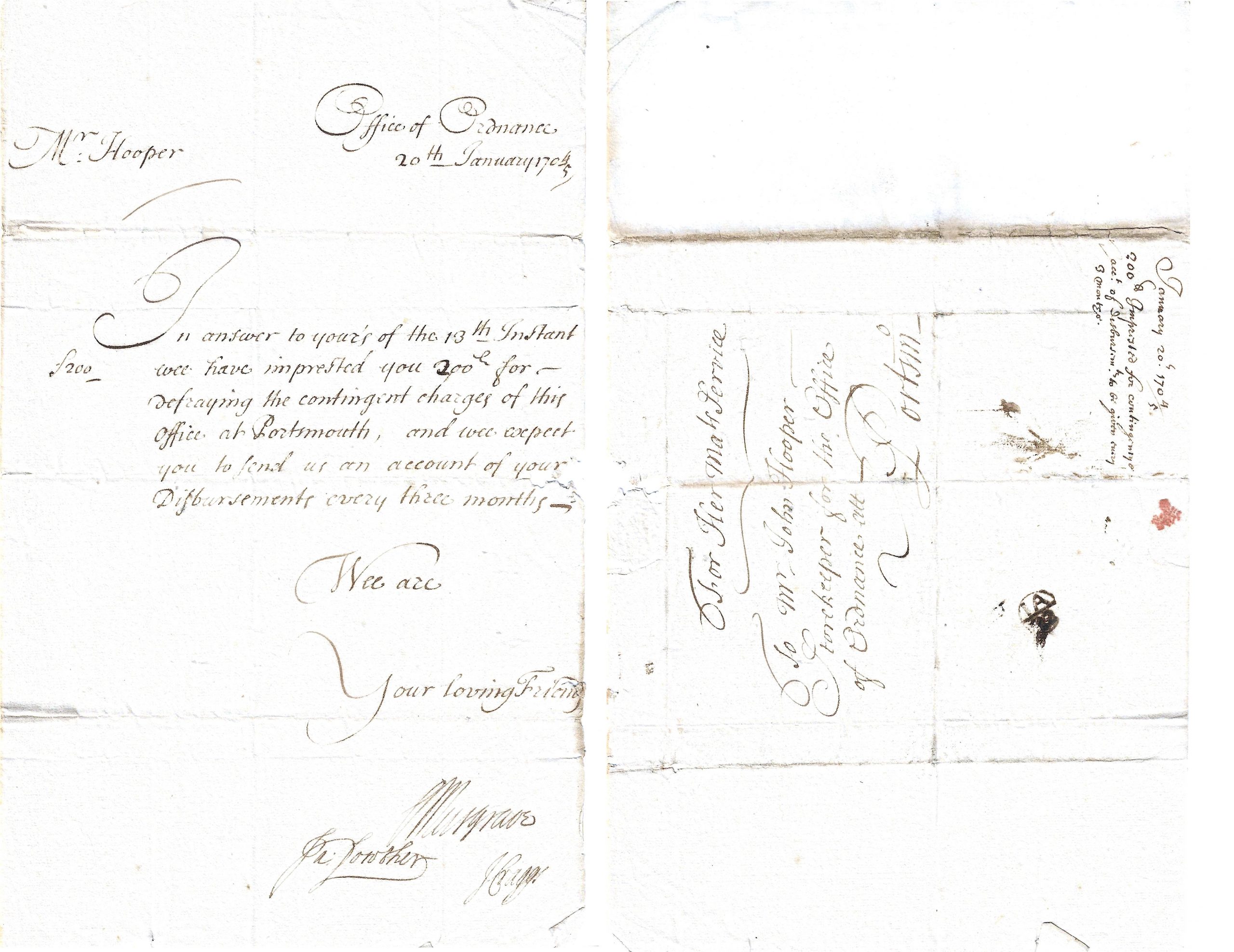
View in new tab:
In business letters today, we enter our address top right, then the recipient’s address top left before the date and the content. At this time the recipient’s name/address appears at the bottom left.
The letter of 3rd April 1705 from The Admiralty Office is directly addressed to John Churchill, Duke of Marlborough (sixth great grandfather of Winston Churchill), Master General of Ordnance. The letter is from ‘George’, who George was is unknown, possibly Admiral Sir George Byng, or maybe Prince George, husband of Queen Anne. Whoever he was he felt no need to use anything but his first name.
The use of the contraction Ym in this letter demonstrates that the ‘Y’ is pronounced ‘th’, so proving that Ye is not pronounced ‘ye’, but ‘the’.

View in new tab:
This document from Josias Clark, cooper, 1st July 1705, makes reference to Quay Gate, sometimes spelt Key Gate, and also known as King George’s Gate, one of the gates through the wall which surrounded Portsmouth town. It stood next to the Camber dock, where Portsmouth Fish Market now stands in White Heart Road, Old Portsmouth.

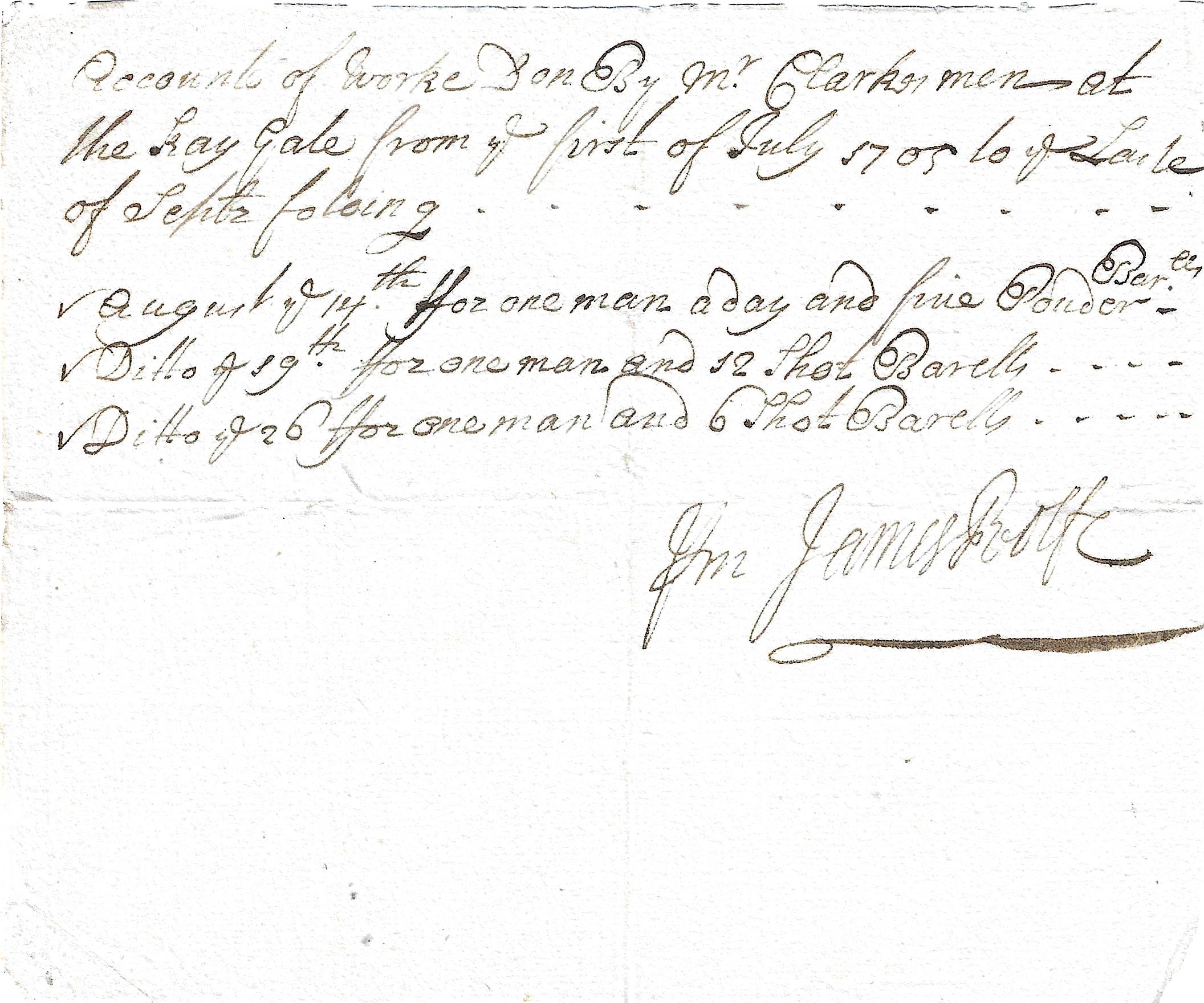
View in new tab:
Mr Clark’s men were then busy aboard HMS Grenwich on 28th July.
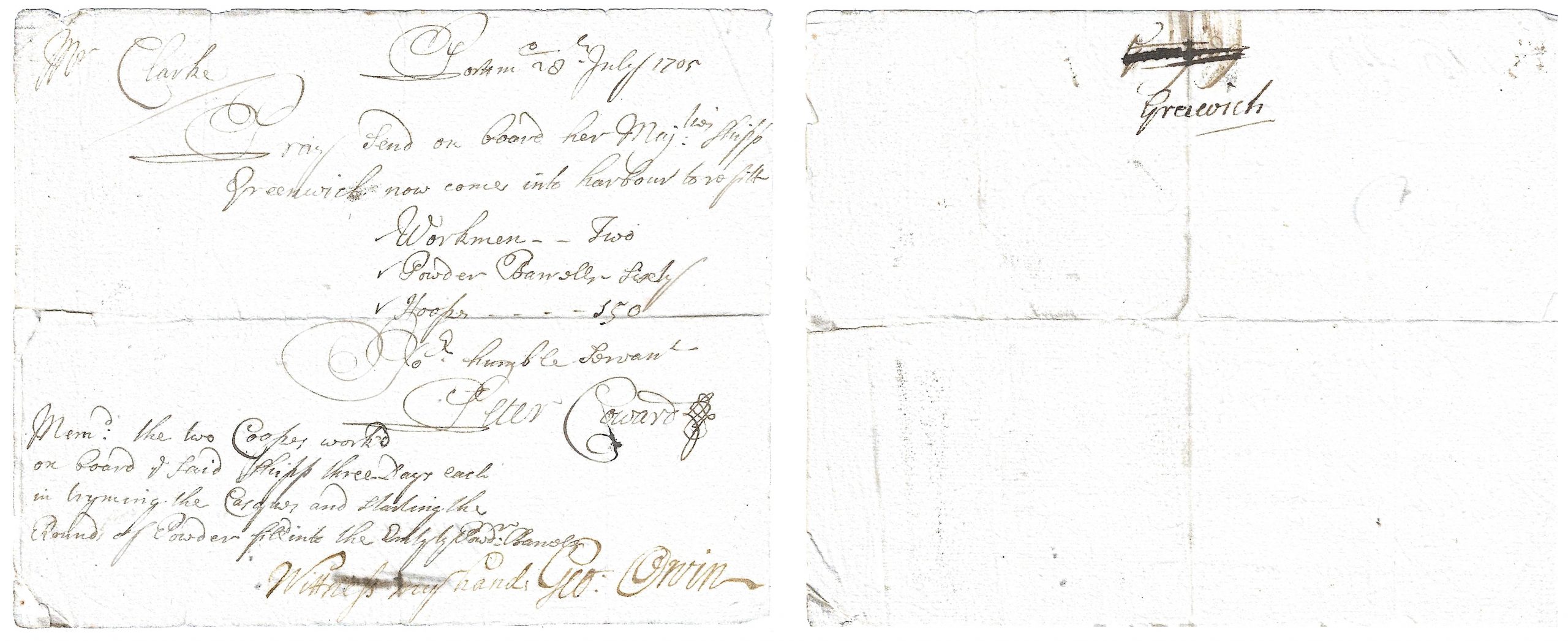
View in new tab:
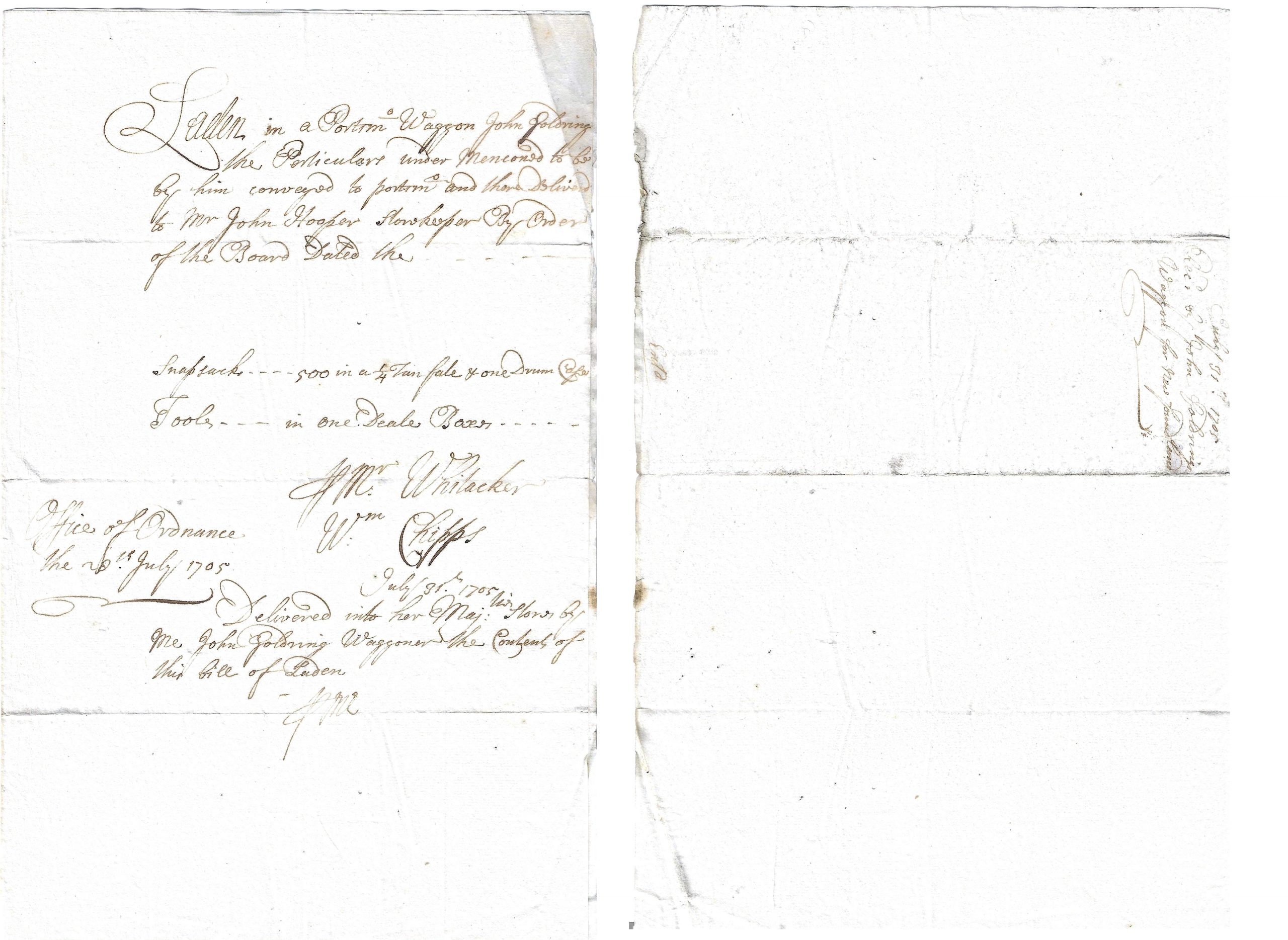
Then, on 31st July, a bill of laden for stores transported by John Goldring, over land, to Portsmouth endorsed with a receipt for the stores. This bill of laden for John Goldring’s wagon refers to ‘snapsacks‘ (a tubular leather or canvas sack with a drawstring). It then says ‘500 in a 1/4 tun fale‘. However, looking at the document as a whole, the writer (I suspect it was Peter Coward) has a tendency to not cross the ‘t’s, for example ‘Perliculars’, ‘lhere’ and ‘lhe’. So, if we substitute ‘t’ for the ‘l’, we get ‘fate’. The word we now spell as ‘Vat’ (a large barrel) was once spelled ‘ffat’, ‘fat’, or, in this case ‘fate’.
My thanks, once again, to Philip Eley for his help with this.
View in new tab:
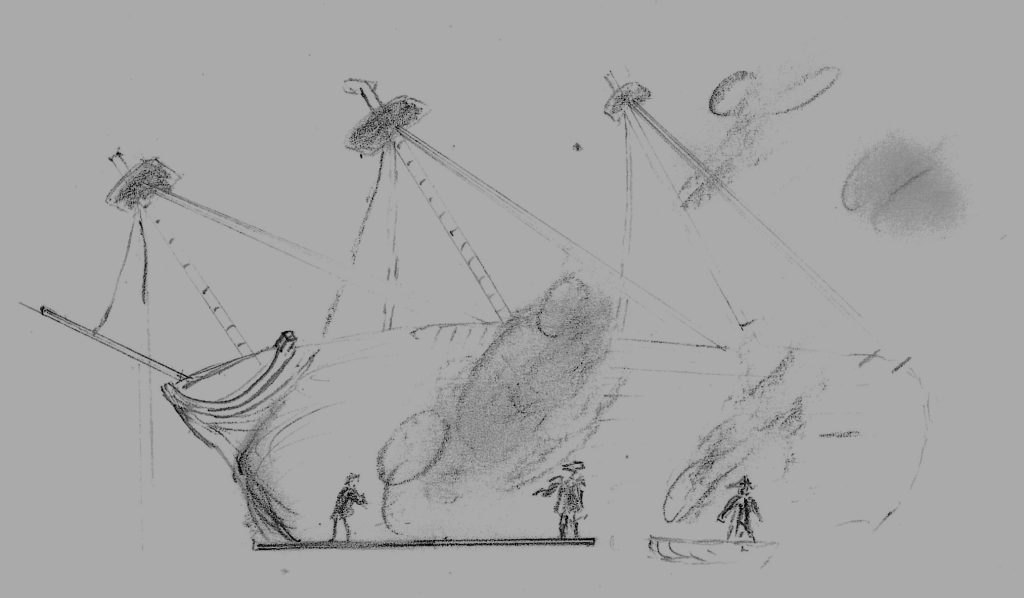
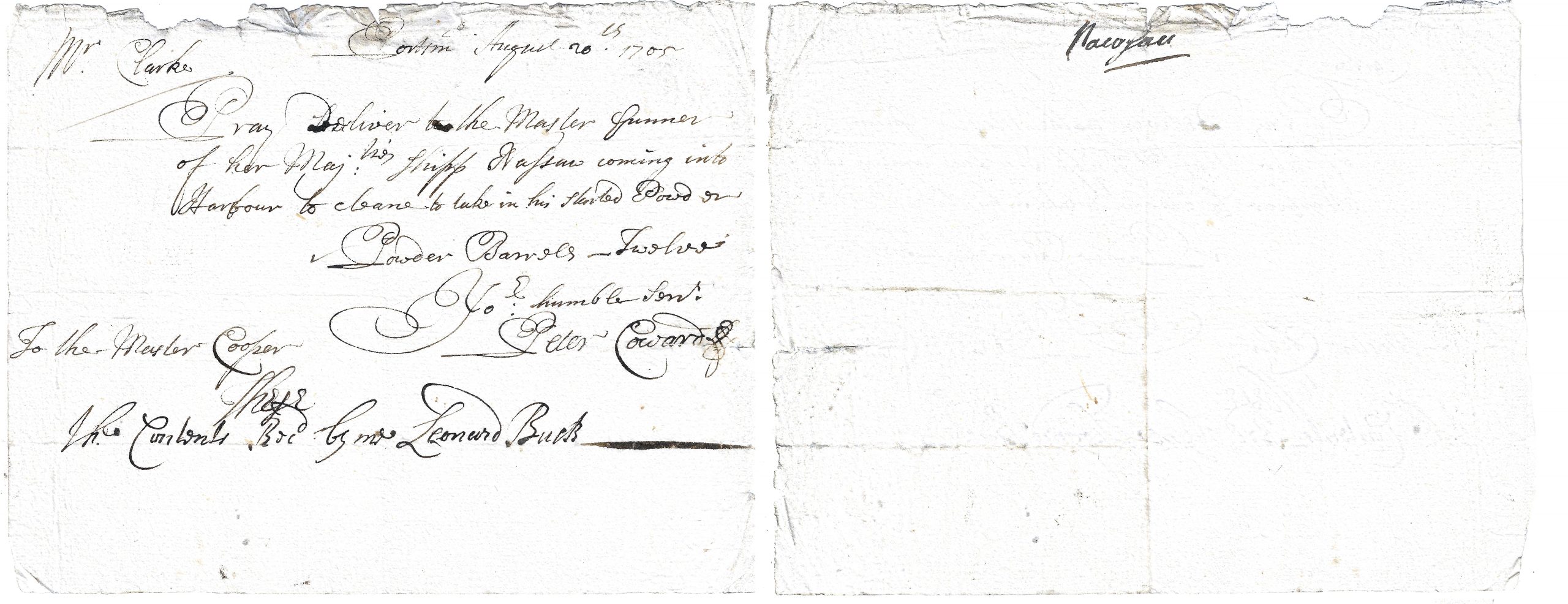
In August of 1705 Peter Coward, (note the similarity of the handwriting with the previous document) a clerk to Mr. Hooper, requests that Mr. Josias Clarke supply 12 powder barrels to HMS Nassau when she arrives in harbour for cleaning. Given that the decks and rigging would be maintained by the ship’s company we must assume that the ‘cleaning’ referred to is cleaning the ship’s bottom of weed and the hull of infestation by shipworm (Teredo Navalis, a wood eating, marine mollusc). Although copper plating, which solved the problem of ship worm, was recommended in 1708, by one Charles Perry, to prevent these problems, it was not until the 1760s that the navy finally introduced it.
Ships were cleaned of weed either by careening them (bringing them ashore, and hauling them onto their side using a purpose built capstan), or by putting them into a dry dock. The weed, barnacles etc. would then be scraped off. The timbers were then treated with fire which killed the ship worm. A mix of pitch and horsehair was then applied which offered limited protection against reinfestation.
Needless to say, careening would have been practiced on hard ground. However, much of the ground around Portsmouth Harbour is mud flats, so to perform careening, hard ground would have to have been created. This was done by transporting shingle from the shores of the Solent and depositing it where hard ground was required. This was done for a number of reasons: careening, loading and unloading, breaking of vessels for salvage, or simply launching, or pulling vessels out of the water. The hard ground thus created was known as a ‘Hard’. In Portsmouth the area immediately outside of the Dockyard Main Gate is known as ‘The Hard’ and is used by local fishermen to launch their boats. Directly opposite, across the harbour in Gosport another hard was created to facilitate a landing place for ferry boats. Also in Gosport, further north, there is an area known as ‘Hardway’ where 7 more hards were created. You can read about Hardway on another page of this site.
View in new tab:
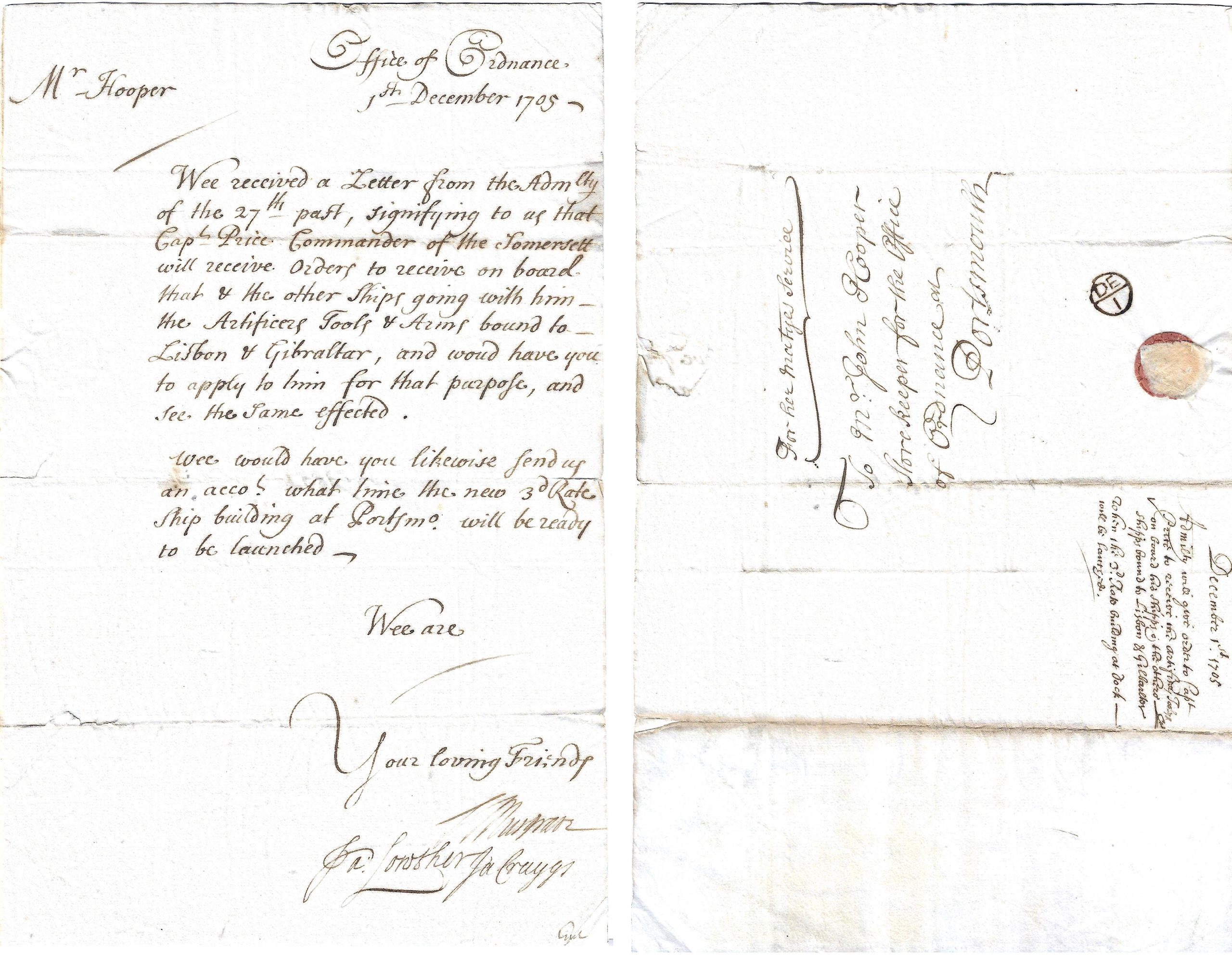
In December of 1705 a letter from The Tower emphasizes the high status of John Hooper, it states that HMS Somerset (1698) commanded by Captain Price will be ordered to transport tools and arms to Lisbon and Gibraltar. This would have been during the War of the Spanish Succession. So, Mr. Hooper knew before the ship’s captain where she was going next!
This same letter goes on to enquire of Mr. Hooper the progress and estimated completion date of the building of a new 3rd rate ship.
View in new tab:
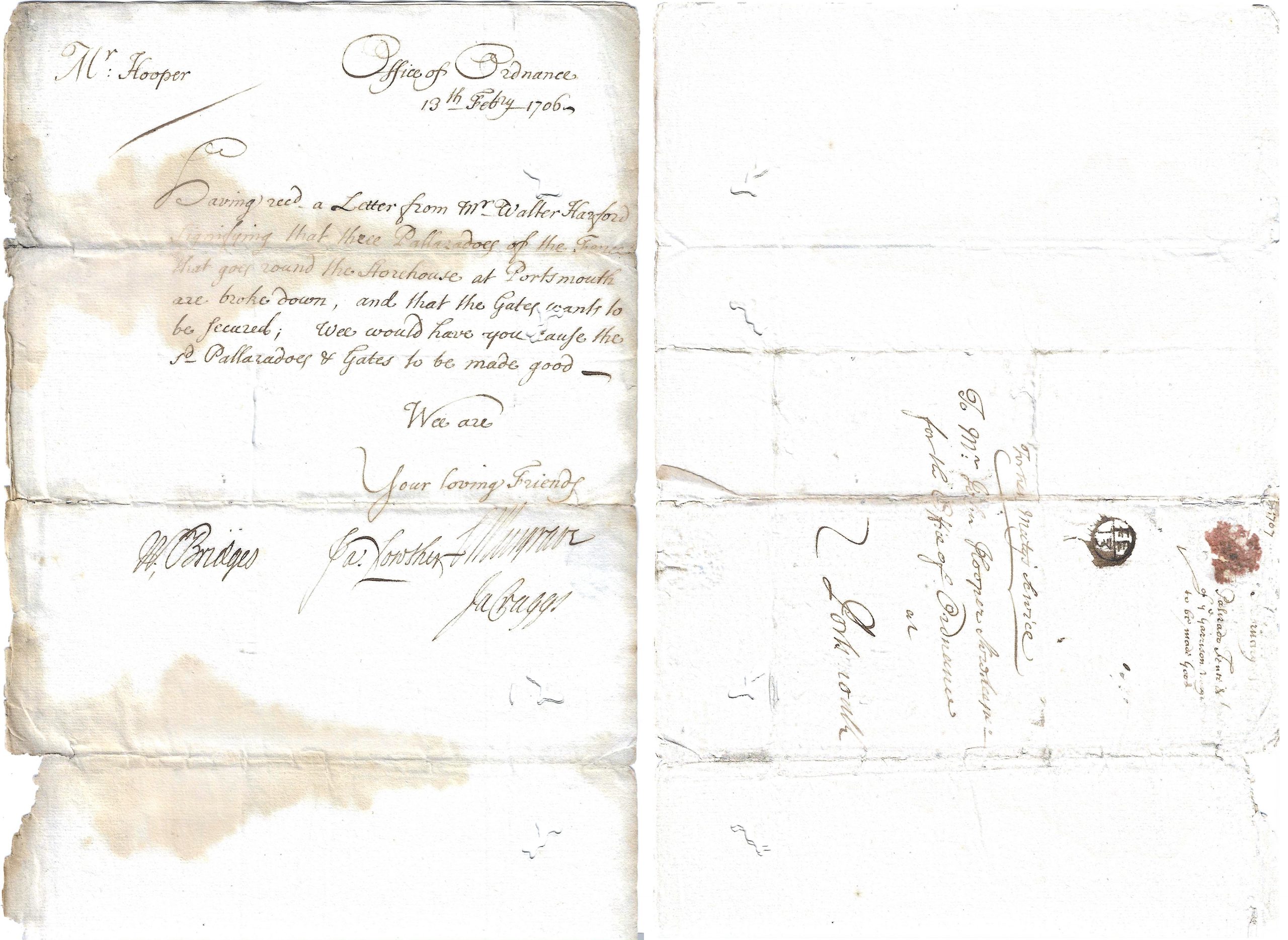
From a faded letter we learn that Mr. Hooper is also responsible for the maintenance of some of the dockyard buildings. In February of 1706 he is asked to arrange the repair of palisades around the storehouse.
View in new tab:
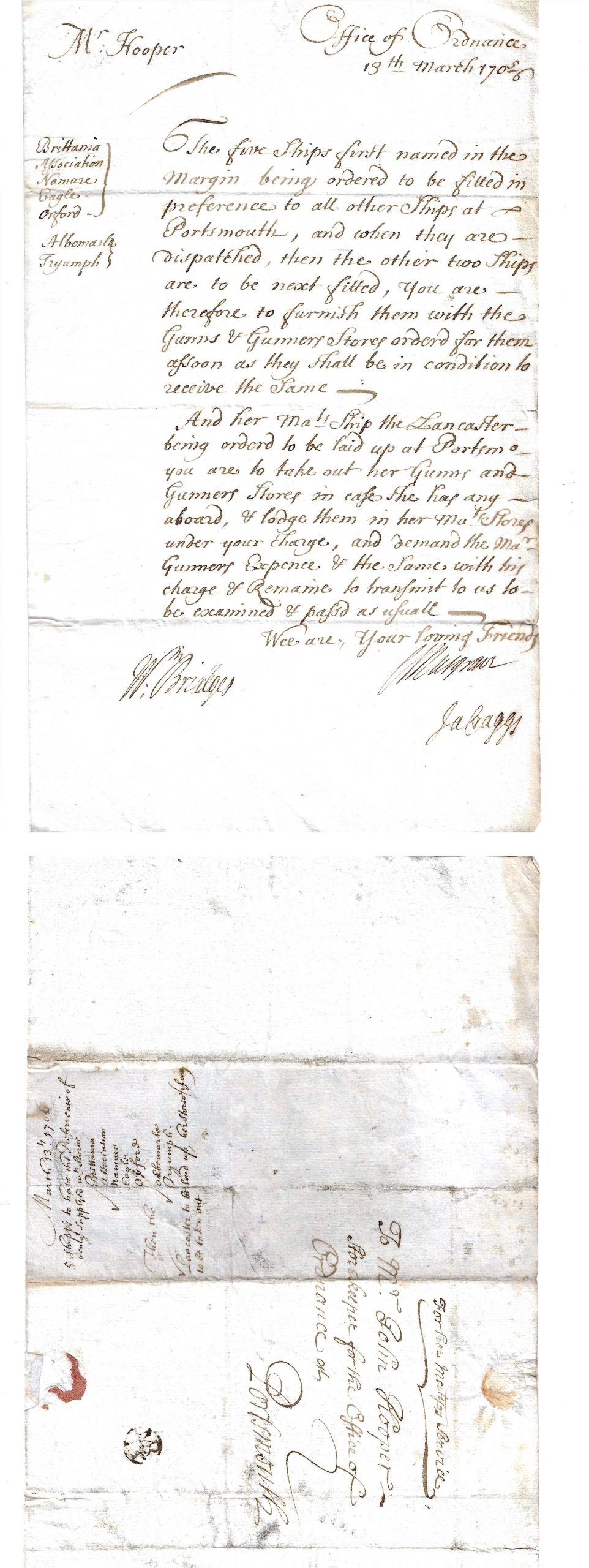
A letter in March 1706 asks that five named ships jump the queue for resupply, and that two others should follow. This is the first letter in which we see the dockyard ordered to ‘take out her guns and gunners’ stores’, a soon to be familiar phrase frequently used when a ship was to go into refit, or, as in this case, to be laid up. A simple phrase concealing a huge amount of work to be done.
View in new tab:
Unusually this letter has no address, has no Bishop Mark, and was folded laterally only, yet it has come from The Tower as it is signed by Christopher Musgrave and James Craggs. Perhaps it was sent as part of a bundle of letters?
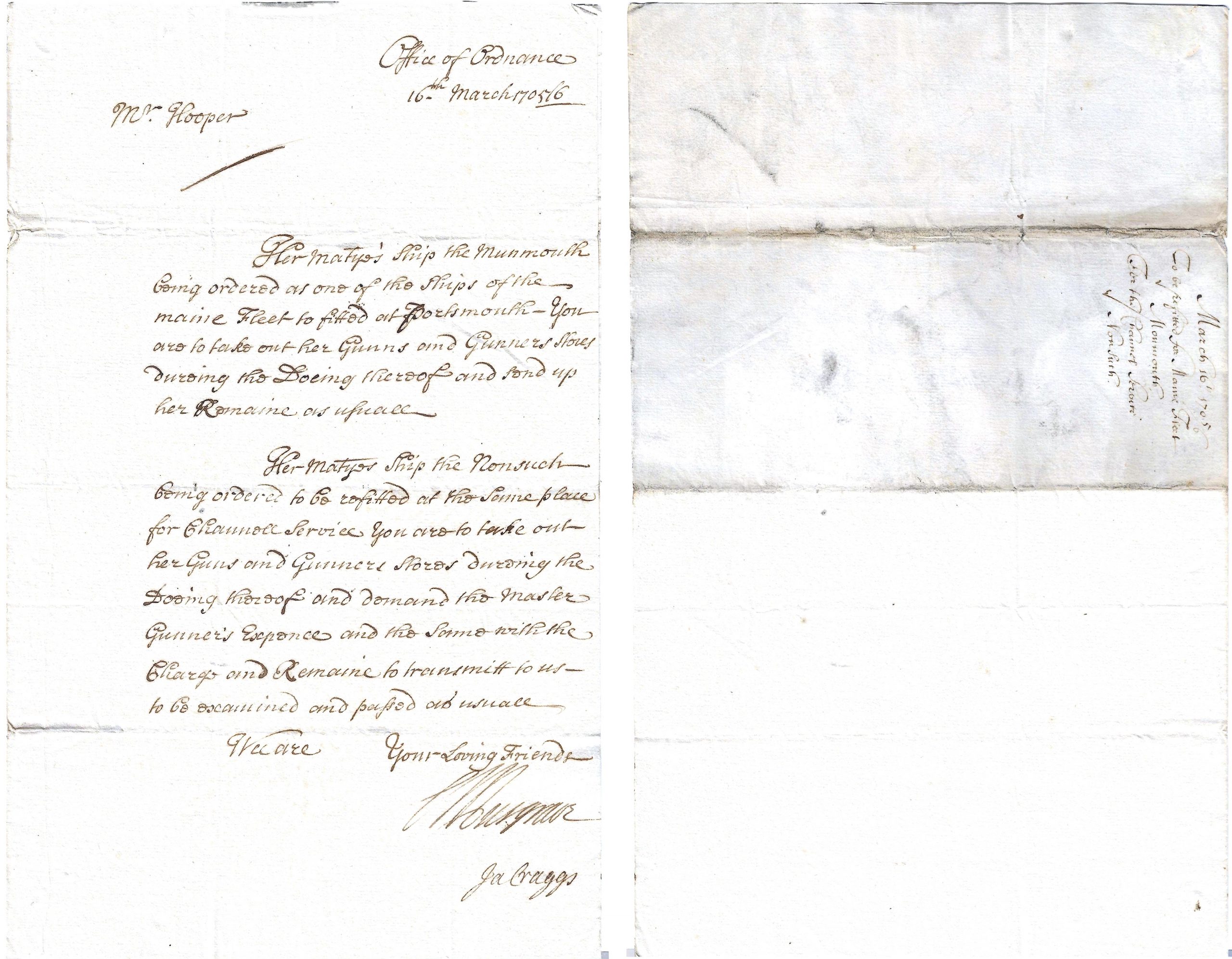
‘The Main’: a term that is sometimes heard in historical novels and folk songs, appears in a letter of 16th March 1706. The Main was a province in the northwest of France to the south of Normandy and between Bretagne and Orléans. HMSMonmouth, having been ordered to join The Main fleet, is to be refitted for such duty, while HMSNonsuch is to be refitted for service in The Channel fleet.
View in new tab:
HMS Granada, a bomb vessel (it was actually called Grenado, but the letter has clearly misnamed her), was also refitted for service in the Main fleet in July. Again, we see the familiar order: “you are to take out her guns and gunners stores during the doing thereof and send up her remains as usual.”

View in new tab:
On 19th of October 1706, Tartar and Sorlings are also refitted, this time for service in the Mediterranean fleet. We can only speculate as to the nature of these refits and what service in the different fleets required of them, but it almost certainly relates to the quantity of stores that are loaded after the refit.

View in new tab:
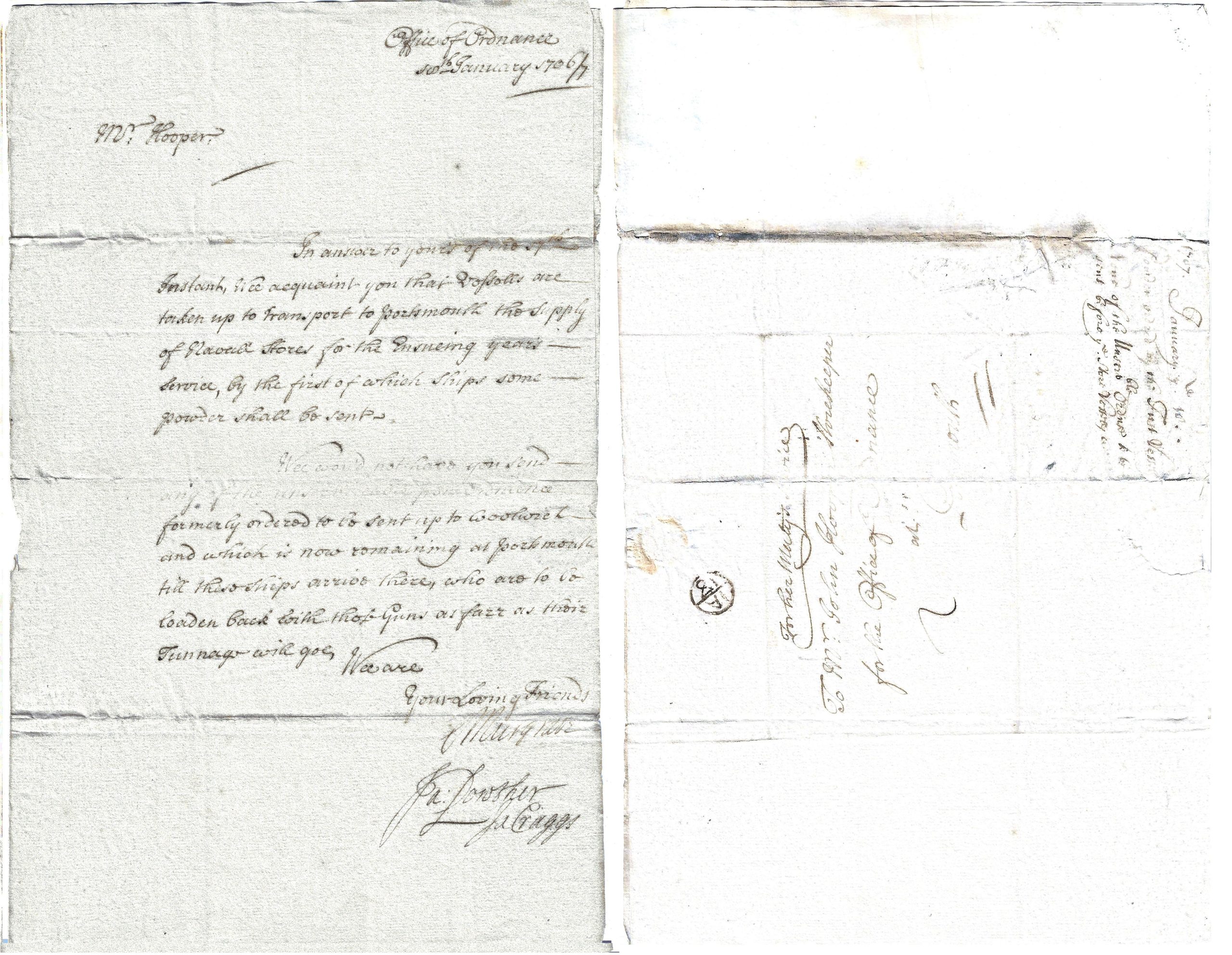
Mr. Hooper must have written to The Board about returned powder as a sadly faded reply of 10th January 1707 advises that he should not send unusable returned powder back to Woolwich, but retain it at Portsmouth.
It may be of interest here to note that in 1716, following representations from the people of Portsmouth requesting that powder not be stored close to their homes, Mr. Hooper wrote to The Board suggesting that it was unwise to store powder in The Square Tower at Portsmouth. It was not until the 1760s however that The Board took this seriously and began the building of a purpose-built armaments store at Priddy’s Hard in Gosport, designed to contain any explosion, and well away from residential buildings. These buildings still stand today, some forming part of Explosion! Museum, and the powder store converted to ‘The Powder Monkey’ brewery.
View in new tab:
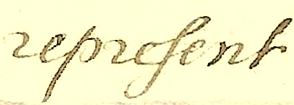
In March of 1707 The Board agree to Mr. Hooper’s recommendation for employing Henry Stanyford to build cartwheels for powder carts and a pair of wheelbarrows. It is worth noting how the word ‘represent’ is written here; the ‘s’, although in the middle of the word is written as a capital. This is usual where it is followed by another ‘s’, but not often seen where there is a single ‘s’.
There is also a postscript to this letter regarding a mislaid account for £372/6/- (£372, 6 shillings) thereby delaying payment; not an insubstantial amount.
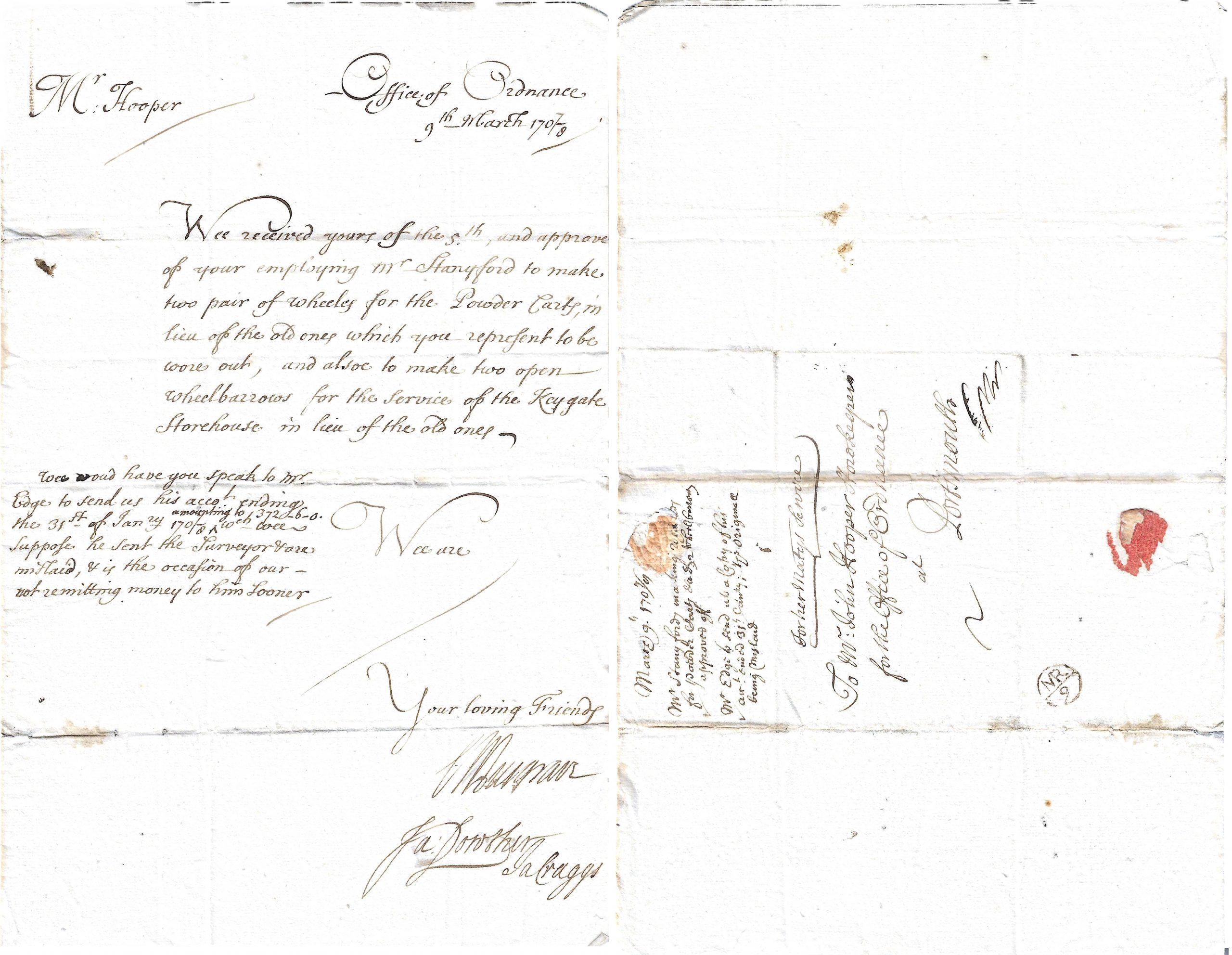
View in new tab:
Three letters follow in May of 1707 instructing the yard to prepare ships for refit. Starting on the 3rd with Cambridge, Roebuck, Foulkston & Seaford which are to be refitted for Channel service.
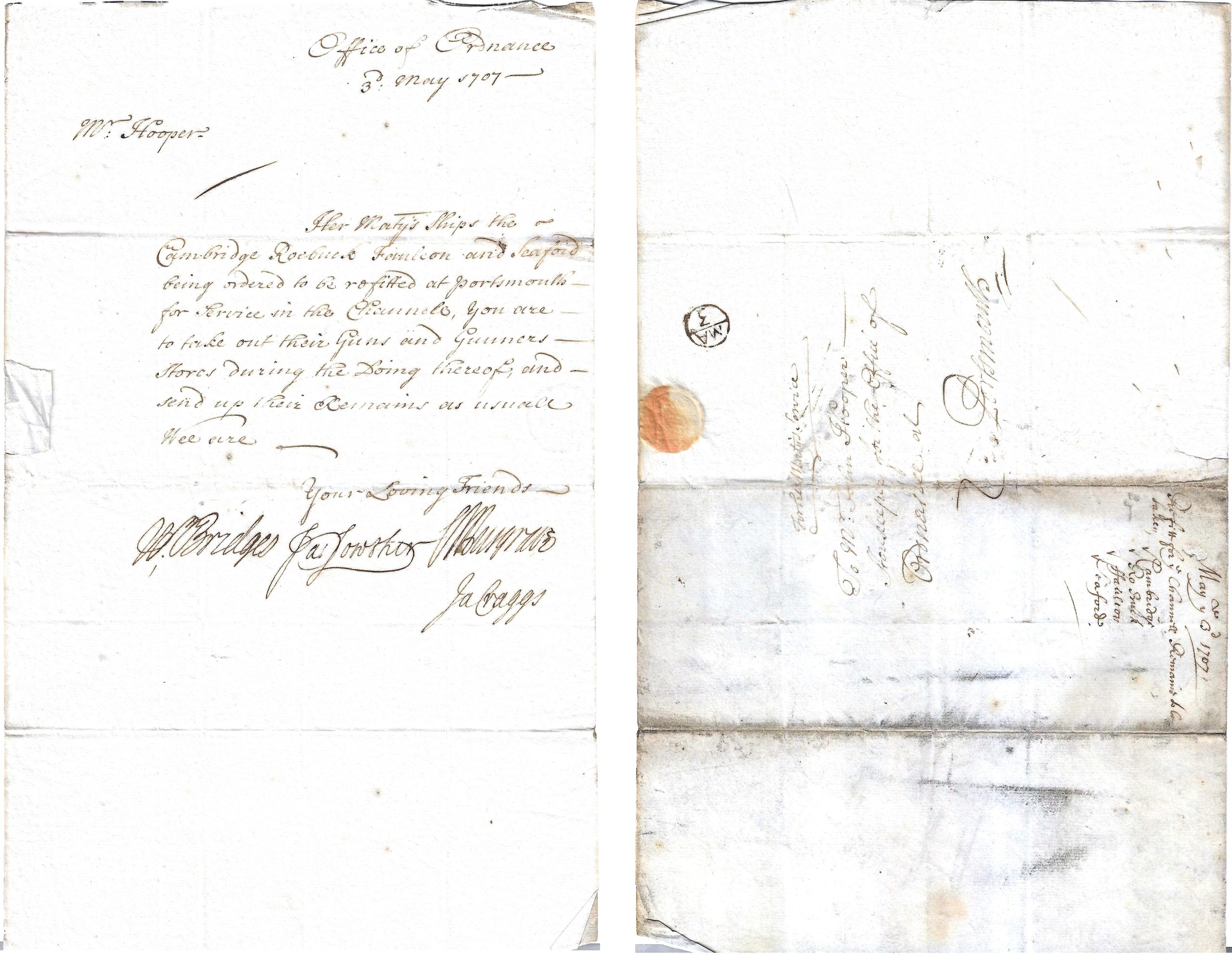
View in new tab:
On the 8th there seems to have been a change of plan as Cambridge is now to be refitted for service in the Mediterranean along with Cumberland & Devonshire.
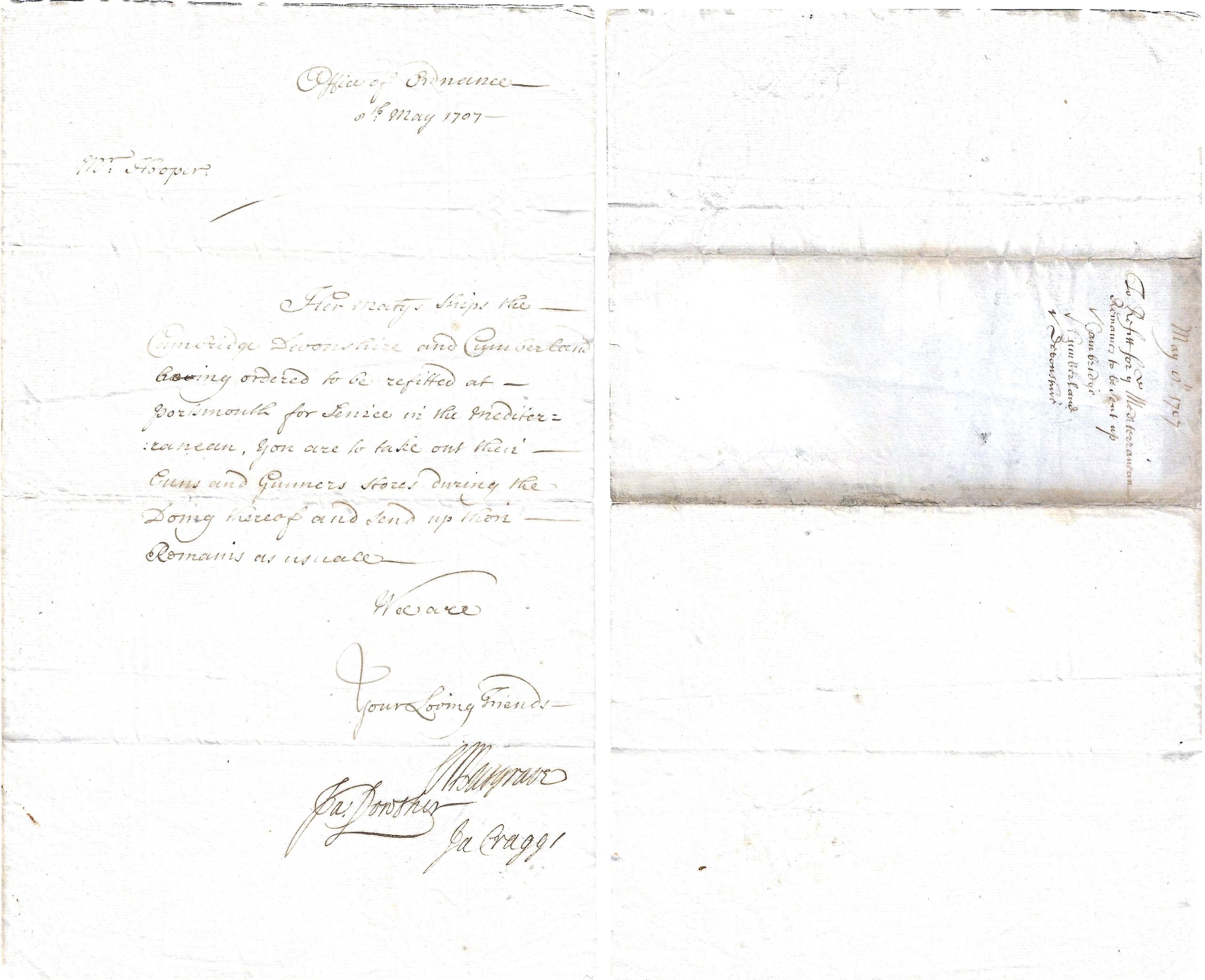
View in new tab:
On the 12th Northumberland & Canterbury are to refit for Channel service.
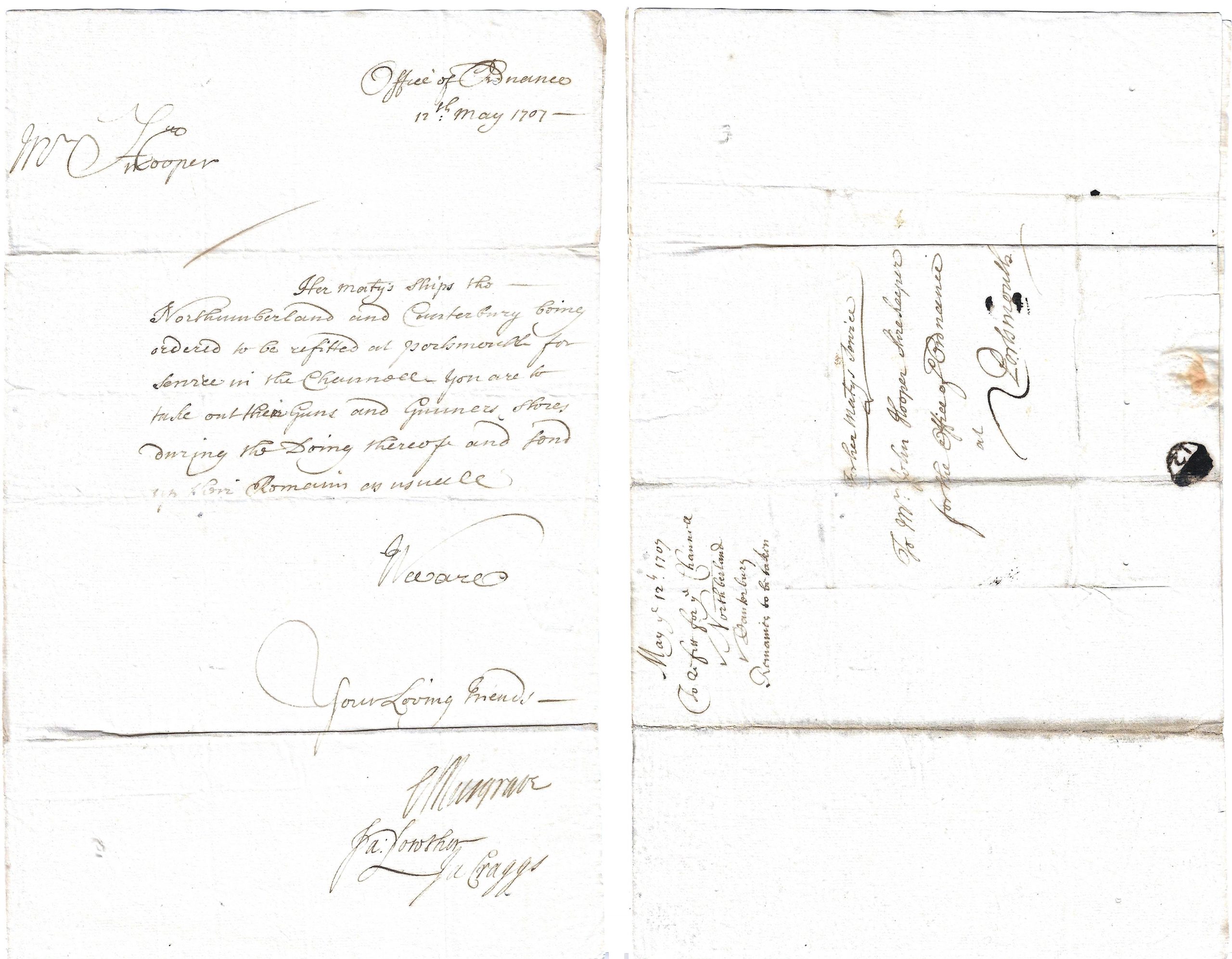
View in new tab:
Henry Silvester’s smithy’s bill for the period between October 1707 and March 1708 is a challenging read. He begins by craving an allowance, yet nowhere does he put monetary value on his work, we are only shown the weight of iron involved. He has also included much of his working out which makes reading most difficult.
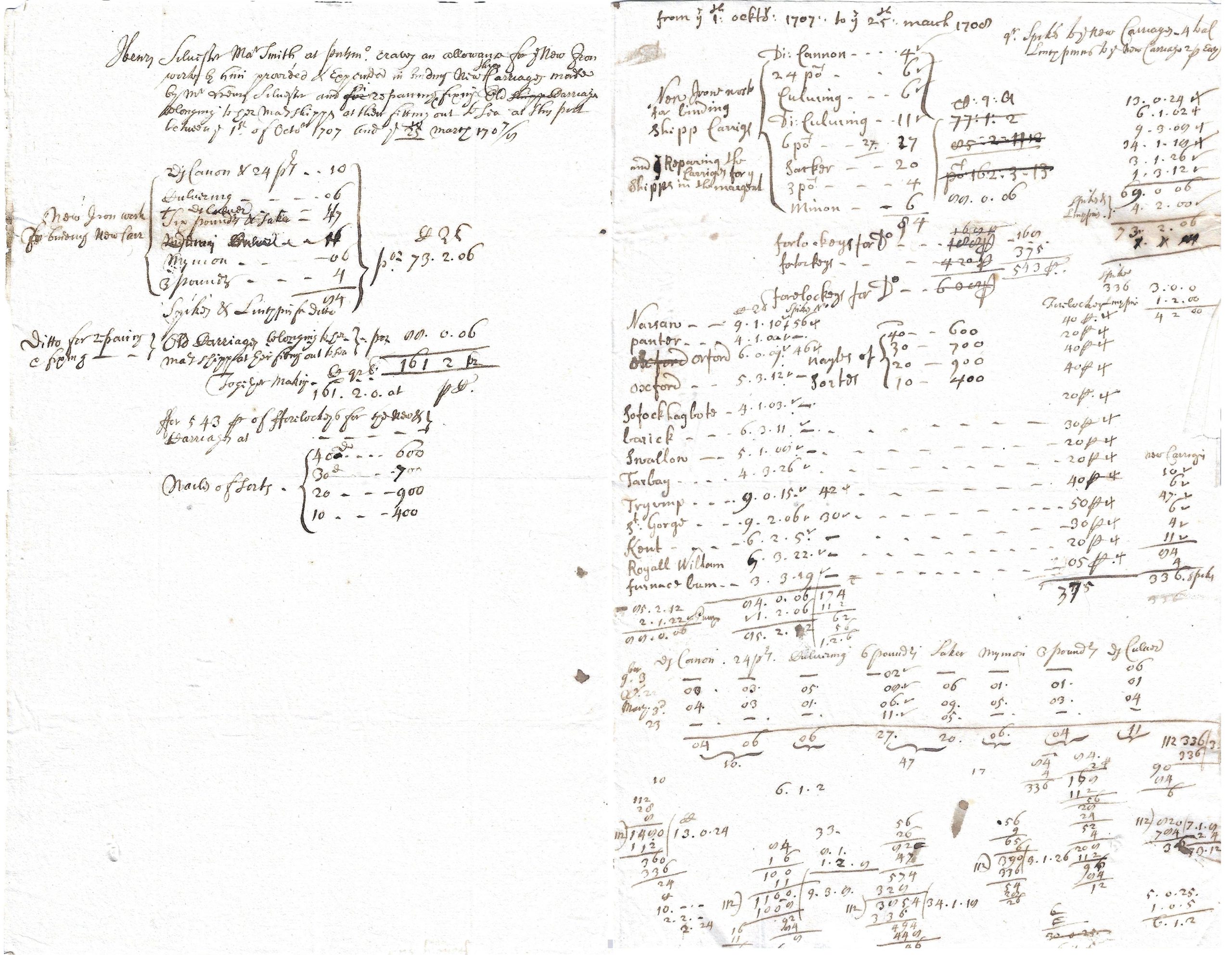
View in new tab:
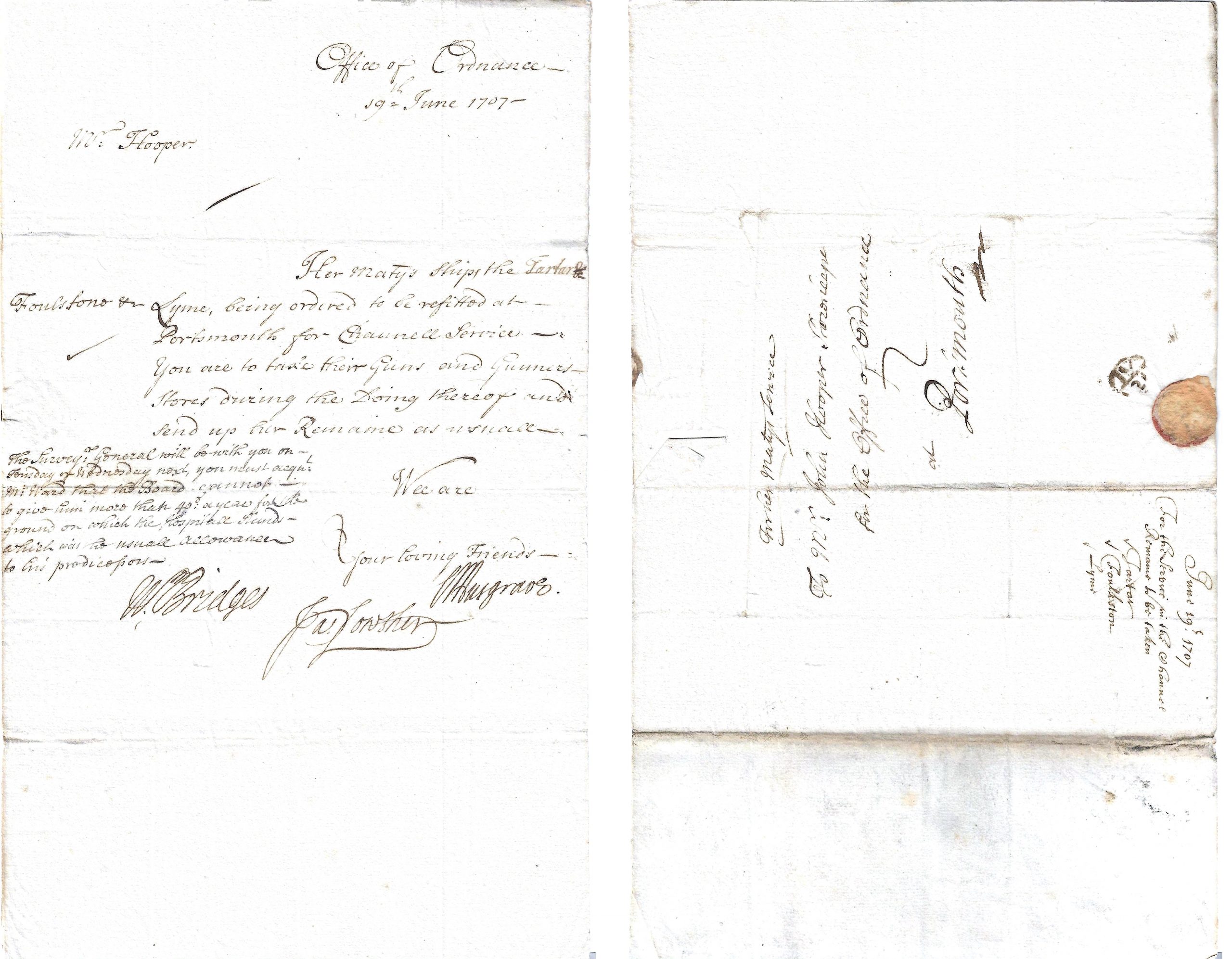
A postscript to a letter of 19th June 1707 ordering the preparation of HMS Tartar, Folkston and Lyme for refit informs Mr. Hooper that the Surveyor General, William Bridges, signatory to many letters from The Tower, and indeed this one, will be with him the following Tuesday or Wednesday. It advises that Mr. Ward will be paid no more than £40 for the ground that the hospital stands on.
It is unclear where this piece of land was. The hospital in the Dockyard was superseded by the Royal Hospital Haslar in Gosport in 1762, yet there was another hospital in Gosport at the time, at Forton. Fortune Hospital, later to become Forton Prison, may well have been the hospital being discussed here as stood partly on land owned by a Mr. James Ward; it is likely that there some connection. Some buildings of Forton Prison remain, and can be found in Lees Lane, Gosport if you look carefully.
View in new tab:
This document, transcribed by Philip Eley, seems to refer to a dispute between the Government and the local authorities as to who is responsible for the upkeep of the bridge at Hilsea which connected Portsea Island to the mainland at Cosham.
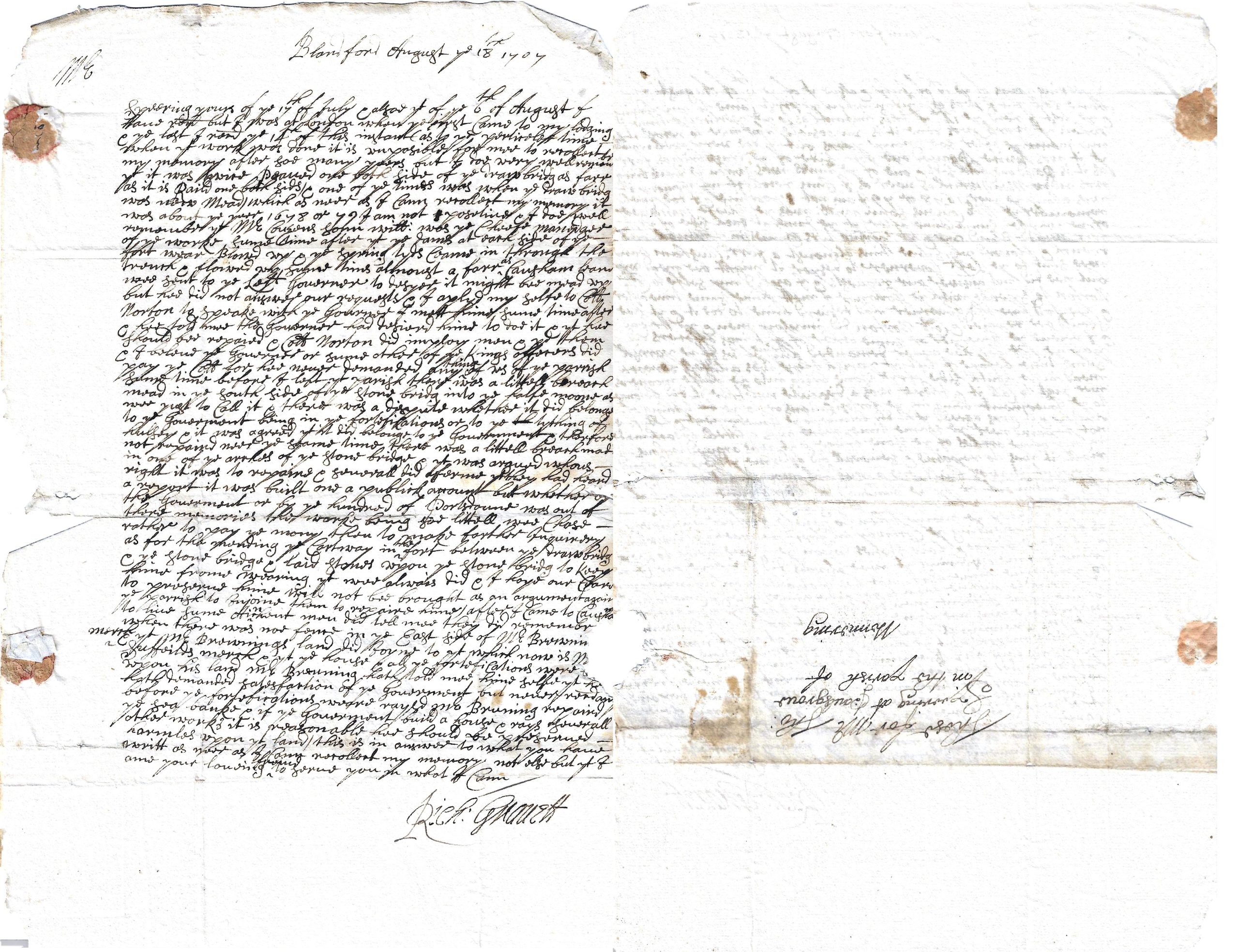
View in new tab
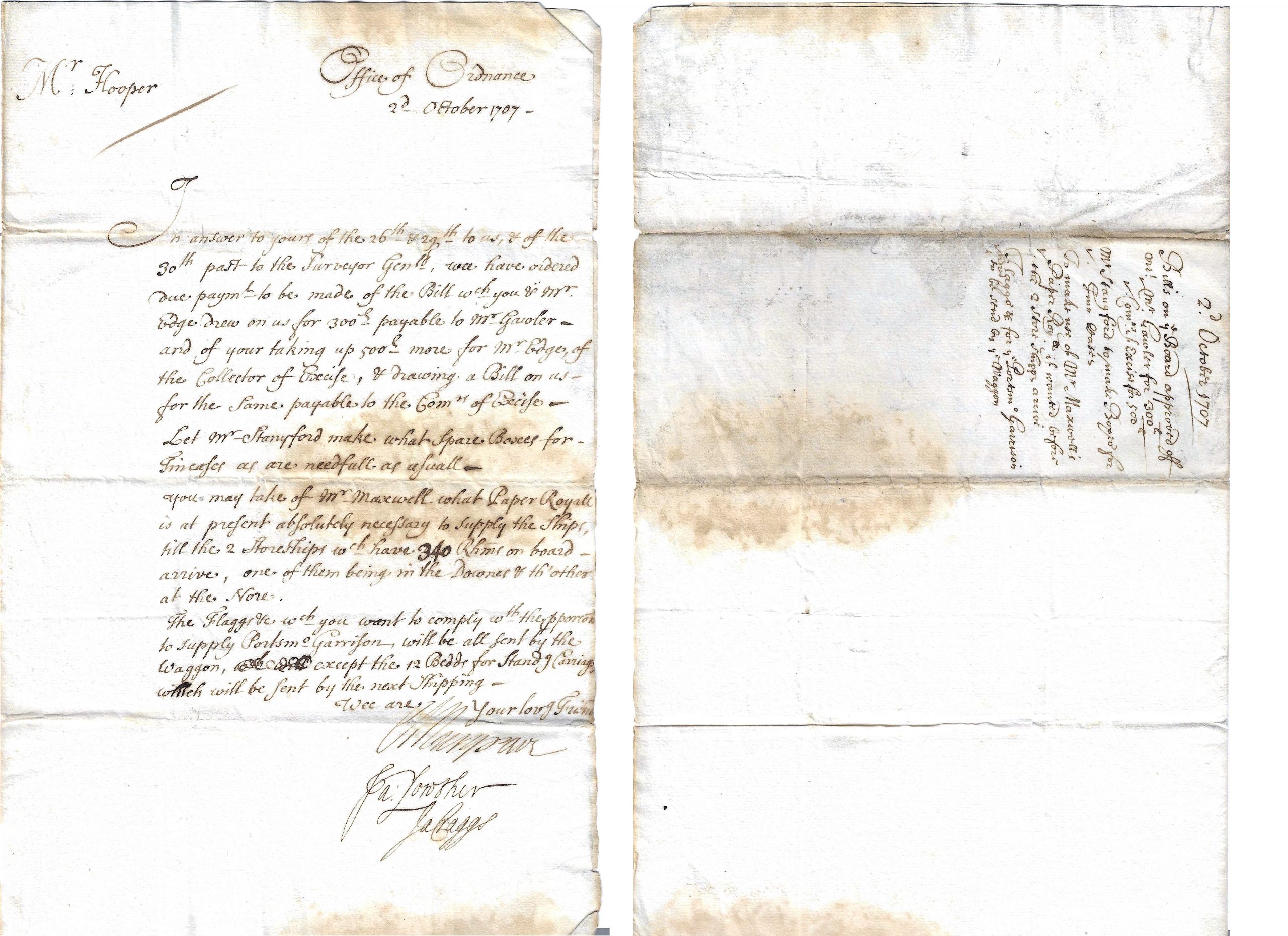
There was clearly a delay with the stores ships from Greenwich on 2nd October 1707 as, apart from agreeing to Mr. Hooper paying out a couple of substantial bills they have asked him to draw on Mr. Maxwell’s paper supplies while awaiting the ships. This emphasizes the difficulty that was experienced supplying Portsmouth and Plymouth dockyards, especially with weighty supplies. In this case the two storeships are sheltering from bad weather at The Downes, and The Nore, off the east Kent coast. It is also interesting to note how the amounts are written, both in the precis and the body of the letter, with the symbol for a pound weight and not the ‘£’ sign we use today.
View in new tab:
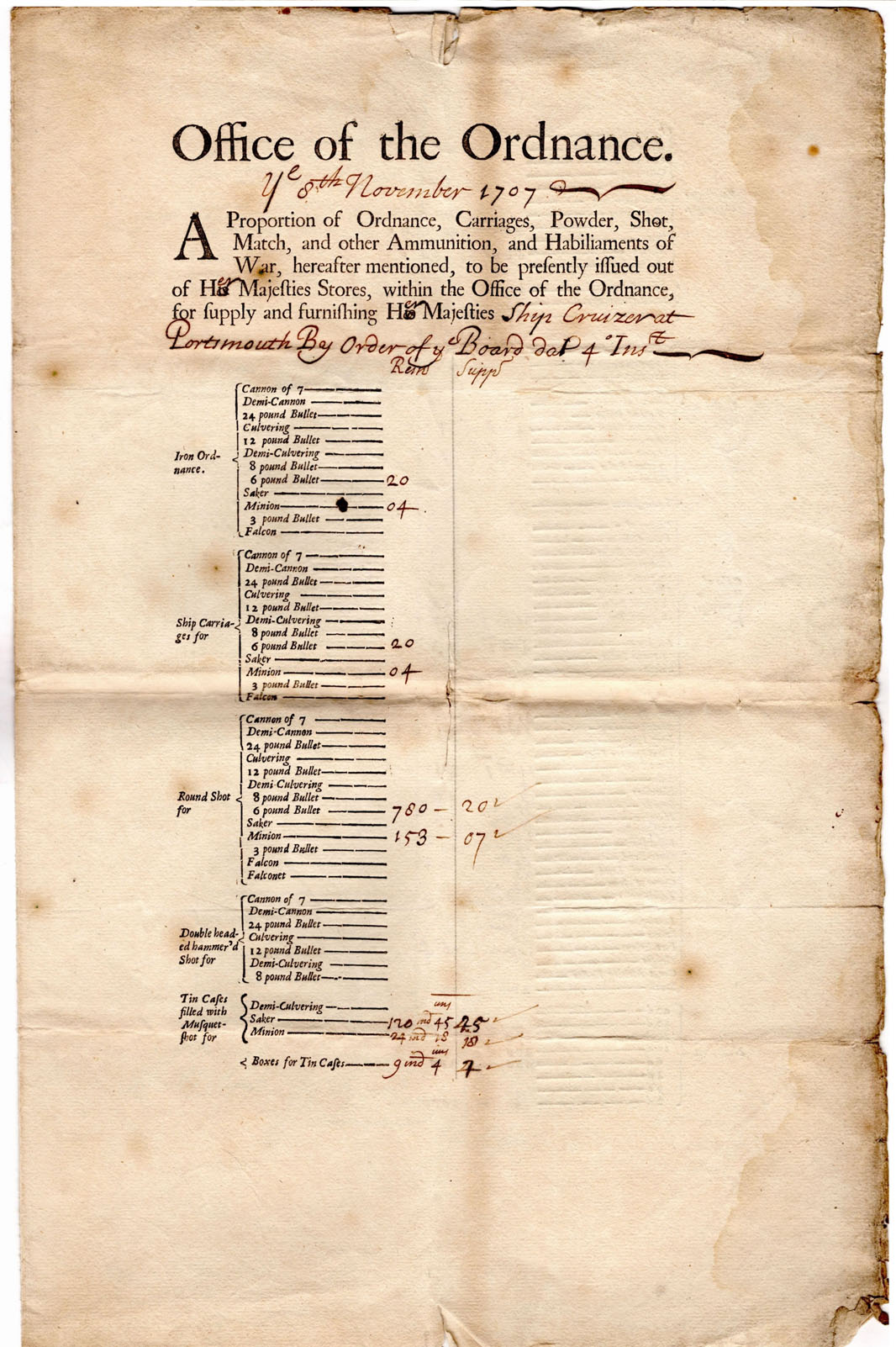
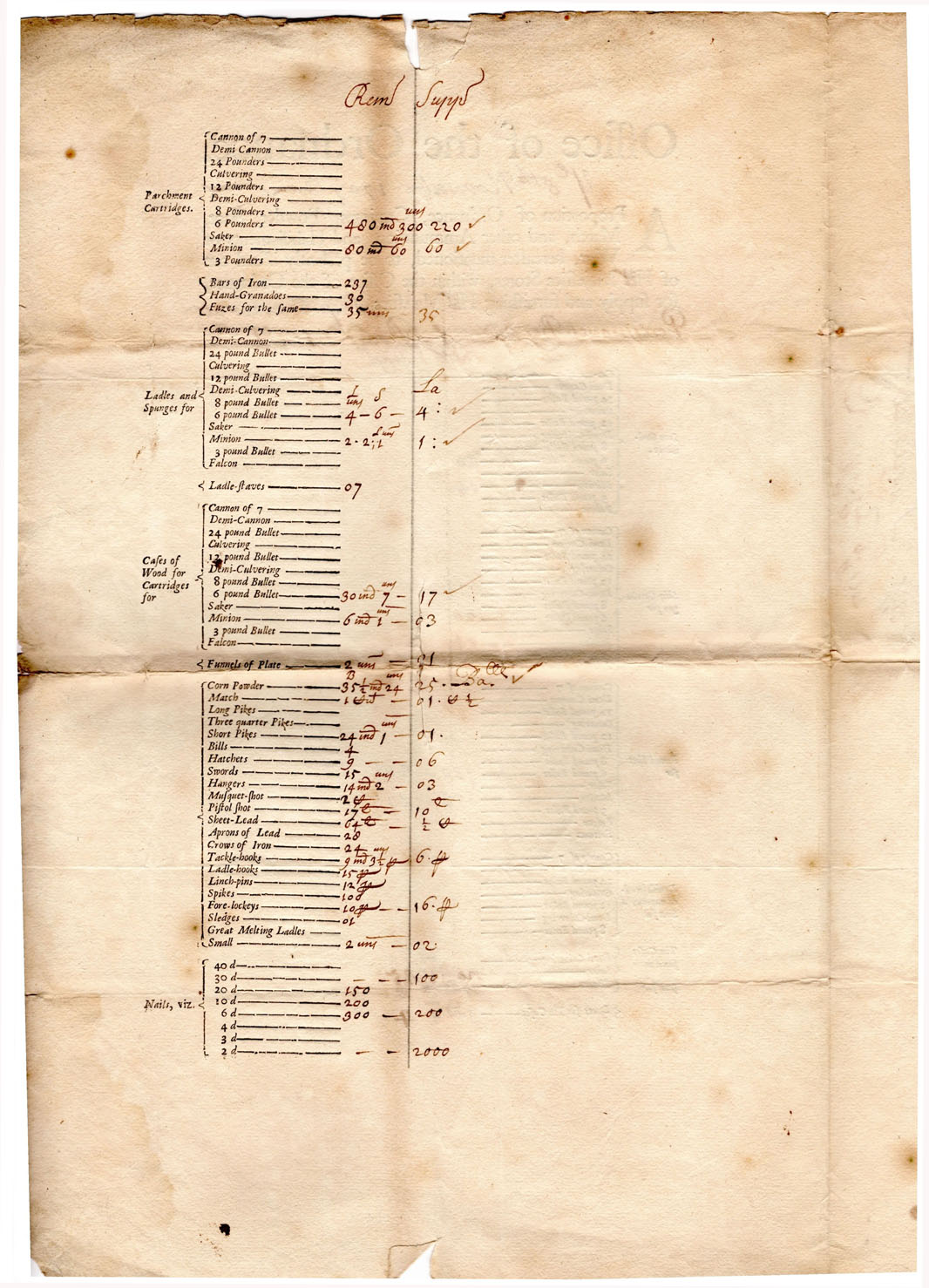
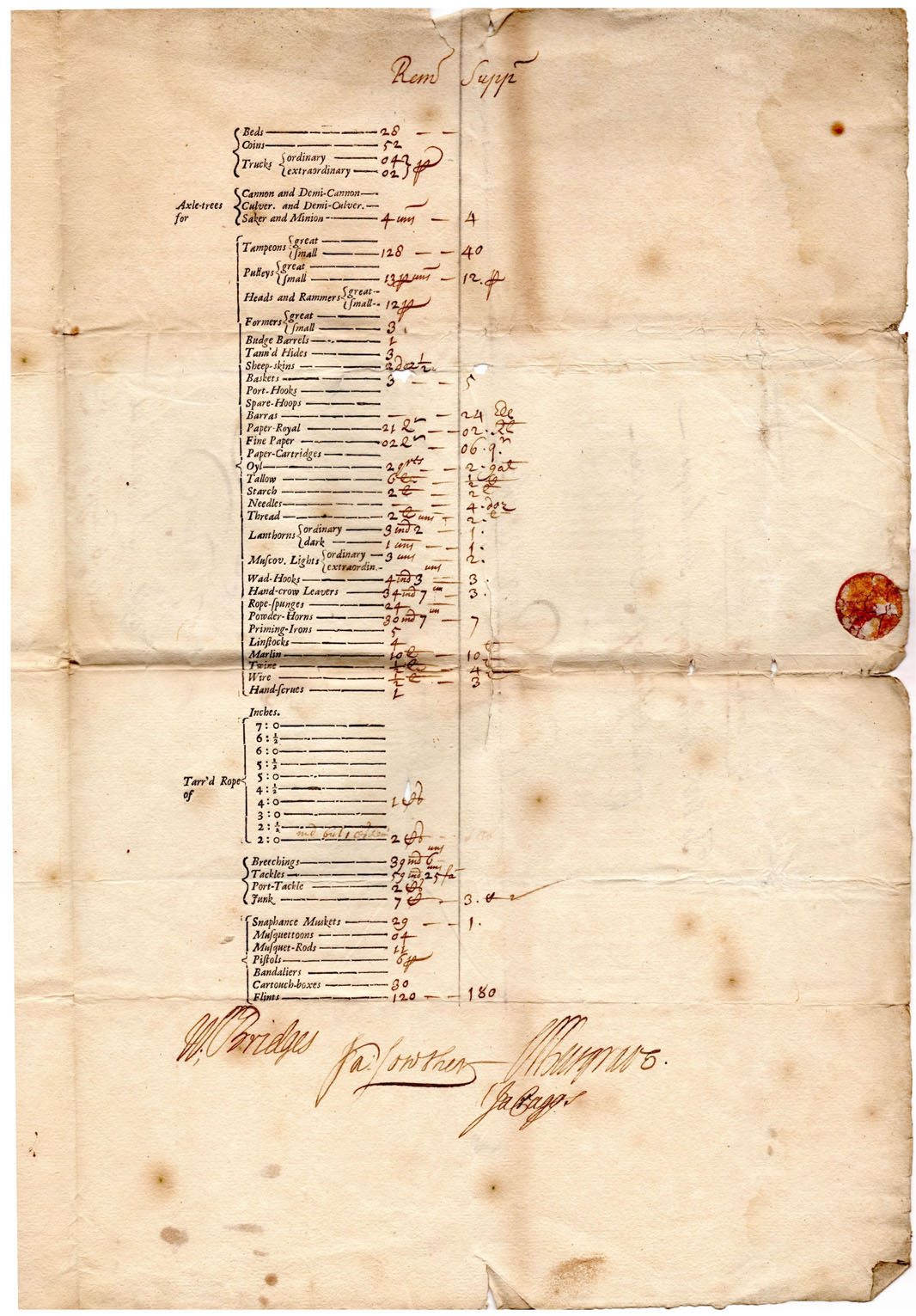
In November, on the 8th and 15th 1707, two indents for stores for HMS Cruizer appear for a substantial quantity of stores. These ‘Proportion’ documents are huge, about two foot square and printed in one piece of very heavy paper.

View in new tab:
Only one page of this document has survived.
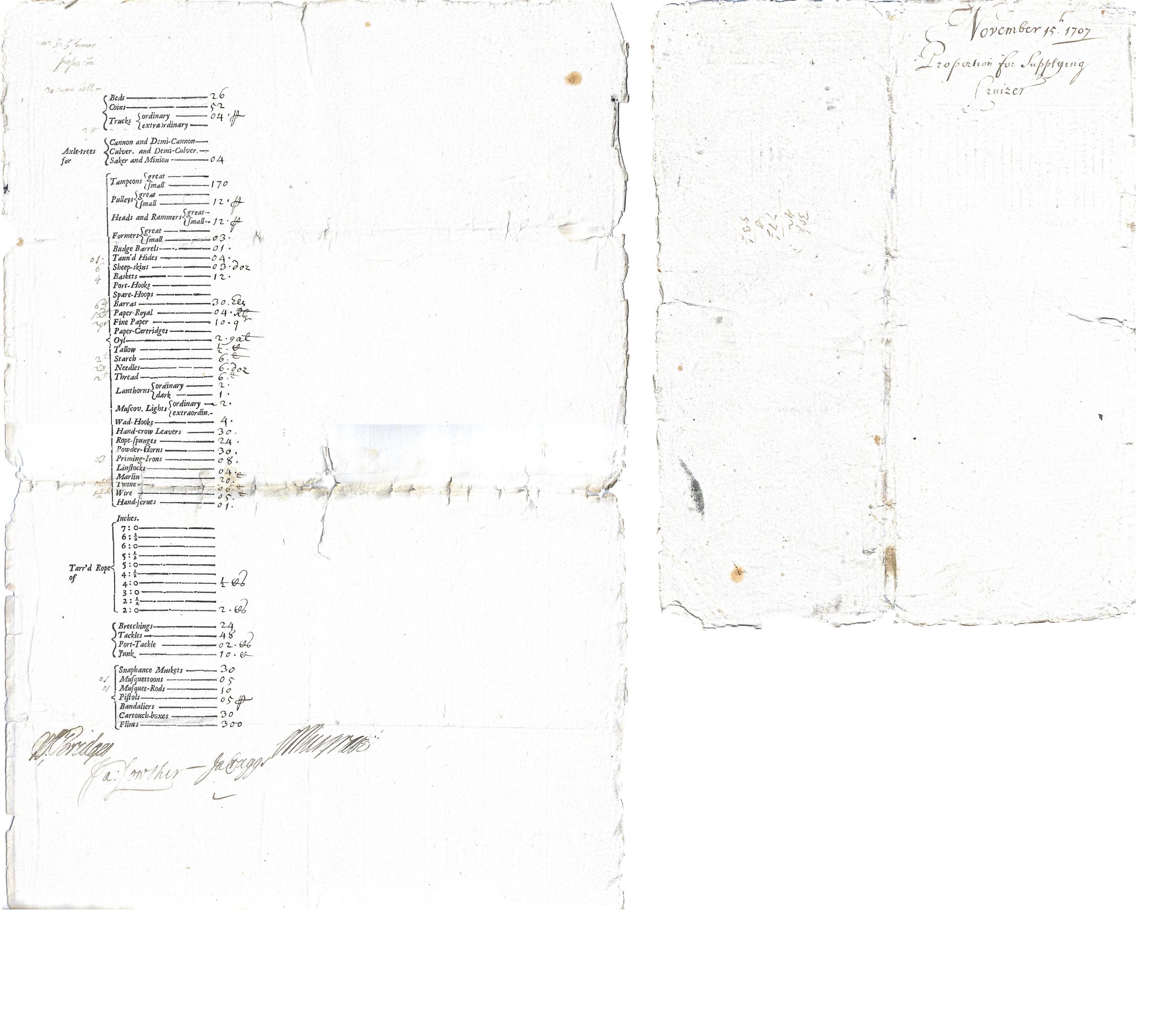
View in new tab:
On the 20th November 1707 The Board request an inventory of mortars in store at Portsmouth. Curiously, they also ask what bomb vessels are there; one might have expected them to know where their ships were. This letter is not as well set out as was usual for The Tower: the addition of the phrase ‘of what diameter &’ was clearly an afterthought, yet the letter has been signed by three board members.
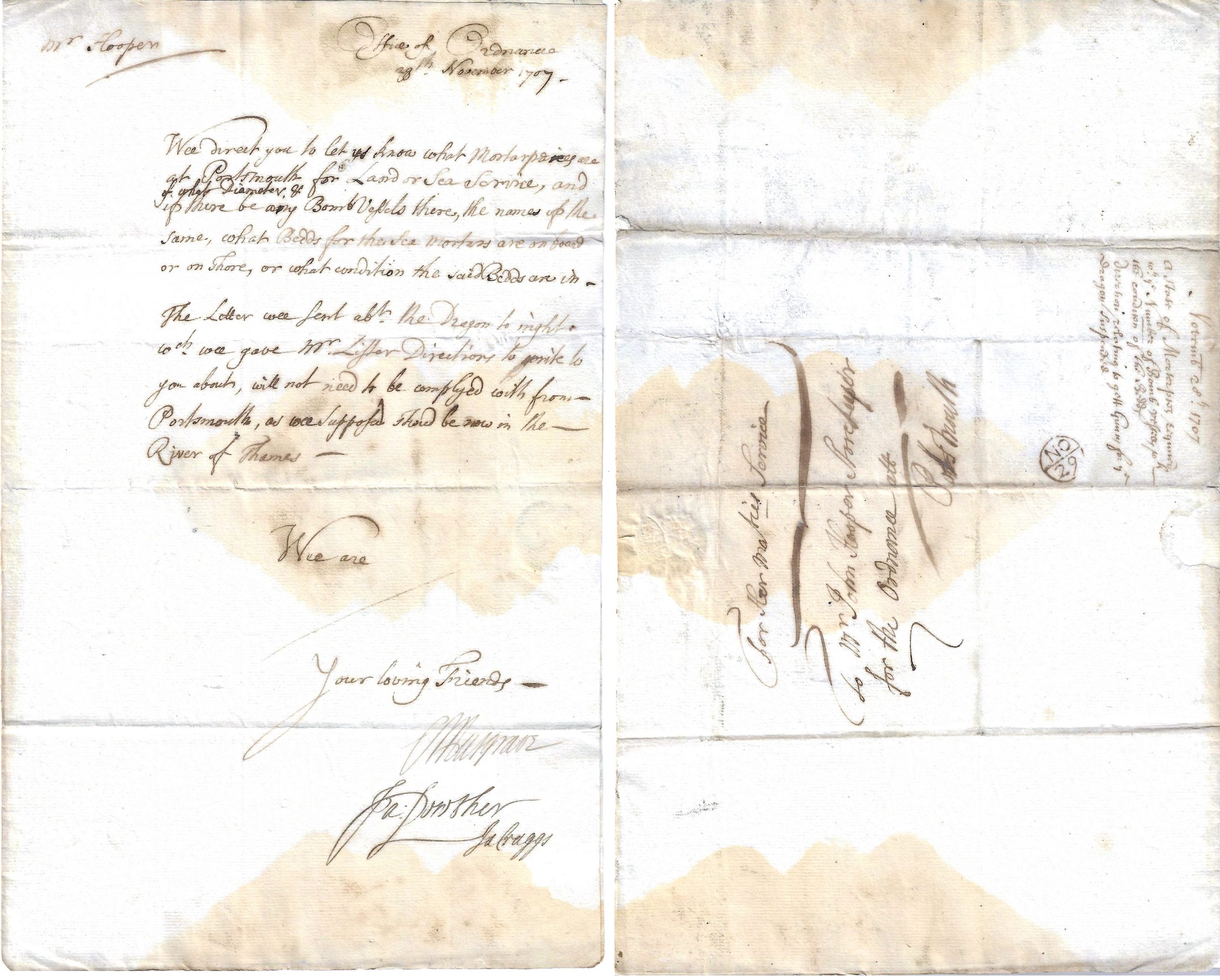
View in new tab:
It looks as though the mice have attacked the letter of December 20th, 1707, as there are two large holes in it removing some of the text. It concern’s Mr. Edge’s bill mentioned in the letter of 2nd October. It also advises that the Commissioners of Excise will be making a visit.
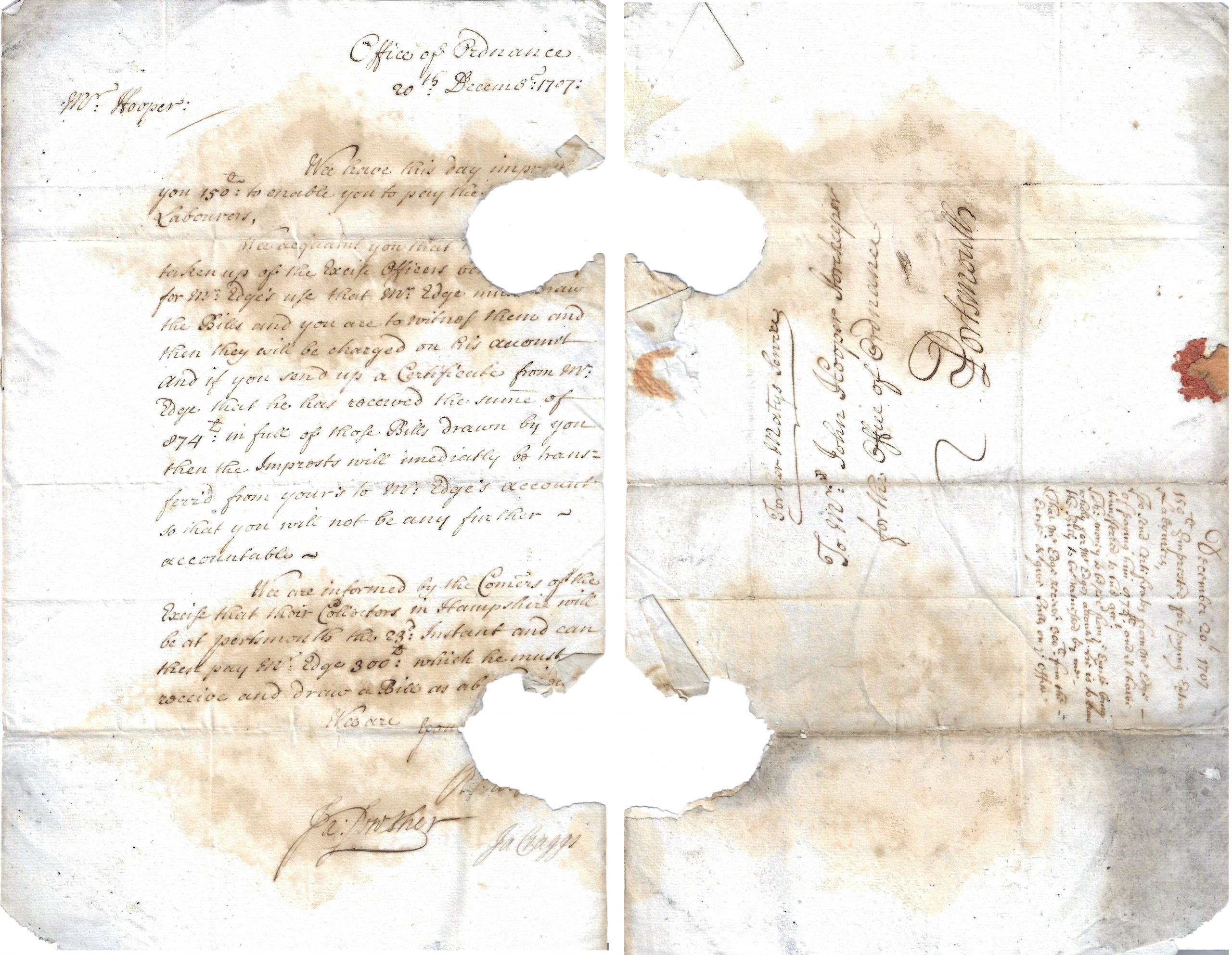
View in new tab:
The first letter of 1708, 27th January has an interesting postscript. It would appear that the army have been taking liberties with the dockyard by trying to draw ammunition without authorisation. There is a clear statement advising that they must apply to The Board in writing giving an account of expenditure.
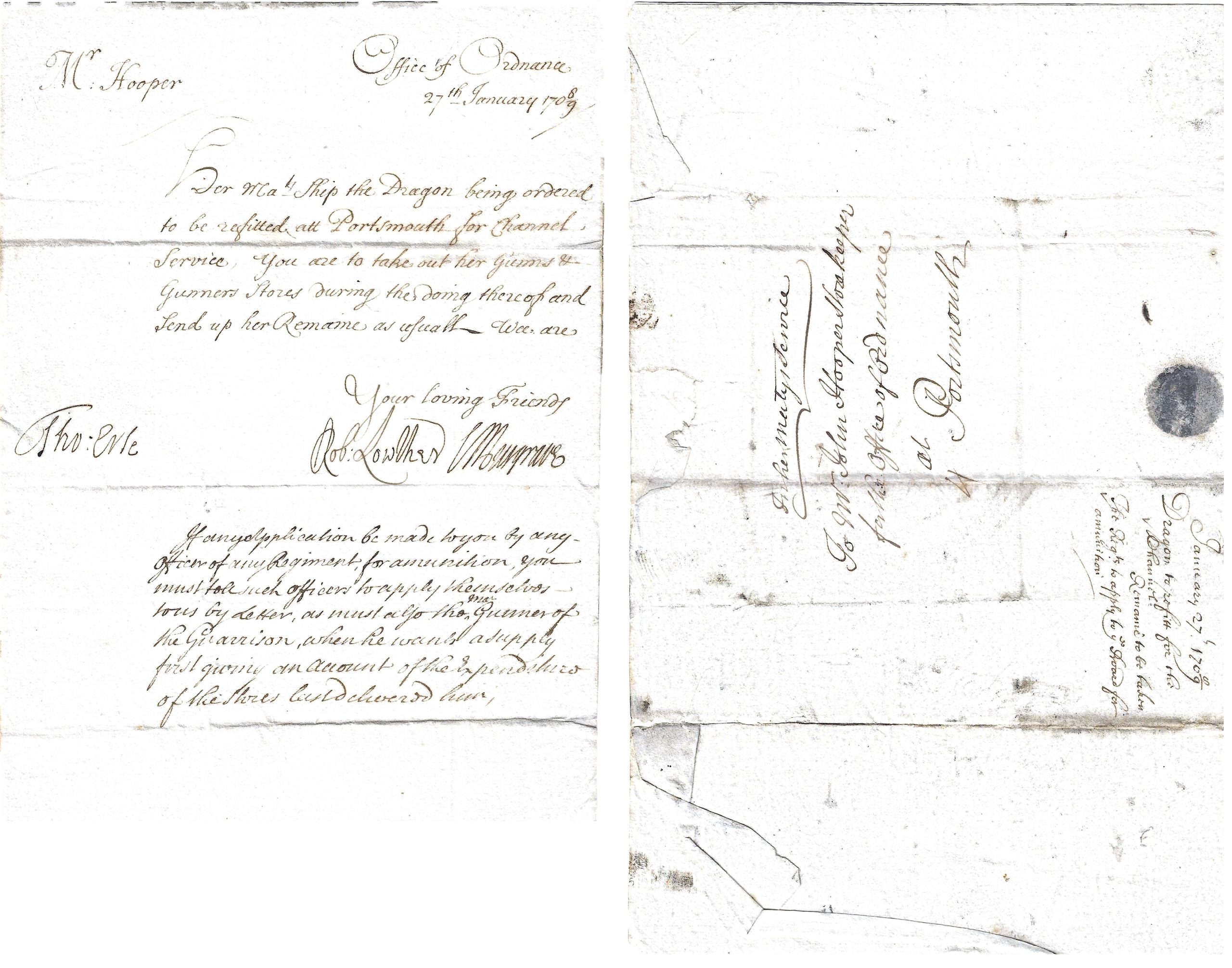
View in new tab:
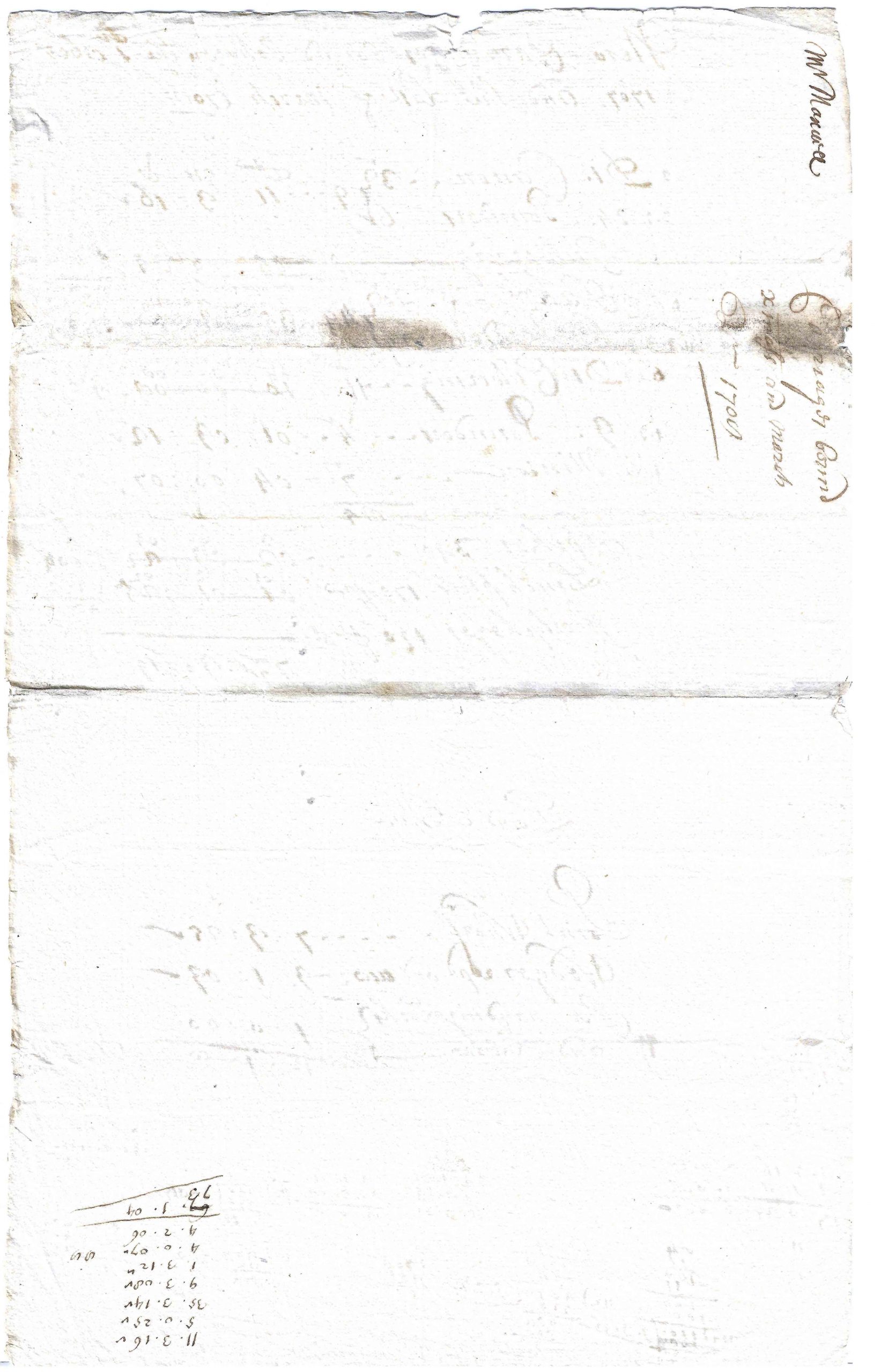
At the end of March 1708 Mr Maxwell submitted a bill for carriages. Usually the symbol for a pound weight was an ‘L’ with a strike through it, yet in this note we see the use of a unique symbol for a pound, he also uses a capital ‘C’ for cwt, and qr for quarter. He also uses the elaborate capital ‘P’ for ‘pair’, .
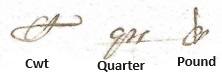
No costs are included, but we do get to see his workings at the bottom. Although there are no headings on the table, adding up the ‘Land Service’ bill, near the bottom, we know that these are weights being counted because the first column (pounds) adds up to 28 which is one quarter, if we then add this to the next column it comes to 5, so 1 recorded and one to carry to the hundredweights column. This gives us the result: 12cwt 1qr 0lb.

View in new tab:
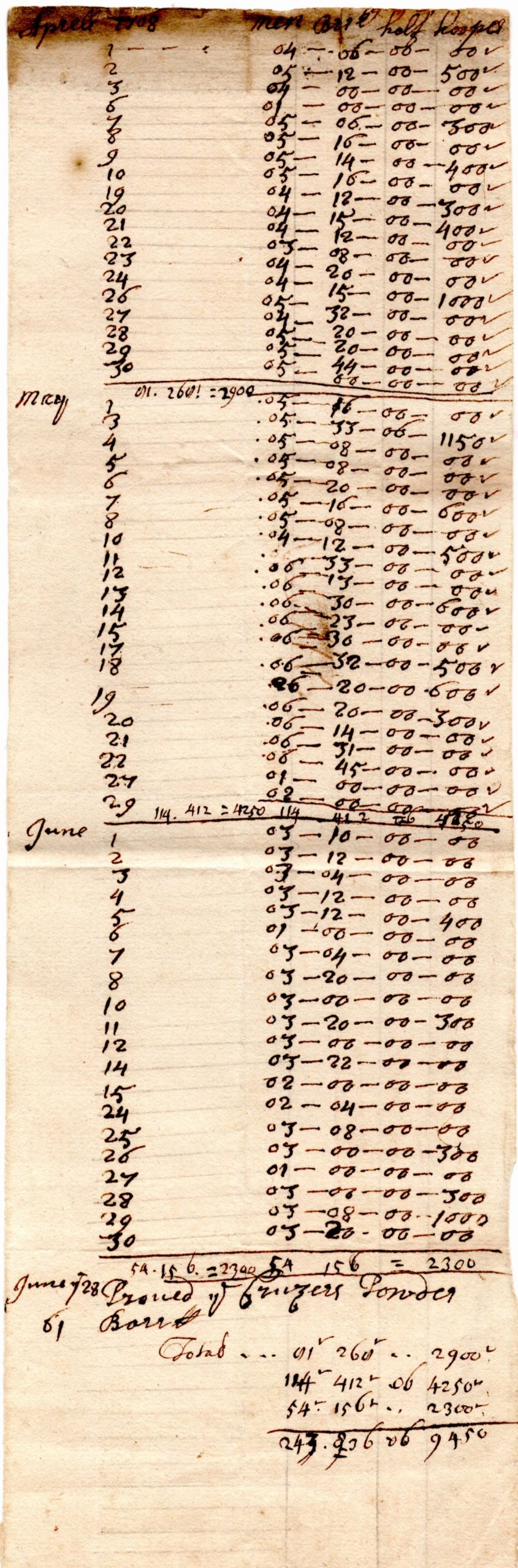
This document was transcribed by Philip Eley. It appears to be a list of work done by coopers during quarter two of 1708.
View in new tab
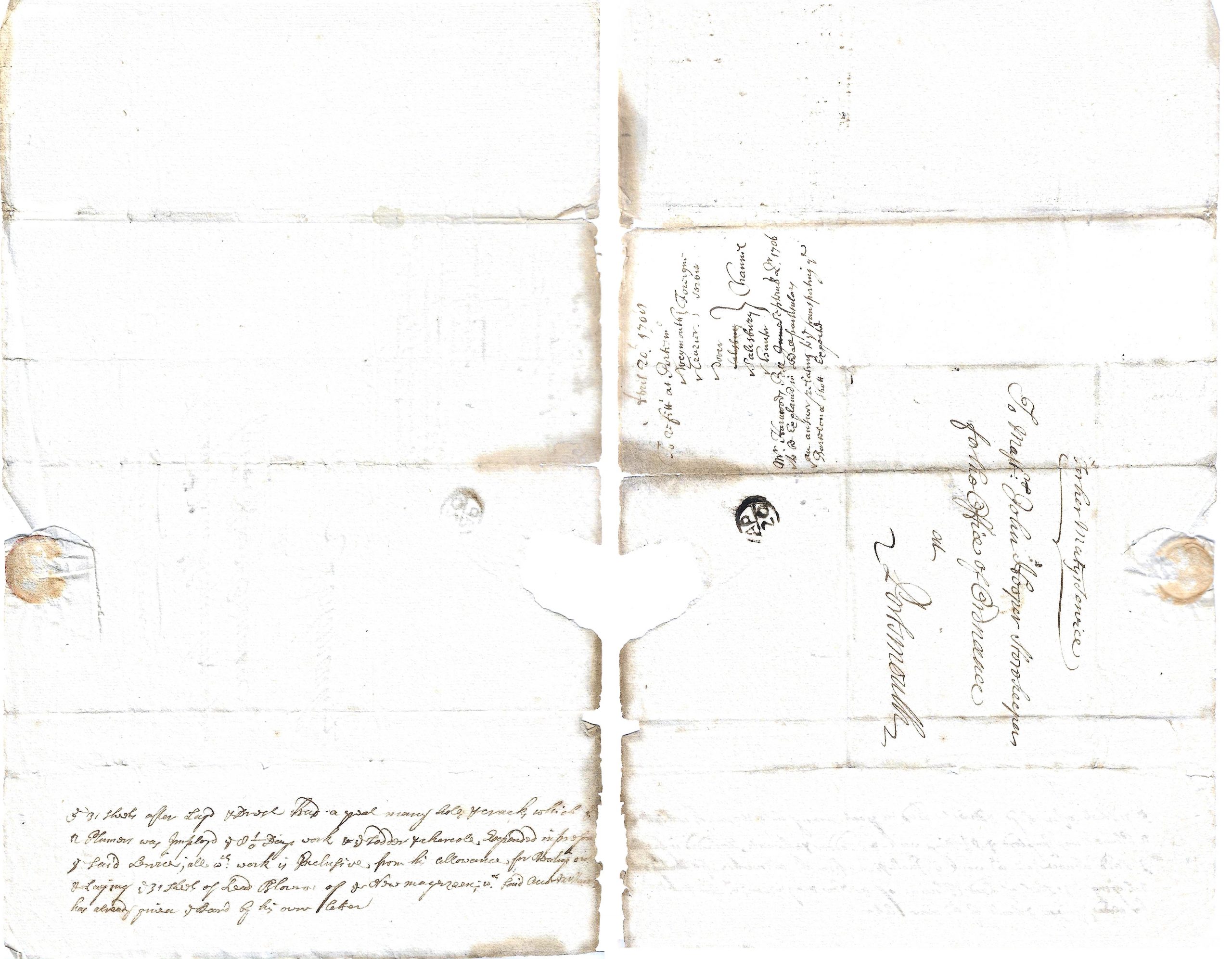
This is a confusing document. I suspect that a sheet ordering the refit of ships is missing. Curiously the bill from Mr Harmood, the plumber, appears to cover the September quarter 1706, yet is dated April 20th 1708, clearly, not both dates can be correct. Further: the precis does not appear to relate to the content of the note which on first sight appears to have been written by Mr. Harmood, yet has been addressed and sealed as if it has come from The Tower.
View in new tab:
The document of May 20th, 1708 while written in a neat hand, is difficult to transcribe as the writer uses some unusual characters for his ‘h’s, ‘c’s and ‘s’s. It is unclear who the letter is from or to, but the precis says that it is Mr. Hooper’s report relating to guard ships, so it is likely that it was written by John Hooper, or his clerk, and one might assume that it was intended for The Board, but it would seem unlikely that he would bother The Board with trivialities such as three stopped vents.
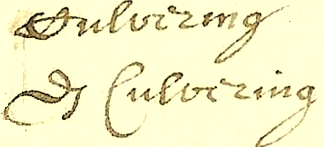
Something that I noticed: Where this document refers to Culvering and Demi Culvering is the use of two differently scripted capital letter ‘C’s, and the use of an odd contraction for Demi, meaning half. The ‘C’ s are a mix of the older style ‘hot cross bun’ design which we also see used as a contraction for hundredweight, and the more modern version that we are more accustomed to. While the contraction for Demi (di) appears to be using the same contraction that was used to indicate a penny (d) followed by ‘i’.
This document introduces Isaac Townsend (1656 – 1731) who was commissioner of Portsmouth Dockyard, not to be confused with his nephew Isaac Townsend (1685 – 1765).

View in new tab:
We then have three bills for carpentry, cooperage, and armoury.
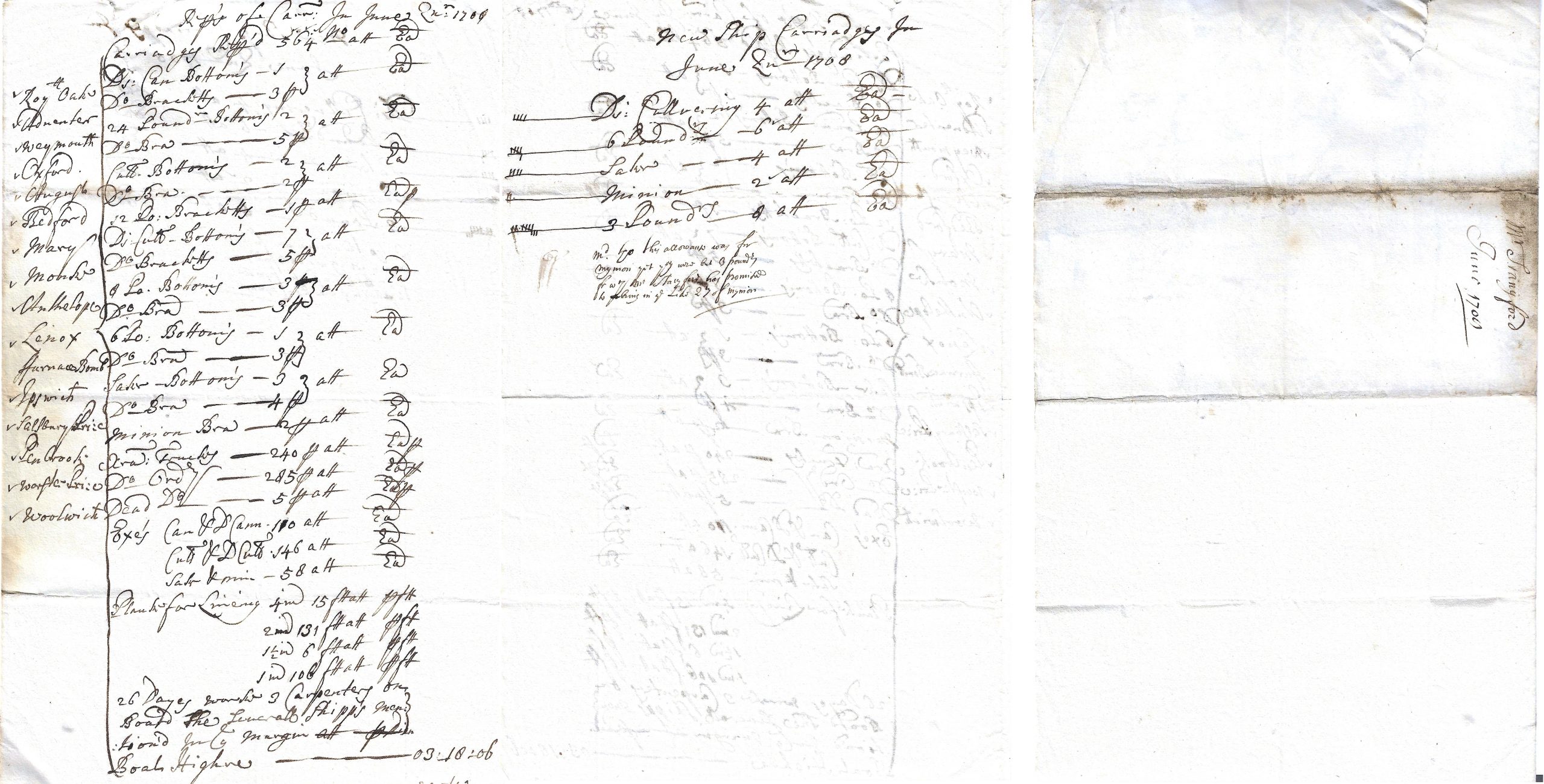
In June of 1708 Henry Stanyford was busy repairing gun carriages for 16 ships. As £3/18/6 was billed for boat hire we must assume that the ships were moored at Spithead. He has abbreviated many of the terms, but in most cases his meaning is clear. In this bill we also see the use of a redundant term for money: ‘mammon’, spelt mymon in this bill.
View in new tab:
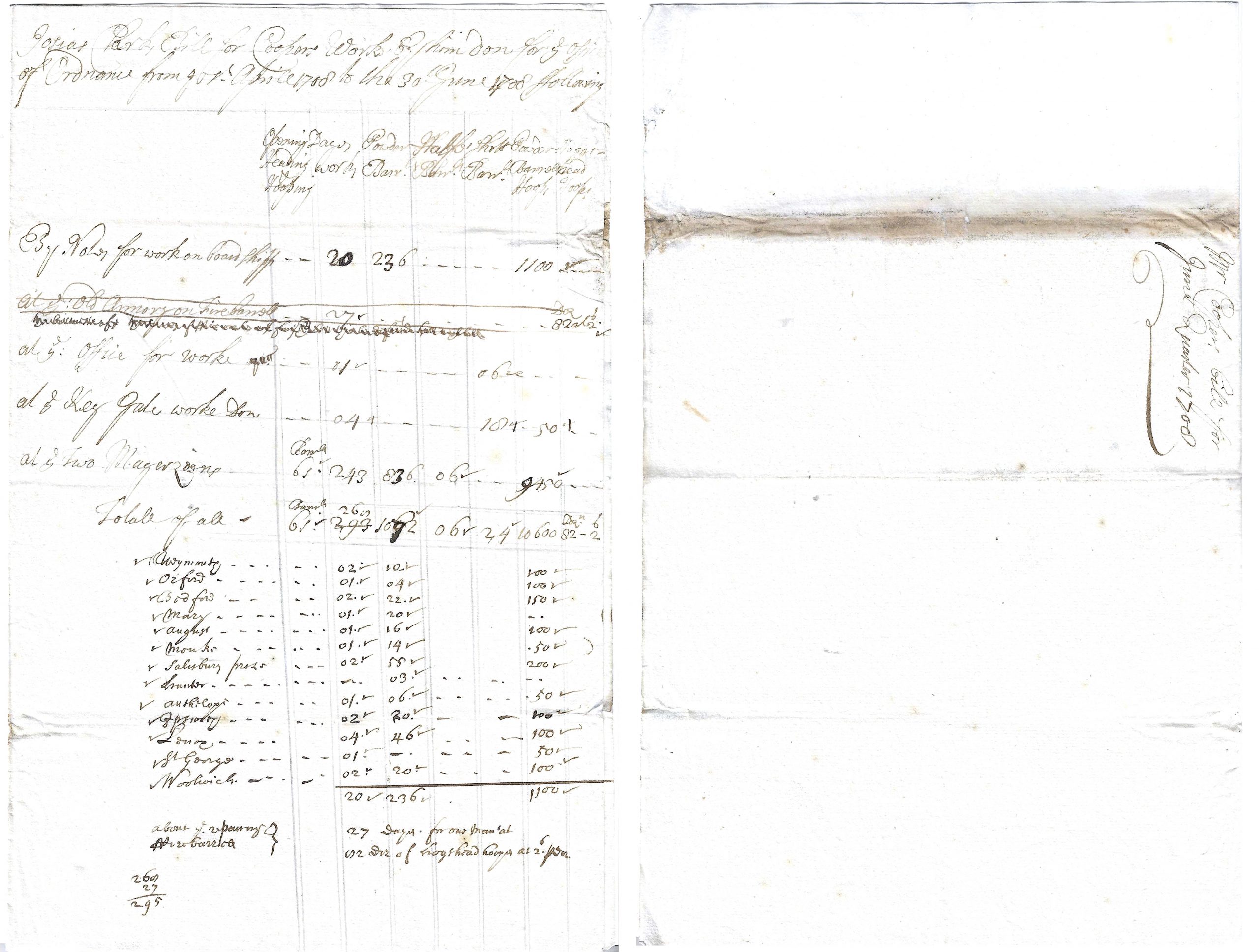
Mr. Josias Clarke’s coopers bill, written on fine paper demonstrates how Mr. Clarke struggled: paper was at a premium, so mistakes had to be included.
View in new tab:
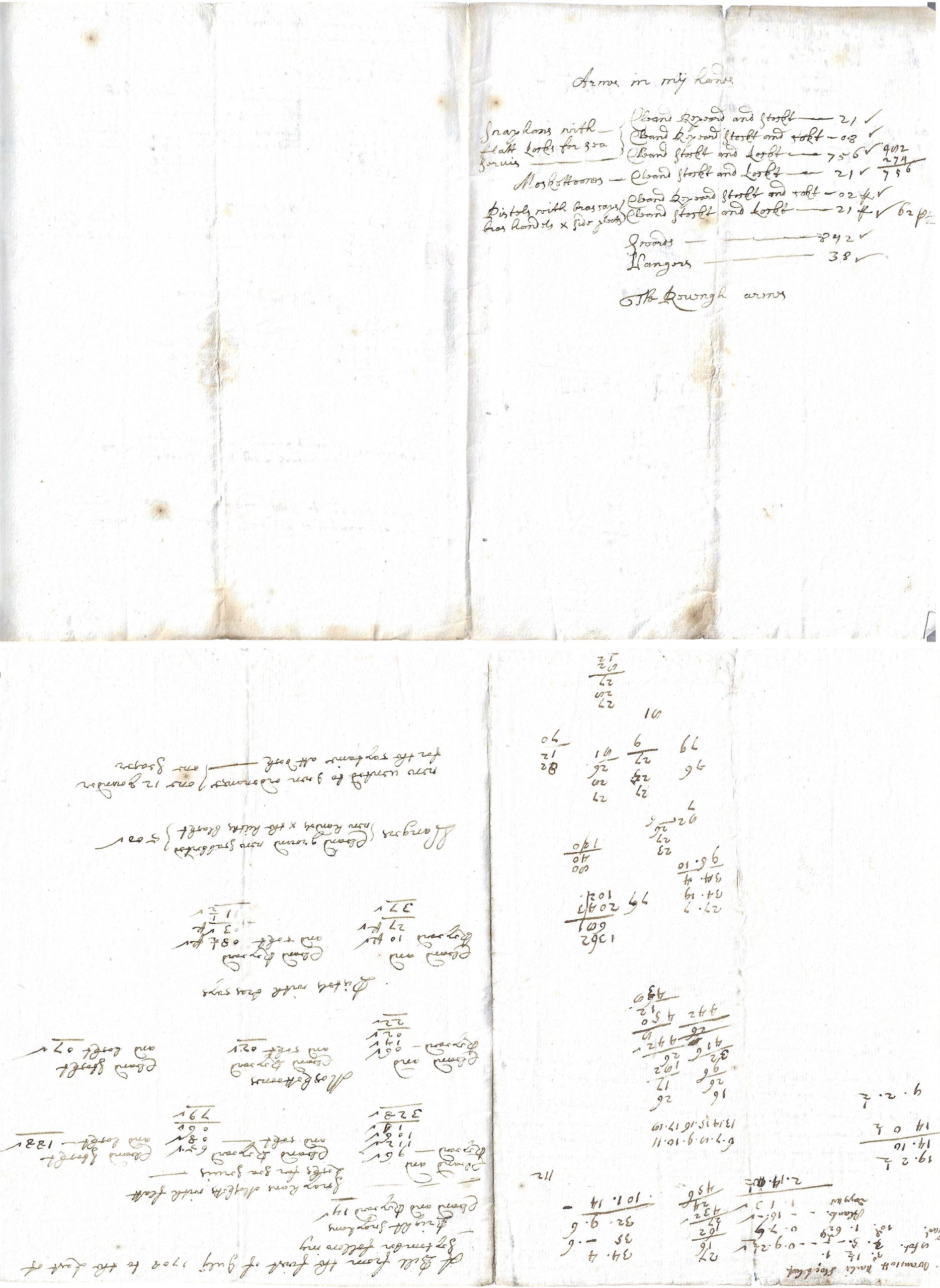
The third is an armourer’s bill, probably from John Silvester, or his son, Edward.
View in new tab:
Most of the stores sourced for the Ordnance Office were brought by sea, but some, smaller items, came by land, and some were locally sourced.
Notice at the bottom September has been contracted to ‘7ber‘
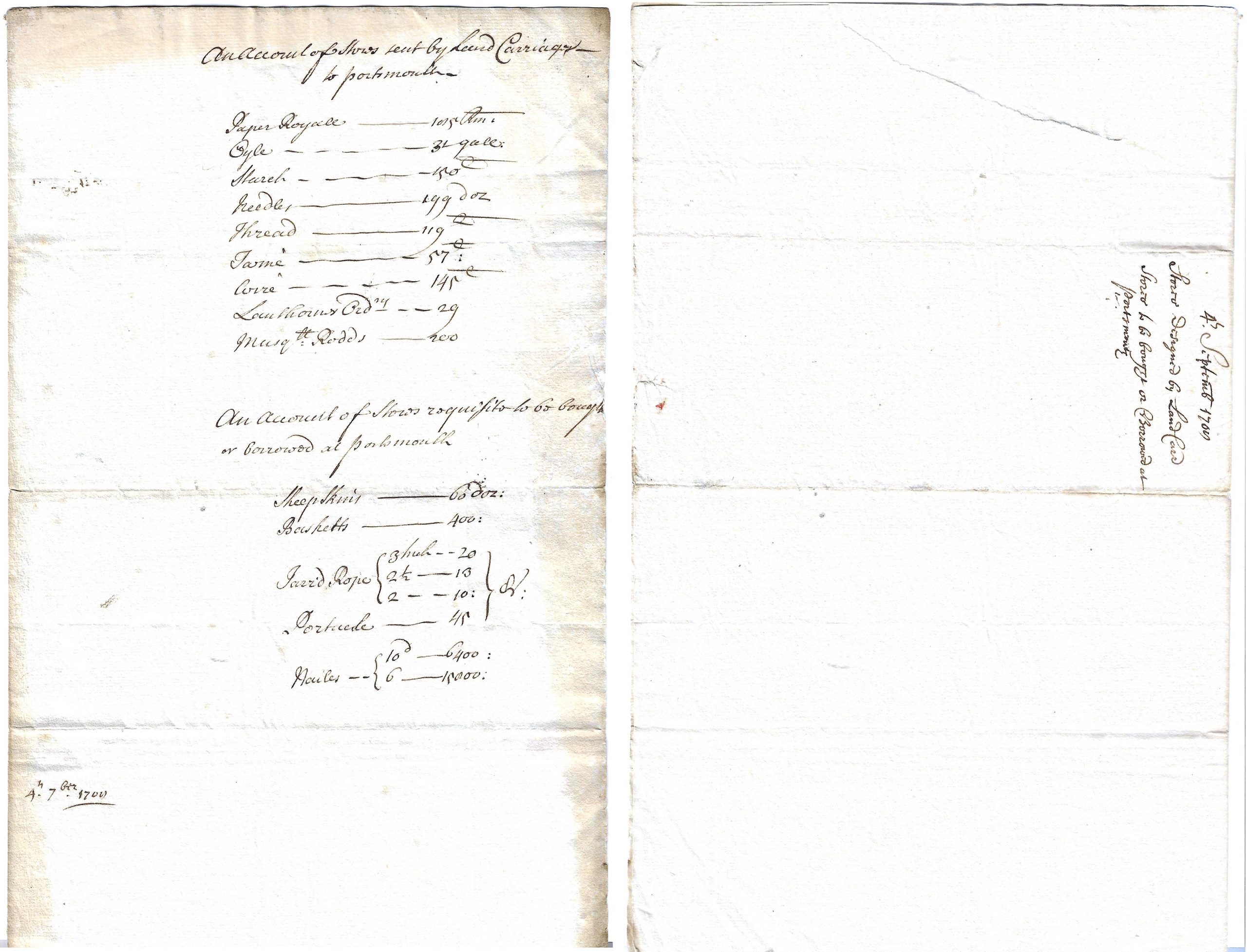
View in new tab:
The 126 reams of paper royal referred to by John Mears on September 7th arrived on 4th September when we see a double receipt, neither are signed.
Mr. Basket of London, who also had a store in Portsmouth, was a regular supplier of paper.
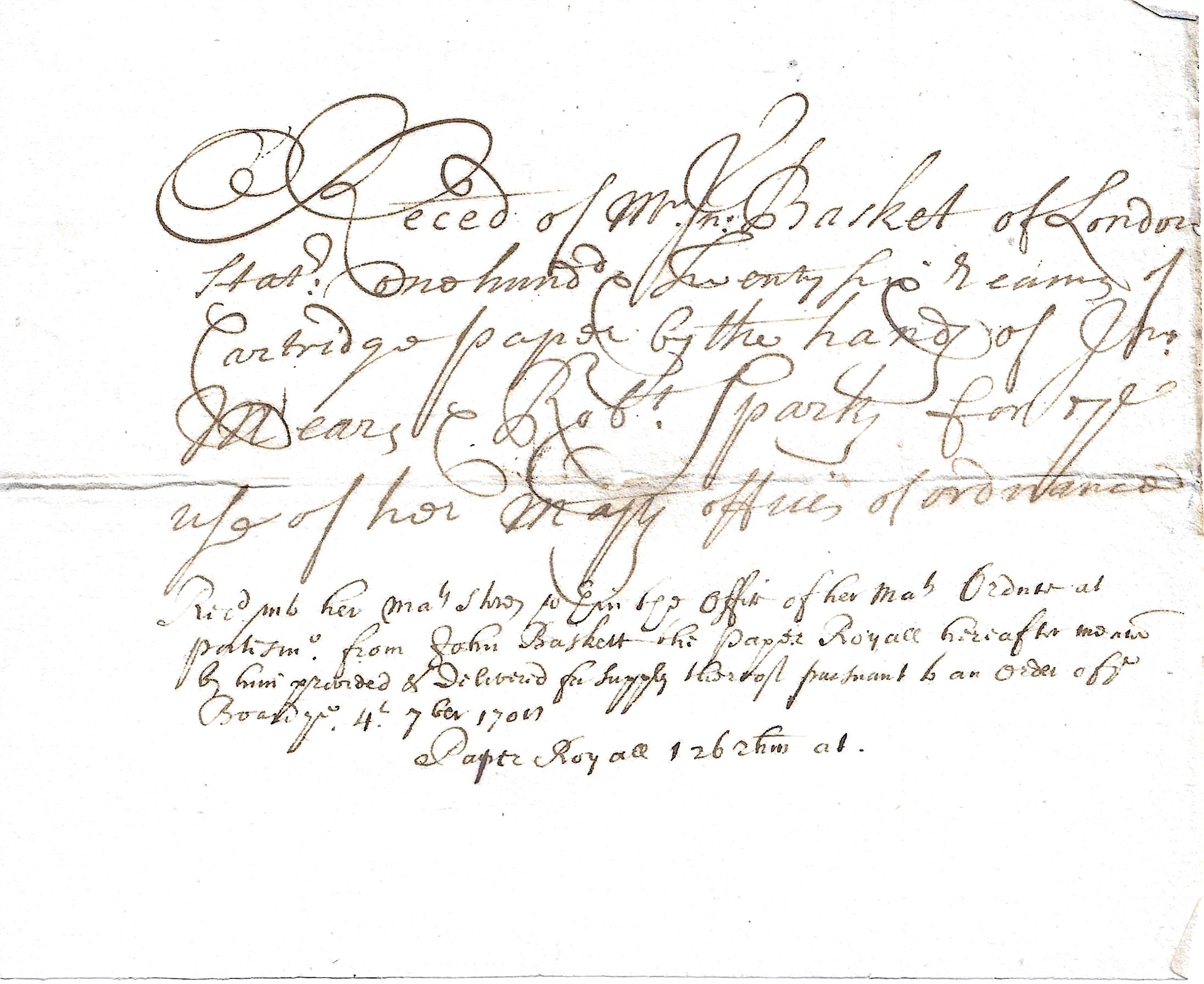
View in new tab:
This one is a gem! A note, written on fine paper by the master of the hoy Sarus, it is full of information and atmosphere. A ‘receipt for payment for paper royal’ (cartridge paper) dated September 8th, 1708, John Mears apologises for a shortfall of 59 reams of paper due to bad weather. This, again, underlines the difficulties in transporting goods in these times. It is this document that allows us to positively identify ‘Paper Royal’ as Cartridge Paper, used to make cartridges of powder for the guns.
One should not take the use of phonetic spelling as a sign of being uneducated. Being a ship’s master required a deep knowledge of mathematics and having passed the master’s examination, so John Mears was probably better educated than the clerks who wrote the well-presented letters from The Tower.
This note is also an excellent example of phonetic spelling, one can almost hear John Mears’ accent when reading this; one might imagine the actor Robert Newton, in his portrayal of Long John Silver in the 1950 film Treasure Island. However, this does present a challenge in transcribing the document; it requires that one reads it in the ‘accent’ it was written for it to make sense.
Unusually, I have included a translation from the original, faithful transcription to modern language for this document.
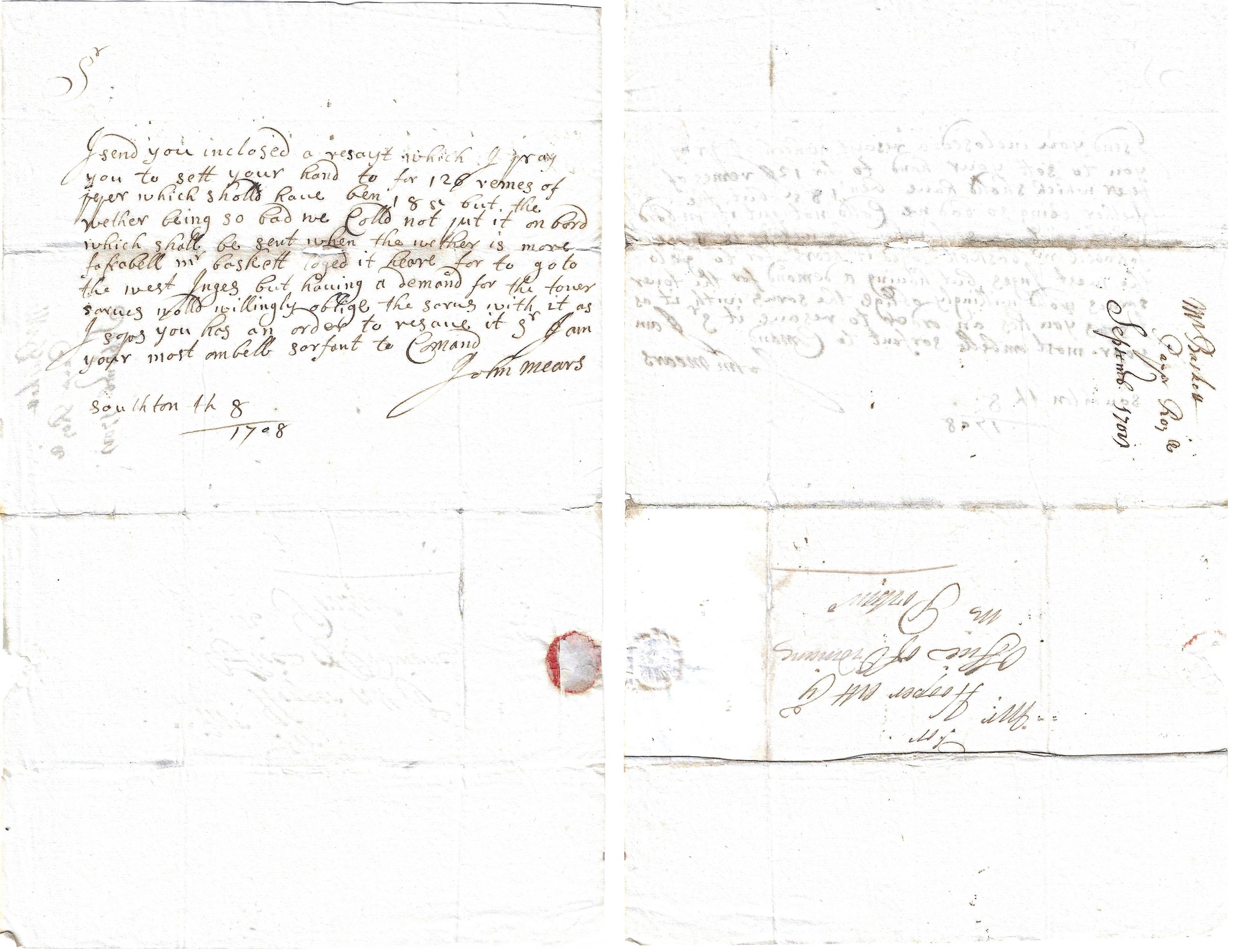
View in new tab:
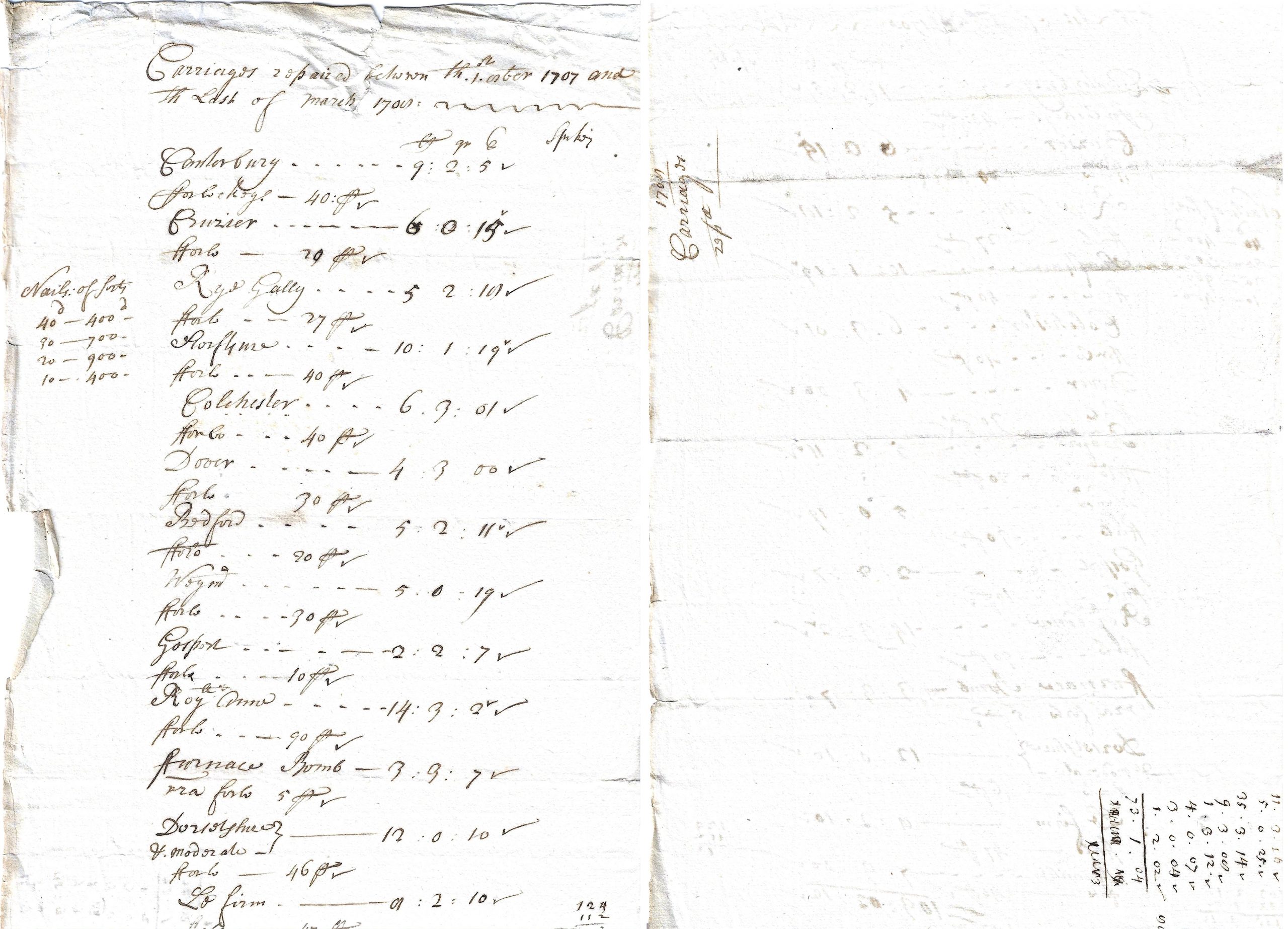
This receipt for repairs to carriages is particularly challenging. I have assumed that the contraction ‘Forlo’ is for Forelock Keys. These looked like large cut nails, retained by a chain, and were used to lock down the cap squares onto the trunnions by driving them into a hole in the hasp of the capsquare.
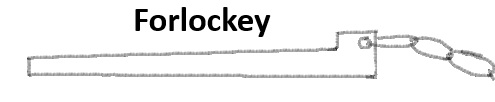
View in new tab: