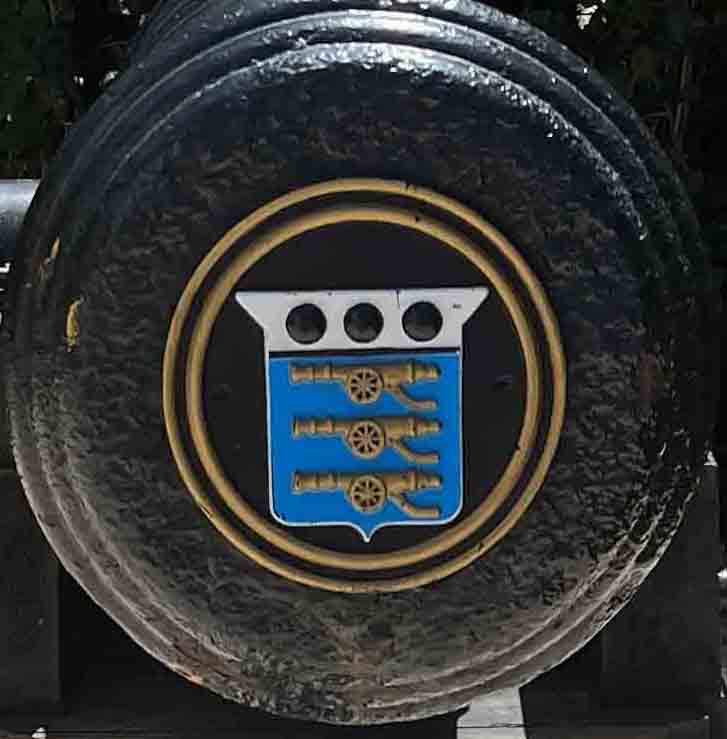
You will find download buttons for the scans and transcripts, or you can view them online by clicking the links where it says “View in new tab:”.
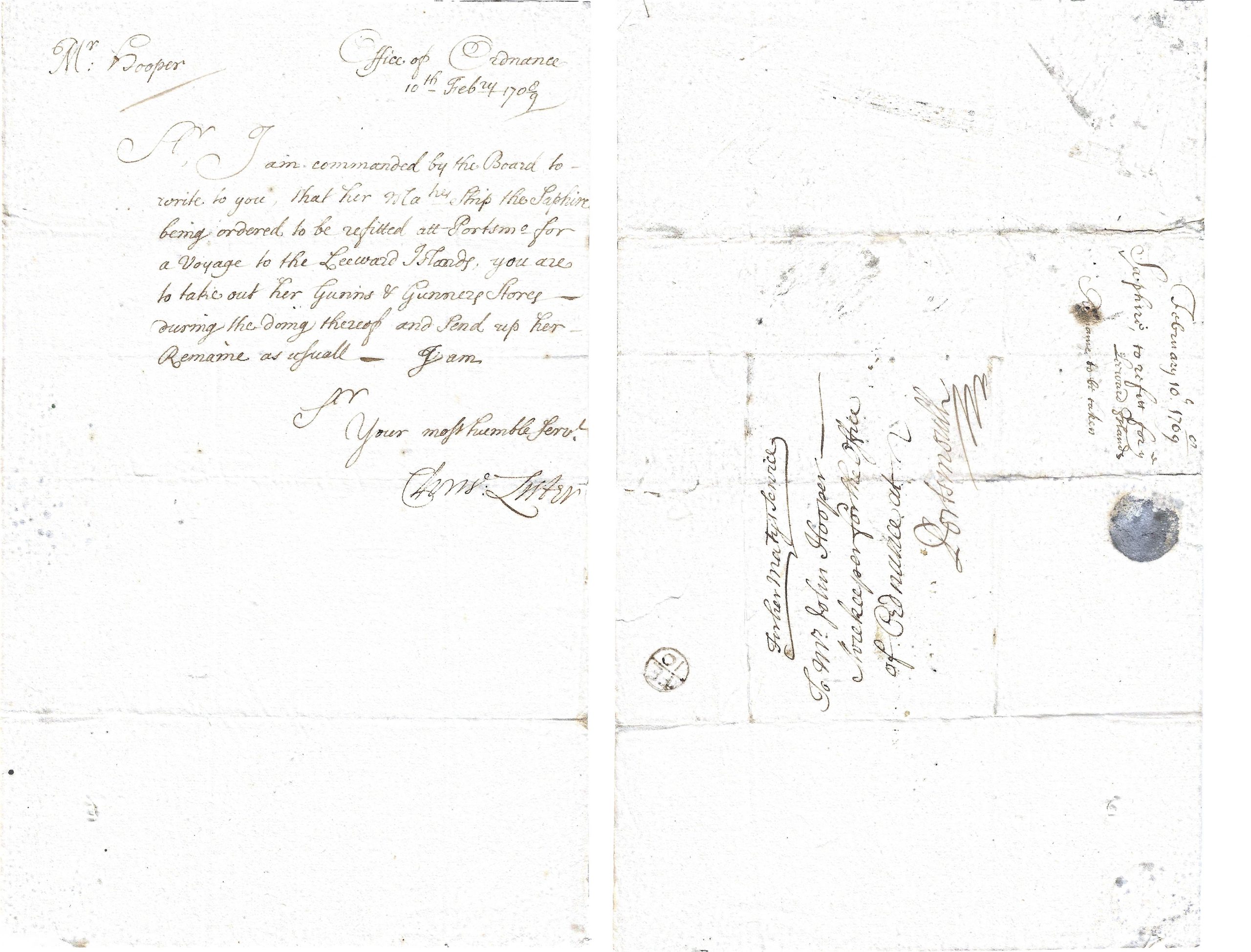
The letter of 10th February 1709 introduces Chris Lister who will be signatory to many future letters from The Tower to Mr Hooper. This one advising that HMS Sapphire is to be readied for a refit in preparation for a voyage to the Leeward Islands.
View in new tab:
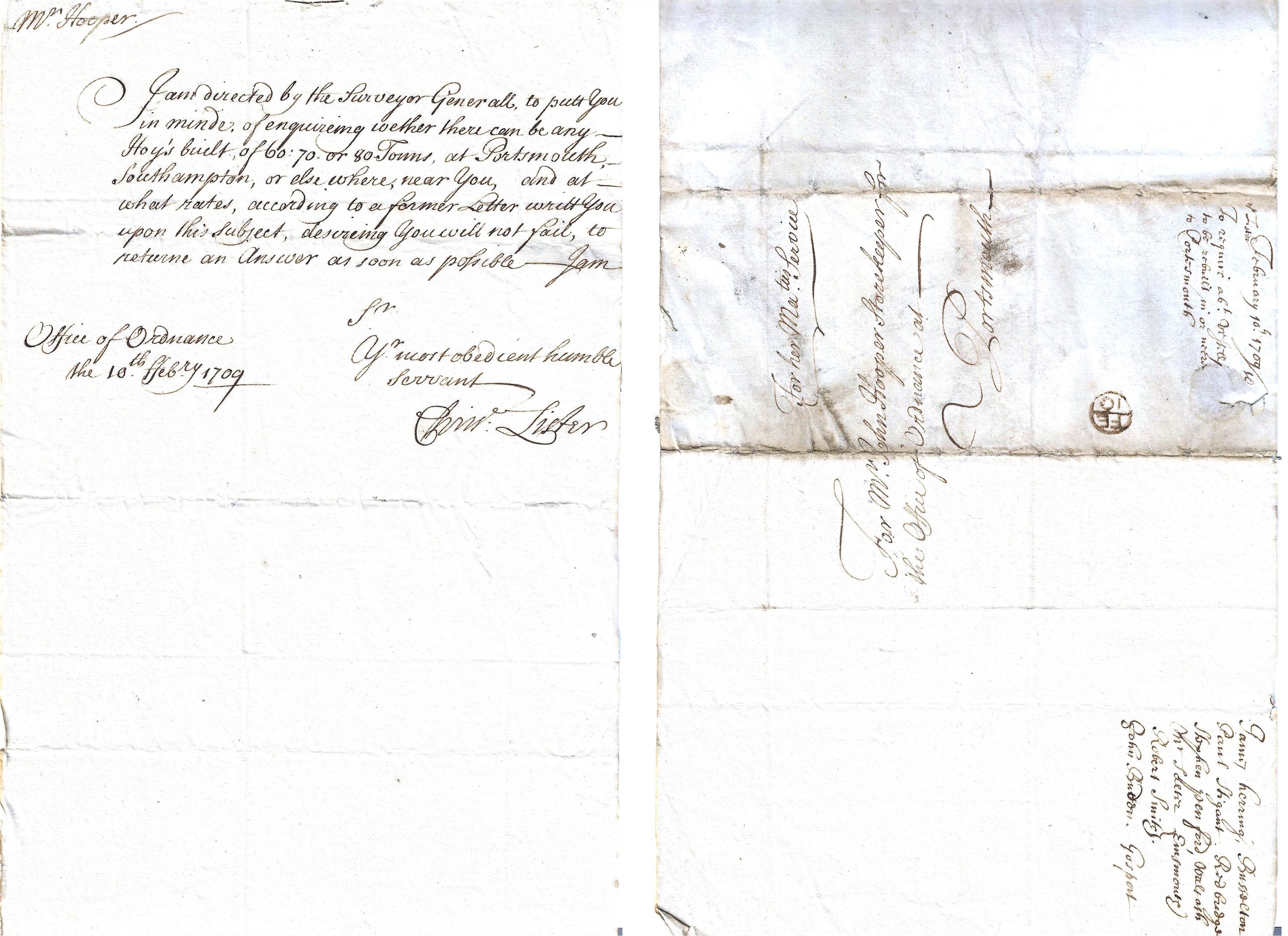
Chris Lister writes again to Mr. Hooper enquiring if he can recommend builders of hoys. Unusually, we get to see, in part at least, the reply, as suggested boat builders are listed on the reverse of the letter. He recommends three in the Southampton area: Burseldon, Redbridge and Warsash, one at Emsworth and another in Gosport.
It would appear that Mr. Hooper has not answered the enquiry in full as he has put no rates for the hoys, but then, we don’t actually see the the reply that was sent.
View in new tab:
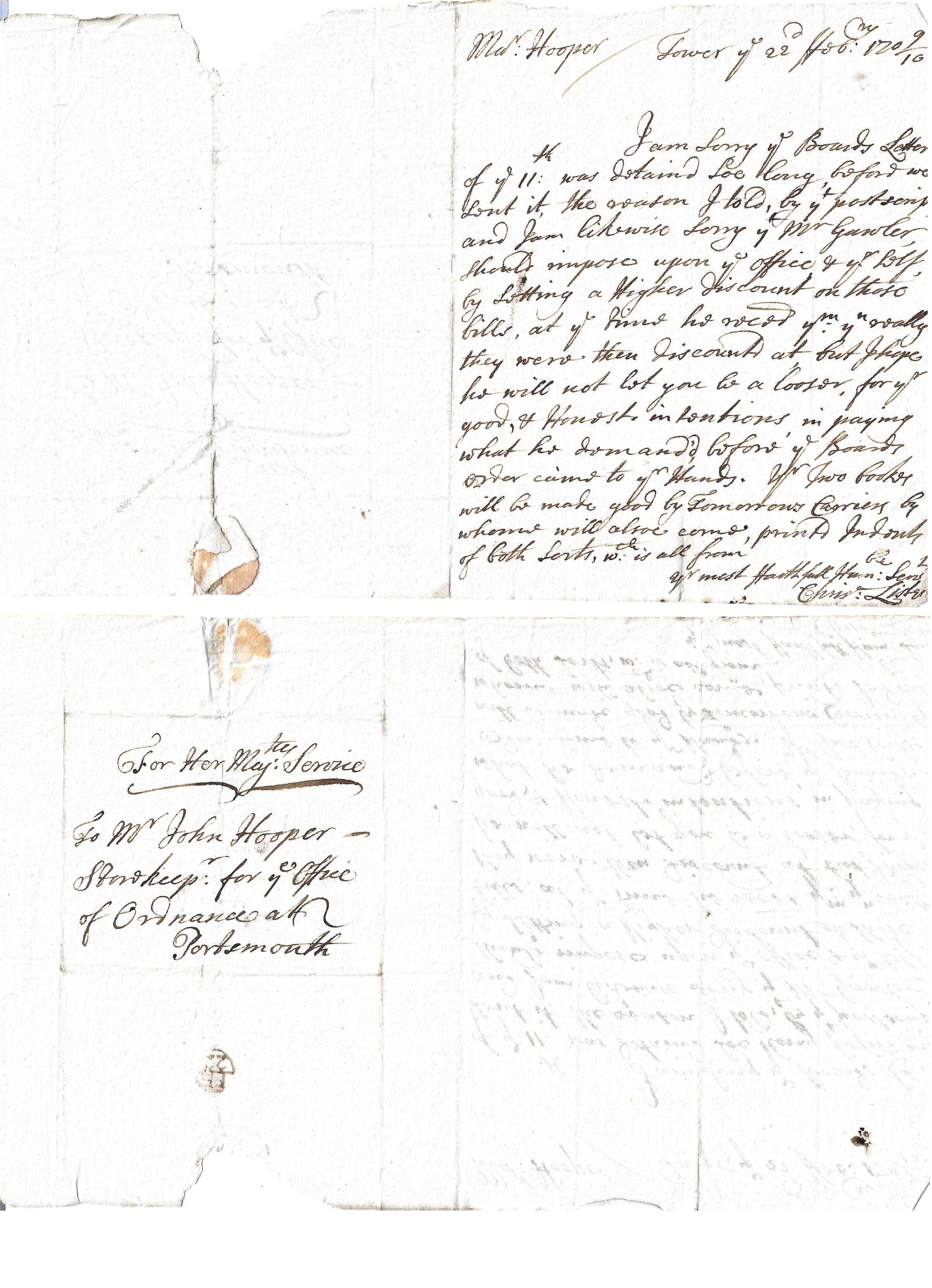
On 22nd February Chris Lister writes a letter, crammed with contractions, apologising for the delay of a previous letter which we are not privy to. The delay, it would appear, has created difficulties for Mr. Hooper which Chris promises to rectify the following day.
View in new tab:
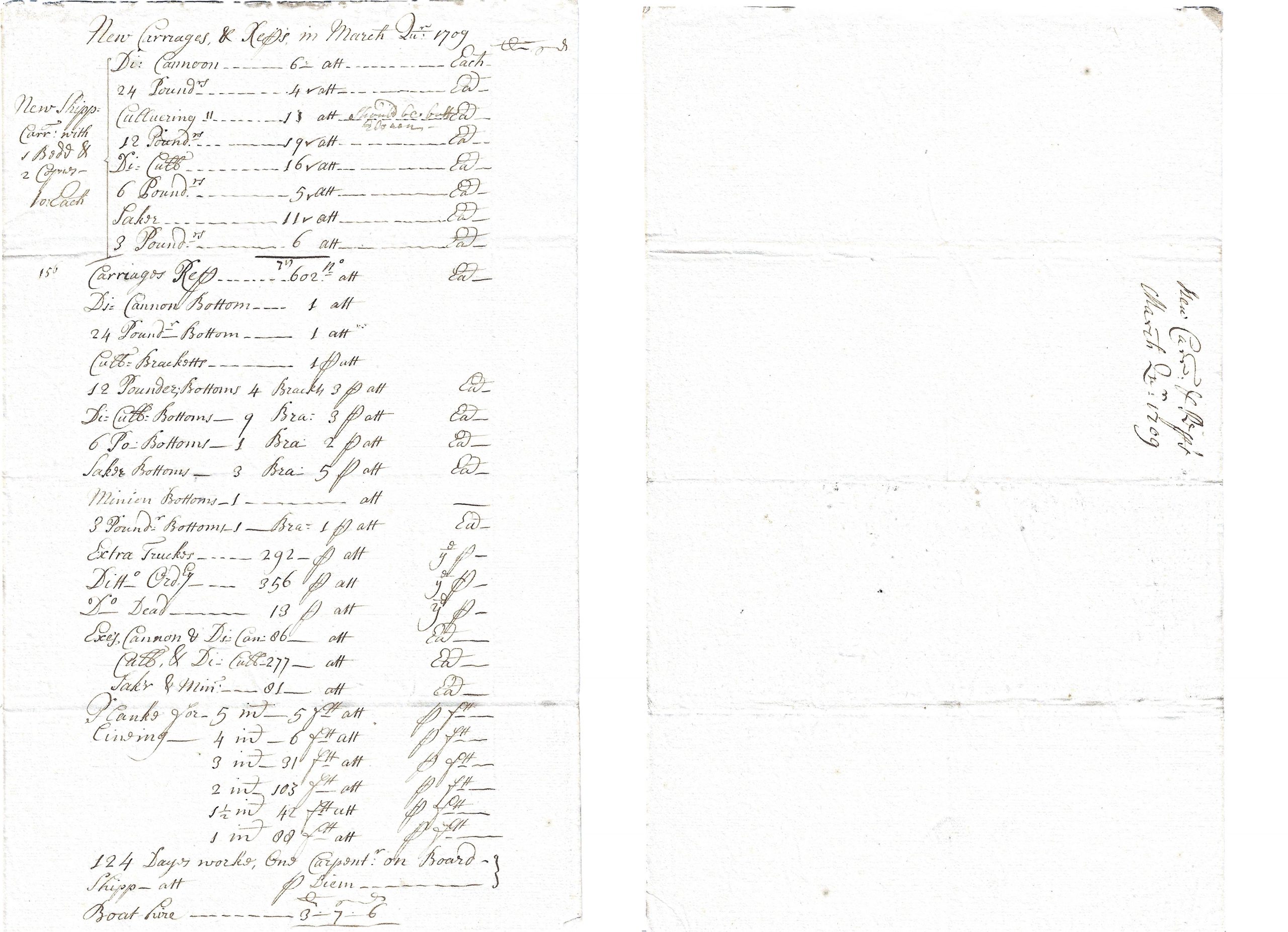
This list of new gun carriages and repairs for the March Quarter, probably from Archibald Maxwell, makes good use of the capital ‘P’ as a contraction both for ‘pair’ and ‘per’.
View in new tab:
On 5th March a letter requests that HMS Medway Prize (1704) is prepared for refit. The suffix ‘Prize’ was given to a vessel taken, in battle, as a prize. In this case Medway Prize was taken from the French in 1704 by HMS Medway (1693). She was a 28 gun frigate, originally known as Les Trois Provinces. HMS Medway actually took three ships as prizes.

View in new tab:
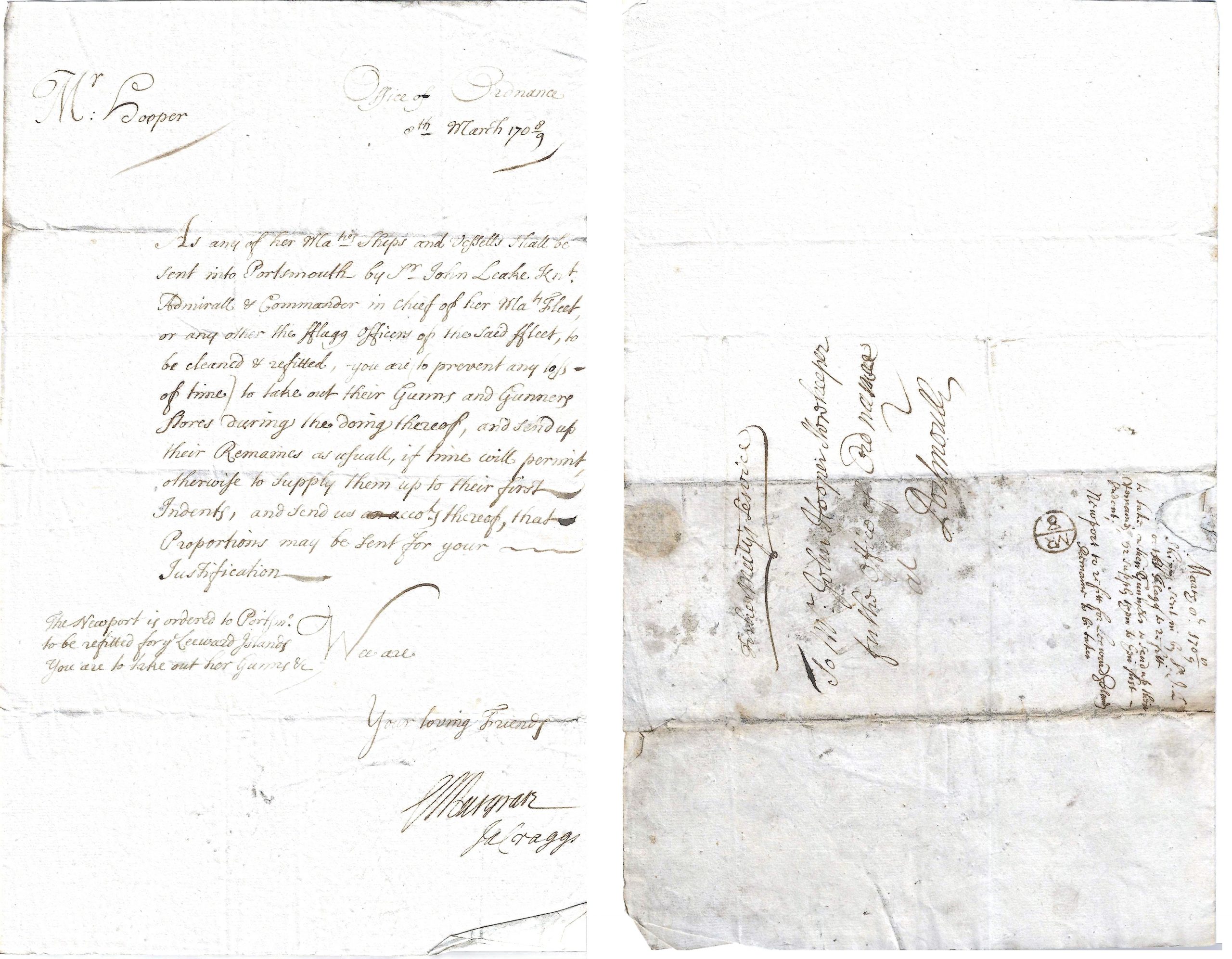
Admiral Leake was, in 1708, reappointed Commander-in-Chief of the Navy. The letter of the 8th of March 1709 appears to be a reasserting, in his name, the need for the dockyard to expedite the turnaround of vessels coming in for cleaning and/or refitting, and that they should take instructions from any flag officer of his fleet. A flag officer would have been a man ranking commodore or above, who would have flown their own pennant.
Possibly Admiral Leake was asserting his authority, or possibly had experienced delays, yet there has been no mention of such in previous letters from The Tower.
View in new tab:
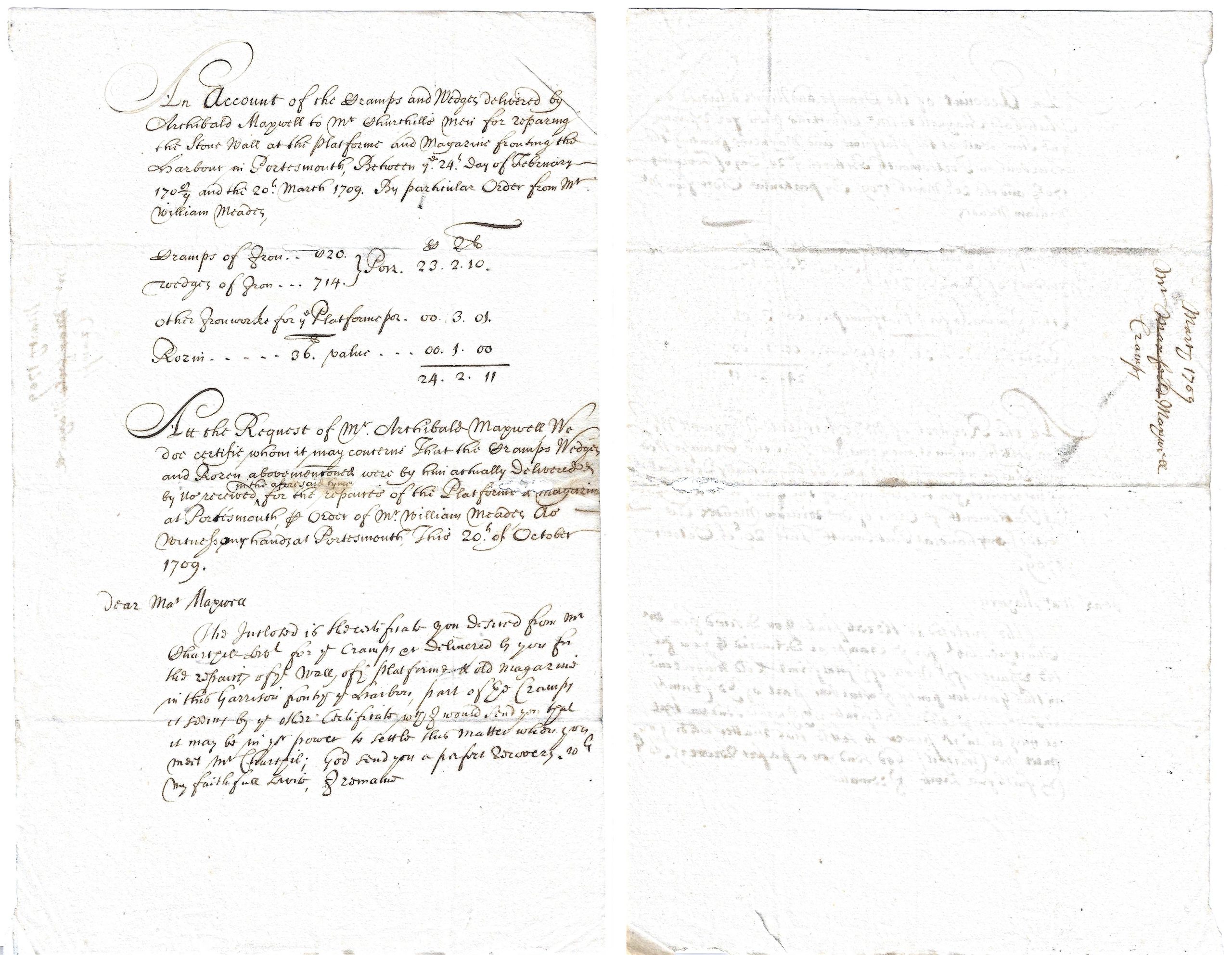
This note regarding supplies for repairs to ‘The Magazine’ and ‘The Platform’ is referring to The Square Tower and The Saluting Platform, at the north west end of the Curtain Moat.
View in new tab:
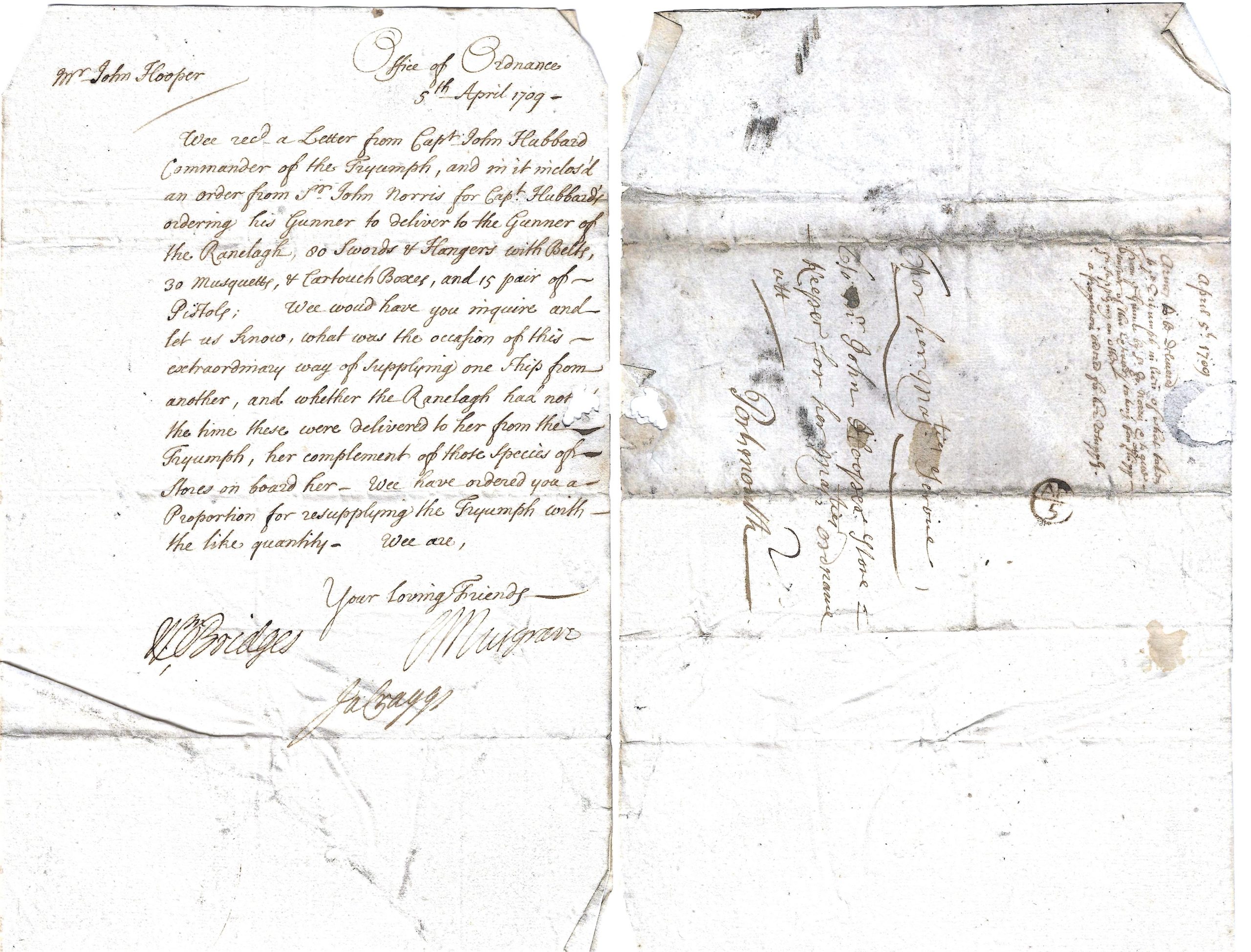
A somewhat angry letter from The Tower to Mr. Hooper on 5th April 1709 asks him to investigate the circumstances which resulted in the commander of HMSRanelagh (1697), Sir John Norris, ordering Captain Hubbard of the Triumph to supply him with small arms. An irregular occurrence that required Captain Hubbard to write to The Tower in order to replenish his own supplies. Incidentally, on 24th August 1704 Ranelagh had fought in the Battle of Malaga against a Franco Spanish fleet. John Hubbard also fought in the battle where he commanded HMS Essex.
View in new tab:
An account of work performed by hoys. Unfortunately the bottom of this document missed the scanner. Thanks to Philip Eley for his help in transcribing this document.
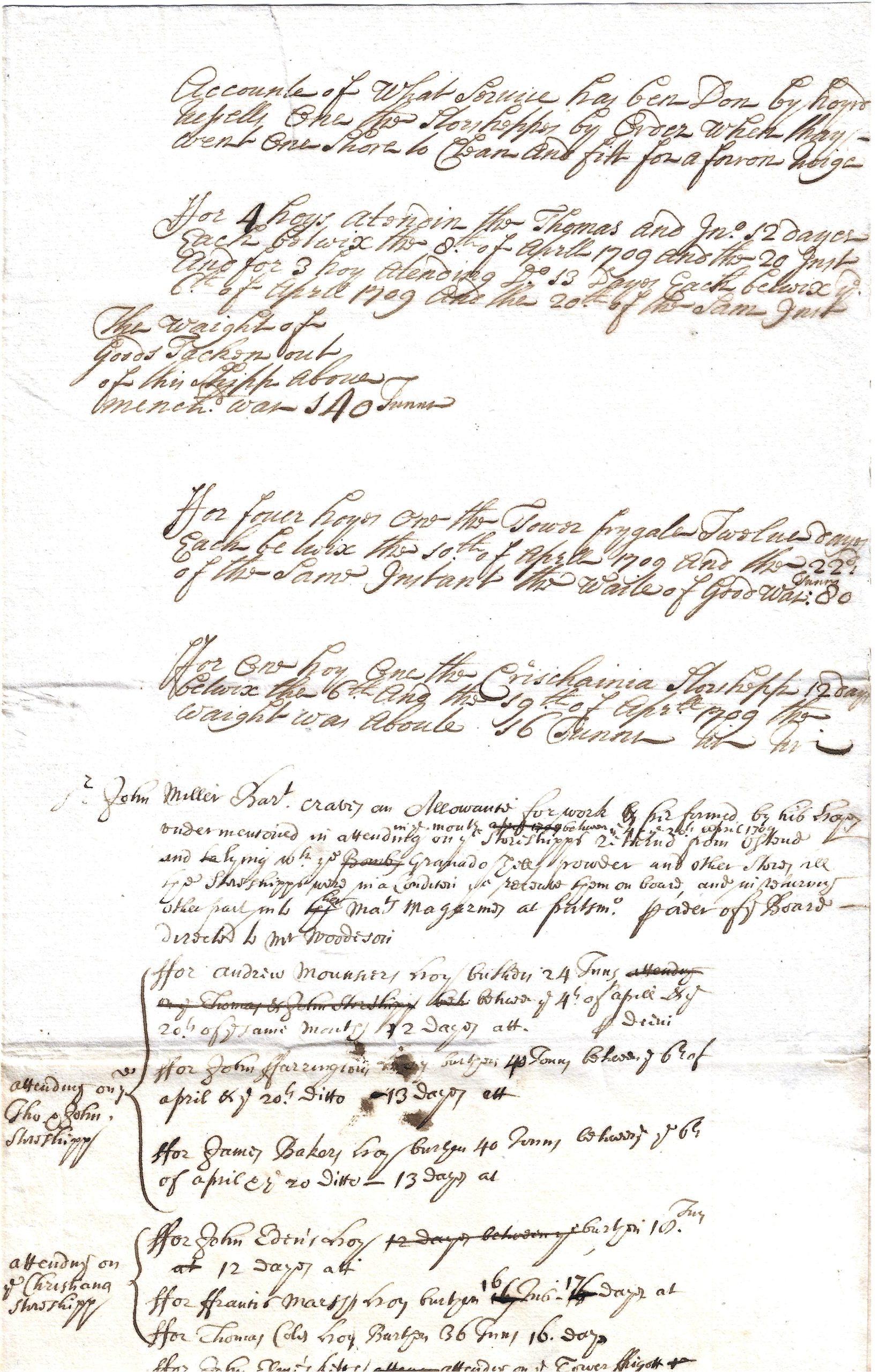
View in new tab
Chris Lister writes on the 9th April 1709 to advise that the carpenter, Henry Stanyford, should supply timber, and the yard should supply kettles and bedding to Commissary Hawys for an upcoming expedition. We are not told which expedition.
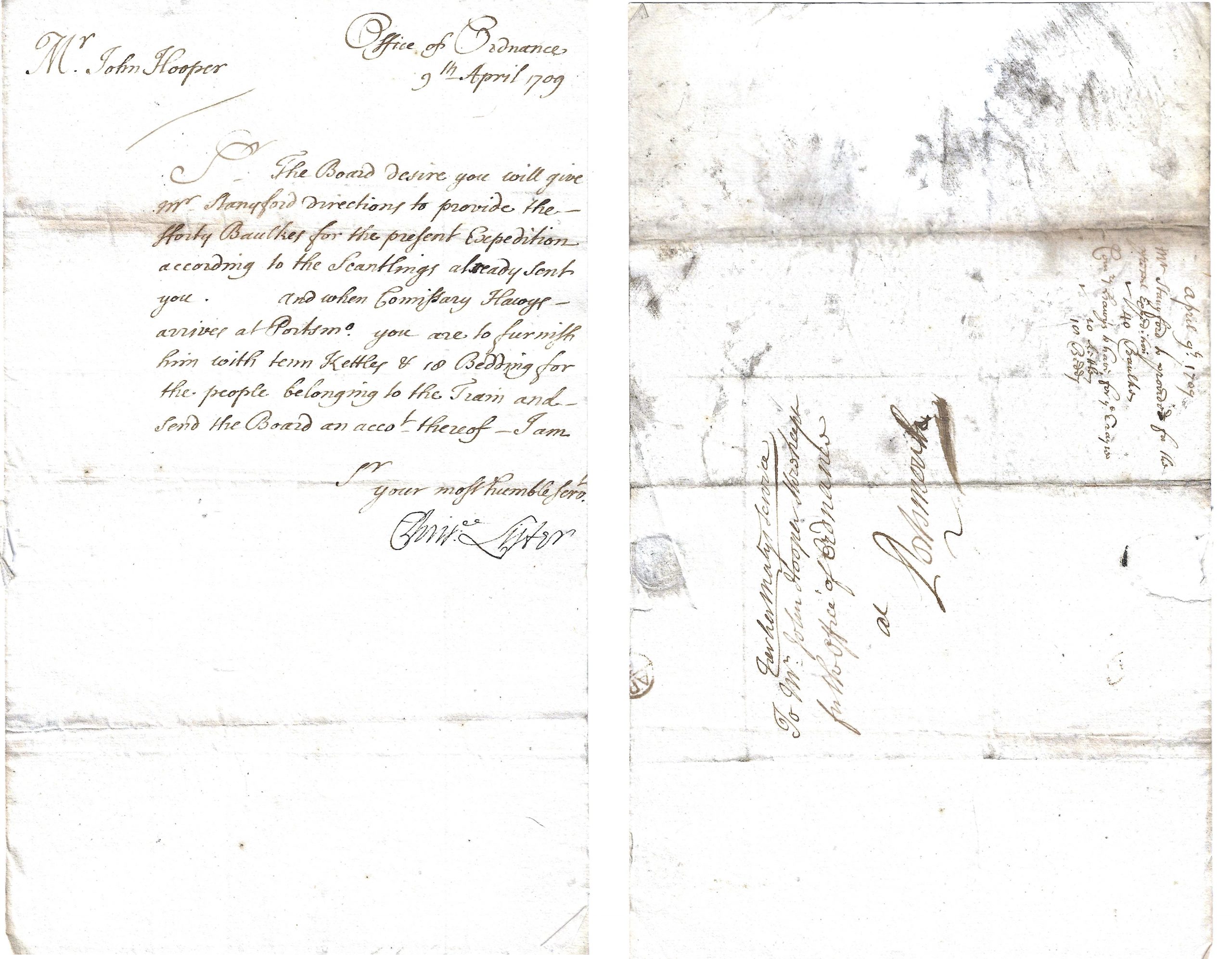
View in new tab:
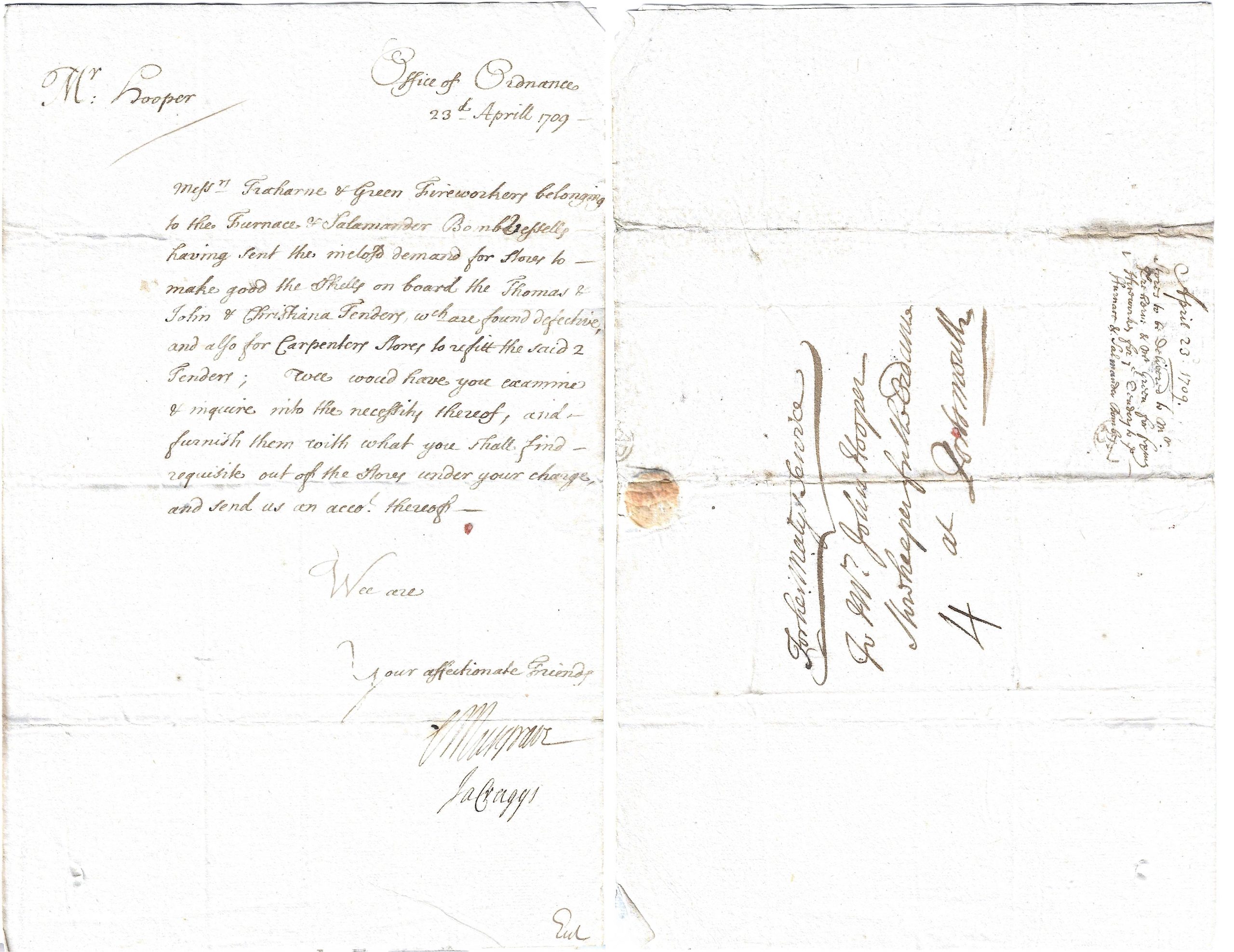
The letter of 23rd April 1709 is regarding two bomb vessels, Furnace (1695) and Salimander (1687), Messrs Traharne and Green, named as ‘fireworkers’ are demanding stores.
A bomb vessel was a specially designed vessel, usually a ketch, which carried mortars as its main armament with a few guns for self-defence. Firing mortars was complicated as they would fire mortar bombs which required priming with a fuse of set length to ensure that they exploded when intended. It is likely that fireworkers were those skilled in firing them.
This letter also asks that Mr. Hooper investigate an additional request for repairs to harbour tenders.
View in new tab:
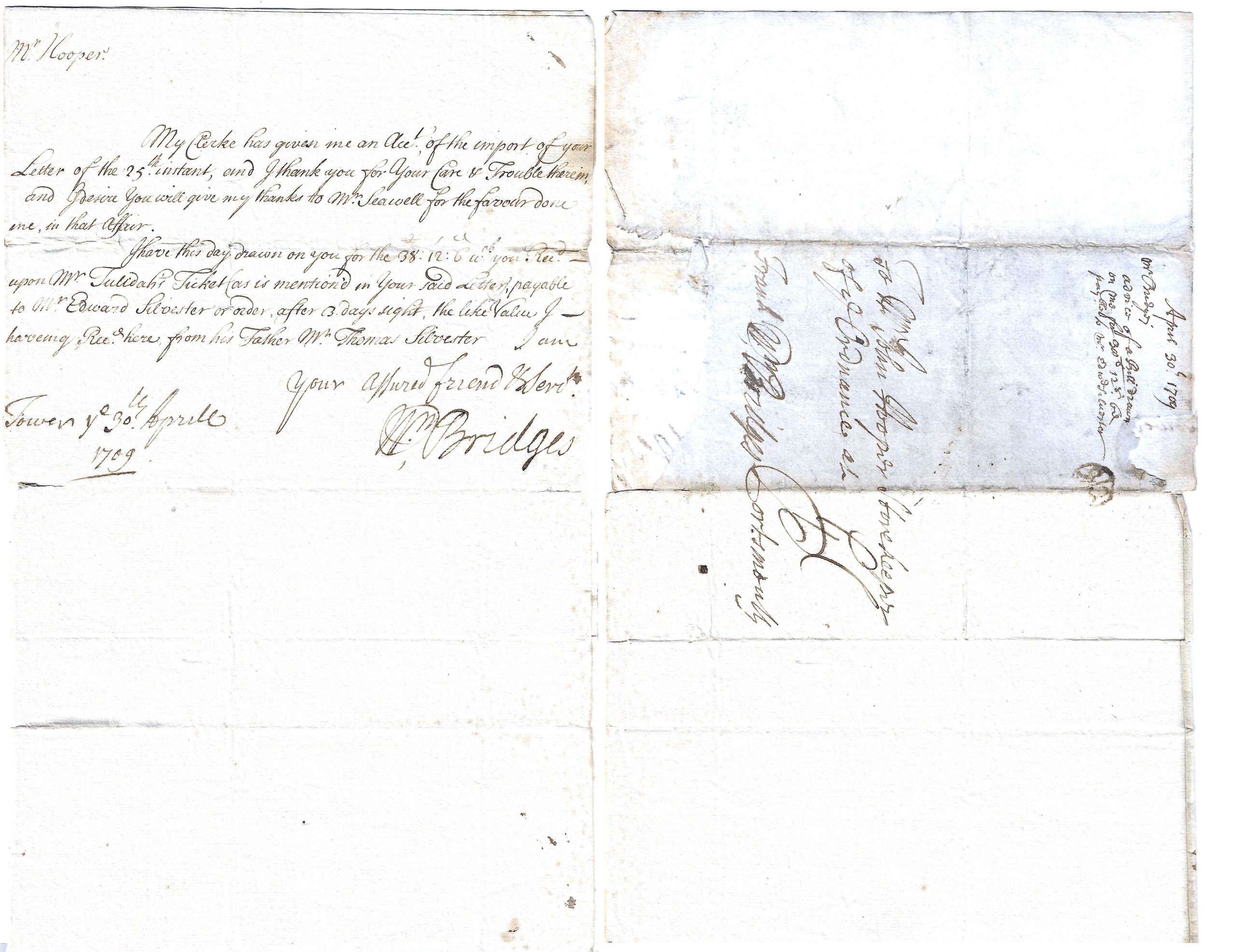
In the letter from The Tower on 30th April 1709 we learn that Mr. Thomas Silvester, the armourer at Portsmouth dockyard is the father of Edward Silvester, the blacksmith. The letter also shows us the close working relationship between The Board members and Mr. Hooper. Unfortunately, we don’t know what the subject of the letter is.
View in new tab:
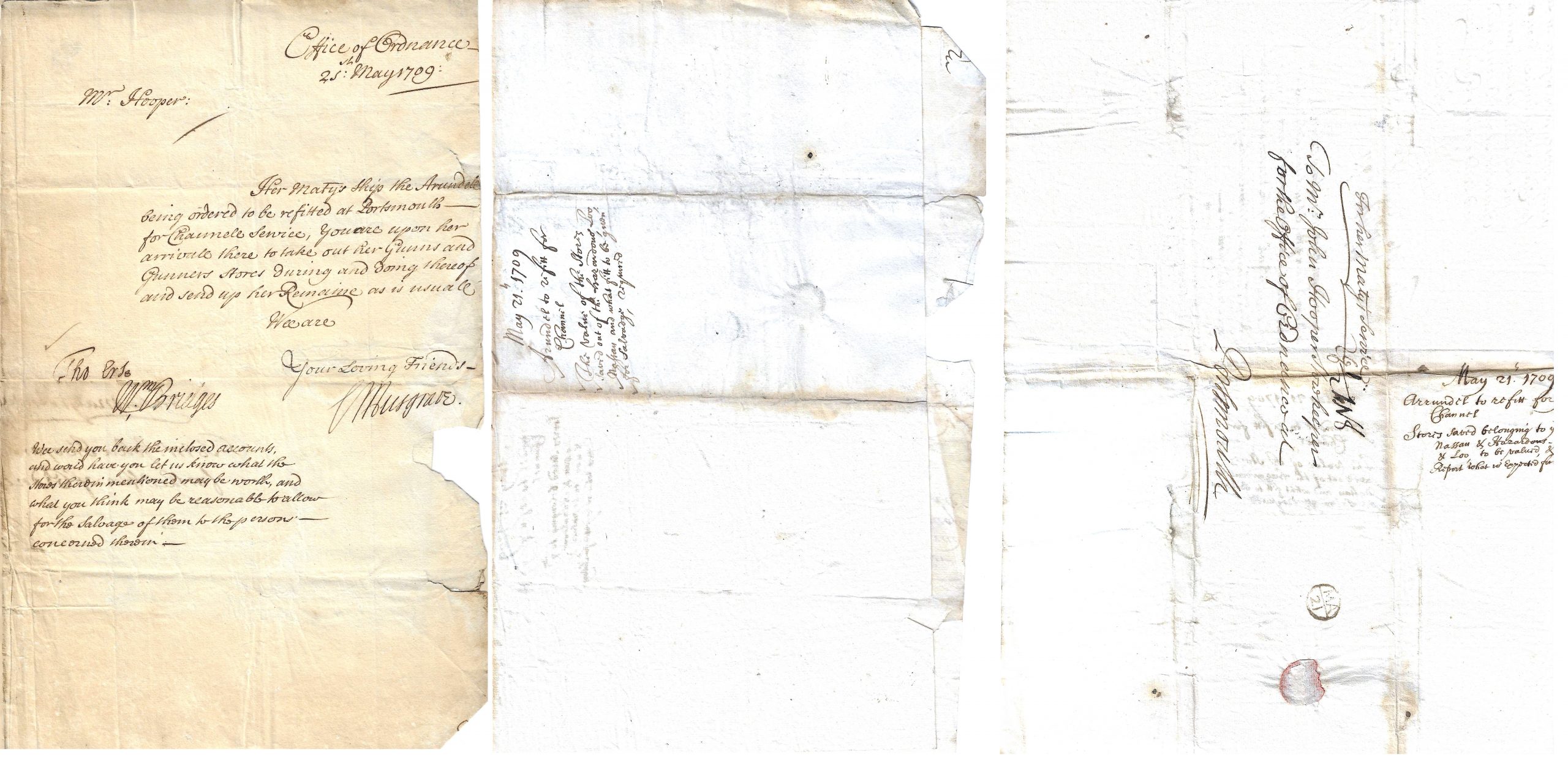
It is the story behind the postscript in the letter of 21st May 1709 that provides interest. It asks Mr. Hooper’s advice on the value of salvaged stores. The precis mentions three ships, all of which were recently wrecked. Hazardous, Looe and Nassau, so it is salvage from these to which this refers.
Hazardous ran aground on a sandbank at Bracklesham Bay in Sussex, so was in shallow water. Therefore, we can assume that much of her equipment was salvaged at the time. Clearly, enough was salvaged for The Board to be enquiring as to the value thereof. One gun was recovered in 1966 and others have been identified since. She carried 54, but maybe we can now see why so few remain to be recovered in modern times.
HMS Looe (1697) was wrecked in Scratchwell’s Bay on the south west coast of the Isle Of Wight close to The Needles. 8 men were lost.
HMS Nassau (1699) was wrecked on 30th October 1706.
View in new tab:
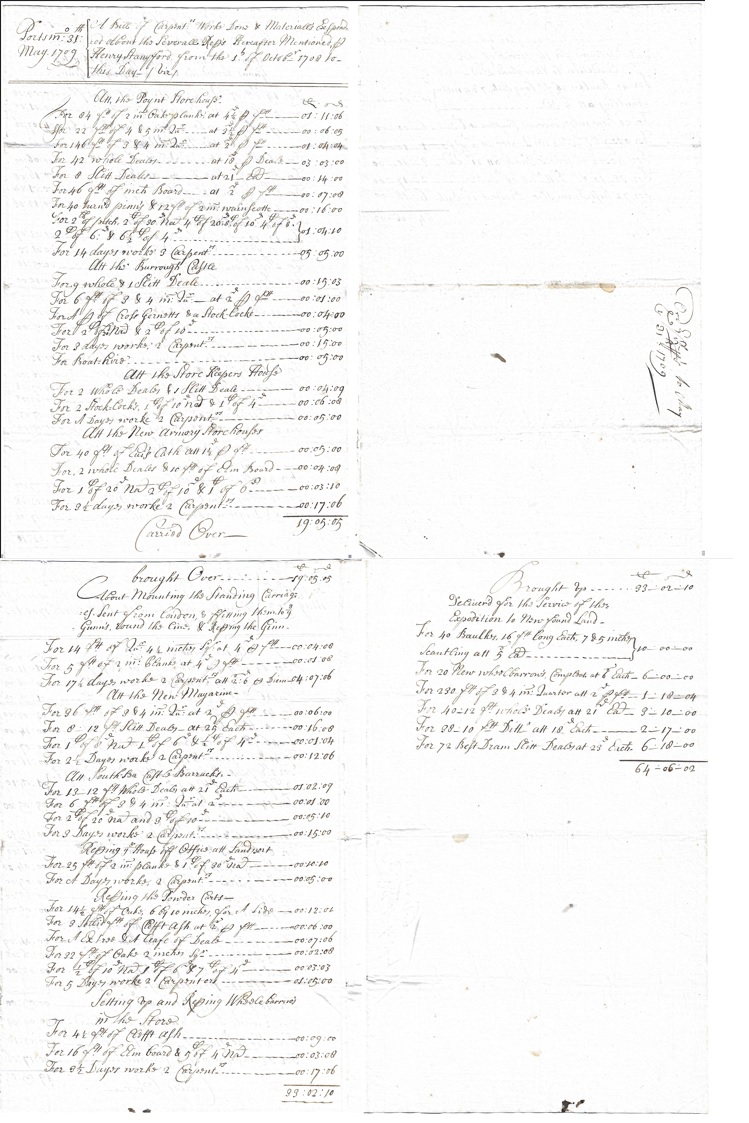
Two bills follow for carpentry, the first on 31st May 1709 from Henry Stanyford for work done on buildings around the yard.
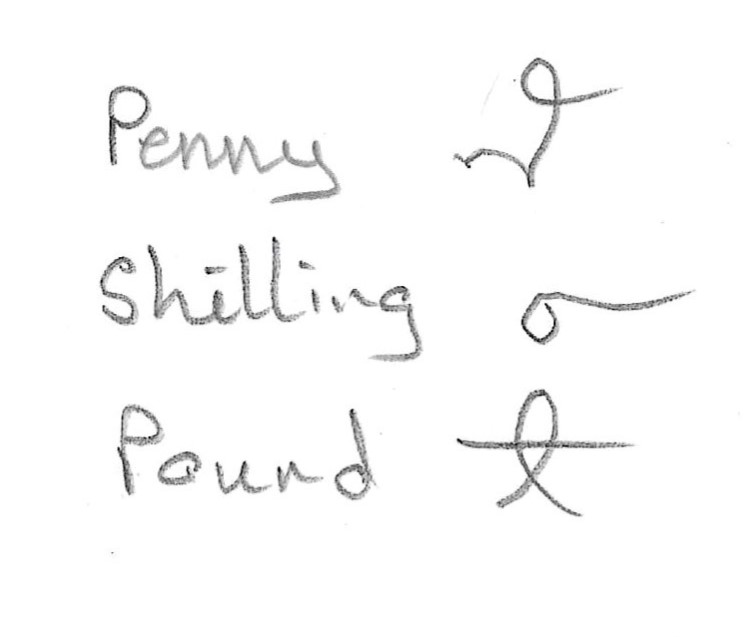
From this document we can deduce the symbols used to denote pounds shillings and pence.
View in new tab:
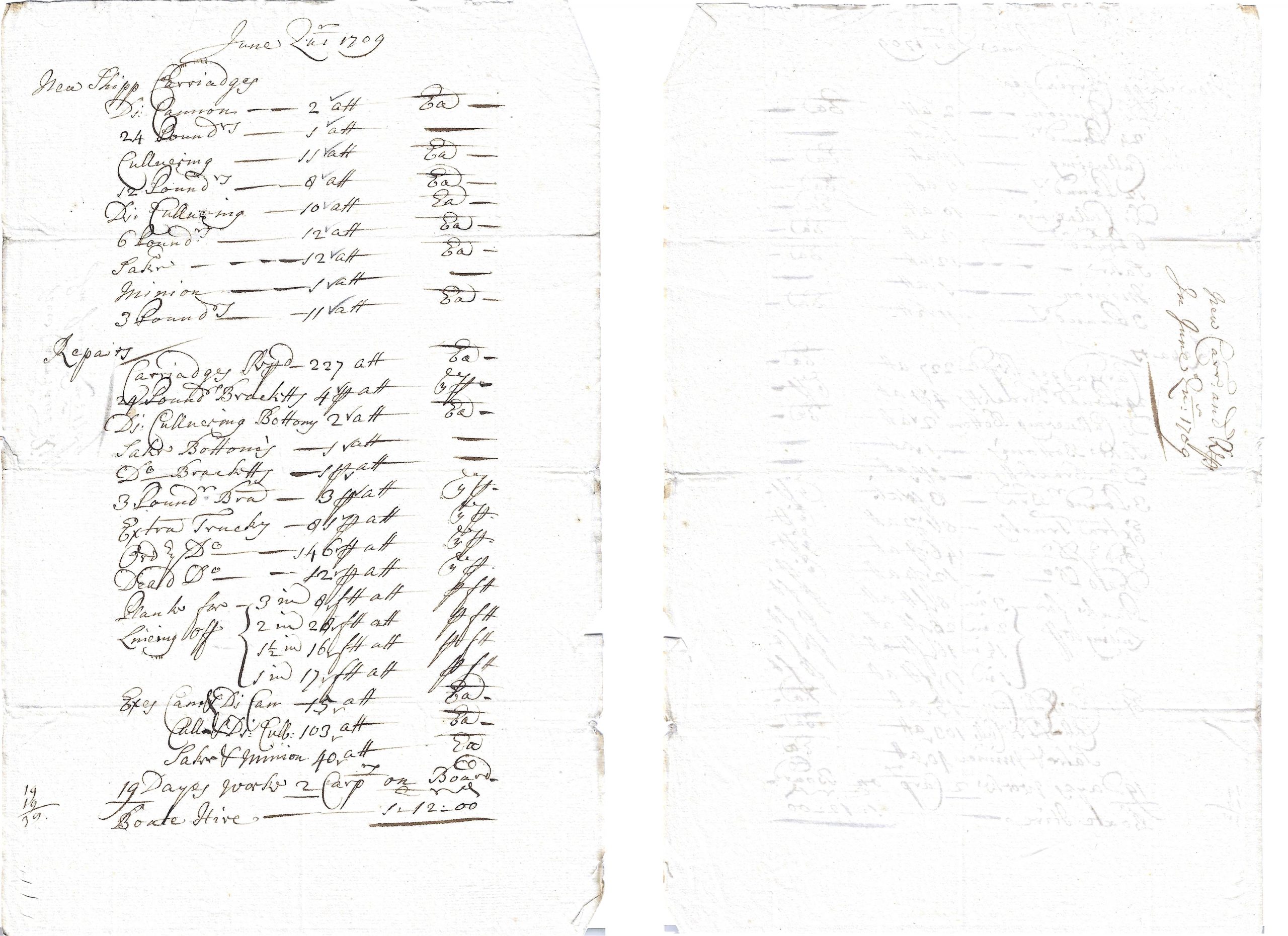
The second bill of the day was for new carriages and repairs in June It does not have the carpenter’s name on it, so this may have been from Henry Stanyford or possibly William Ogbourne.
View in new tab:
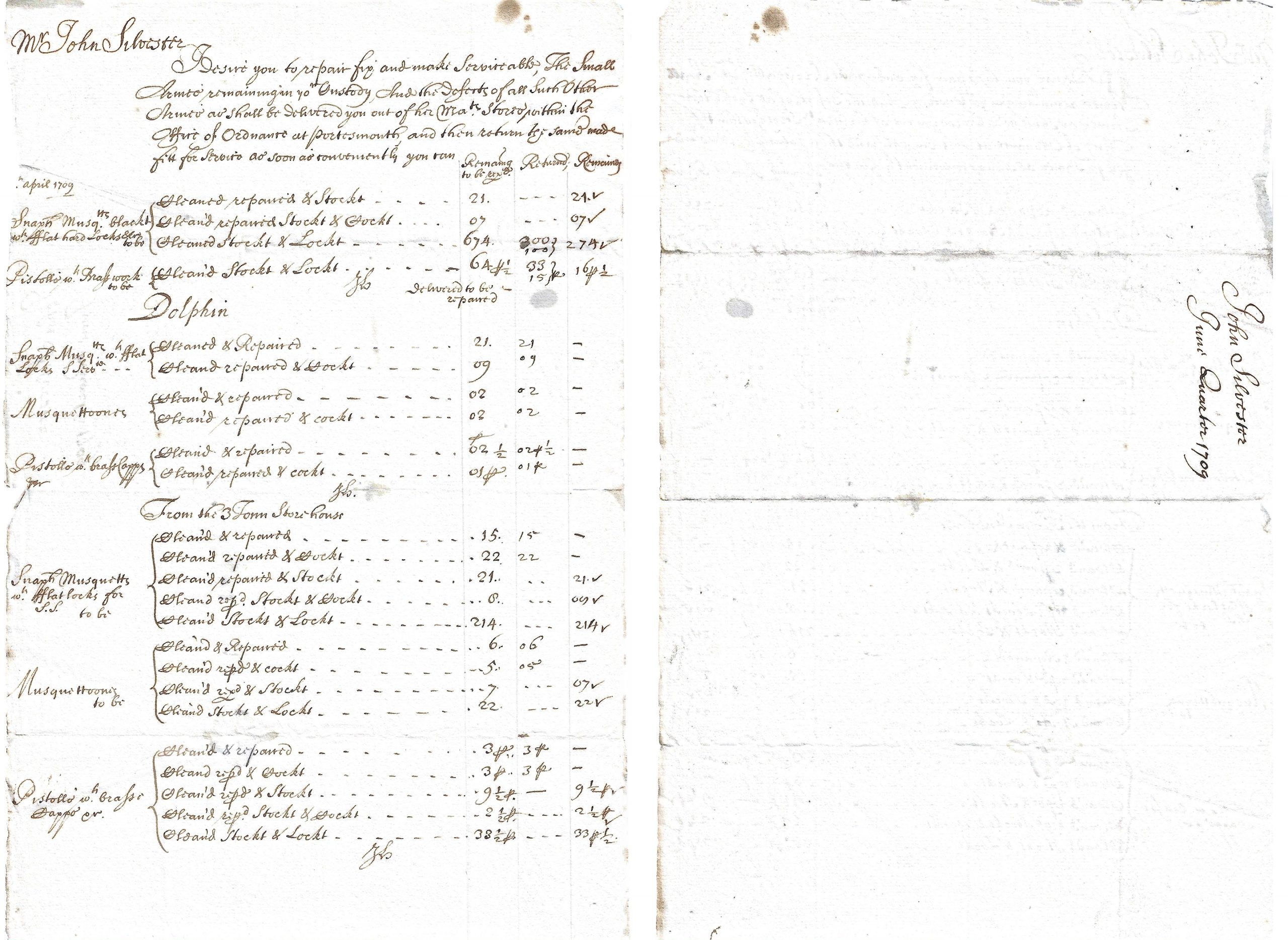
For the June quarter 1709, a detailed list, from John Hooper, of small arms to be repaired by John Silvester, the armourer. Mr Hooper lists the individual types of arms required for both land and sea service.
View in new tab:
22nd June 1709 a letter from Mr. Lister urging Henry Stanyford to provide a flag staff for Calshot Castle.

View in new tab:
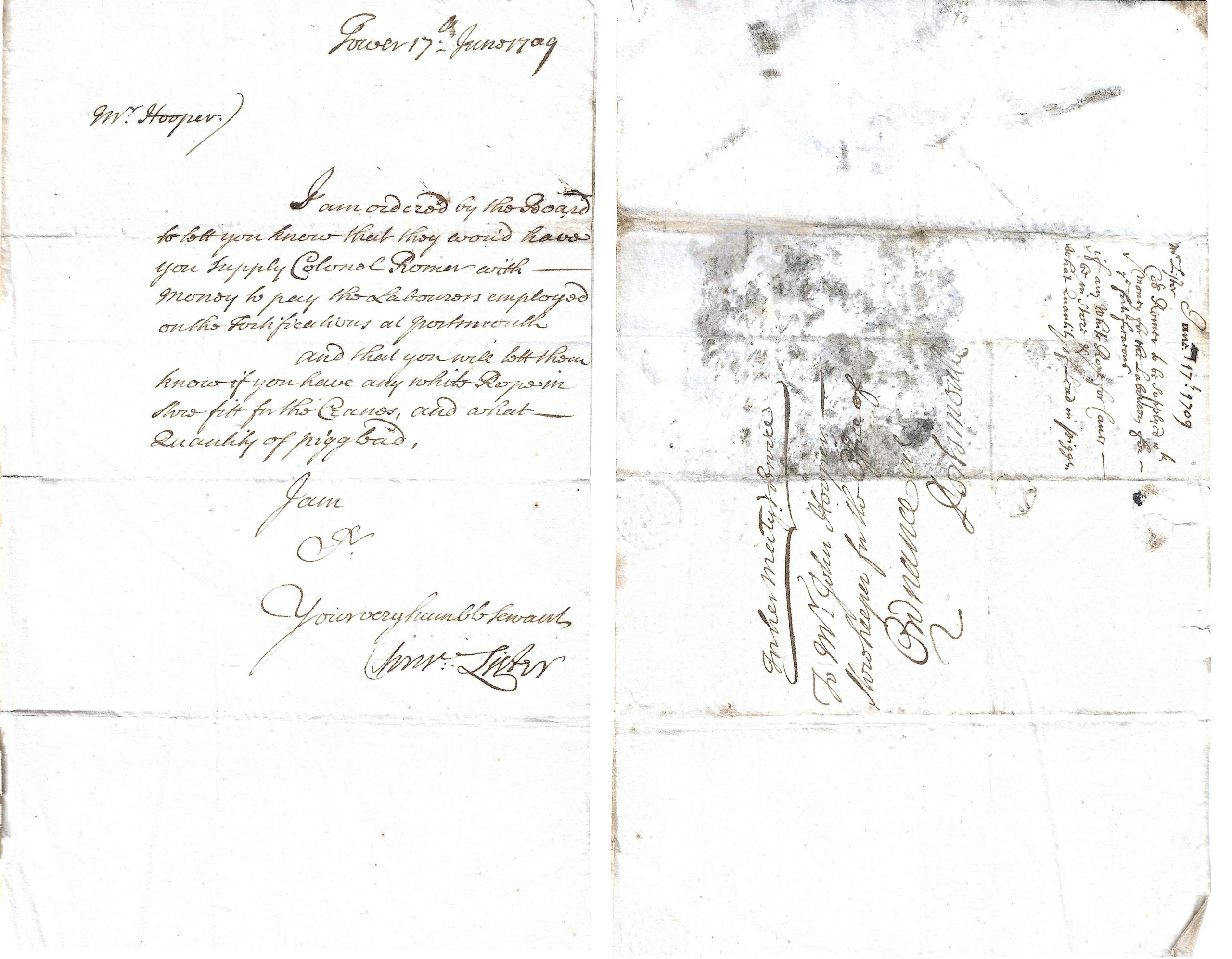
Colonel Romer was accomplished in devising defences and was employed to design defences in Portsmouth. On 17th June 1709 a letter from Chris Lister asks Mr. Hooper to provide the colonel with money to pay his labourers. The letter goes on to enquire about the availability of ‘white rope’ for cranes. White rope was any rope that had not been tarred.
View in new tab:
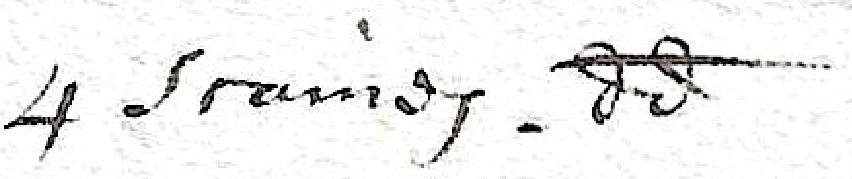
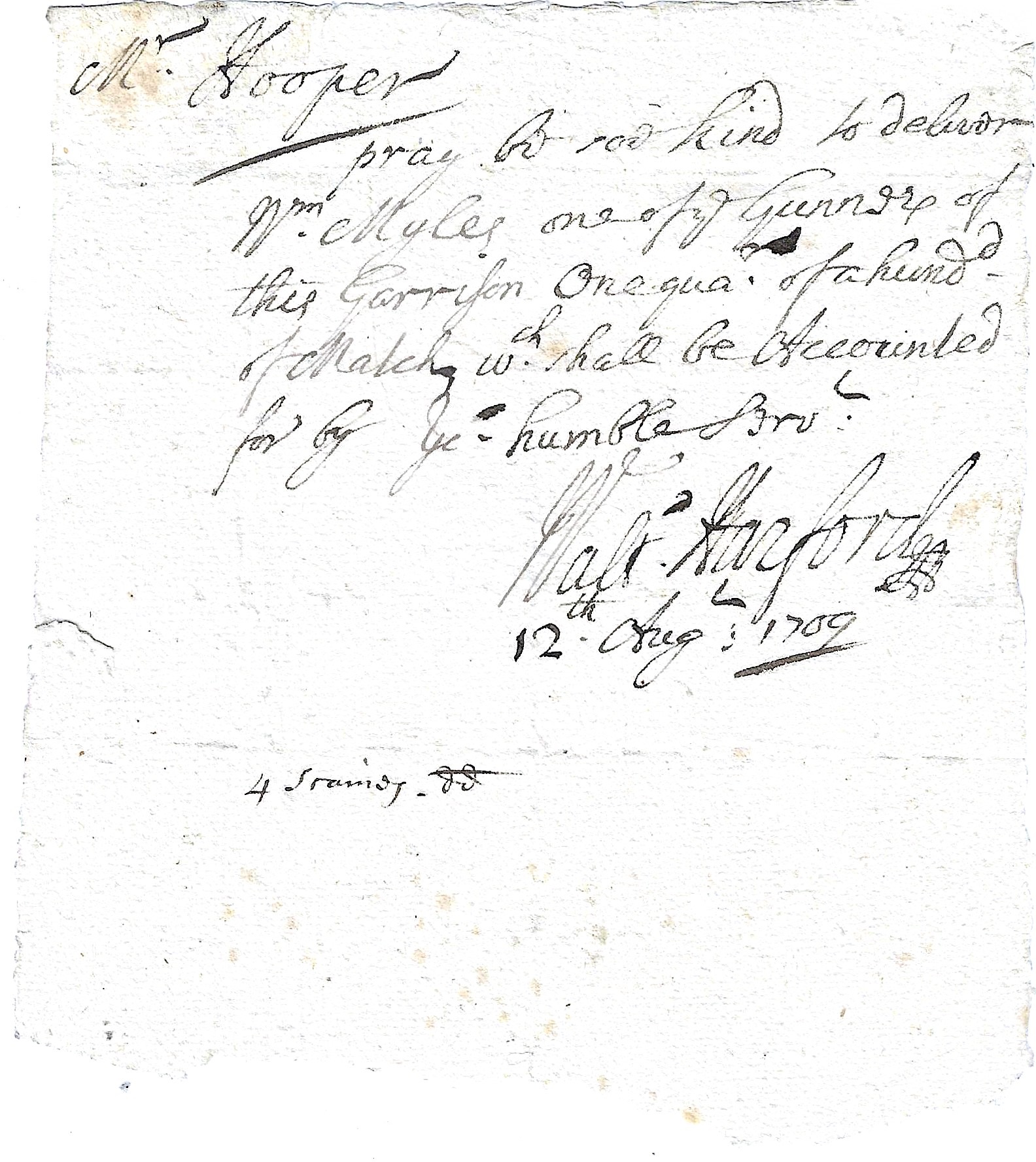
On 12th August 1709 the first of two notes from Walter Harford (in August and September), who we must assume was probably the master gunner of the garrison at Portsmouth. In both cases he is asking for ‘match’. This was in the form of flammable cords of ‘slow match’ to be used in linstocks for firing the guns. This note asks for ‘One quatr of a hundd’ which I assume means ¼ cwt, or 28lb. However, the note has been endorsed at the bottom to say ‘4 scaines dd’ (4 skeins delivered). A skein is 360 feet, which we can now assume weighed 7lb.
View in new tab:
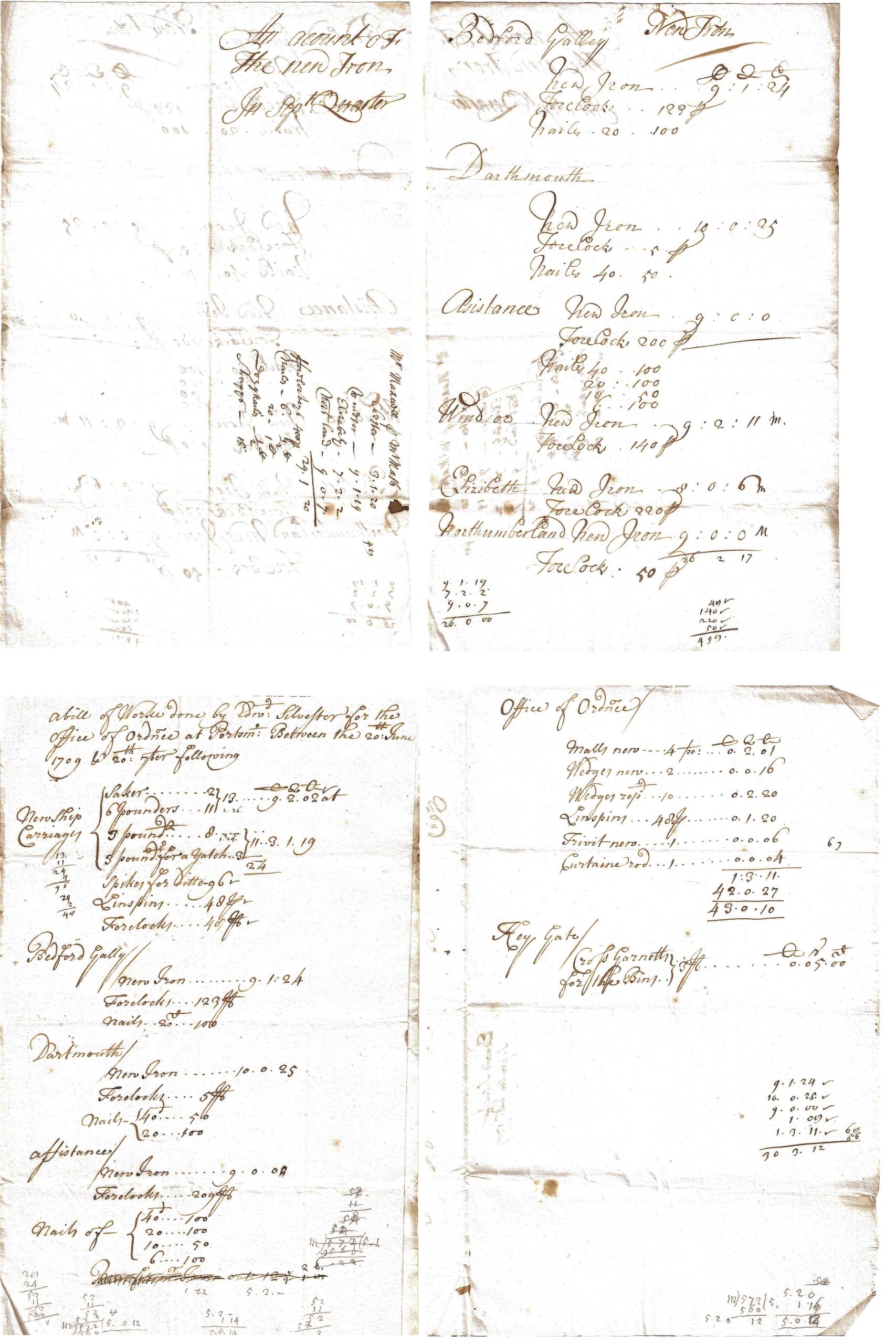
In Mr Maxwell’s busy account for ironwork’s done by Edward Silvester during the September quarter of 1709 we see that apart from ten ships, work was done at ‘Quay Gate’ which was situated approximately where Portsmouth fish market now stands in Old Portsmouth at the west end of Lombard Street opposite where it joins King Charles Street. This was one of many gates into the town of Portsmouth. Several still remain for example Landport Gate, Unicorn Gate and lion Gate.
One of the ships mentioned is Bedford Galley, any ship named ‘Galley’ was so named because it carried ‘sweeps’ or oars which enabled the crew to move the ship without the use of sails.
View in new tab:
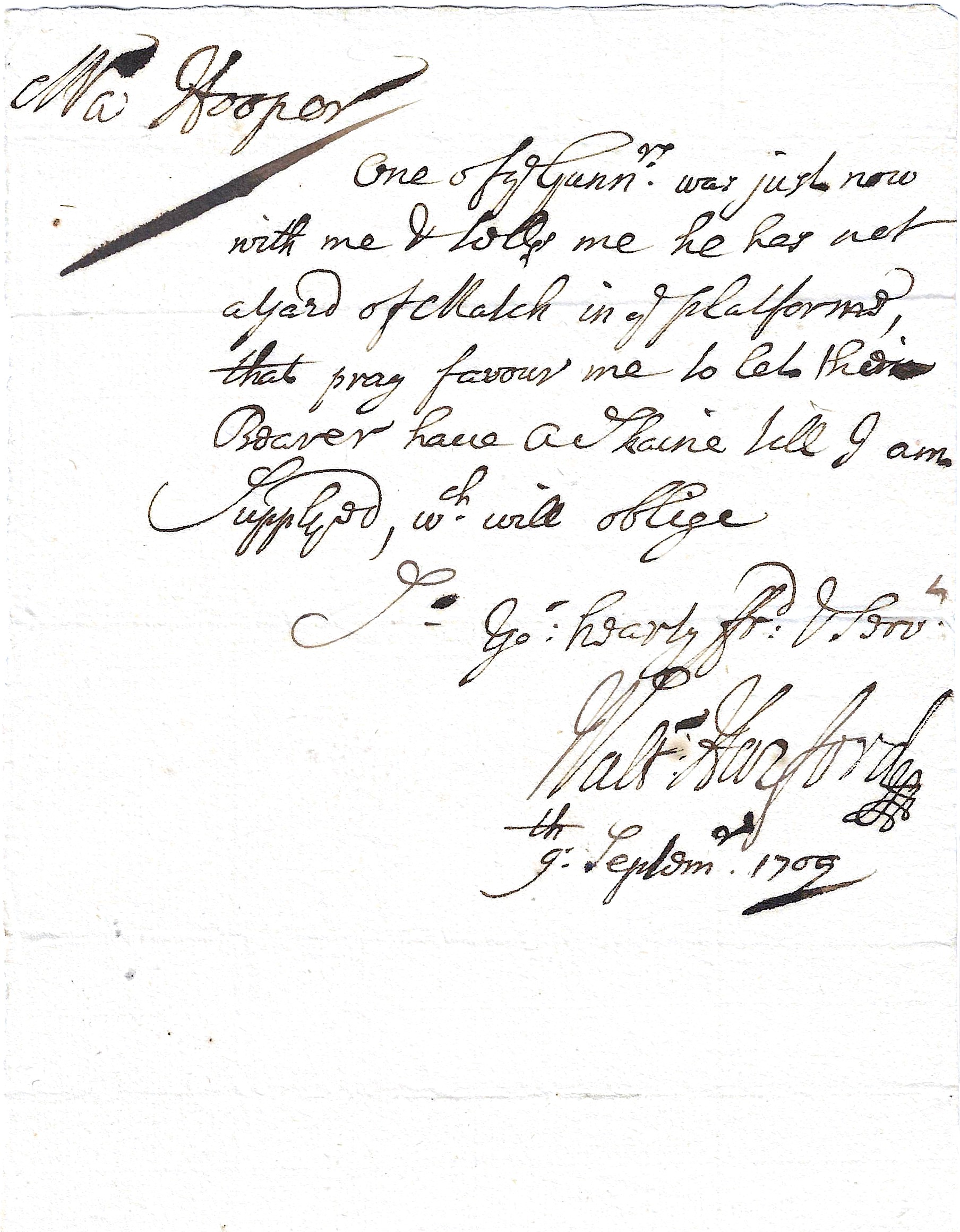
9th September 1709, the second of the notes from Walter Harford asking for match, the first was in August 1709. Whereas in the first he asked for match by weight, this time he is asking for a skein to tied him over.
View in new tab:
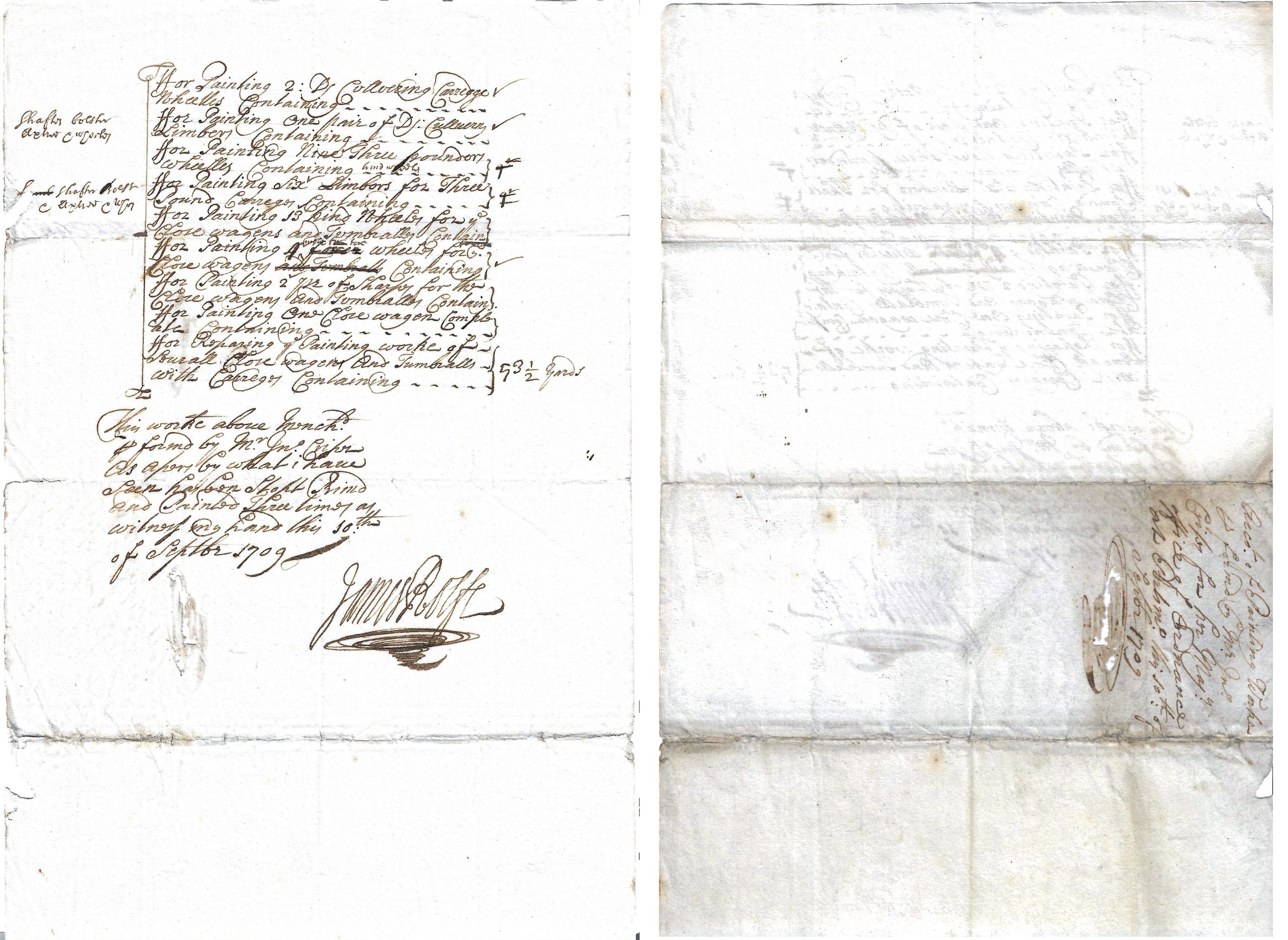
In James Rolphe’s, slightly damaged, bill for painting work done by John Cripes’ 10th September 1709 he mentions painting tumbrels. These were a two wheeled carriage or cart.
View in new tab:
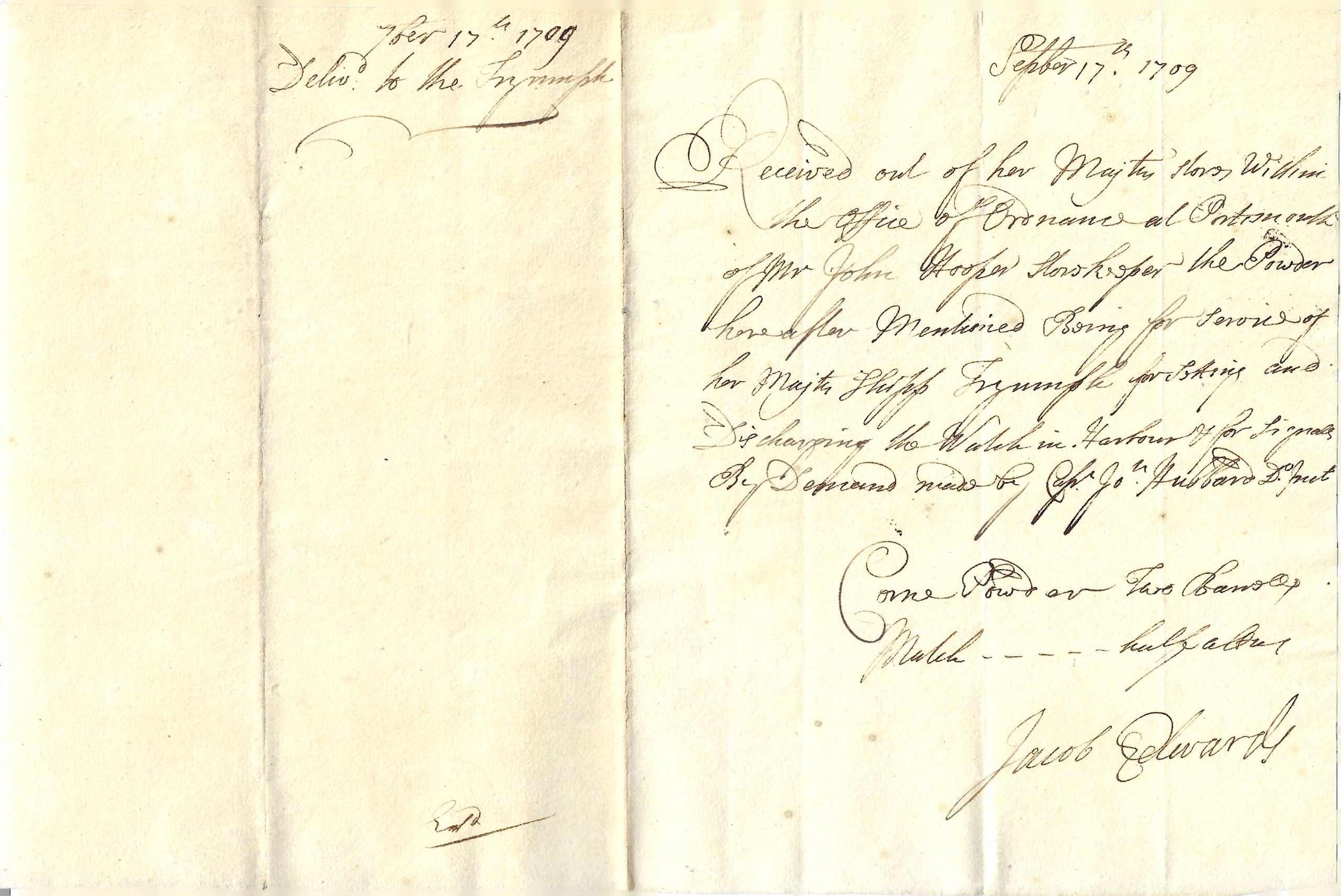
Back in April Captain Hubbard of the Triumph was resupplied following the incident with the Ranelagh. Here, Jacob Edwards, presumably the master gunner of Triumph, acknowledges receipt of more powder and slow match.
View in new tab:
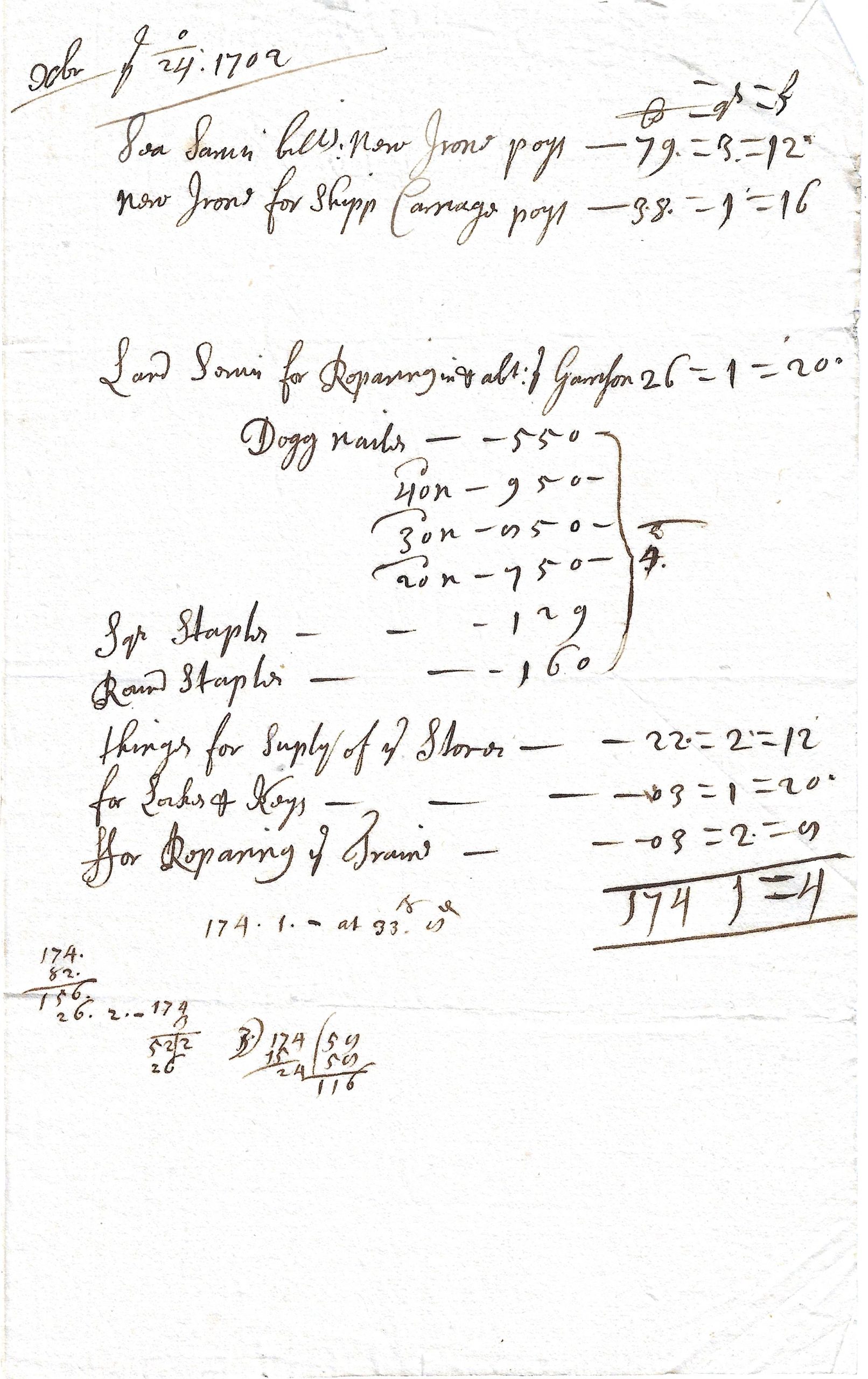
On October 24th 1709 a bill, presumably from Henry Silvester, we again encounter the term ‘poiz’ a contraction for avoirdupois meaning weight.
View in new tab:
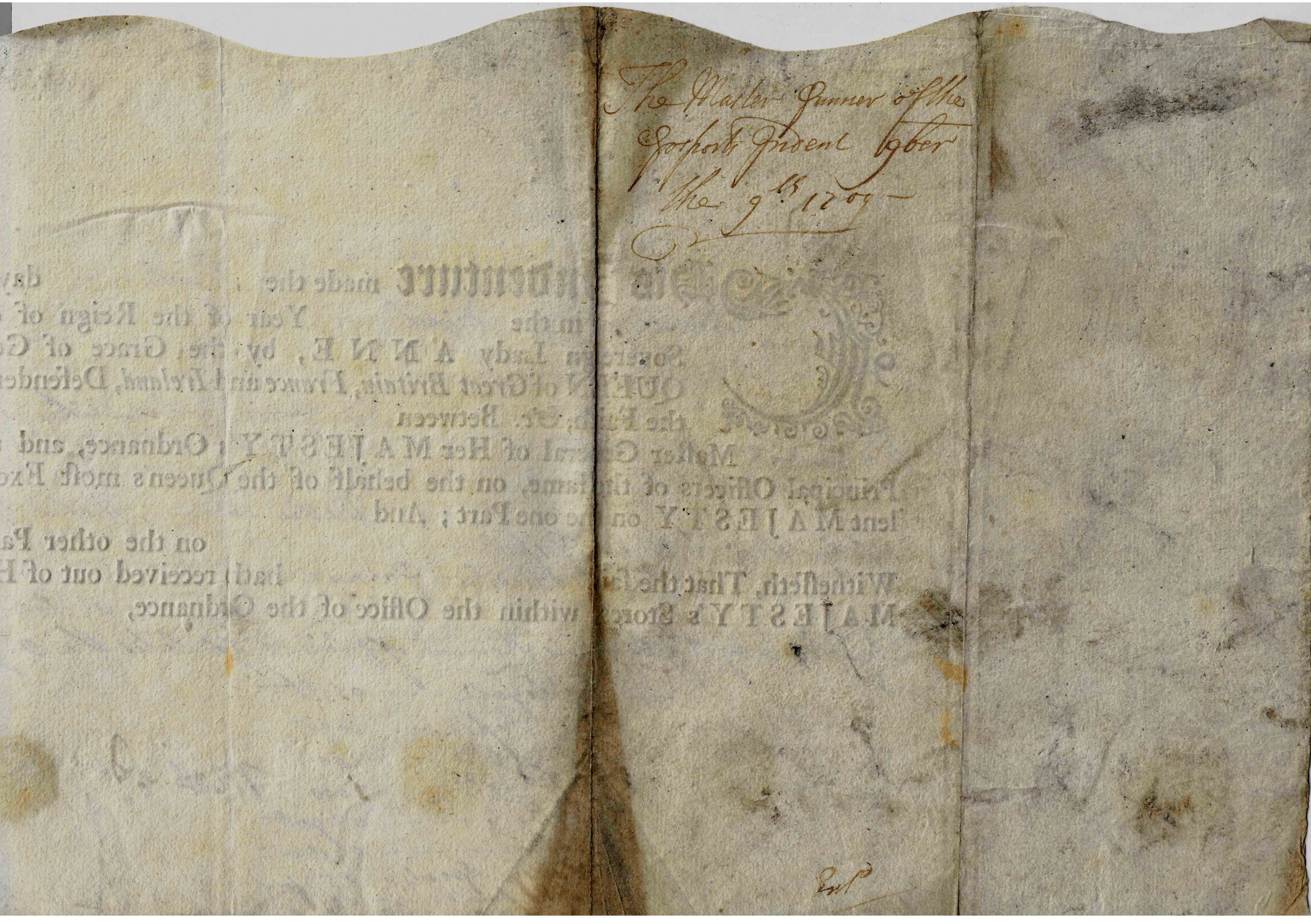
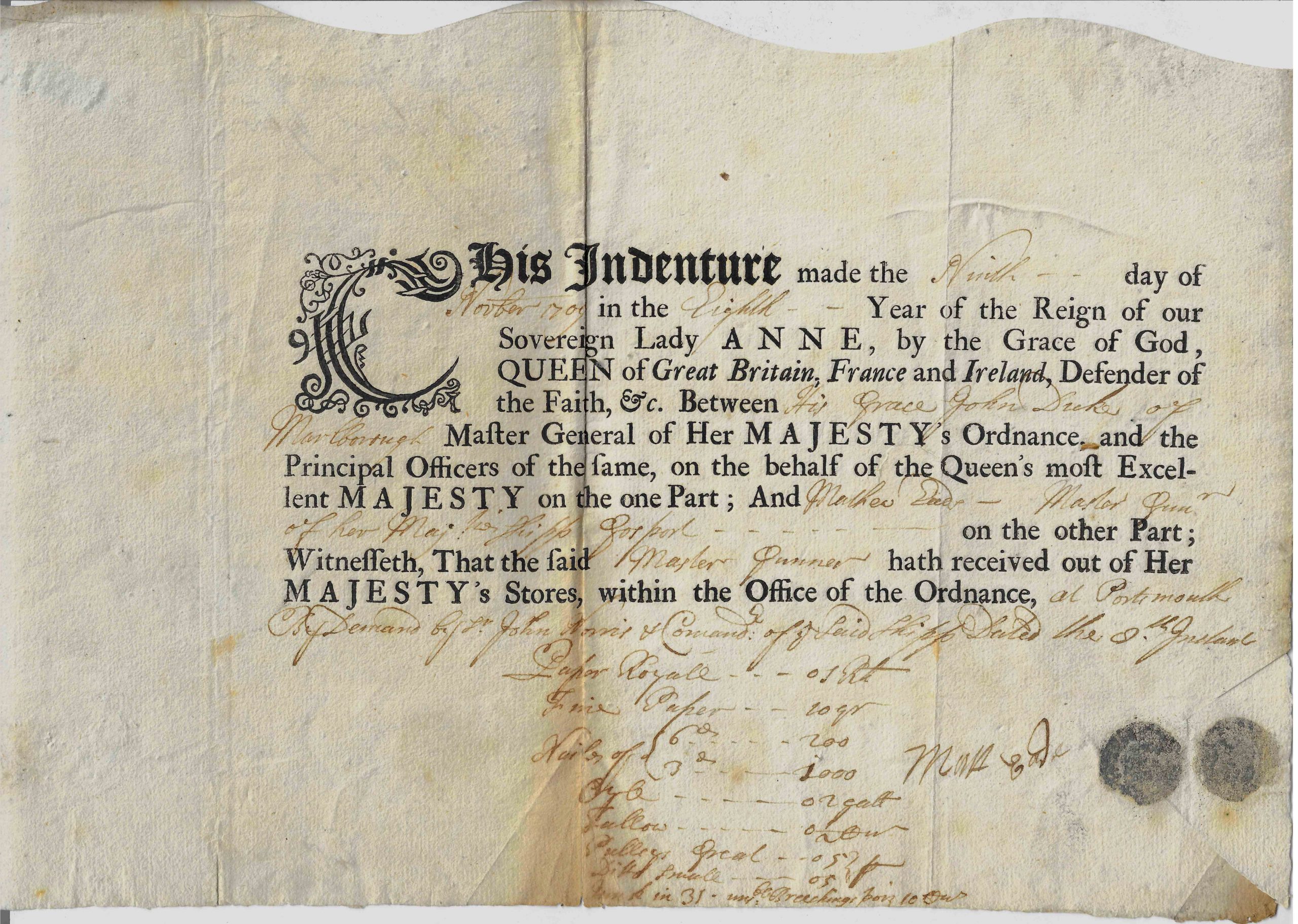
9th November 1709, a supply of gunner’s stores gives us sight of an Indenture. These were a legal document in two parts between two people. In this case John Churchill, Duke of Marlborough and Mathew Eade, master gunner of the bomb vessel, HMS Gosport (1707). Indentures were in two parts which were cut apart with a wavy cut (indentured) such that the two pieces could be matched together proving their authenticity.
View in new tab:
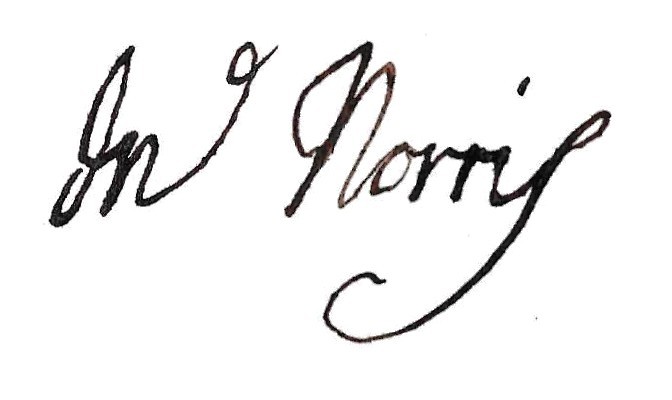
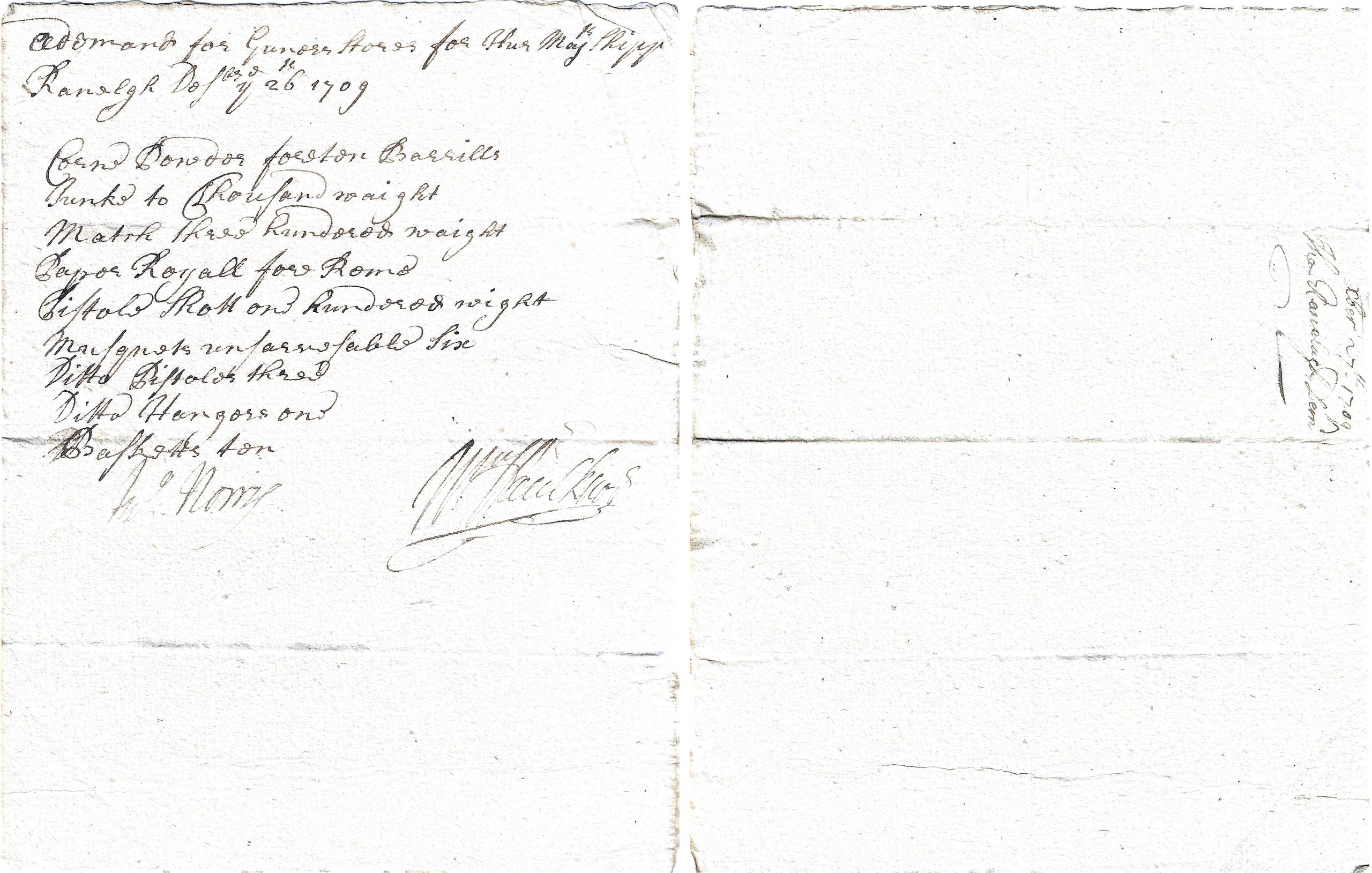
A little challenging to read, we see Ranelagh asking for more supplies. The demand is signed by two people: one being Wm Hawkins, probably the master gunner, the other I believe to be Jno, Norris. We know that Ranelagh was the flag ship of Vice Admiral Sir John Norris at the time, so we must assume that it was he who endorsed this demand.
We know that Admiral Norris has a history of using ‘extraordinary’ methods of restocking his ship (see: 17090405 Restocking Ranelagh). He is supposed to make his request to The Ordnance Board, not directly to The Dockyard.
View in new tab:
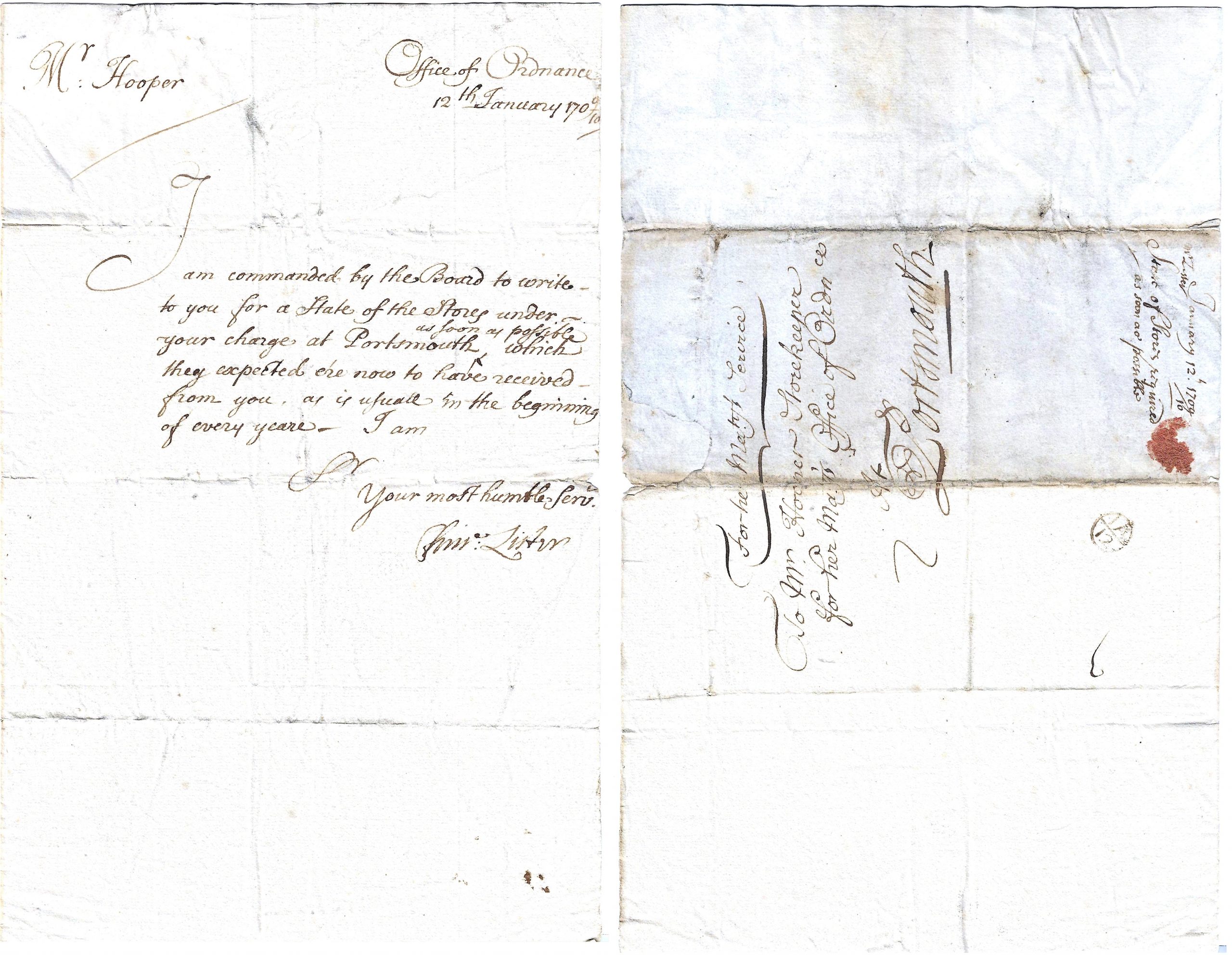
1710 starts off with what looks like a polite reprimand from Chris Lister asking Mr. Hooper for a statement of the stores held at Portsmouth.
View in new tab:
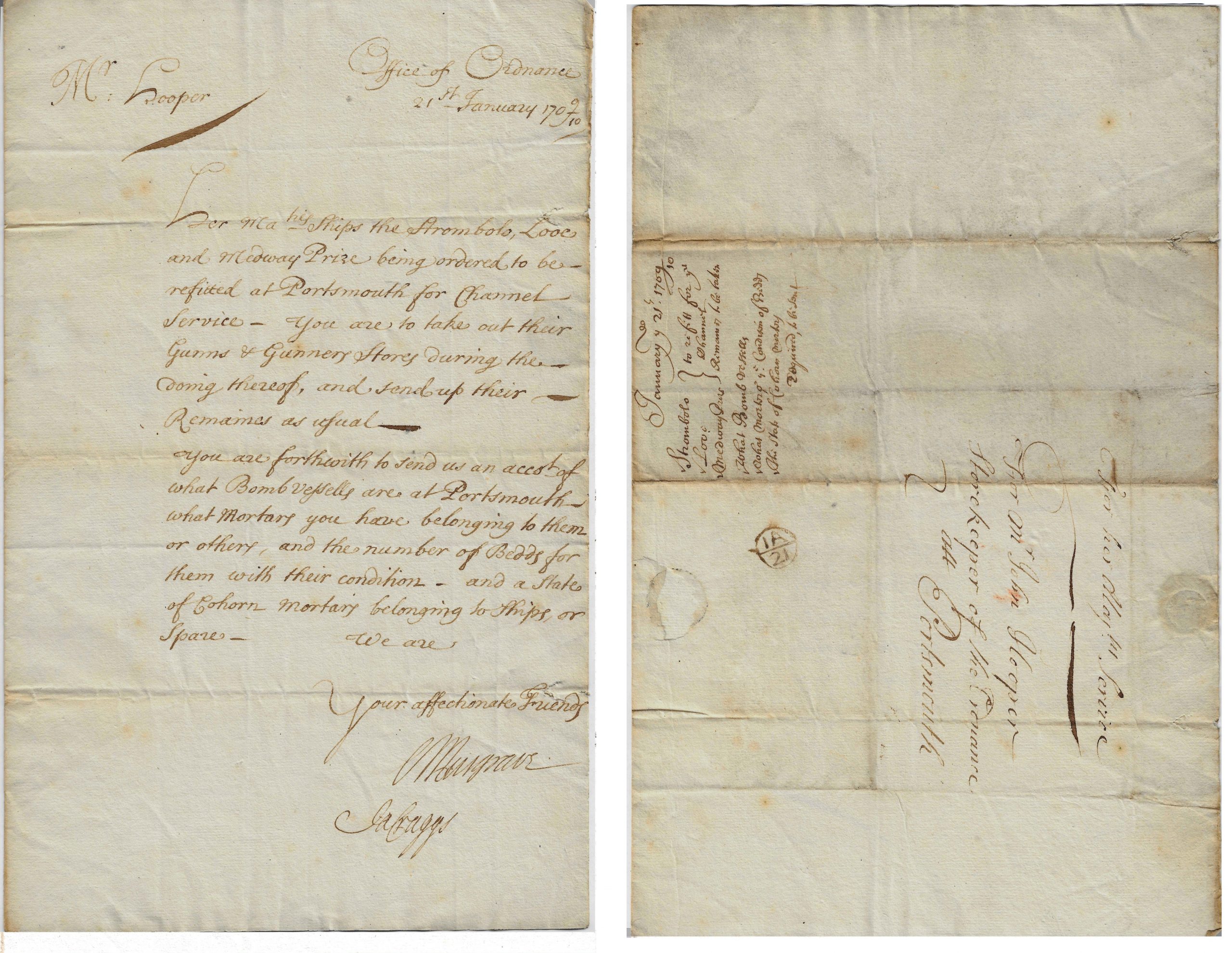
Included in a letter of 21st January 1710 is an order to prepare three ships for refit and request for an inventory of bomb vessels at Portsmouth, curiously a similar request was made in November of 1707. However, in this case they also specifically enquire about Cohorn Mortars, a lightweight mortar.
View in new tab:
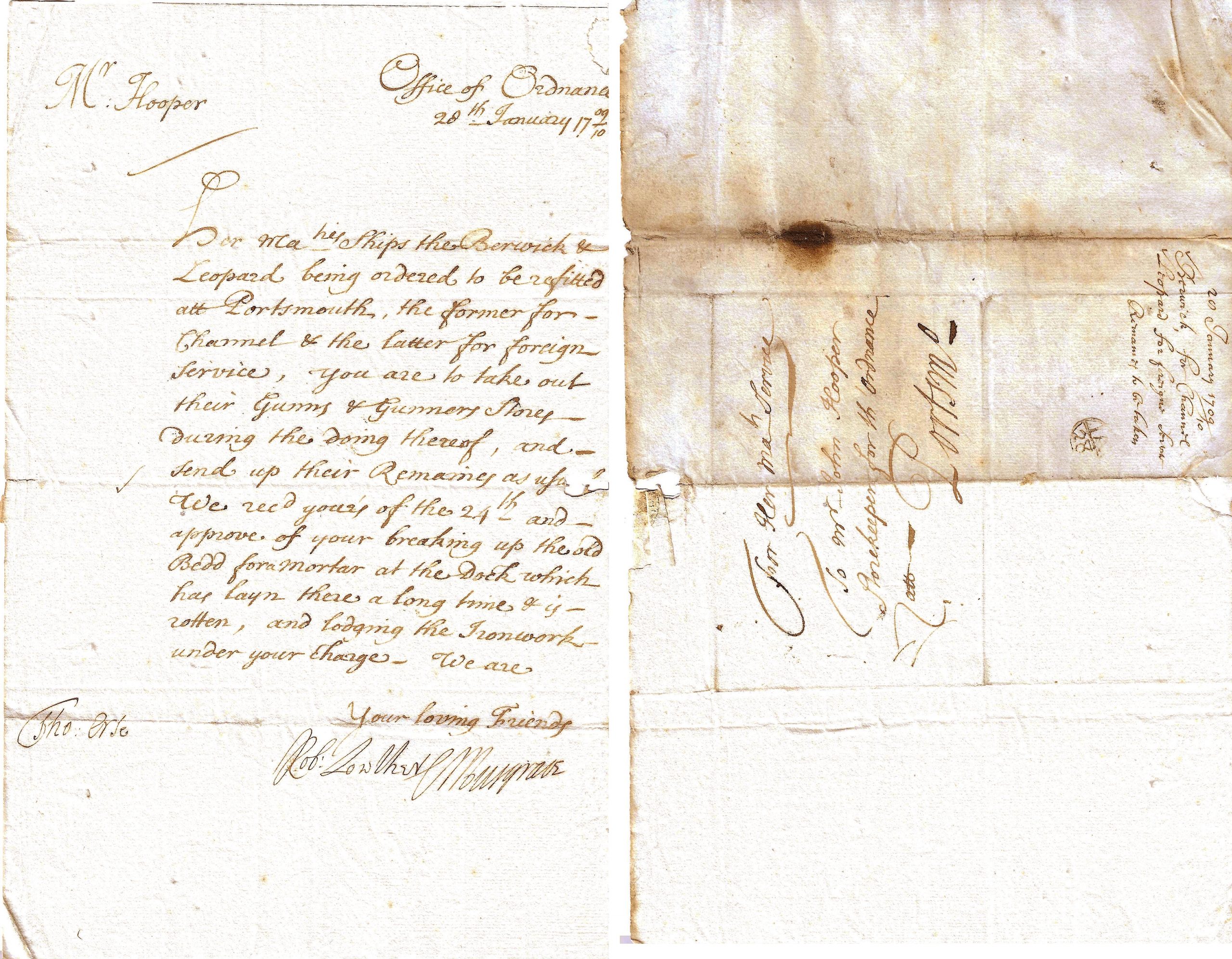
Mr. Hooper must have submitted his account of mortars because on 28th January, along with an instruction to prepare HMS Berwick (1697) and Leopard for refit, The Board agree to his suggestion to break up a rotten mortar bed.
View in new tab:
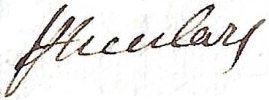
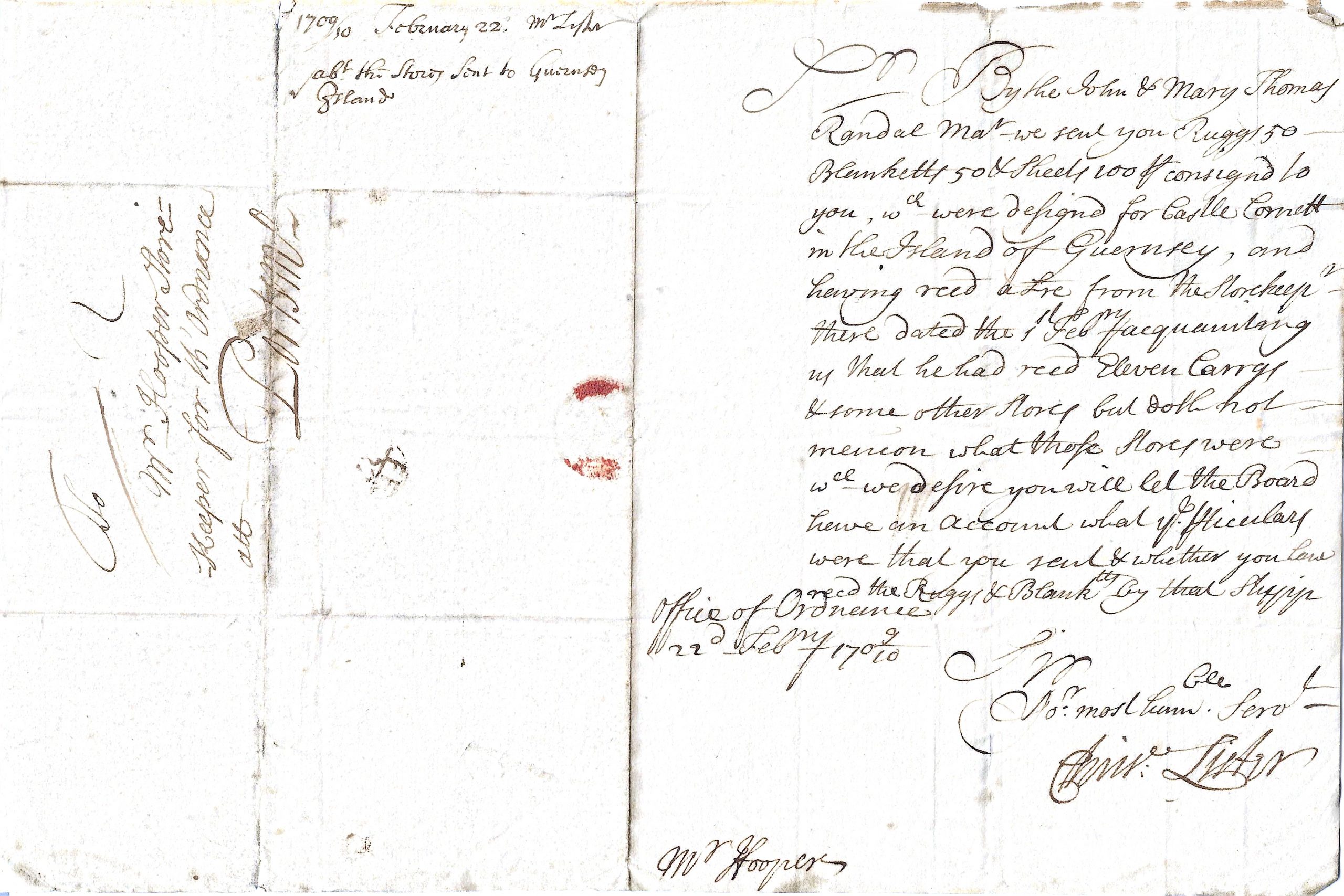
Another example of the difficulties transporting stores and communicating is given in the letter from Chris Lister on the 22nd of February 1710 where he is inquiring about a shipment of stores that were sent to Guernsey, it appears that they arrived, but the storekeeper there has not properly communicated their arrival. one might expect the Tower to simply ask the receiving storekeeper to clarify his receipt, however, if writing to Guernsey the reply would not be received for some days, whereas there was a regular daily post to Portsmouth.
Near the end of this letter, Chris uses a contraction for ‘particulars’ by using the elaborate capital ‘P’ followed by ‘ticulars’.
View in new tab:
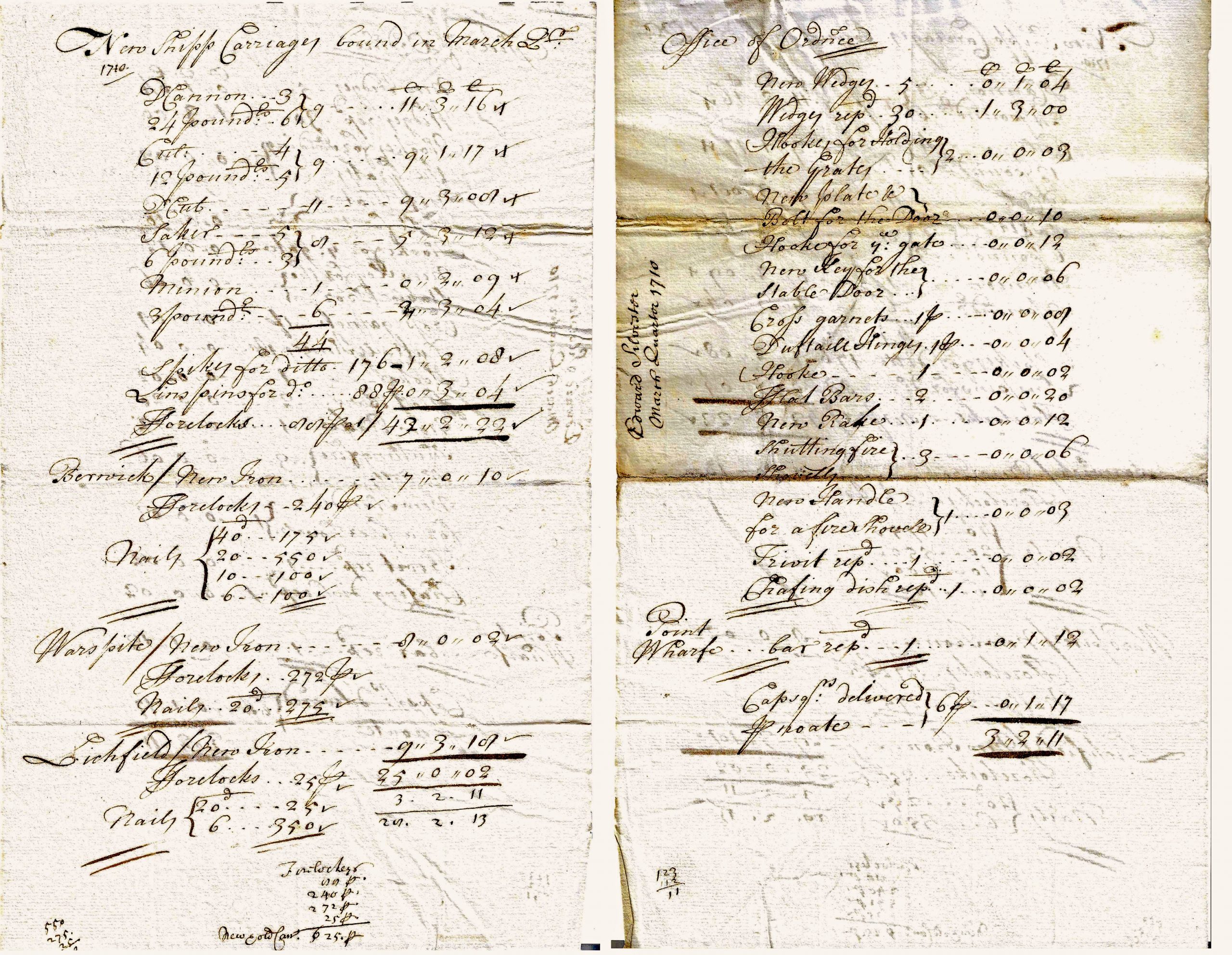
Several bills follow presenting a challenge in transcription. Mr. Maxwell’s bill for carriage repairs in the March quarter is really difficult to read, full of contracted words and untidily written. The figures do not add up correctly, so there must be mistakes in my transcription.

View in new tab:
Similarly Edward Silvester’s bill for new carriages is difficult to read, although Mr. Silvester’s figures for new carriages do add up.
Part of the problem is that these were written on fine paper which does not last as well as the heavy paper used by The Tower. Being fine, it also allows the ink to show on the reverse side, with time this obscures the writing on both sides.

View in new tab:
Edward Silvester’s bill for new carriages during the March quarter 1710 again showing the ravages of time.
View in new tab:
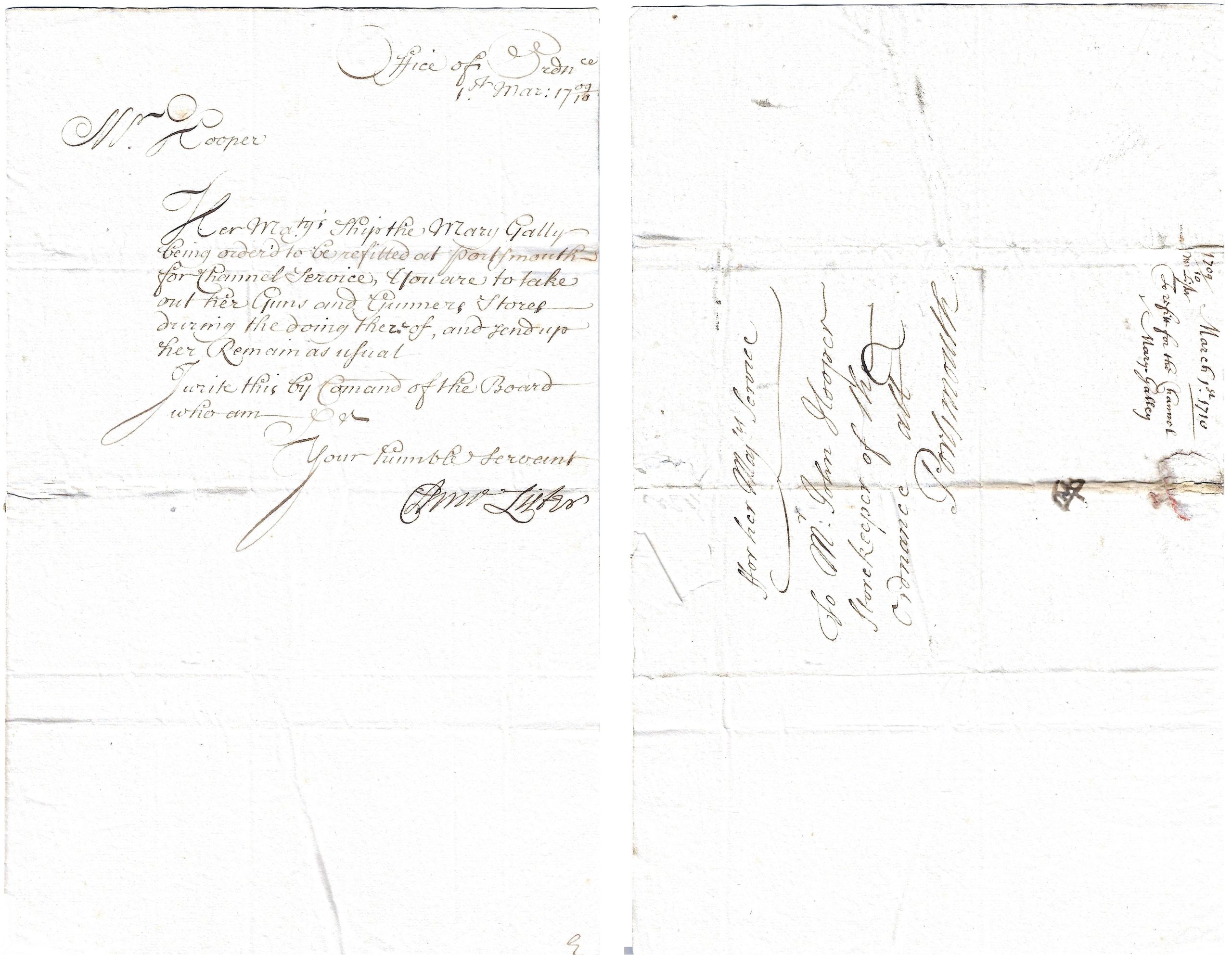
When not pressured, Chris Lister had a truly beautiful hand as is demonstrated by a run of the mill request to prepare the Mary Galley for Channel Service on 1st March 1710.
View in new tab:
Mr. Stanyford’s bill for carpentry has survived a lot better than the others and is more tidily put together. It is interesting to note that, even though these are all bills, the carpentry bills, while quoting weights for some items, are counted in pounds shillings and pence, whereas the smithies’ bills are counted in hundredweights, quarters and pounds.

View in new tab:
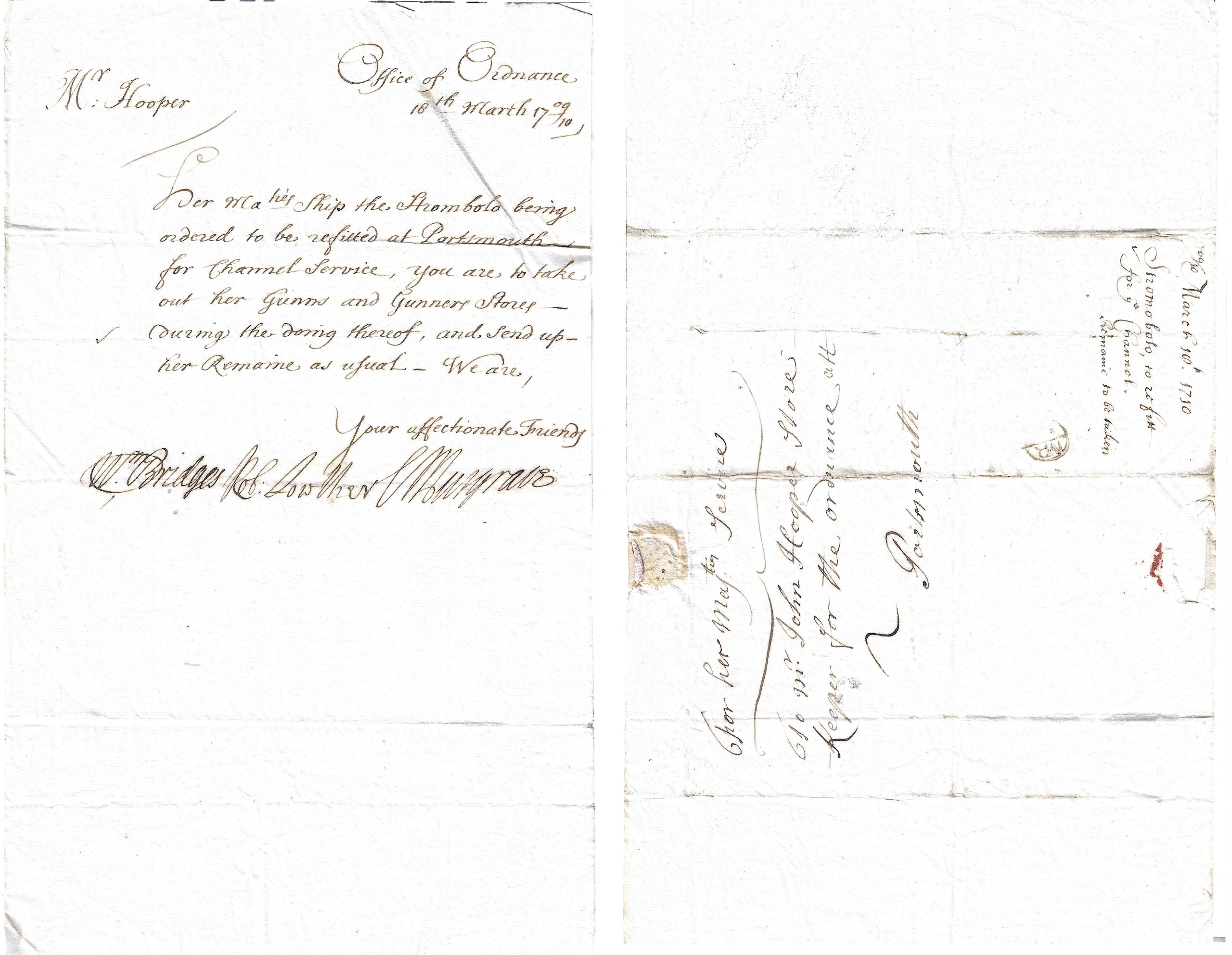
On 7th March HMS Strombolo (1691), an 8 gun Fireship was ordered into Portsmouth to refit for a foreign voyage, yet 9 days later, on the 18th, she is to be refitted for Channel Service. A change of heart by The Admiralty?
Here just 11 days later, we see the same HMS Strombolo, which was to refitted for a foreign voyage, is now to be refitted for Channel service. The difference would have been the quantity of gunner’s stores supplied.
View in new tab:
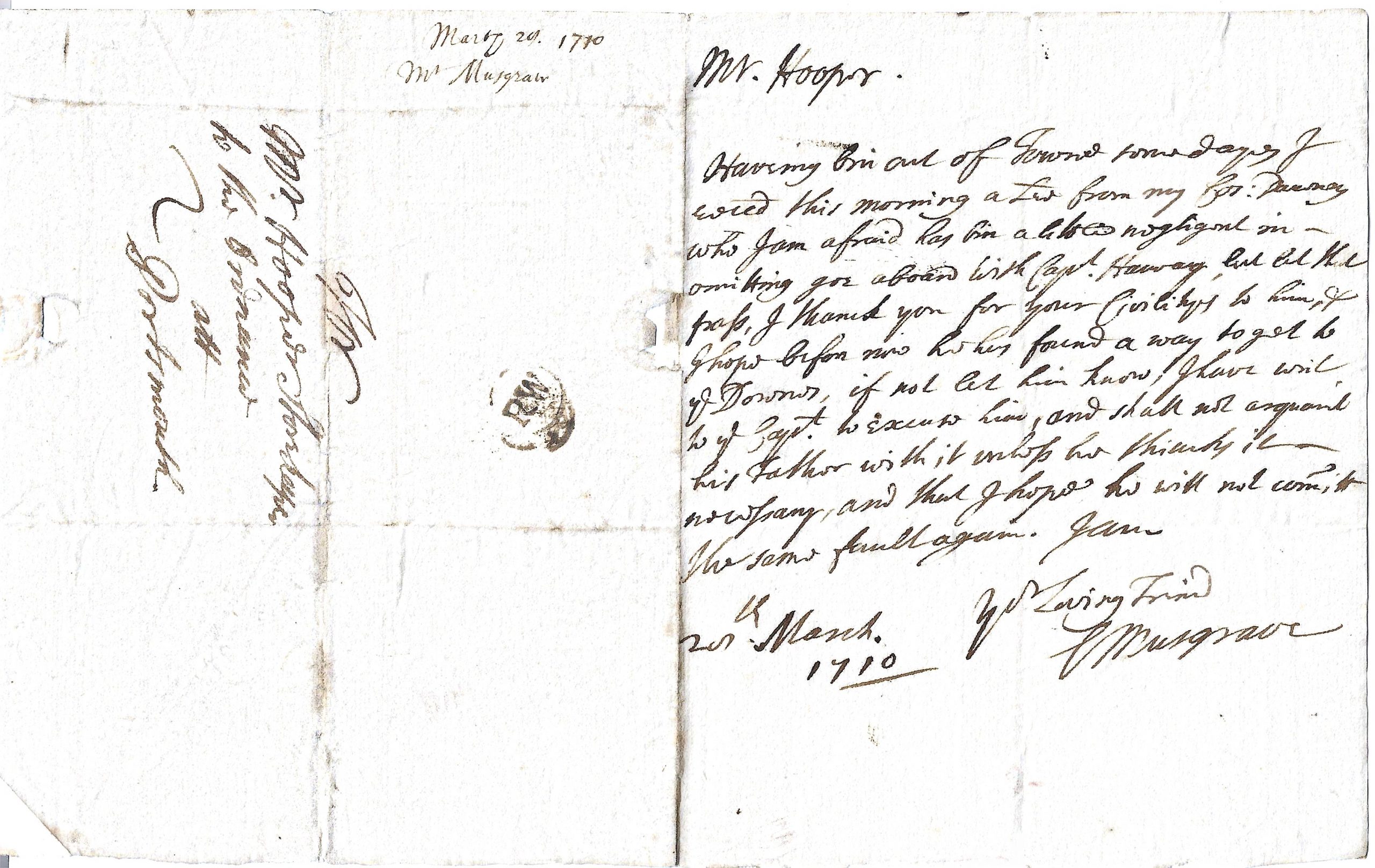
On 28th March 1710 Christopher Musgrave wrote to Mr. Hooper in his own hand, more difficult to read than that of his clerk; he uses more contractions (see reced and Ler for received and letter in the second line, both with a strike above), and his handwriting is less practiced. He wrote to ask for John Hooper’s help in a personal matter concerning his cousin, a midshipman called Dawnay. It would appear that he was supposed to join a ship, but has not done so.
View in new tab:
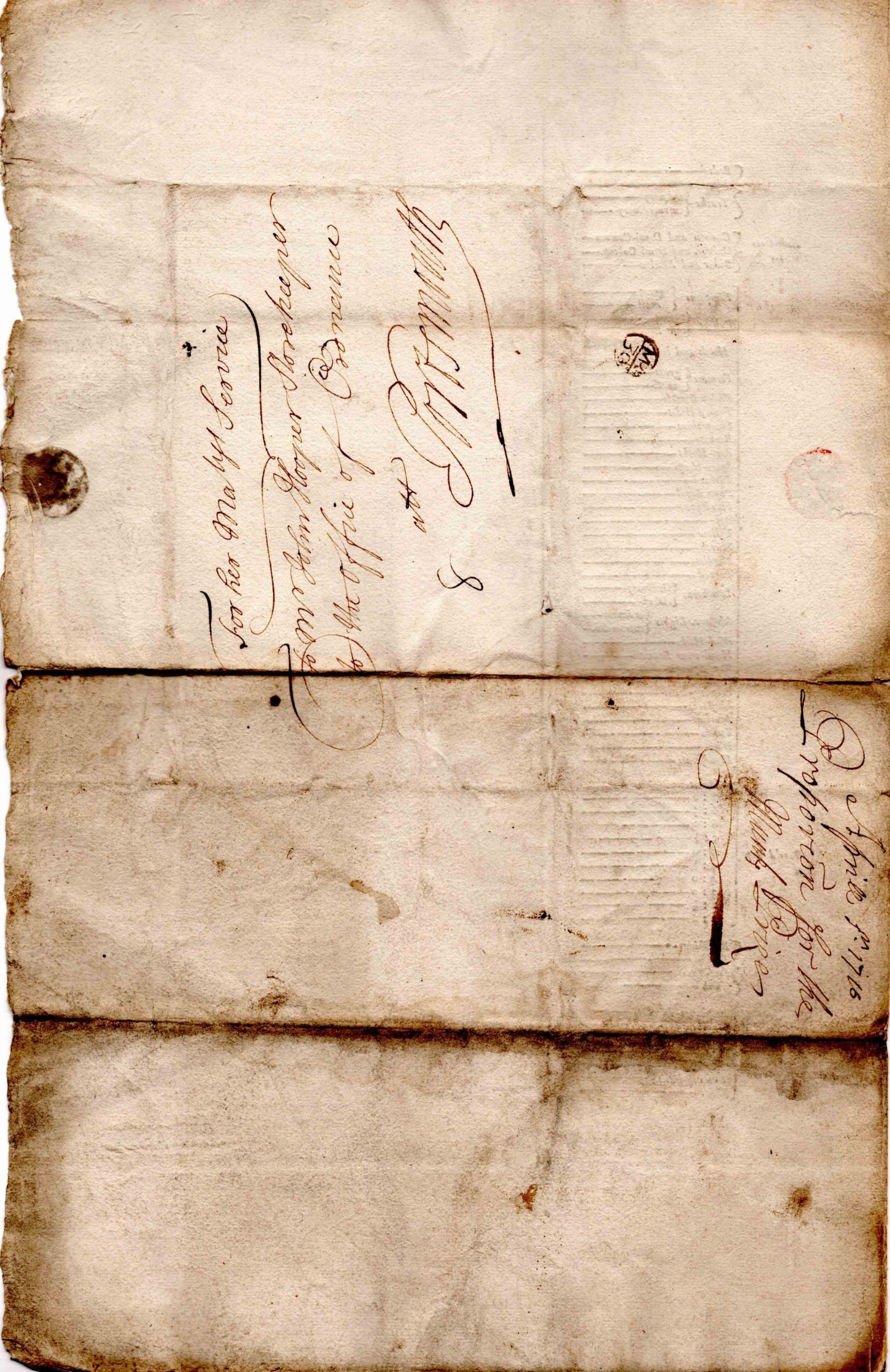
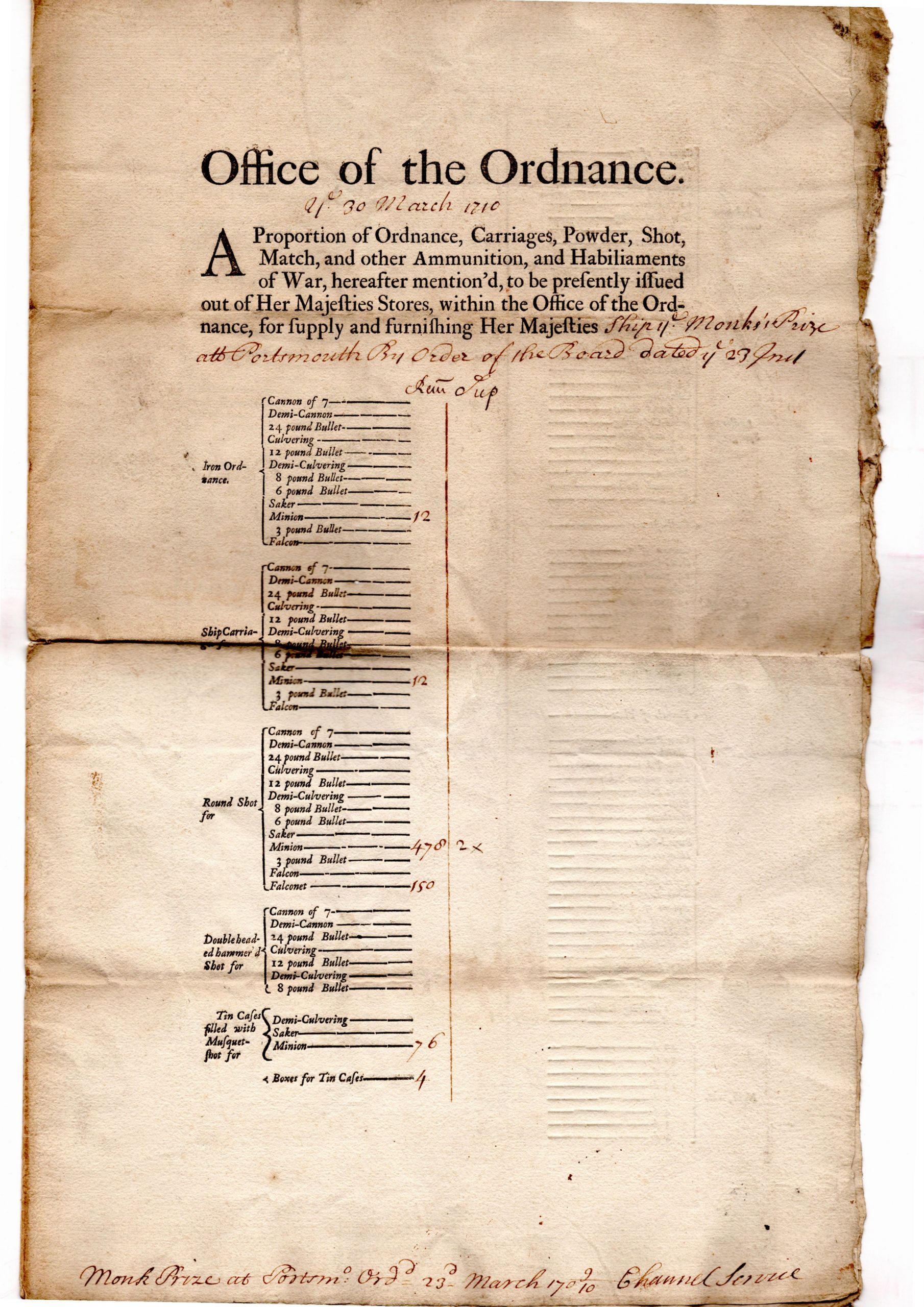
There is no information regarding HMS Monks Prize, yet the Proportion of Ordnance for on 30th March tells us that she was carrying 12 minions. These fired a small shot of 5 pounds (3 ½ inch), so we must assume that Monks Prize was a relatively small vessel. There are no other ordnance or stores mentioned, other than 150 falconet shot (2 inch, 1lb), so she probably also carried a few smaller guns.
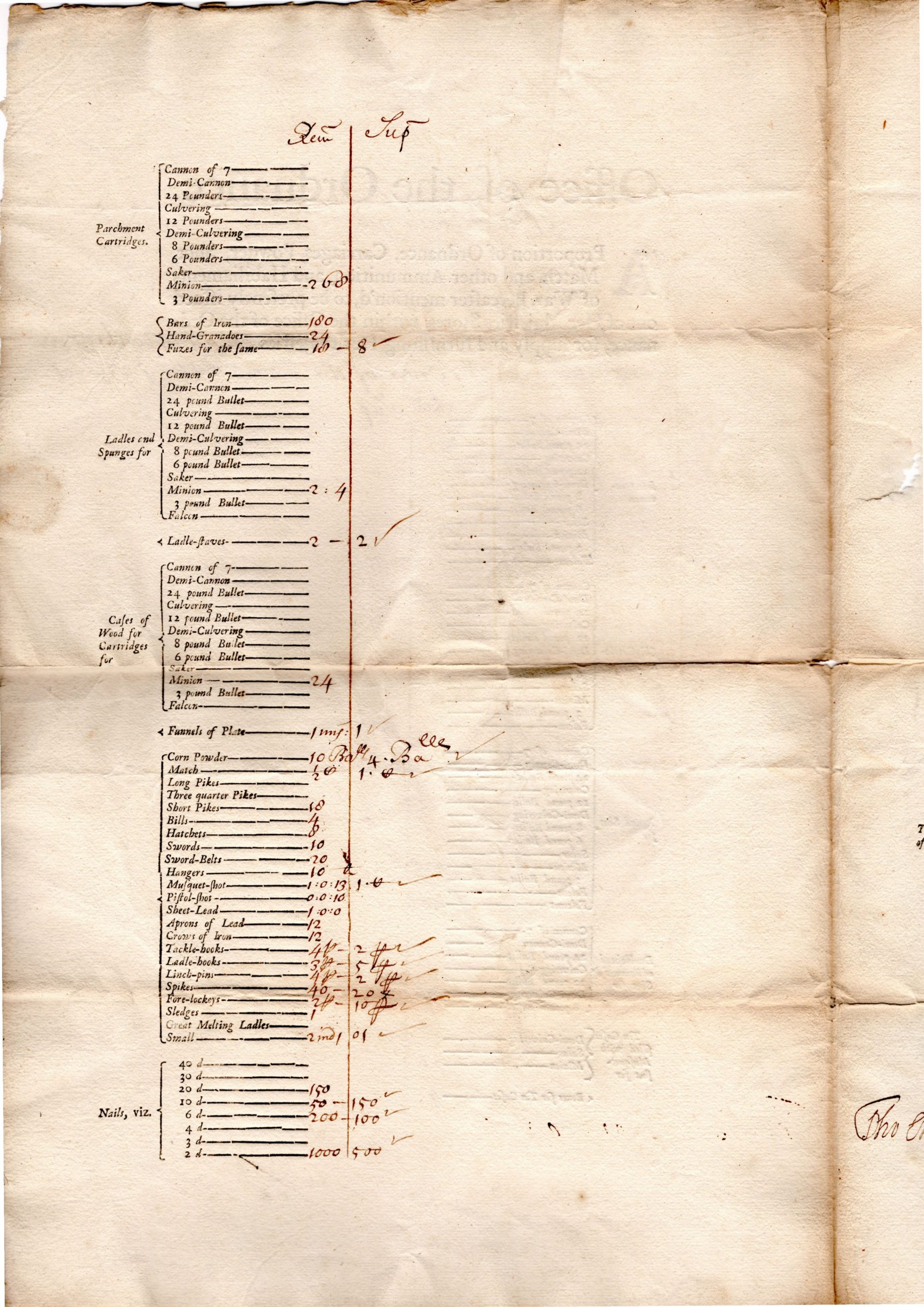
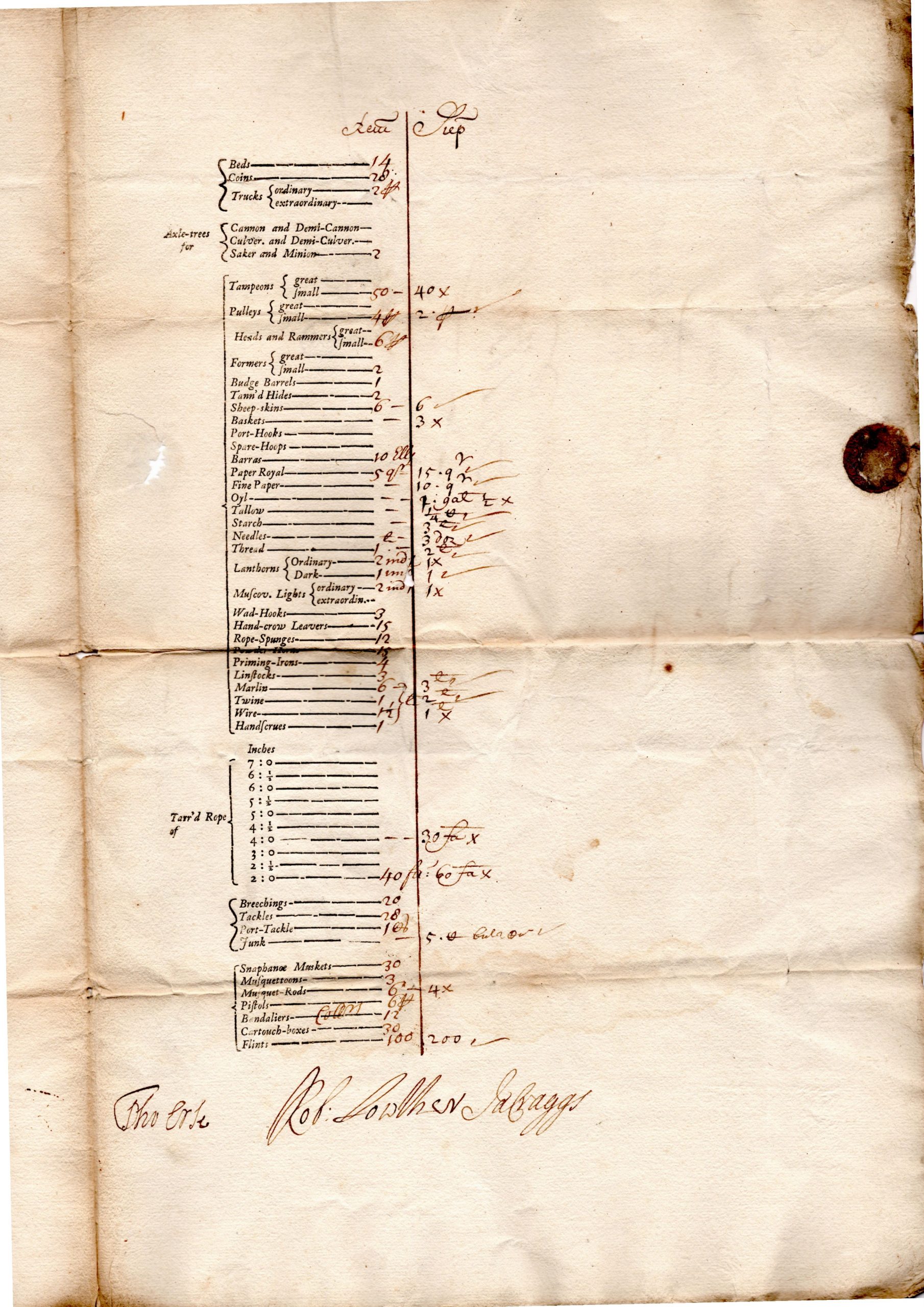
View in new tab:
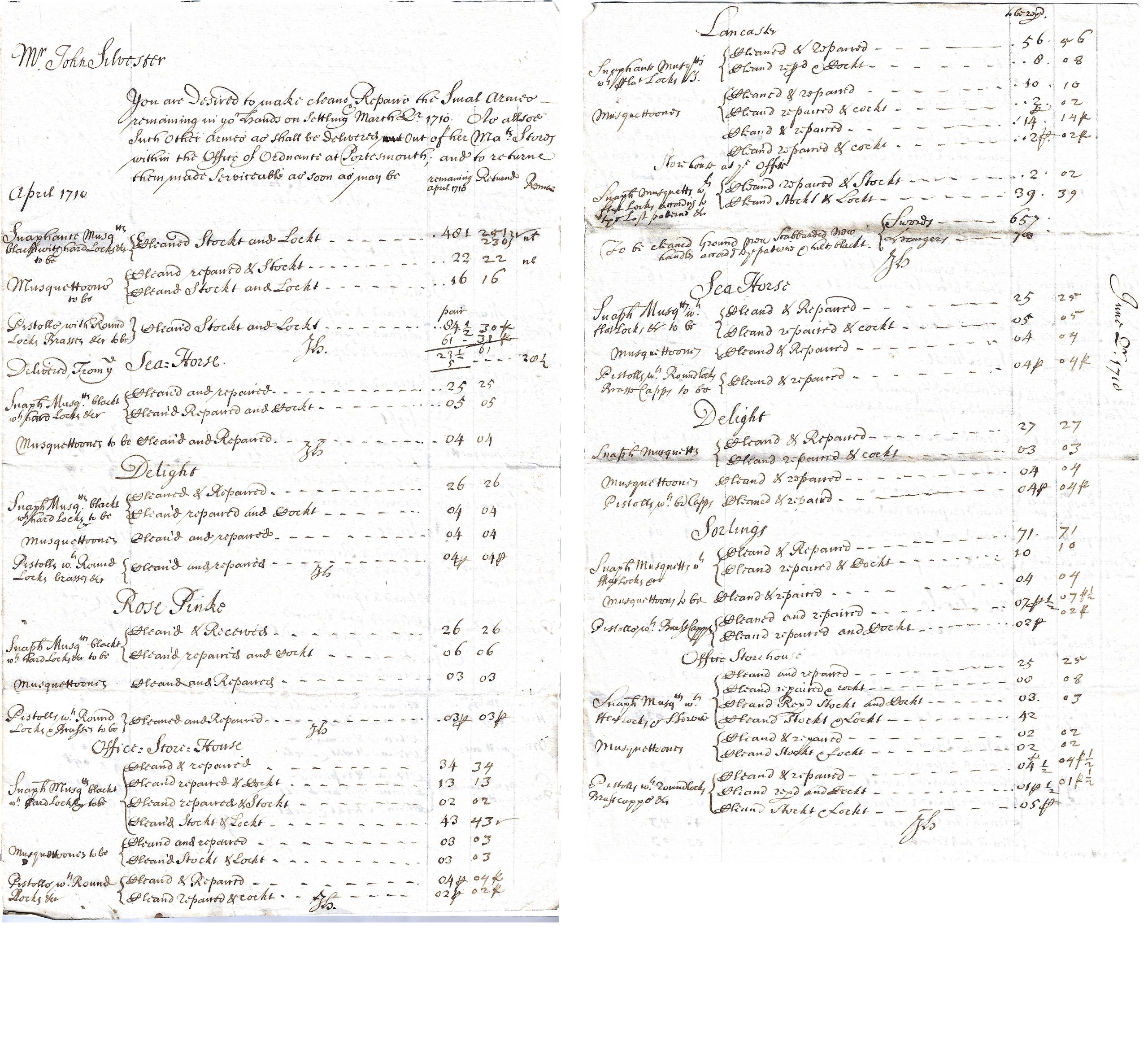
Mr Hooper writes to John Silvester in April 1710 with a list of small arms to be cleaned and repaired. John Hooper has initialled the note at each stage, presumably this is to indicate that he has checked that the work has been done.
View in new tab:
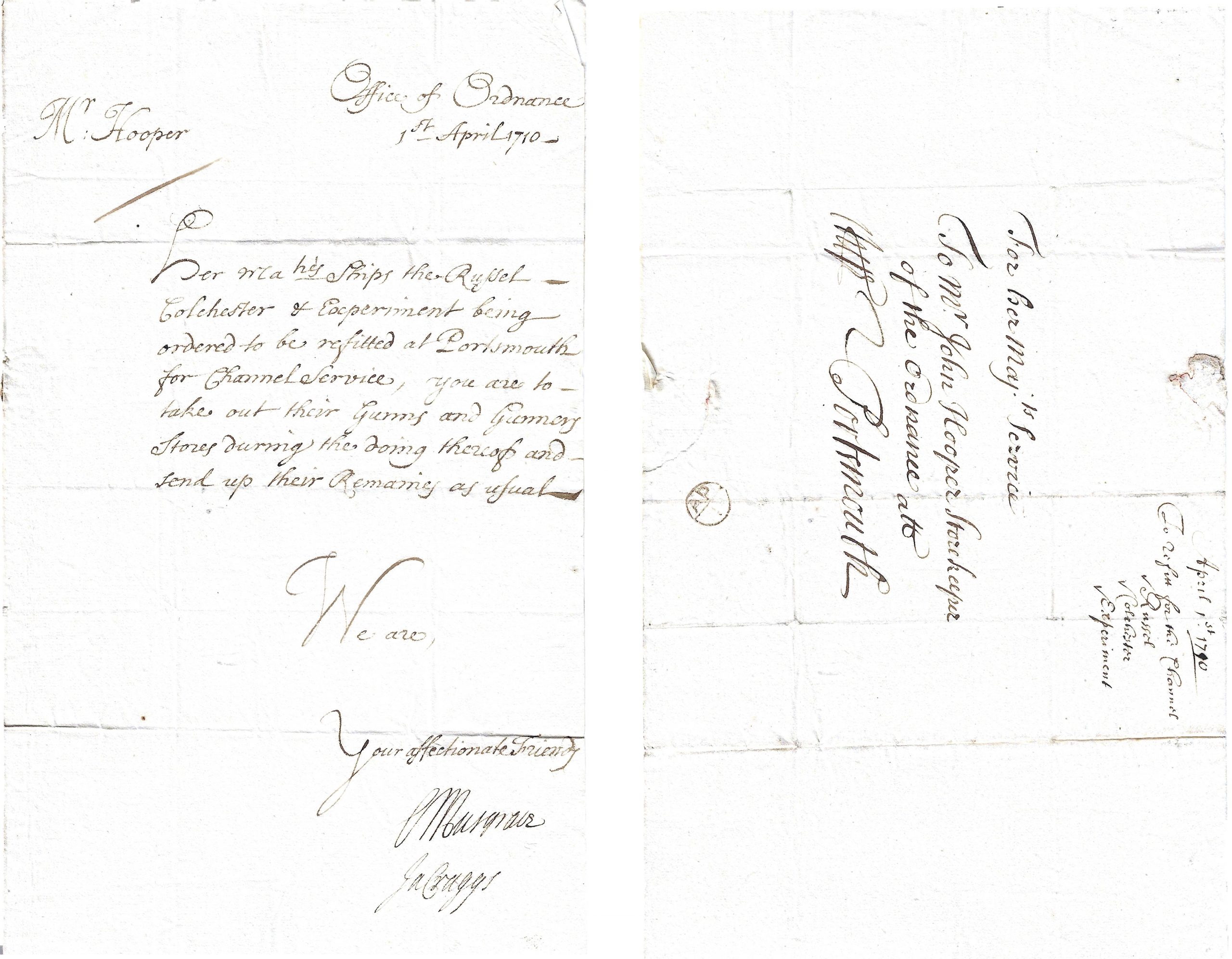
Also, on the 1st April Mr. Hooper is asked to prepare three ships for refit.
View in new tab:
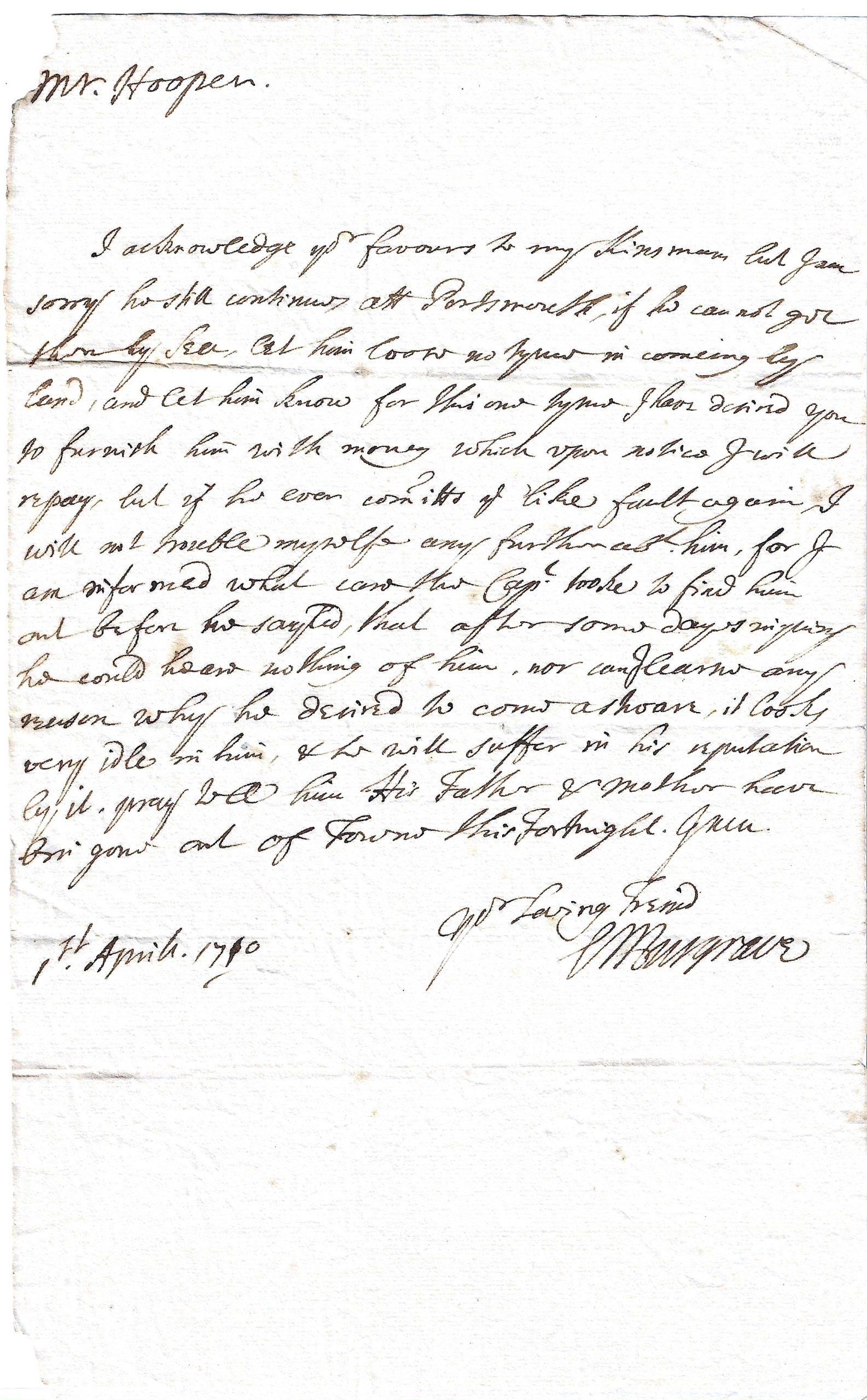
Also on April 1st Christopher Musgrave writes again, in his own hand, to Mr Hooper about his wayward cousin, Dawnay. This would have been one of the Dawnays from the west Riding of Yorkshire. He asks that Mr. Hooper supplies him with money for a fare to get himself to London. Mr. Musgrave is clearly most displeased with his relative.
It is unusual to get such an insight into the personal world of these people. I feel privileged to have been party to this.
View in new tab:
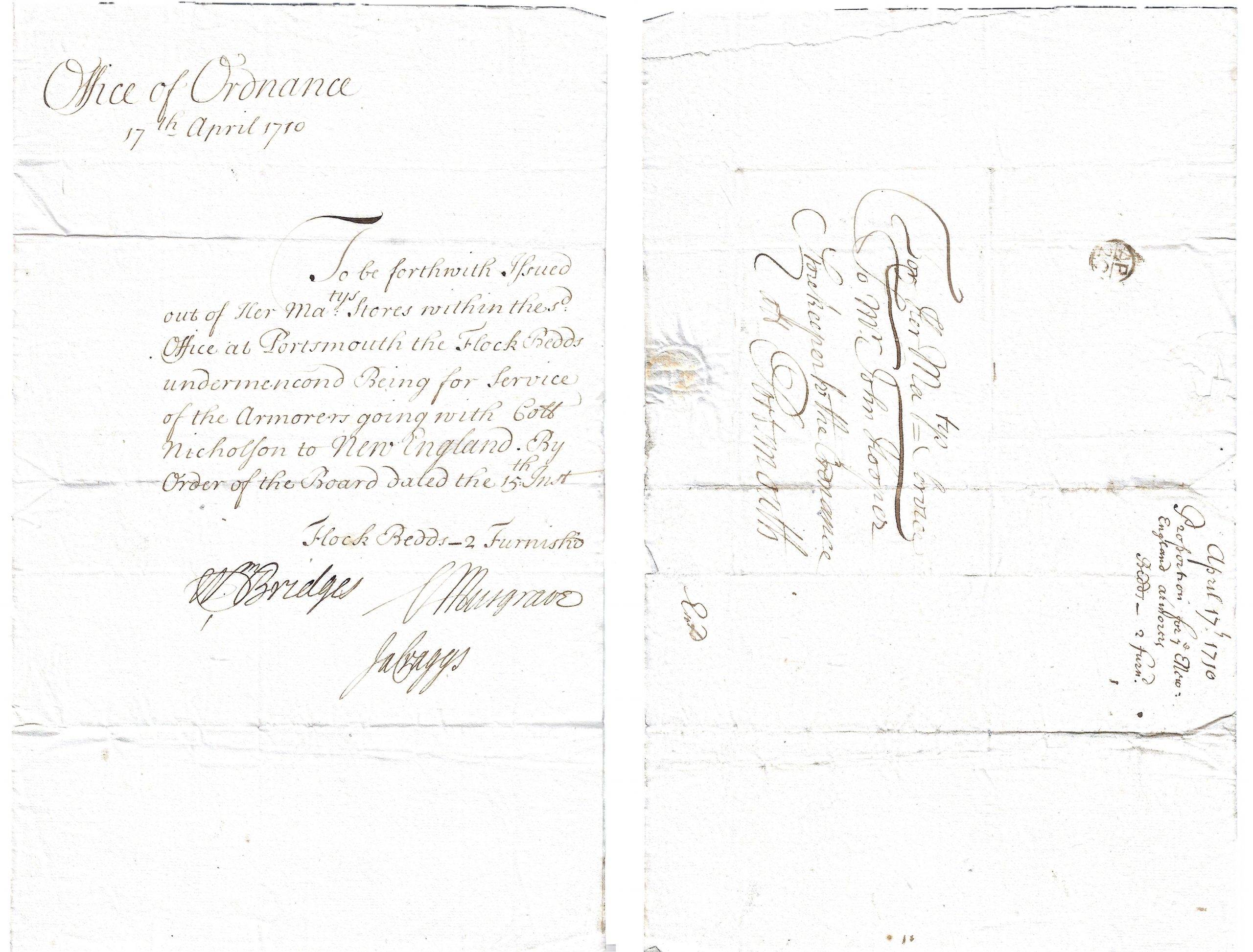
17th April 1710 a seemingly innocuous letter from The Board asks Mr. Hooper to supply ‘flock beds’ for the use of armourers going with Colonel Nicholson to New England. This was in preparation for an expedition to capture Port Royal in Nova Scotia on 2nd October 1710.
View in new tab:
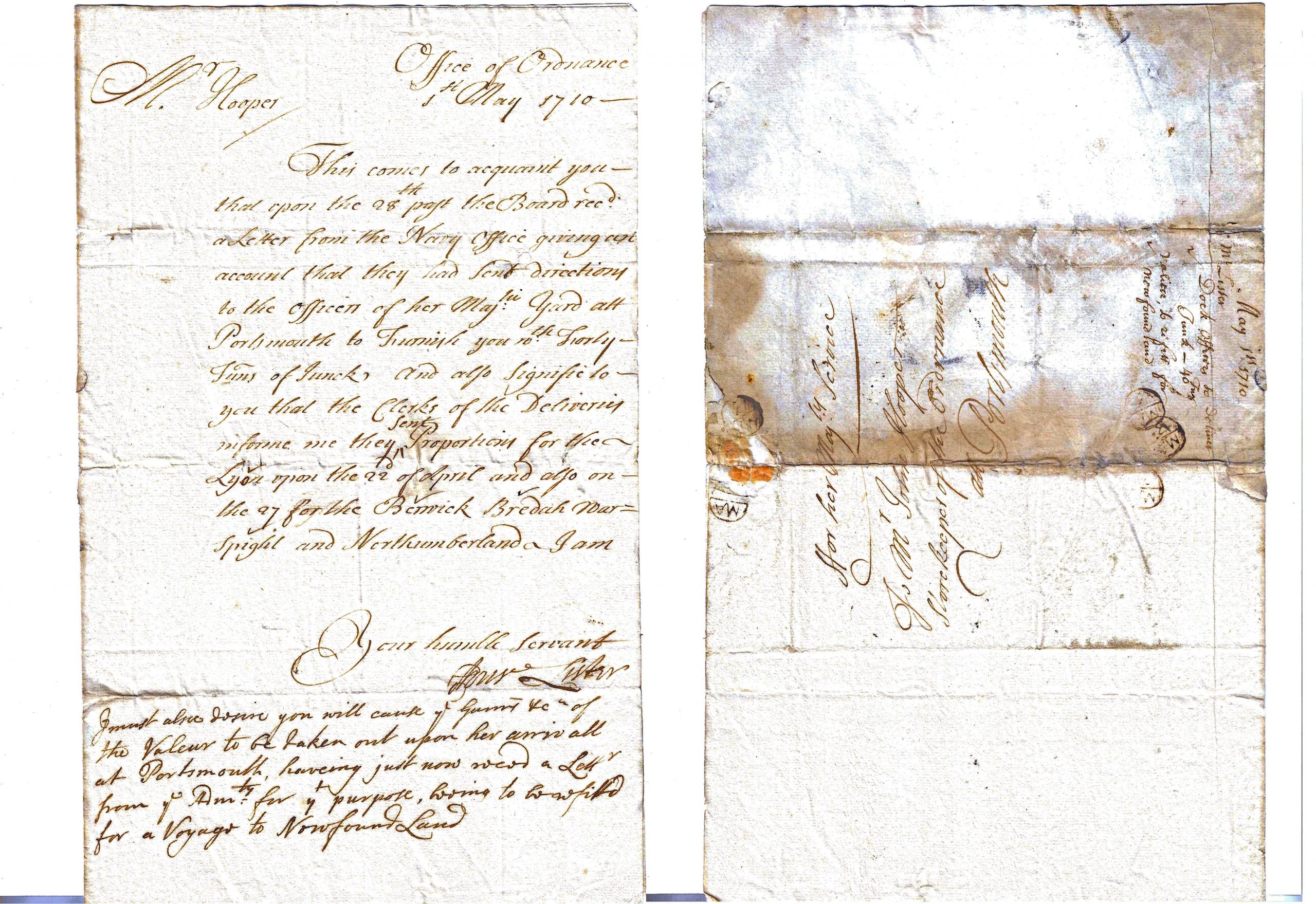
40 tons of junk (rope remnants) are to be delivered, and several ships have been sent stores. In the post script we see that HMS Valeur is to be prepared for a journey to Newfoundland.
View in new tab:
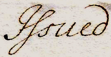
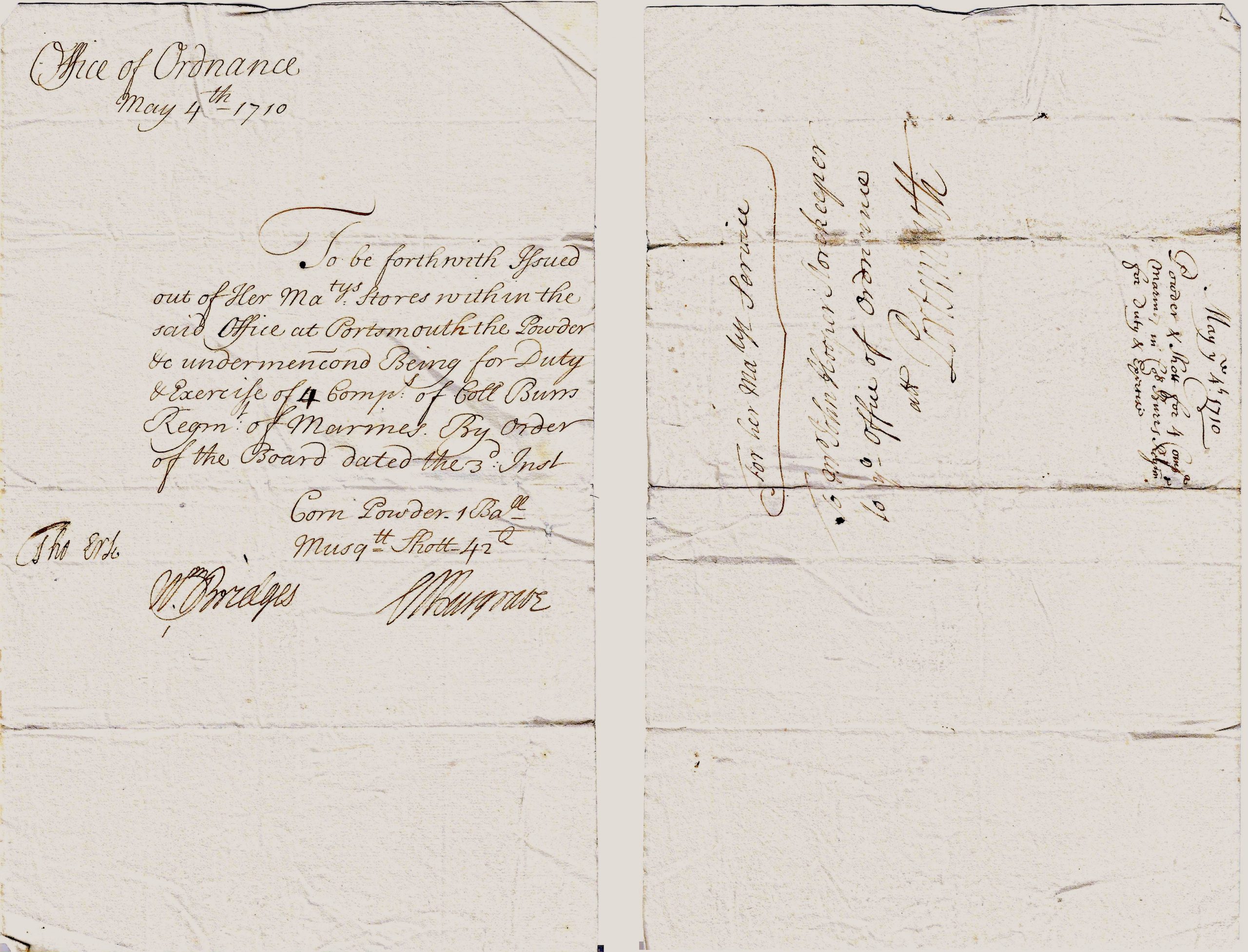
On 4th May 1710 we see an excellent example of the use of a double ‘S’ in the word ‘Issued’, showing how the first ‘s’ is using upper and the second, lower case.
View in new tab:
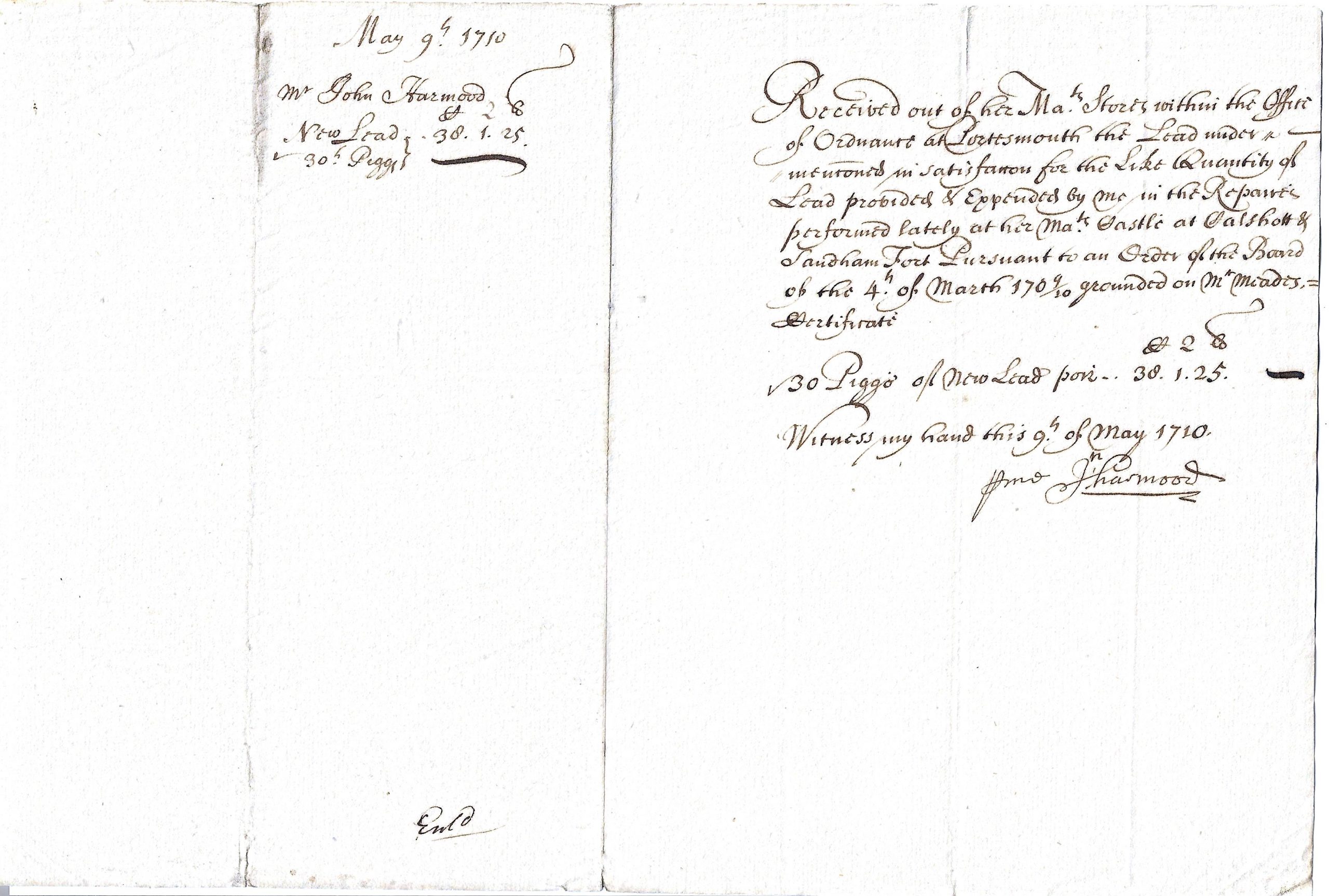
John Harmood acknowledges receipt of over 1 ½ tons of lead in his note of 9th May 1710. We are told that he received 30 pigs weighing 38 hundredweight, 1 quarter and 25 pounds, meaning that a pig weighed 6.8 pounds. The lead was for Calshot castle at the entrance of Southampton Water and for Sandham Fort on the south coast of the Isle Of Wight at Sandown.
View in new tab:
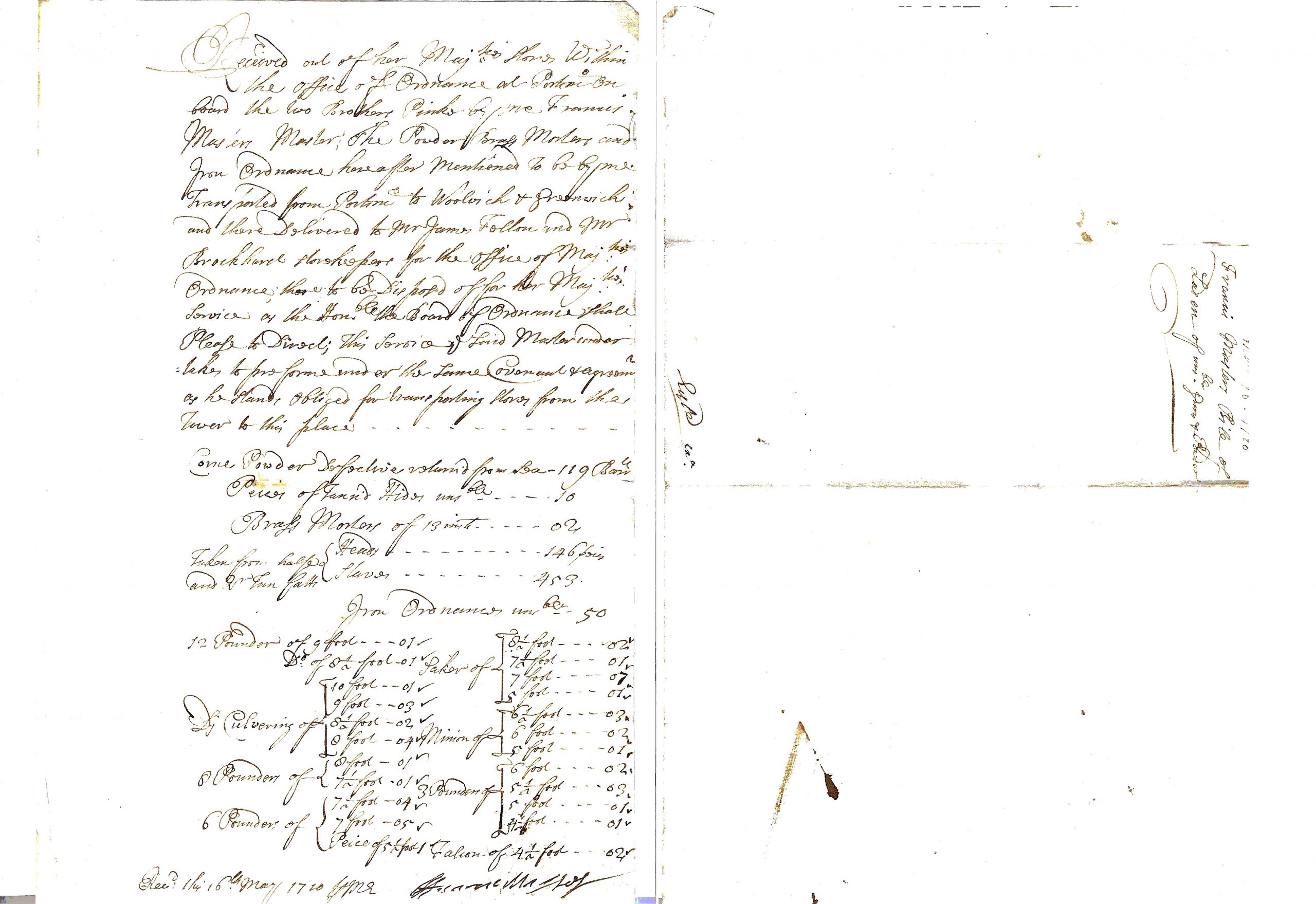
A bill of laden from 16th May 1710, from Francis Masters, commander of the pinke (a ship with a narrow stern), named Two Brothers provides interesting reading. We have seen letters from The Board instructing Mr. Hooper to prepare ships for refit whereby they say: ”You will take out her guns and gunner’s stores and send up her remain as usual.” This bill of laden lists ‘the remain’ being sent up to Woolwich and Greenwich. Among the remain we see mentioned: Brass monkeys of 13” – 2.
What was a brass monkey? We have all heard the term ‘cold enough to freeze the balls off a brass monkey’. There is speculation as to what this means in actual fact. A monkey is a frame used to hold cannon balls close together allowing them to be stacked, either in a square or triangular fashion and often piled into a pyramid. In a land fort, monkeys would have been made of iron, examples of these survive. If iron was used on a ship, the balls and the monkey would be subject to rust, brass however does not rust, so it is probable that brass monkeys were employed. It has been argued that to stack cannon balls on the deck of a ship in a monkey would risk them rolling out if the weather was rough and so balls were stored in galleries, a wooden plank with holes. This is true, so if a brass monkey was employed, it is likely that they would have been used temporarily, possibly with only one layer of balls being contained. As for the brass shrinking enough to release the balls, this is unlikely, but not impossible. There are also suggestions that the term ‘brass monkey’ didn’t appear until the 19th century, this document debunks this idea.
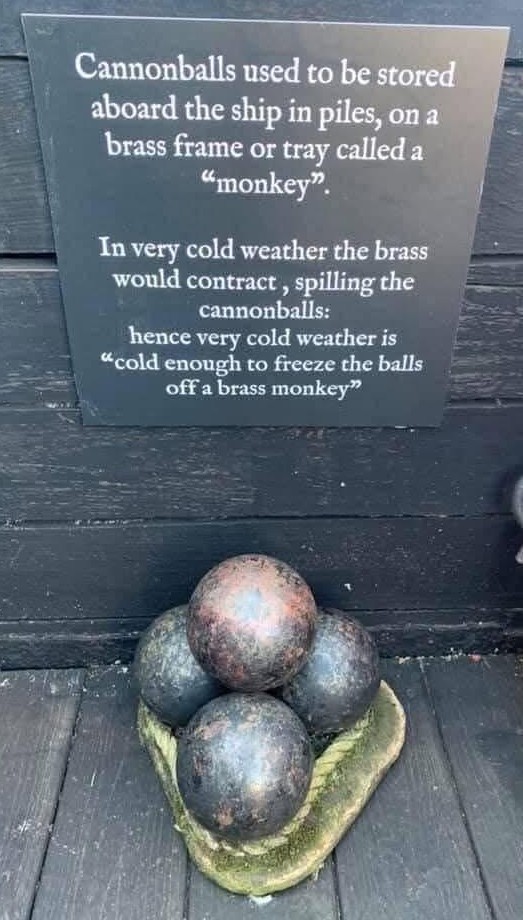
Another possible explanation purported is that a brass monkey was a small cannon, however, a gun firing balls of 13-inch diameter would not be small, and it is unlikely that a gun of only 13 inches in length would be of much use on a ship, so this idea can also be dismissed. Besides: the ‘great guns’ were mostly named after birds of prey, not monkeys.
The bill of lading (here called as bill of laden) goes on to list the guns being carried and states their length, a detail not often mentioned.
View in new tab:
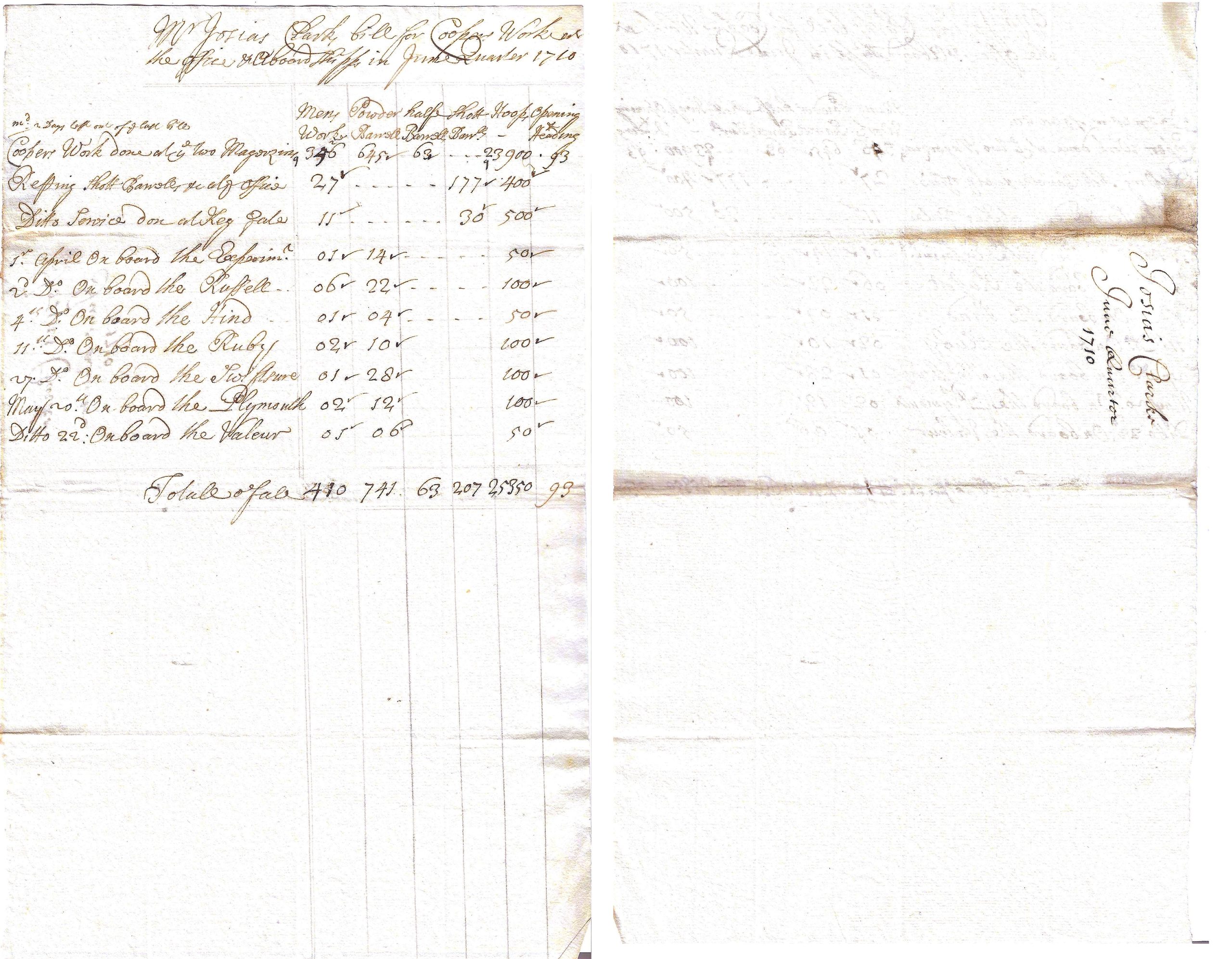
Josias Clarke’s tidy June quarter cooperage bill shows us the work he and his men have done in various places around Portsmouth and on several ships.
View in new tab:
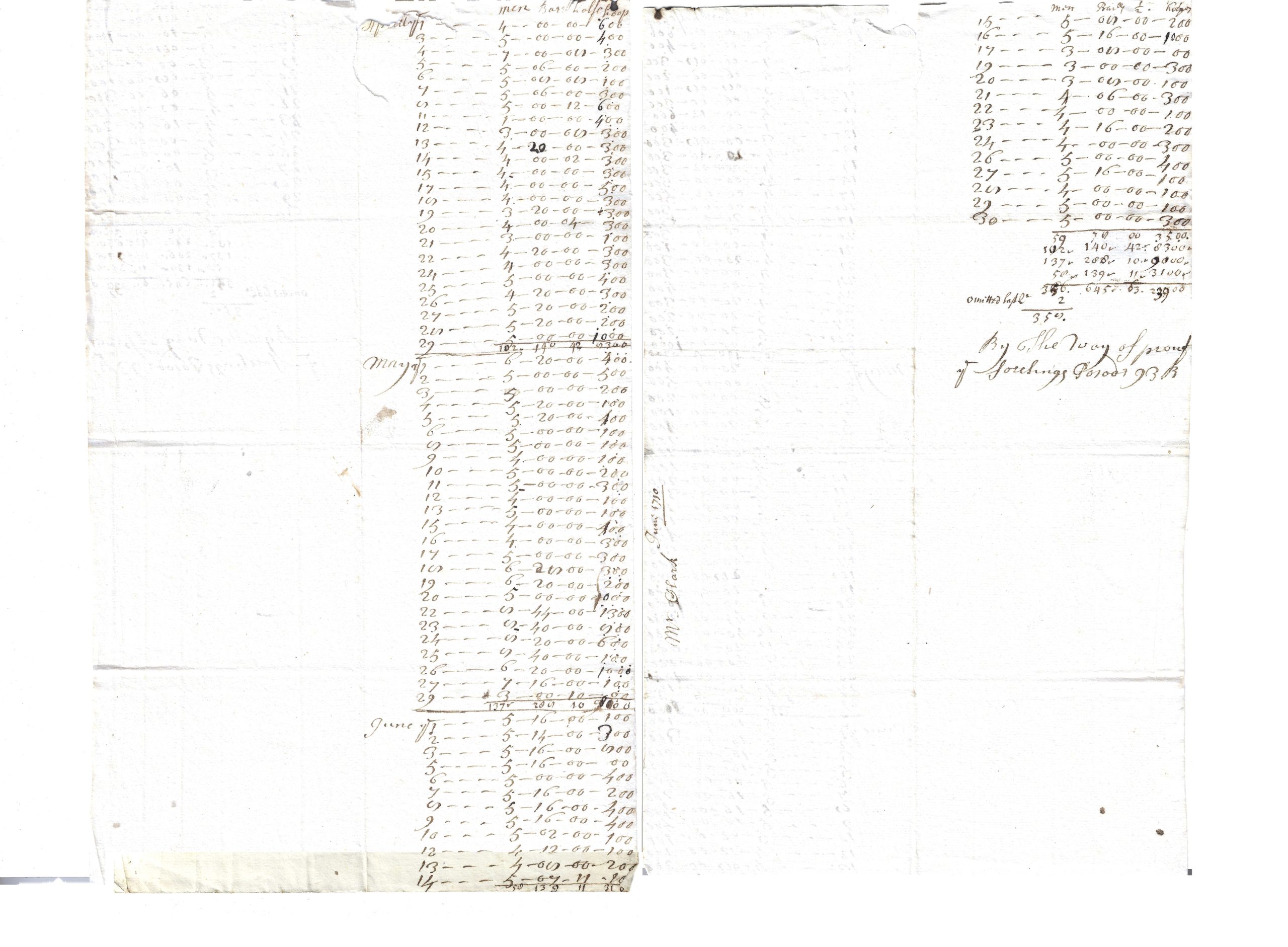
Following Josiah Clarke’s cooperage bill we see an account of cooperage work in April May and June of 1710, seemingly an appendix to the previous bill.
View in new tab:
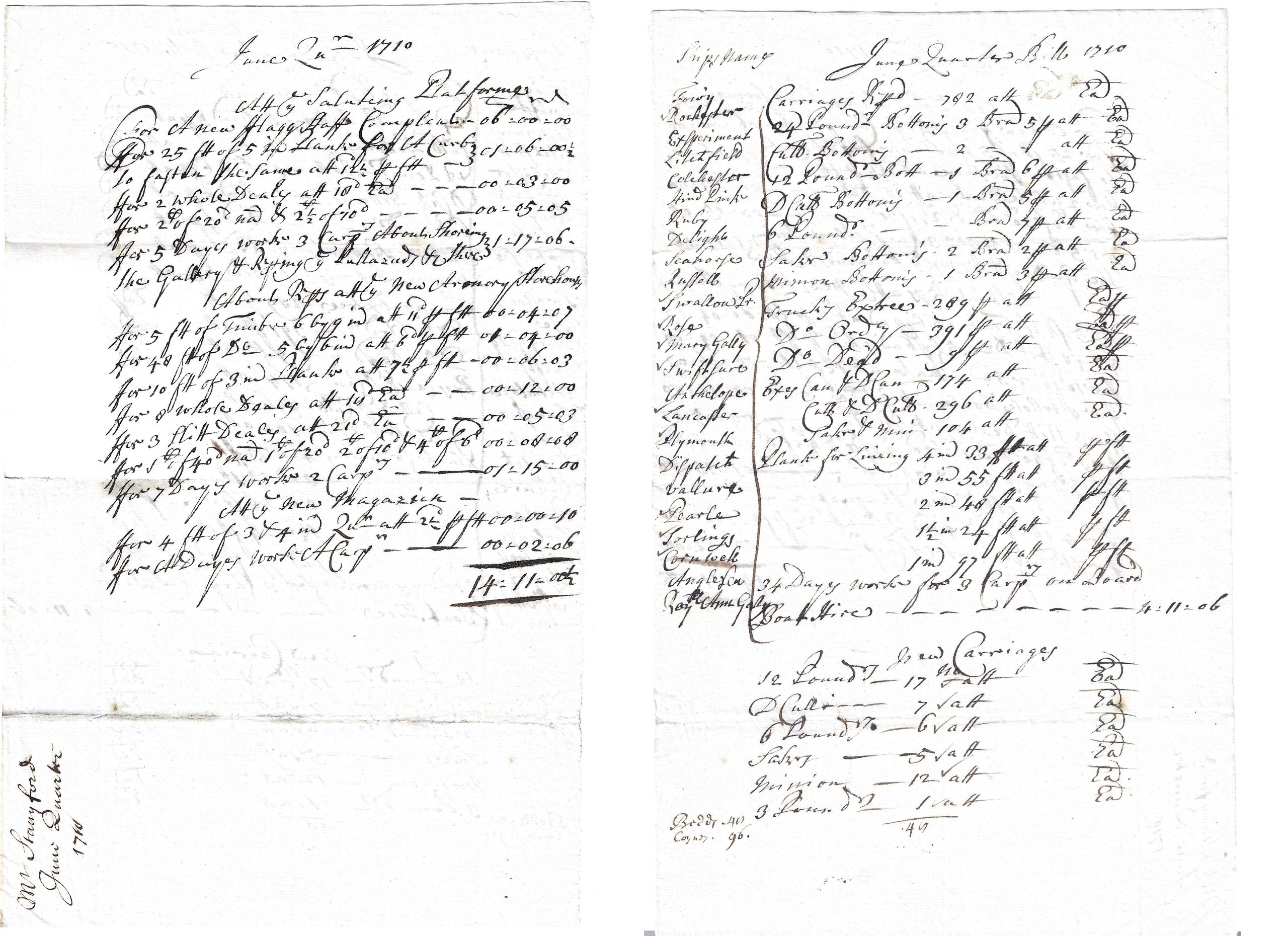
Similarly, Henry Stanyford’s June quarter carpentry bill is very detailed. It talks of work at The Saluting platform, this is still there jutting out into the sea close to the Royal Garrison Church.
View in new tab:
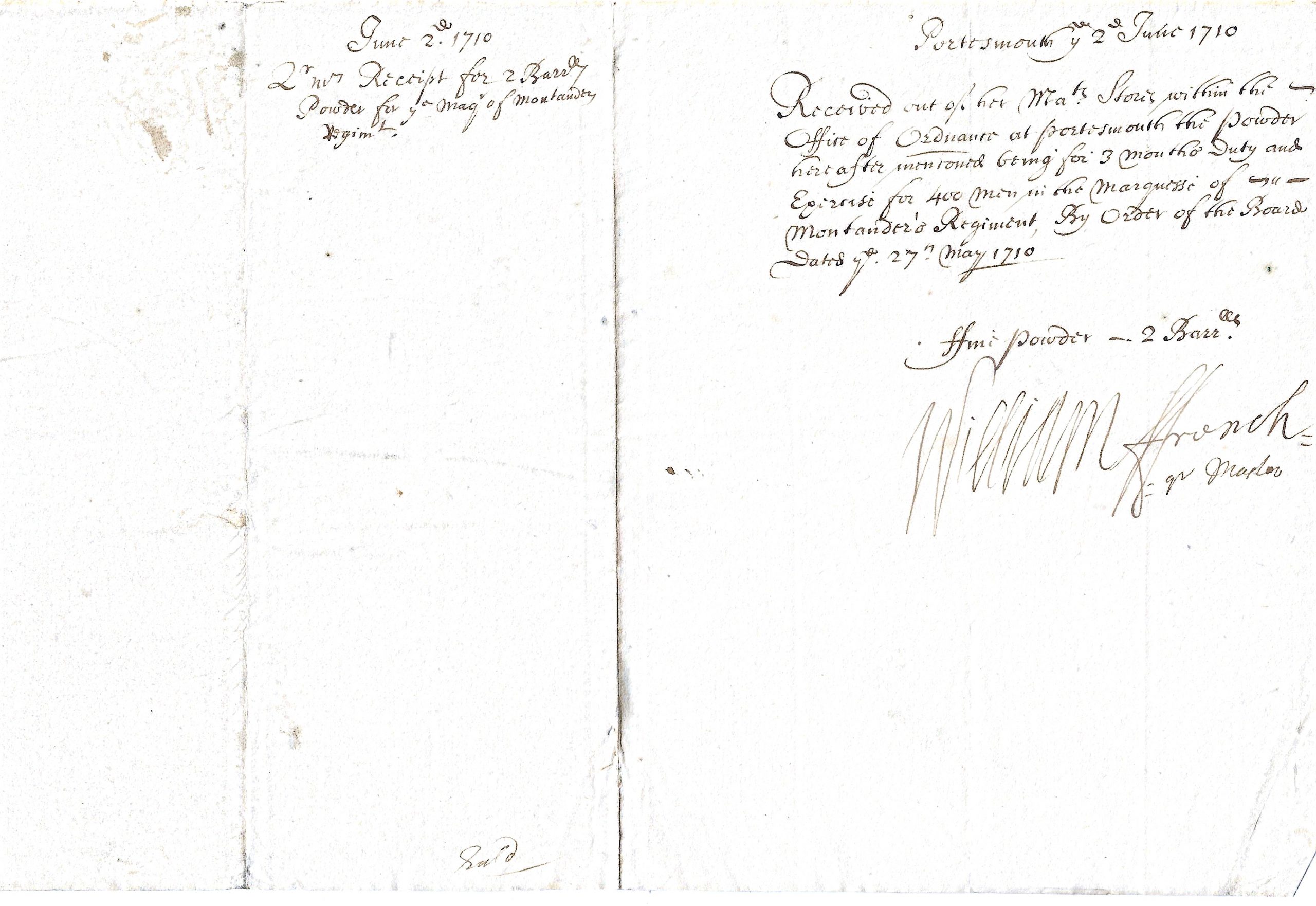
Two notes regarding powder for the Marquess of Montander’s regiment on 2nd June 1710.
View in new tab:
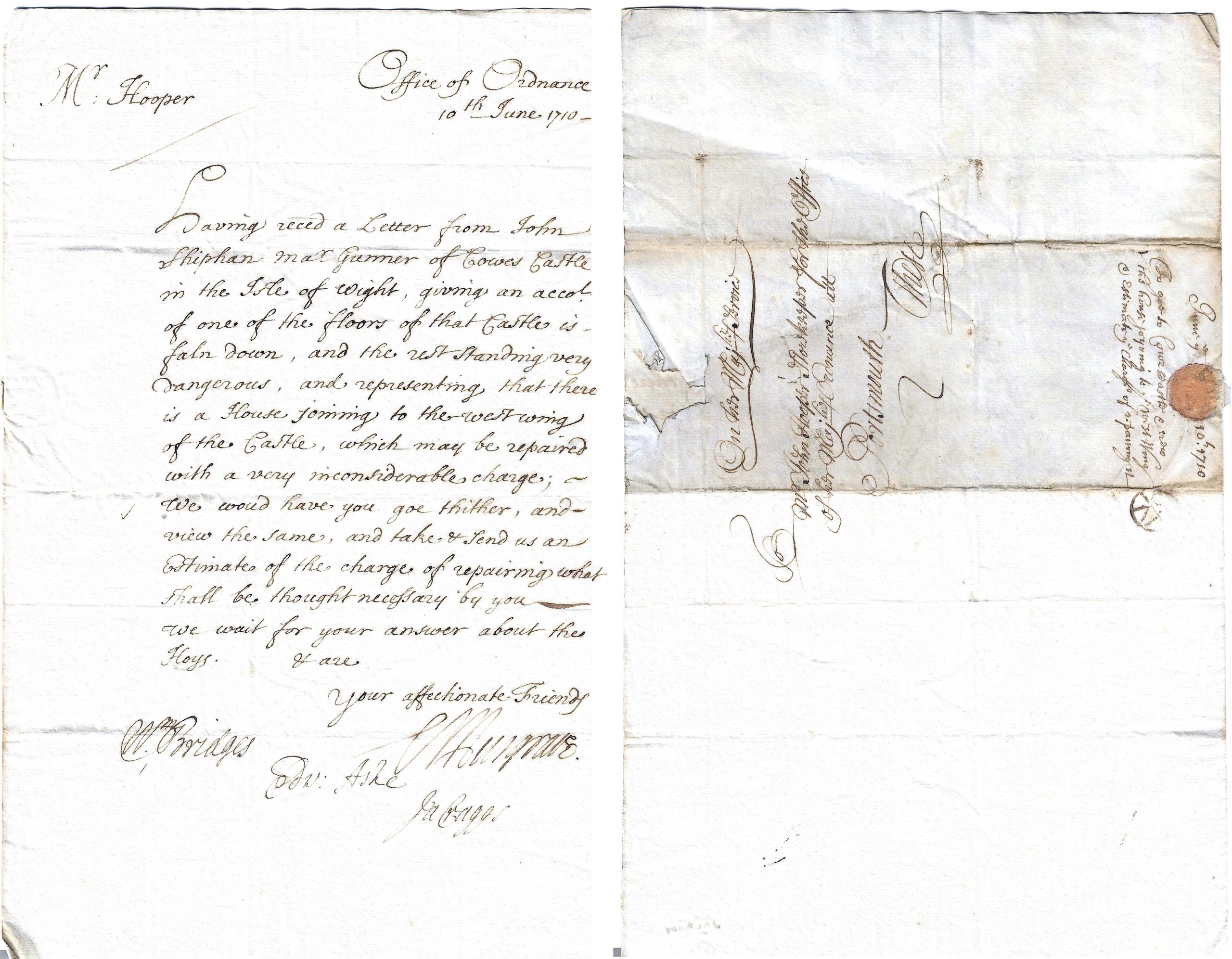
A letter from The Board on 10th June 1710 instructs Mr. Hooper to go to Cowes to assess the repairs required to the castle. He could probably make the return journey easily in one day.
The castle at Cowes, dating from 1539, was deteriorating, and in 1716 was partially rebuilt. It was later described as useless for defence. Later still it became the home of the Royal Yacht Squadron.
View in new tab:
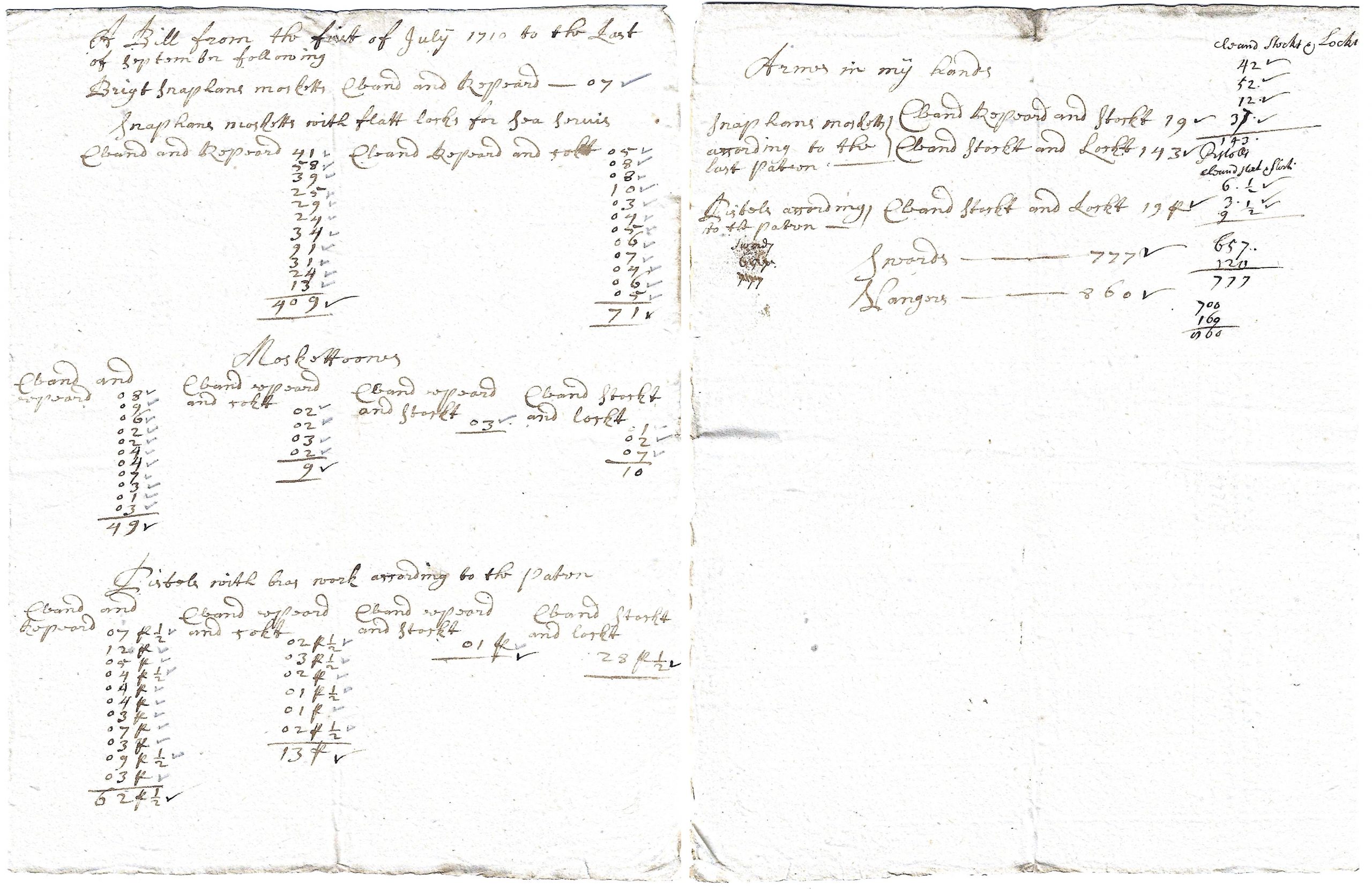
A bill, presumably from John Silvester, for refurbishing small arms.
View in new tab:
On 11th July a letter advises that HMS Humber (1693) is to be laid up and that the master gunner should report on his expense of munitions. This implies that careful records must have been kept of how much powder, shot, &c. were expended whether in practice, saluting or in battle.

View in new tab:
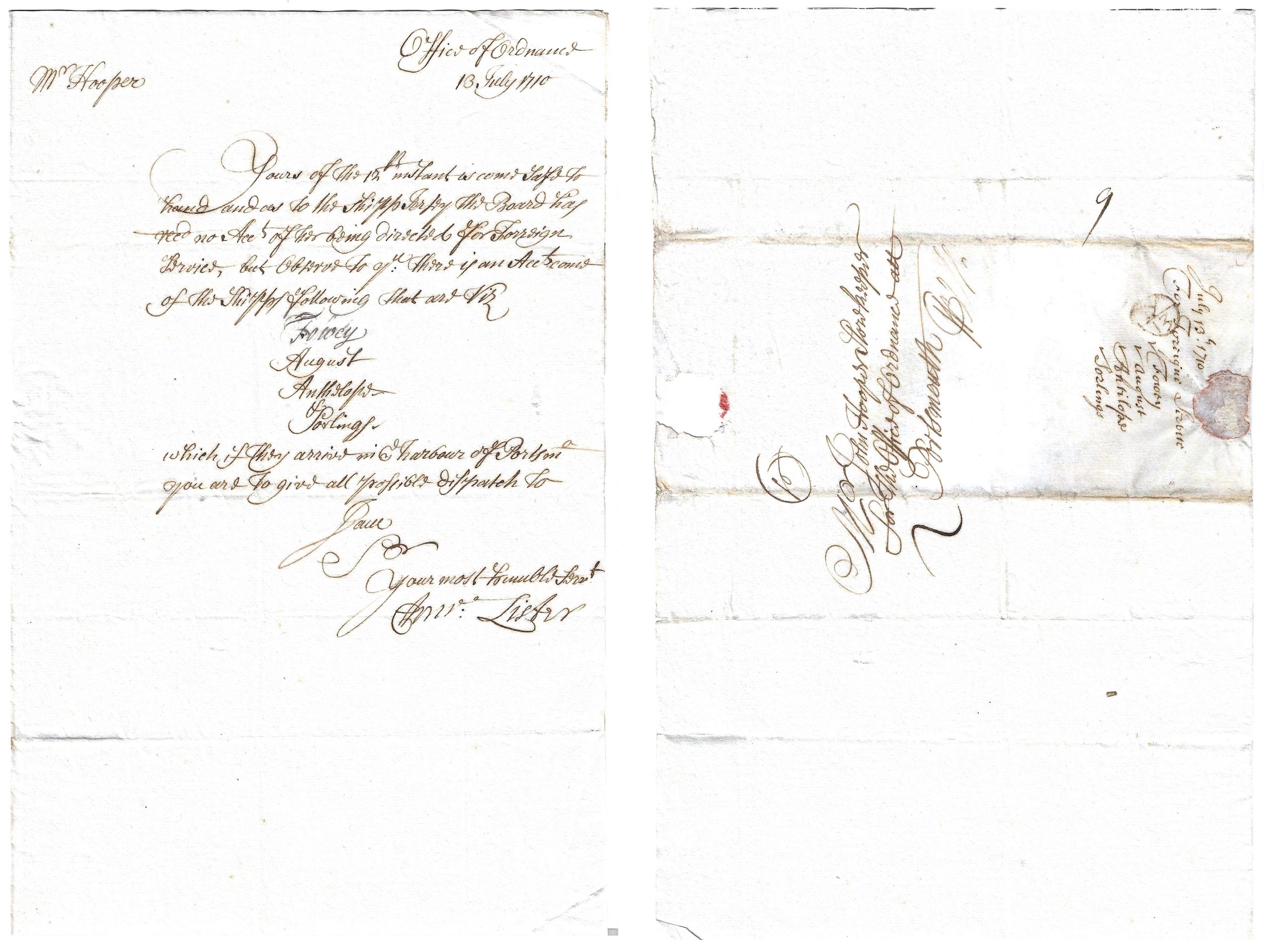
A letter from Chris Lister on the 13th July 1710 refers to four ships to be expected in Portsmouth and that, should they arrive, he should restock these ships as quickly as possible.
A curious thing about this document is that it is one of 8 or 10 in 1710 which have an endorsement after the address which appears to say ‘C these‘ or ‘C Huse‘. Neither makes sense to me. As it is written almost as part of the address, it my be an instruction to the postal service. I am open to any suggestions.
View in new tab:
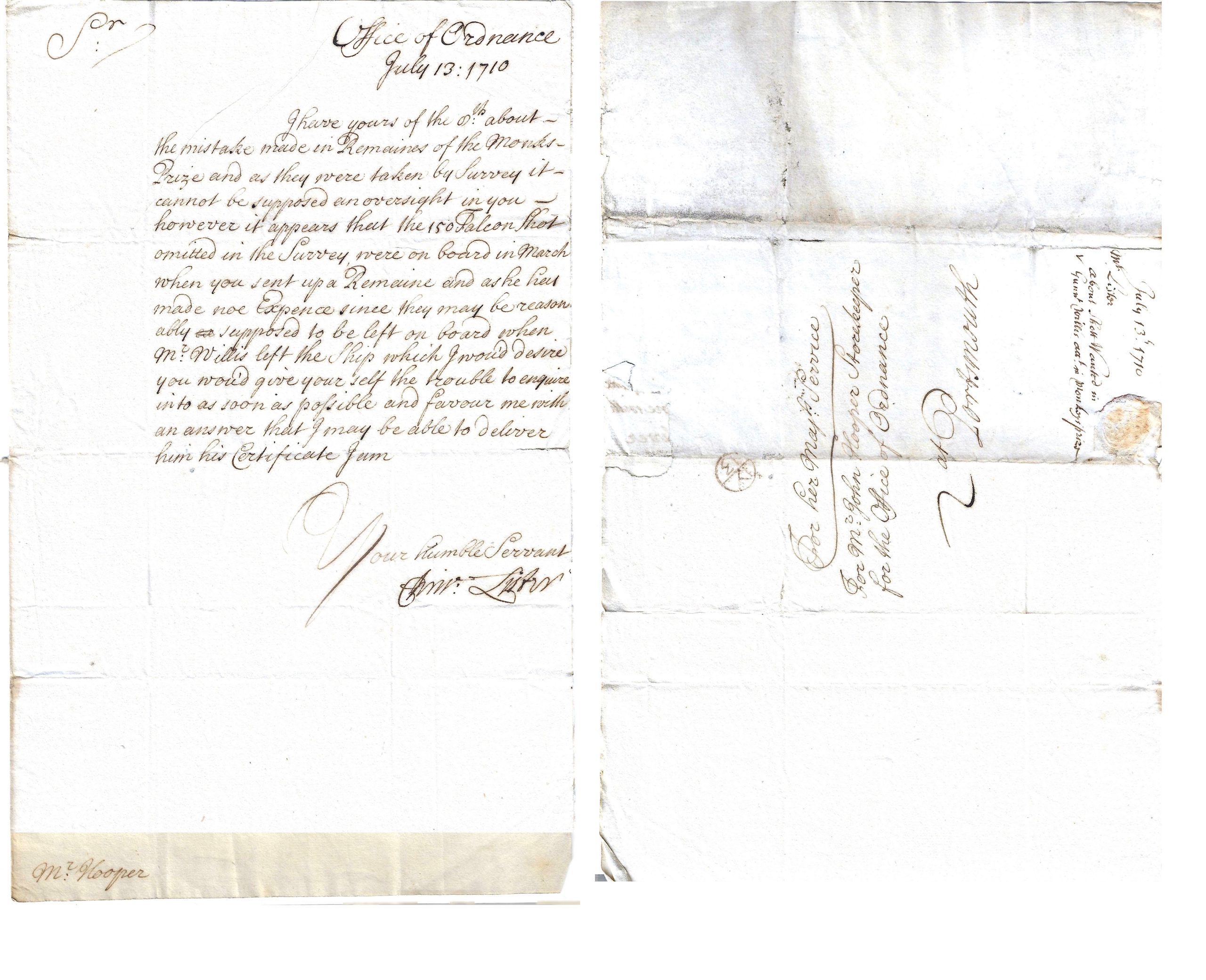
Chris Lister’s second letter of July 13th questions the whereabouts of the 150 falcon shot that was aboard Monks Prize when the remain was sent up in March. In fact the proportion of ordnance from that day, 28th March, mentioned 150 falconet shot, not falcon. Mr. Hooper is to investigate and report back.
View in new tab:
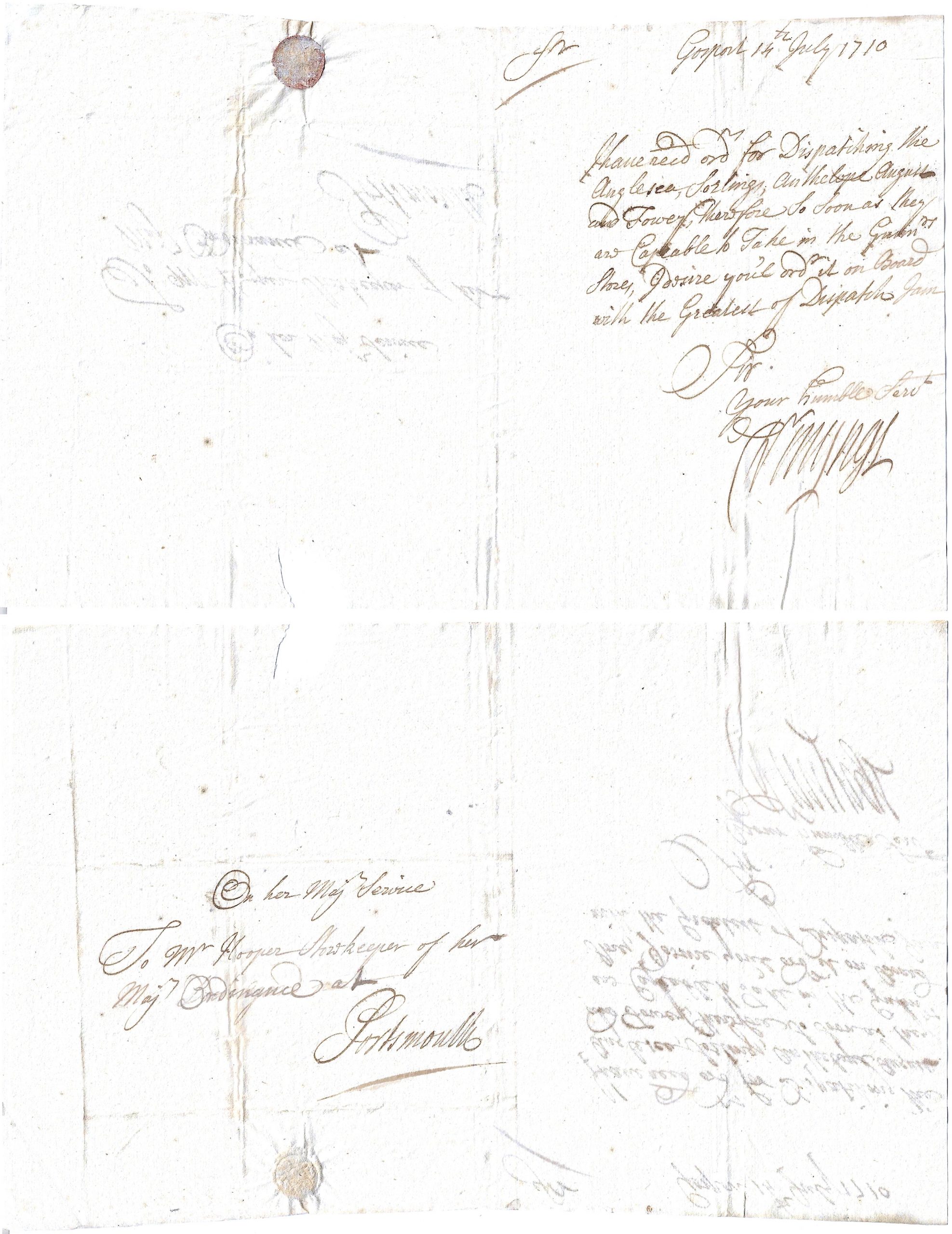
The following day a note from ‘Christopher Myngs’, (a difficult to read signature), who was in Gosport on 14th July 1710. It is written on fine paper which was not used by The Office of Ordnance, yet appears to have been sealed, I wish we could see the seal; I’ll wager it was not the three cannons of the Ordnance Office. It asks Mr. Hooper to speed the resupplying of four ships. He was not issuing orders, as he signs ‘your humble servant’, yet he says that he has orders to dispatch these ships, so we must assume he holds Naval rank, possibly a commodore or an Admiral. In fact, he was almost certainly Christopher Myngs (1655-1725), commander HMS Namur in the Battle of Malaga in 1704; and later, commissioner of The Navy at Portsmouth. He was the son of ‘Cromwell’s Pirate’ the notorious Sir Christopher Myngs (1625-1666). One must assume that an expedition was being arranged and that the four ships were to form a convoy. Mr. Hooper will have received his instructions from The Tower, but Captain Myngs is politely asking Mr. Hooper to expedite the supply of these ships.
View in new tab:
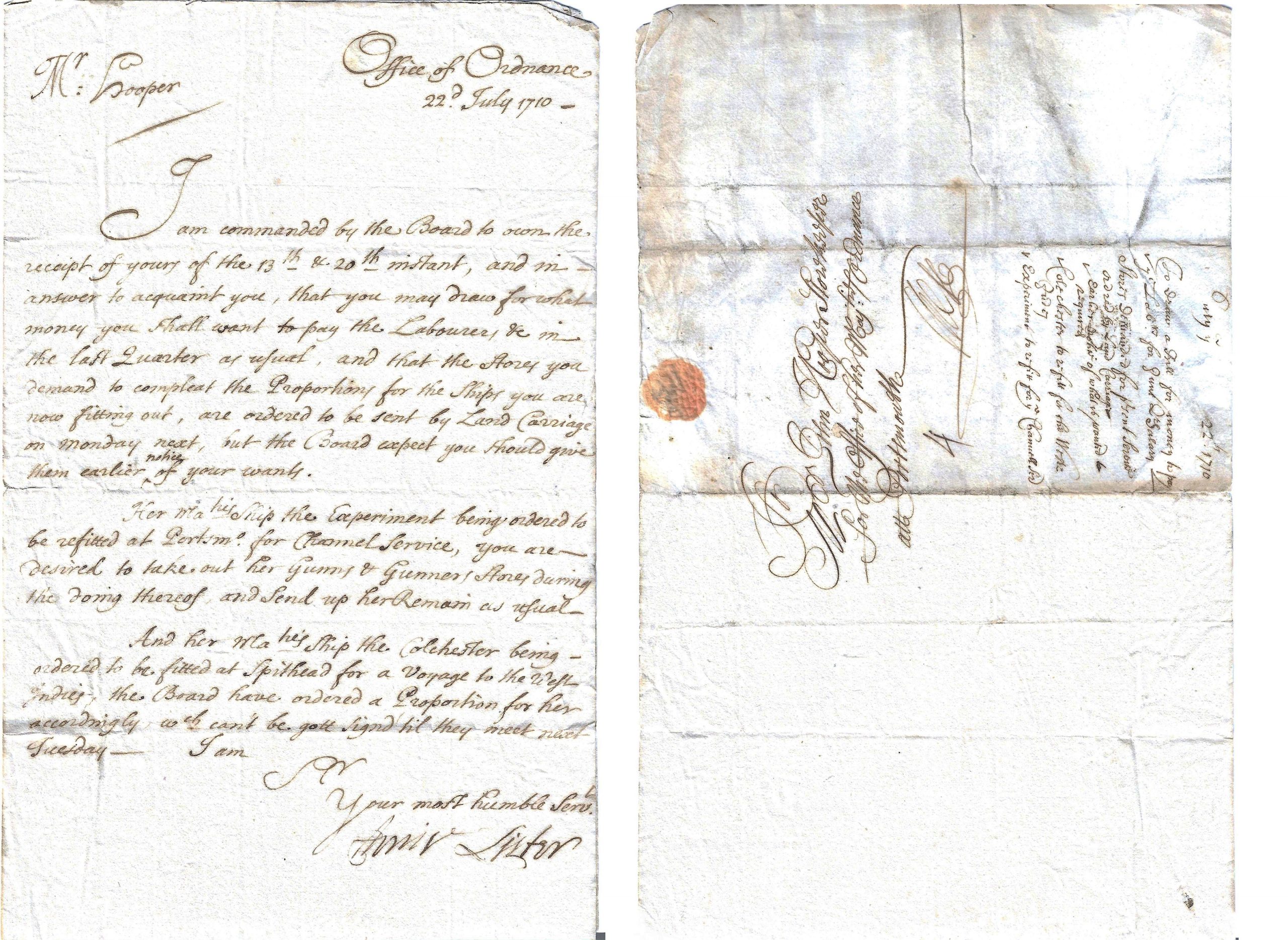
On 22nd July 1710 a letter from Chris Lister demonstrates the trust placed in Mr. Hooper by The Board who advise him to draw money to pay labourers. It also mentions that HMS Colchester (1707) is to be restocked at Spithead. Not an easy procedure as Spithead is in open sea between Gosport and the Isle Of Wight.
View in new tab:
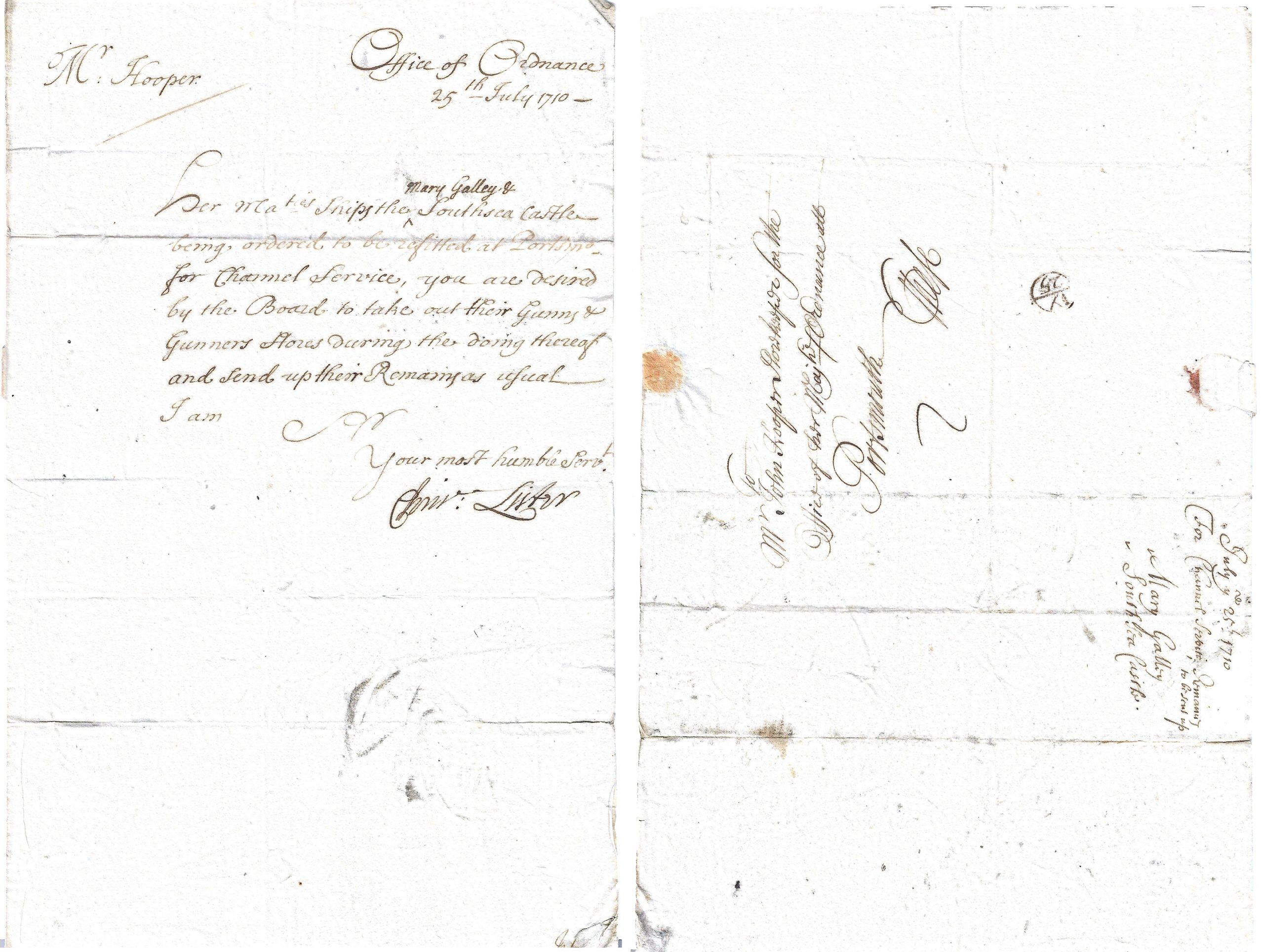
HMS Mary Galley & Southsea Castle to be refitted for Channel service.
View in new tab:
Curiously, very little information is available on HMS Towy, probably spelt Towey, but the indent dated 9th August 1710 tells us that she carried Demi Culverings (4” 8lb shot, lower deck), Sakers (3.65” 6lb shot main deck) and Minions (3.5” 5.2lb shot, upper deck). It does not tell us how many guns but it is fair to assume that she had three gun decks, so was a vessel of at least 64 guns.
Incidentally, there was a 20 gun ship named Towey, launched in 1813, built at Bucklers Hard.
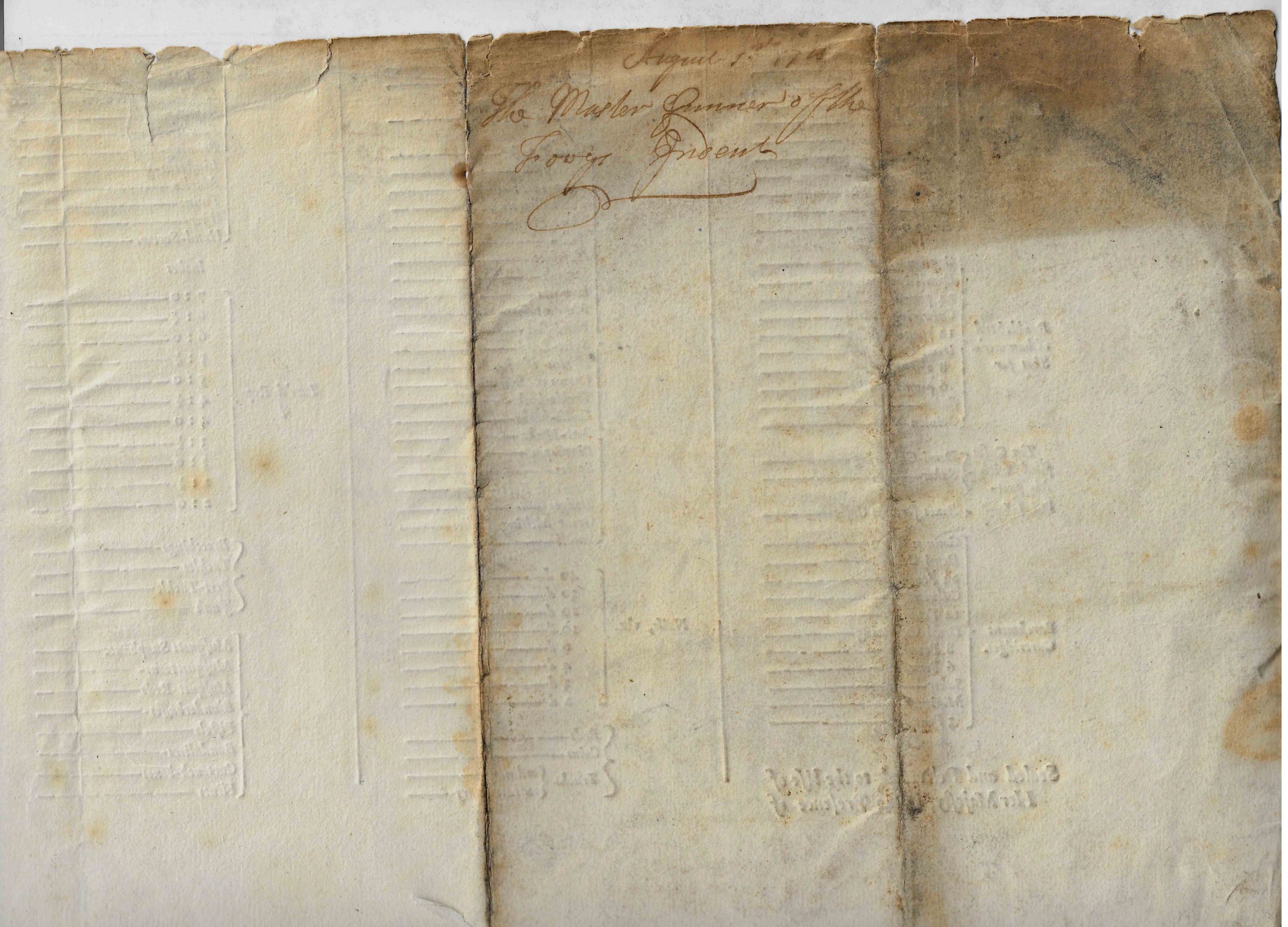
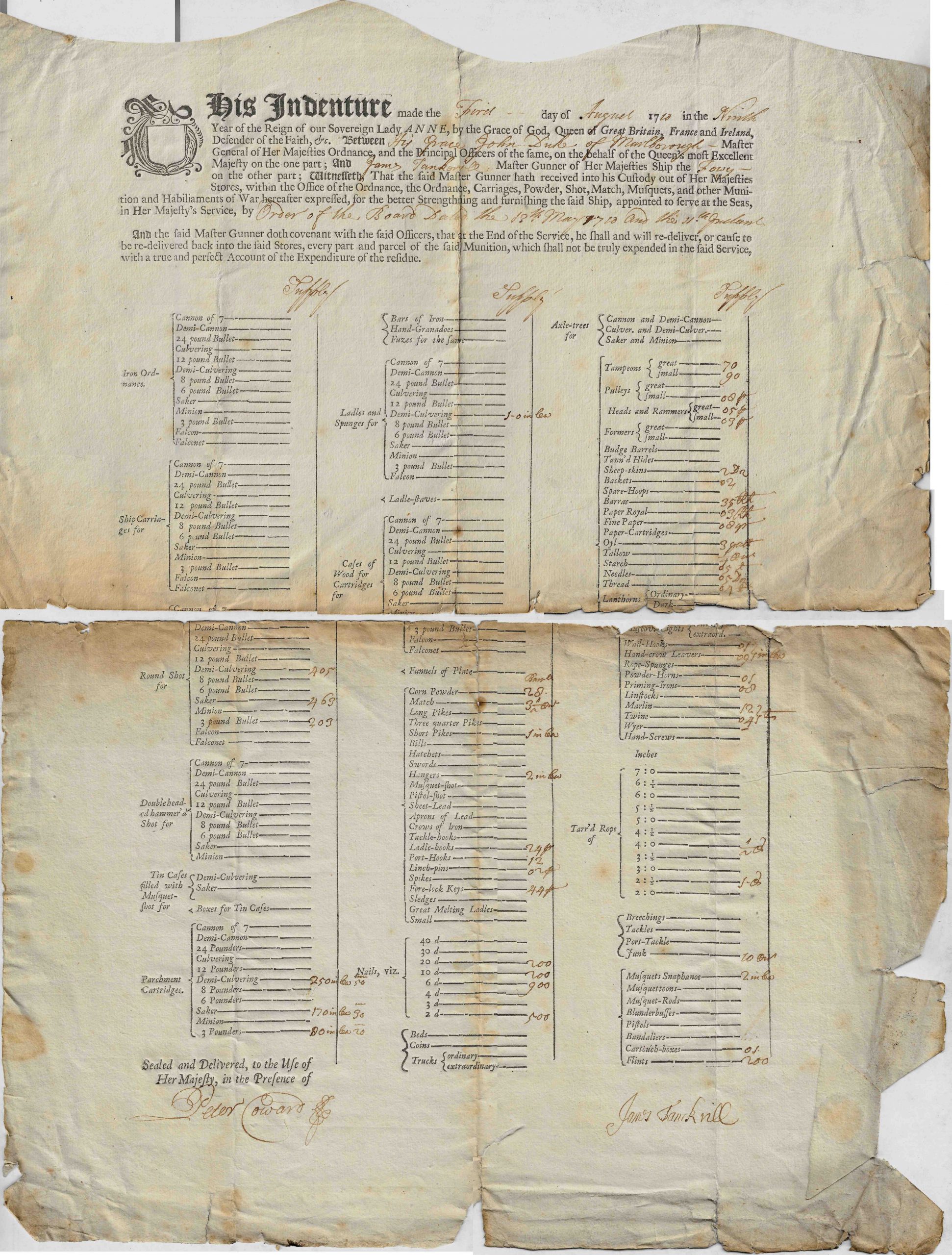
View in new tab:
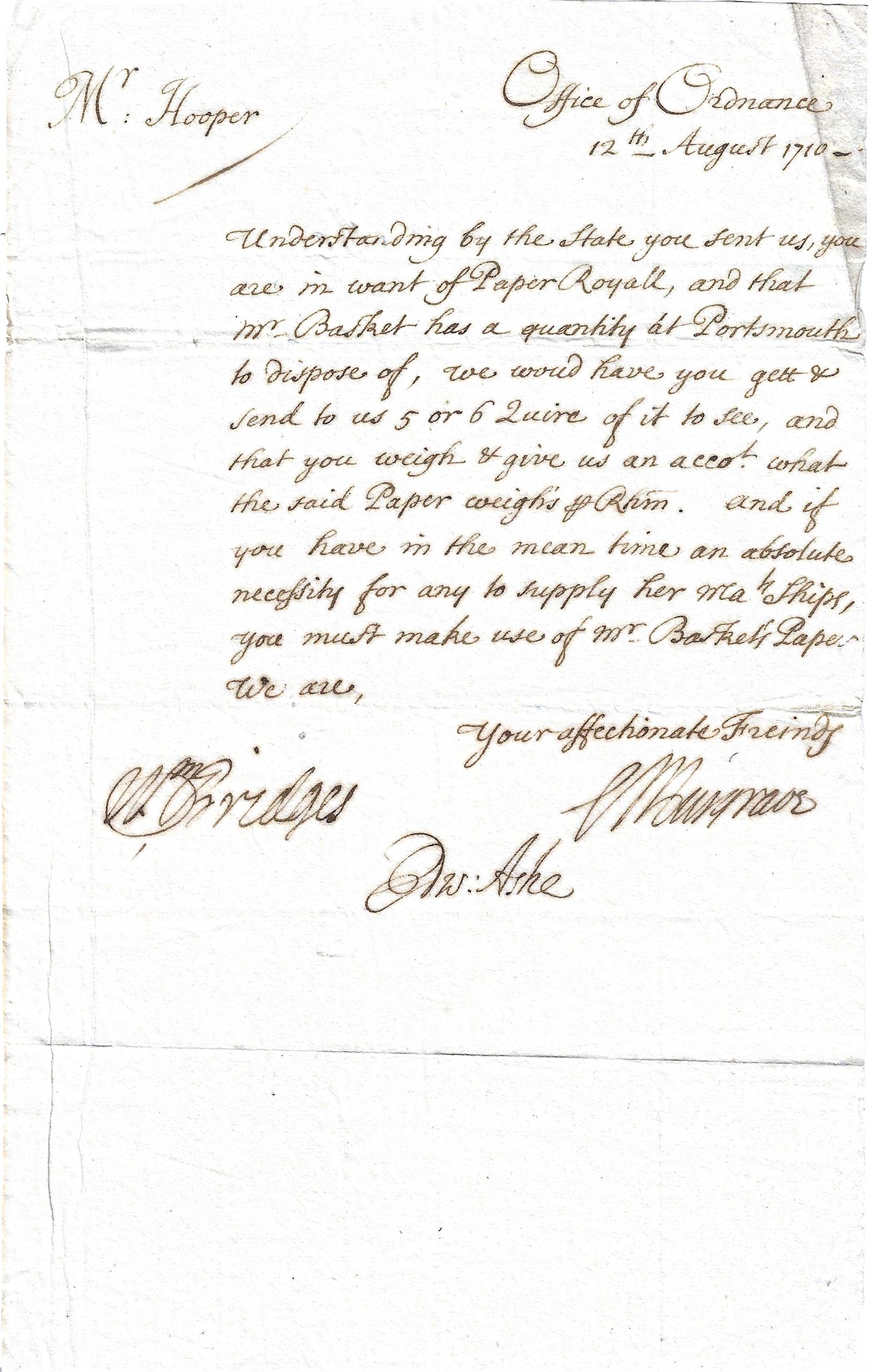
Two letters arrive on the 12th August 1710, the first suggests that Mr. Hooper make use of paper available from Mr. Basket who has some in Portsmouth. Although specifying paper royal (cartridge paper) The Board ask that Mr. Hooper report on the weight of the paper, presumably to measure the quality. Mr. Basket was based in London, so must have also had premises in Portsmouth.
View in new tab:
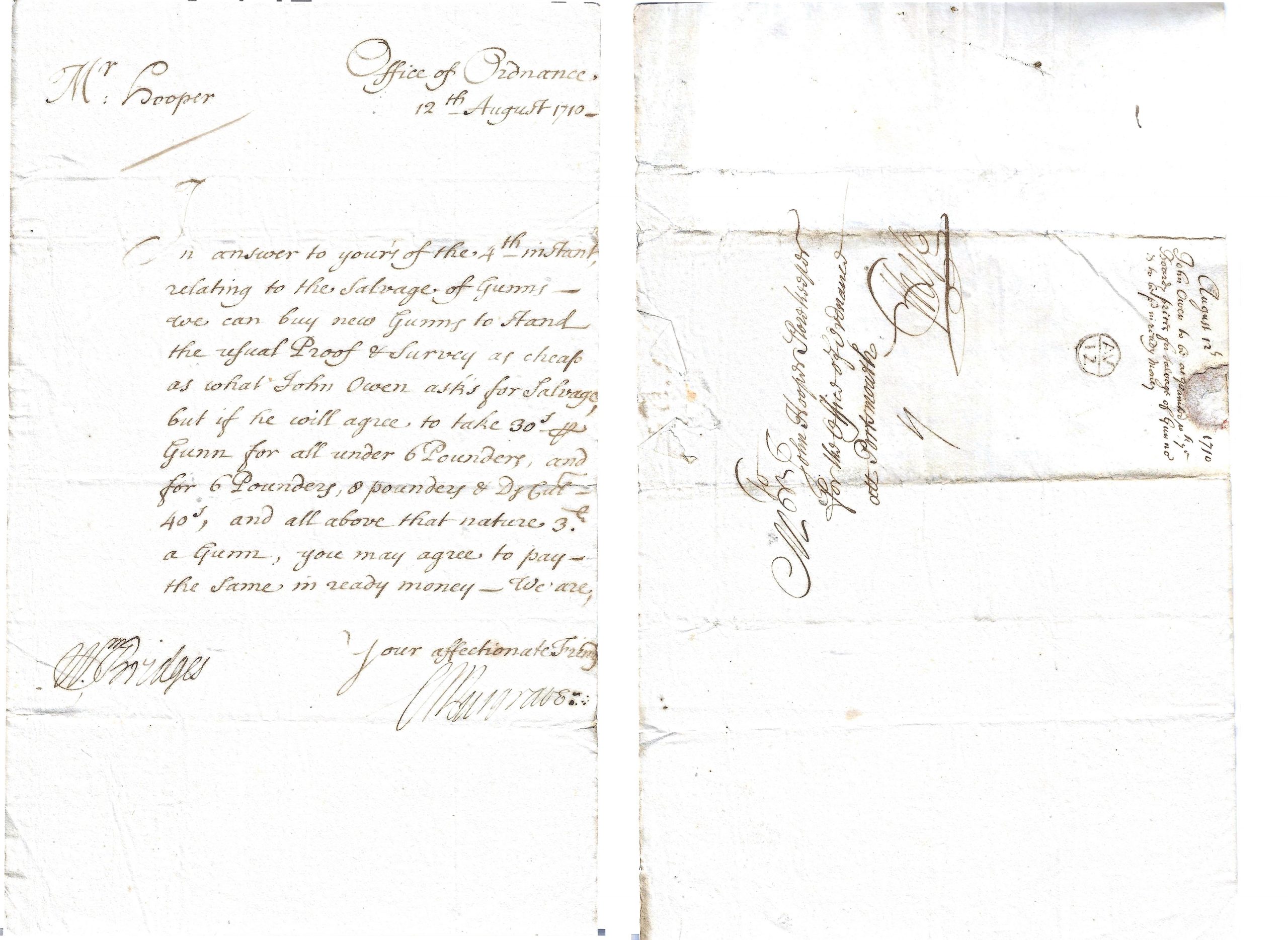
The second letter is asking Mr. Hooper to bargain with John Owen over the price he is asking for salvaged guns. They offer him 30 shillings for the smaller guns, 40s for the larger ones and £3 each for the biggest.
View in new tab:
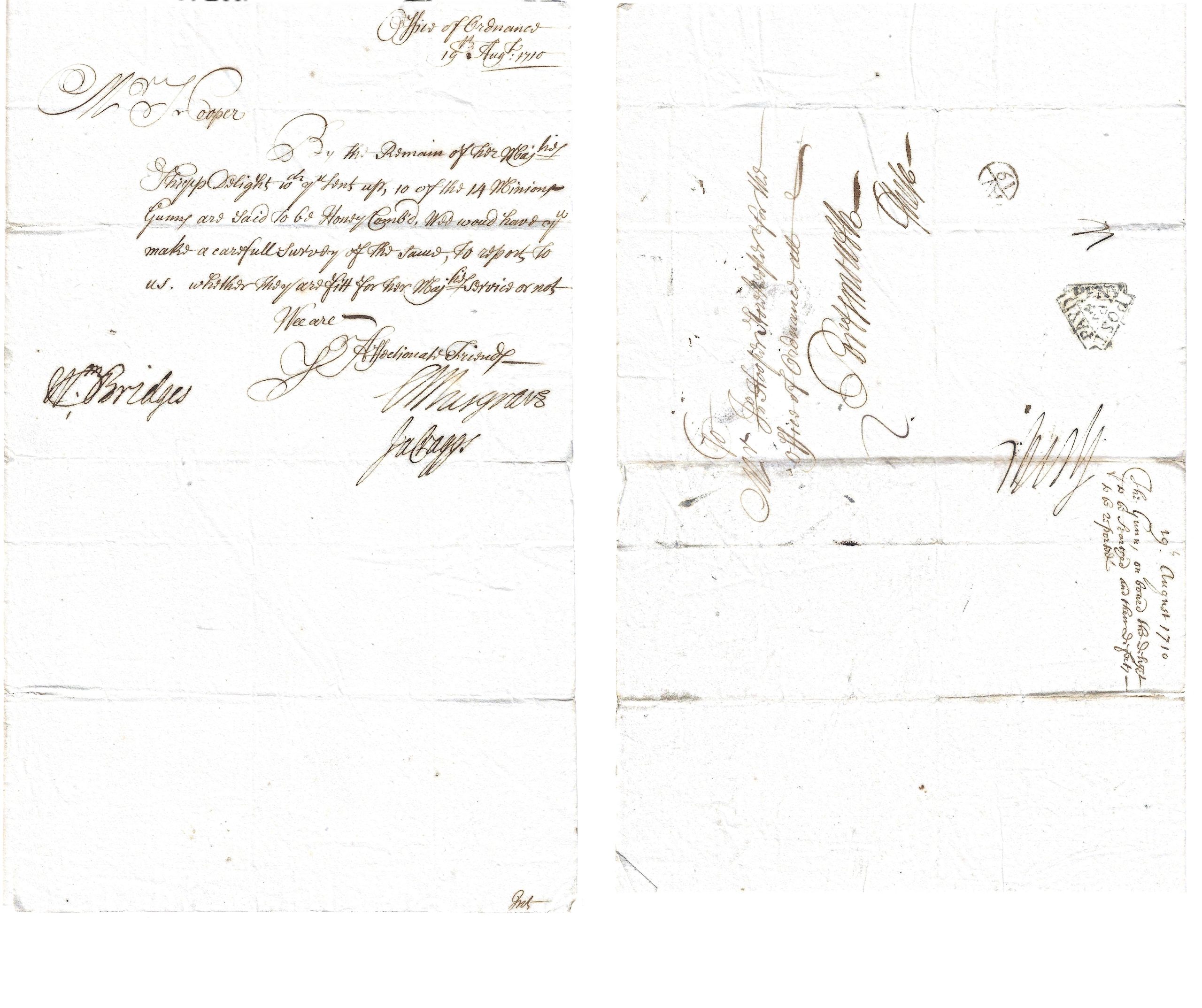
The letter of the 19th of August is of particular interest as it bears the stamp of the PENY POST. The Penny Post was established in the 1600s to serve the city of London and surrounding areas with several deliveries a day, obviously by 1710 it had extended as far afield as Portsmouth.

The letter itself is to ask Mr. Hooper to make a close inspection of the guns on HMS Delight which are reportedly becoming ‘honeycombed’. This was a problem affecting iron guns whereby the chemicals in the gunpowder attacked the metal creating pits inside the barrel.
View in new tab:
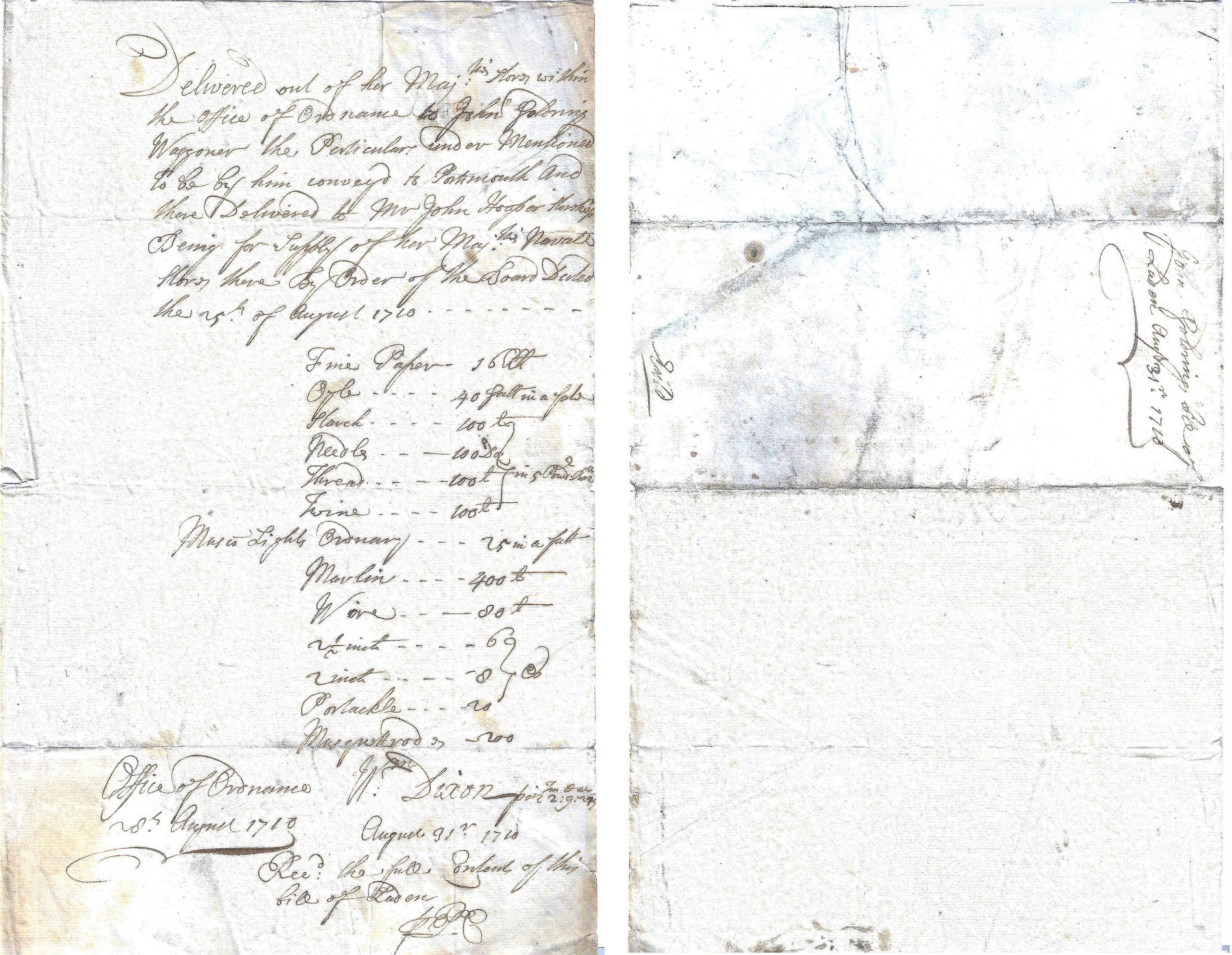
John Golding’s bill of laden of 31st August 1710 introduces to us several unfamiliar terms. Muscov lights were lanterns which used mica as the transparent medium, previously cow horn would have been used (lanthorns). Mica was superior as, unlike cow horn, it did not distort with the heat of the candle. We are told that they are transported in a ‘falt’. This was a measure used for wheat and contained 9 bushels (72 gallons), yet in this case was probably a container which held one falt. We also see the symbol indicating ‘cable’, 10 fathoms or 600 feet, used for measuring rope or cables. The symbol represents the letters ‘Cb’.

View in new tab:
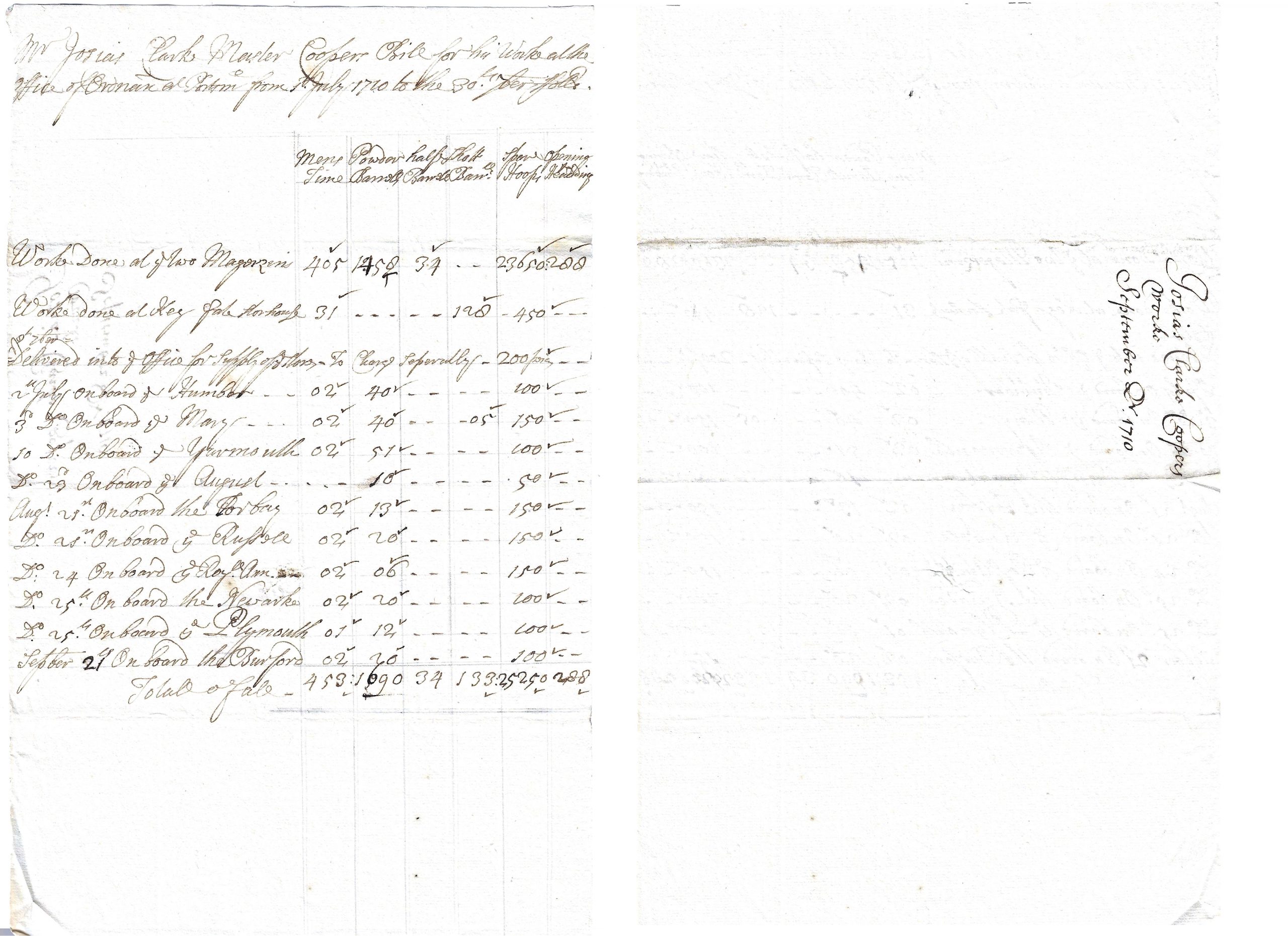
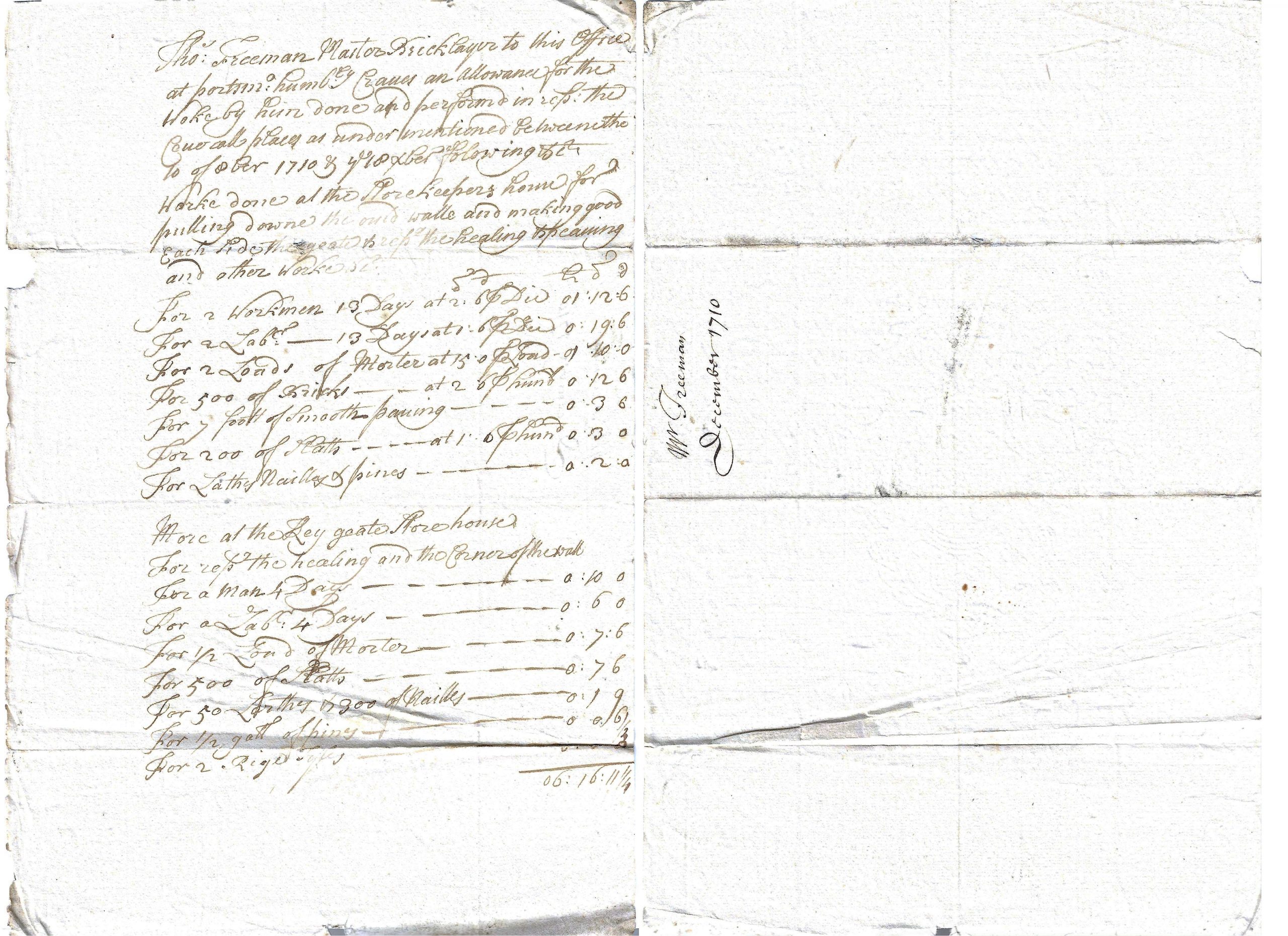
There follows the usual list of small arms repairs for Mr. John Silvester, a bill for cooperage from Mr. Clarke and a bricklayer’s bill from Mr. Thomas Freeman who gives a neatly written and very precise, to the last farthing, account of materials expended, and work done. Sadly, the paper is in poor condition which obscures some of the writing making it difficult to read.

View in new tab:
Another cooperage bill from master cooper Josias Clarke.
View in new tab:
This bill for bricklaying from Mr. freeman was somewhat damaged, but a little arithmetic helped me to determine the original figures.
View in new tab:
On 25th September 1710 The Board order the arming of HMS Swallow Prize (1704) with 32 guns, we are treated to a detailed list of the guns that a 32 gun ship held, in this case 22, 6 pounders of different lengths and 10 Minions of 6 feet.
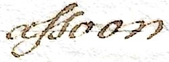
We can also see that the Royal Ann Galley (1709) of 42 Guns carried 20, 9 foot, Demi Culverings and 20 7 ½ foot 6 pounders. Incidentally, Royal Ann Galley was the last British warship to carry oars. Interestingly, we see ‘as soon’ written as one word: ‘aSsoon’, we can see that it is as one word because the first ‘S’ is written in upper case.

View in new tab:
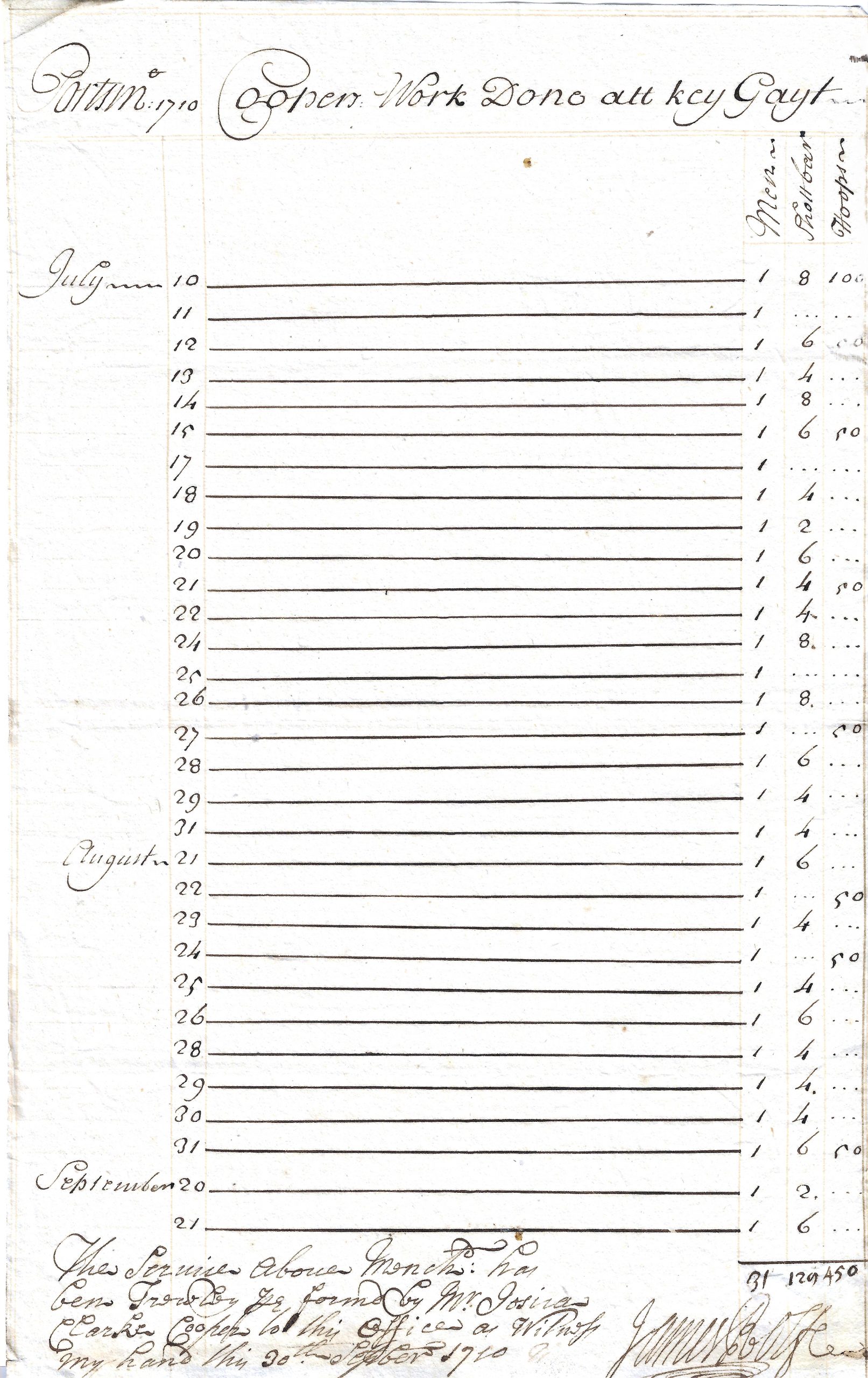
It would be easy to dismiss the bill for cooperage of 30th September 1710 as uninteresting until one notices the spelling of ‘been truly performed’ spelt: ‘ben trewley pe formed’. It says that the work was done at ‘Key Gayt’. This was Quay Gate, also known as King George’s Gate, which stood by the Town Quay, today, the fish market.
View in new tab:
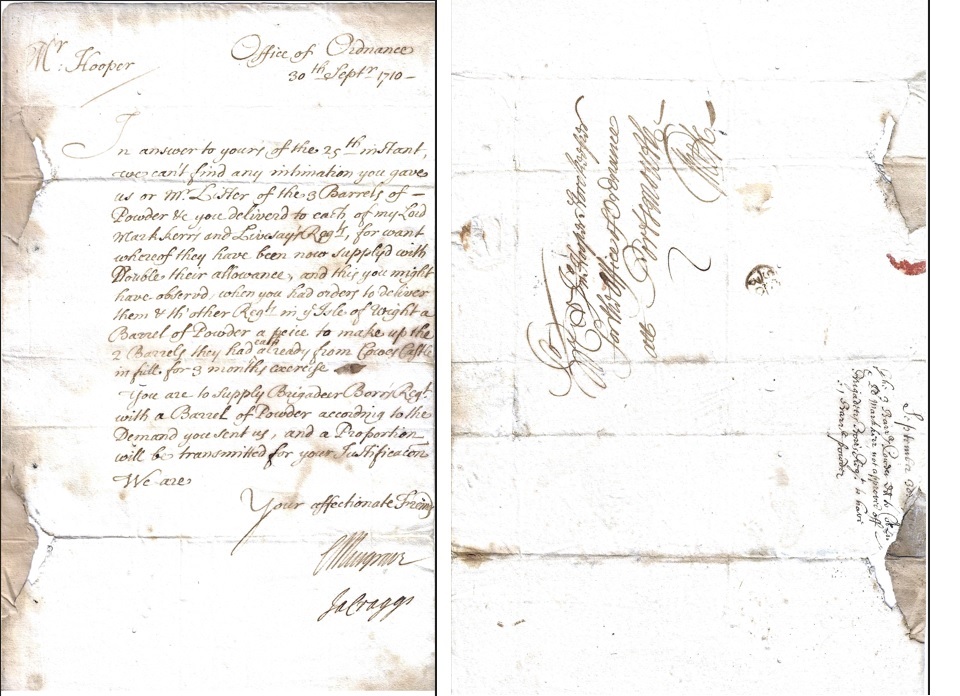
It does seem that there was a recurring problem with supplying the army. In a previous letter Mr. Hooper was advised to insist that the army apply for stores through The Board. In their letter of 30th September 1710, they point out that Lord Kerr and Livesay’s Regiment have been issued a double ration of powder.
View in new tab:
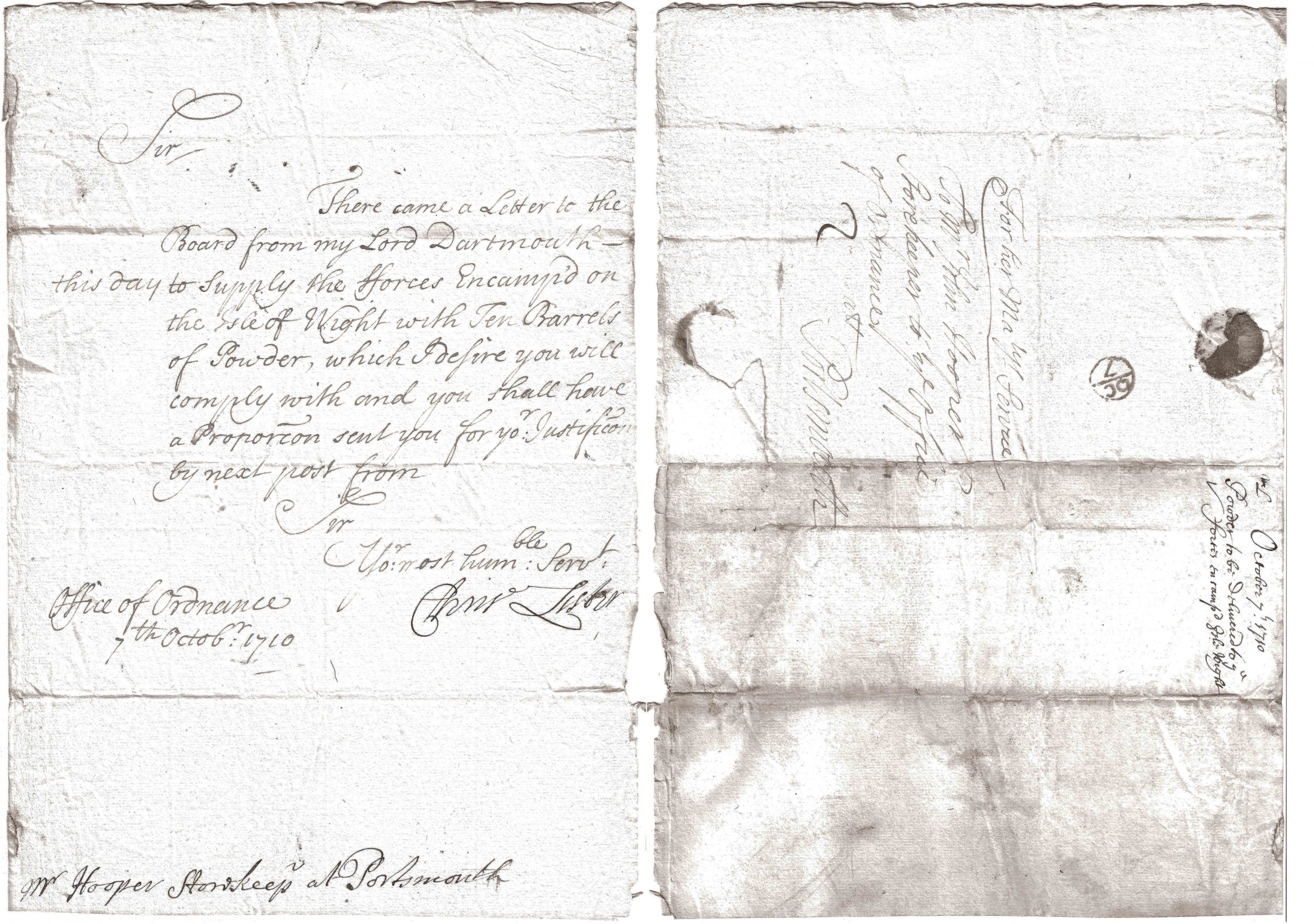
On 7th October comes a request from the army that has followed procedure and come via The Board. Lord Dartmouth (William Legge) an interesting character. It is asking for powder to be supplied to the forts on the Isle of Wight.
View in new tab:
10th October sees more confusion regarding the supply of powder to the army and regarding Mr. Basket and paper royal supplies.

View in new tab:
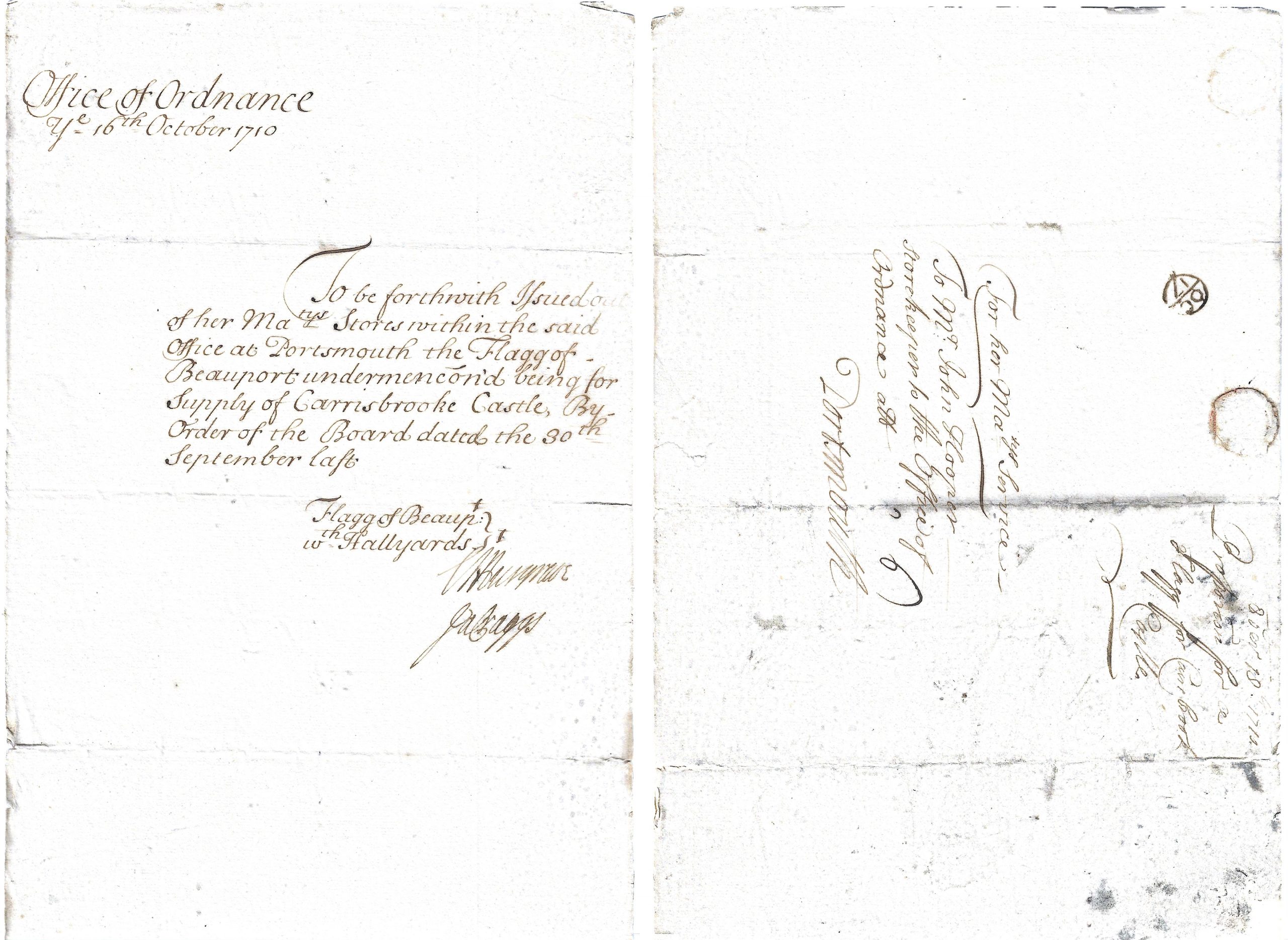
The first of several instructions to issue ‘The Flag of Beauport’. Beauport is a borough of Quebec City, Quebec, Canada on the Saint Lawrence River, established in 1634. However, this flag is so called after the type of cloth with which it is made. The Oxford English Dictionary says: it is referring to Beaupreau, a town of France with manufactures of linen. The flag itself would have been the Union Flag of Great Britain.
View in new tab:
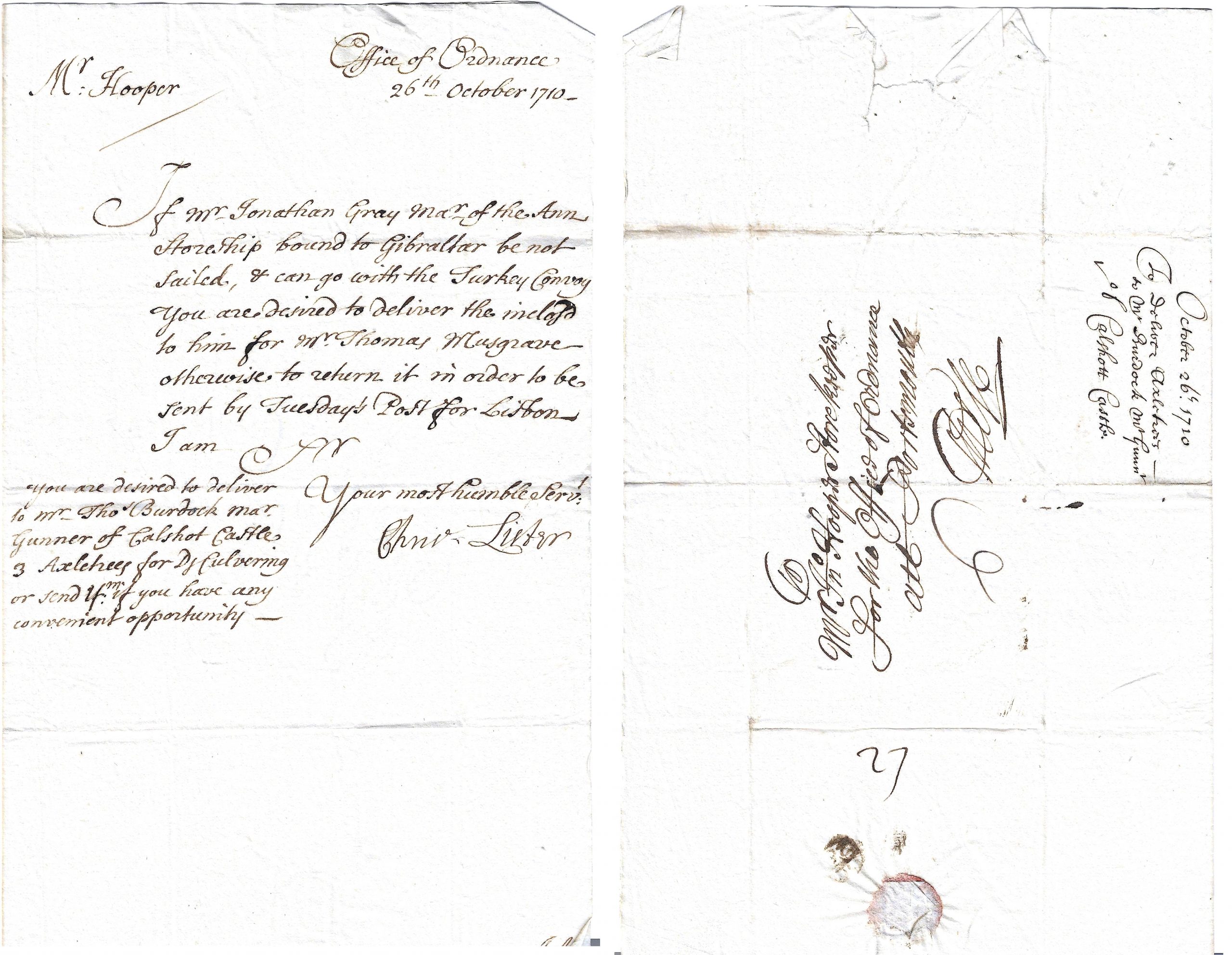
A somewhat confusing letter follows on 26th October 1710 as the body of the letter is regarding a storeship bound for Gibraltar while the postscript asks Mr. Hooper to send axletrees for demi culverings.
View in new tab:
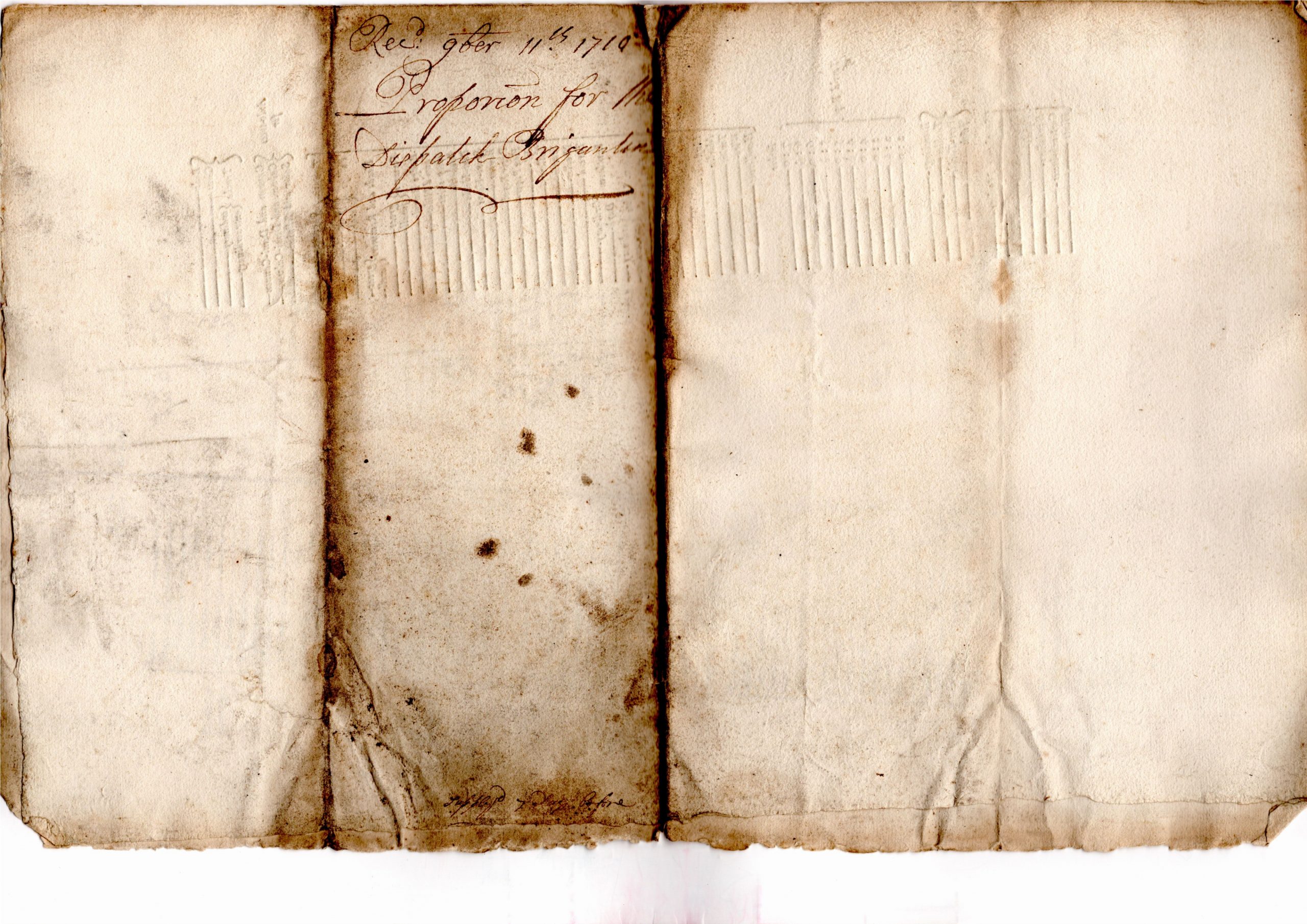
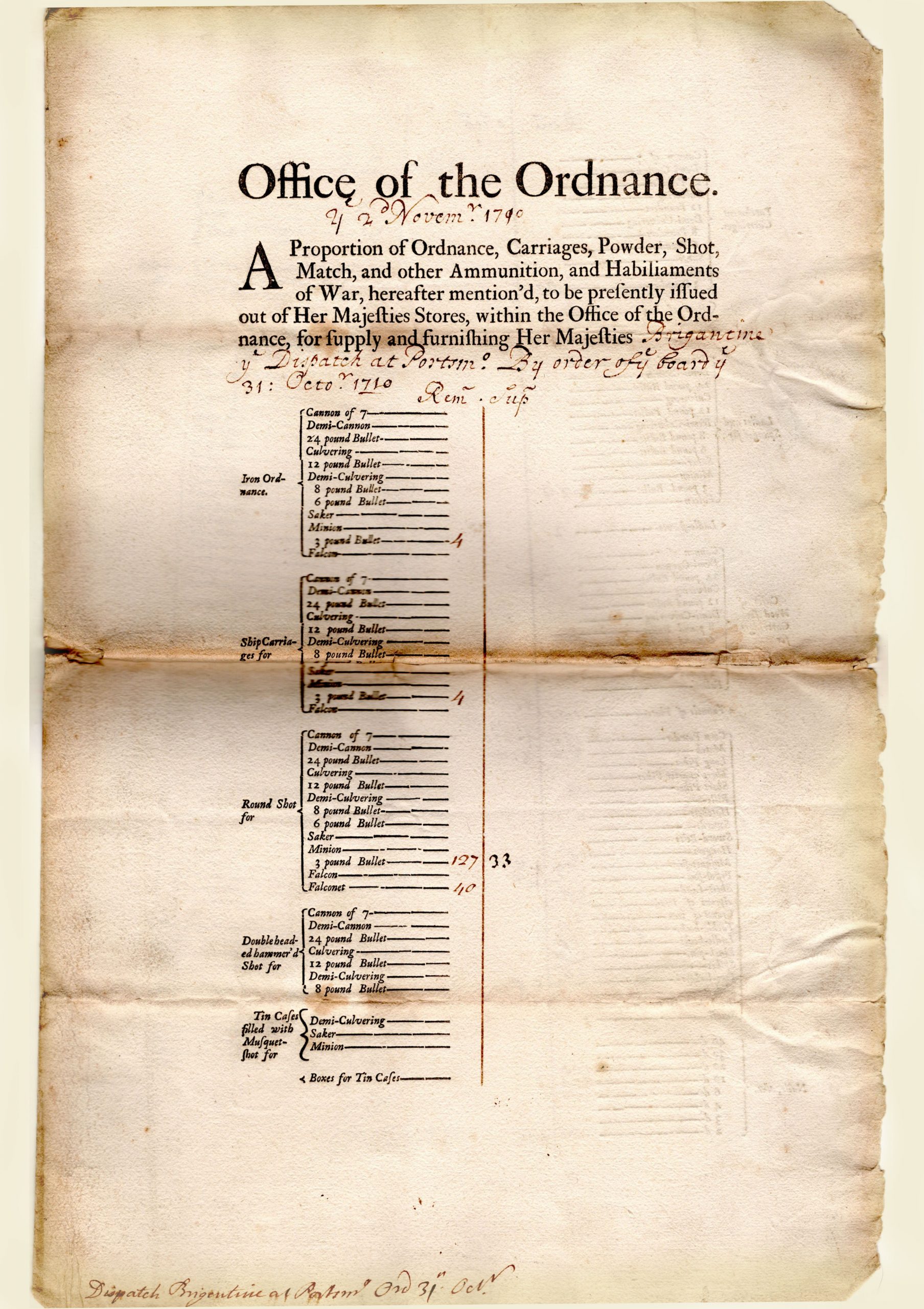
November 2nd, 1710, an indent for the brigantine HMS Dispatch lists the stores she has remaining and those that are issued. Interesting to note is the supply of ‘barras’, measured in ‘ells’. Barras was a coarse linen fabric, an ell was one cubit, the length from one’s elbow to outstretched fingertips. Ell was an old word for arm, so elbow is where the arm bows or bends. Barras would have been used for caulking, or to make wadding for the guns. In this indent we also see tarred rope measured in fathoms (6 feet), port tackle (ropes for opening gun ports) measured in cables (600 feet) and junk (scrap rope) measured by the hundredweight. Wikipedia shows her as a 2 gun vessel launched in 1691 and sold in 1712. We know from this indent that she was a relatively small vessel carrying 4, 3 pounder guns.
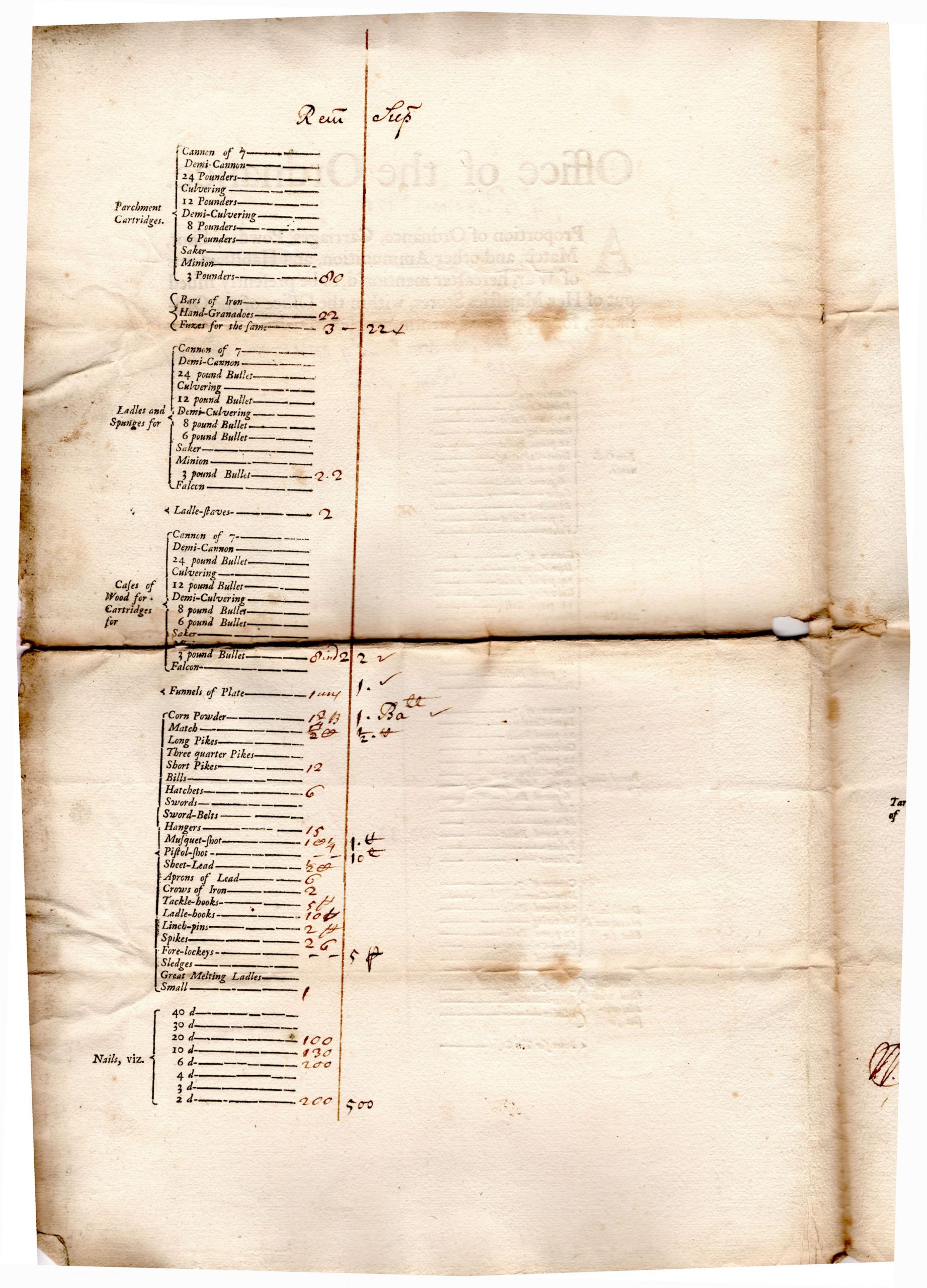
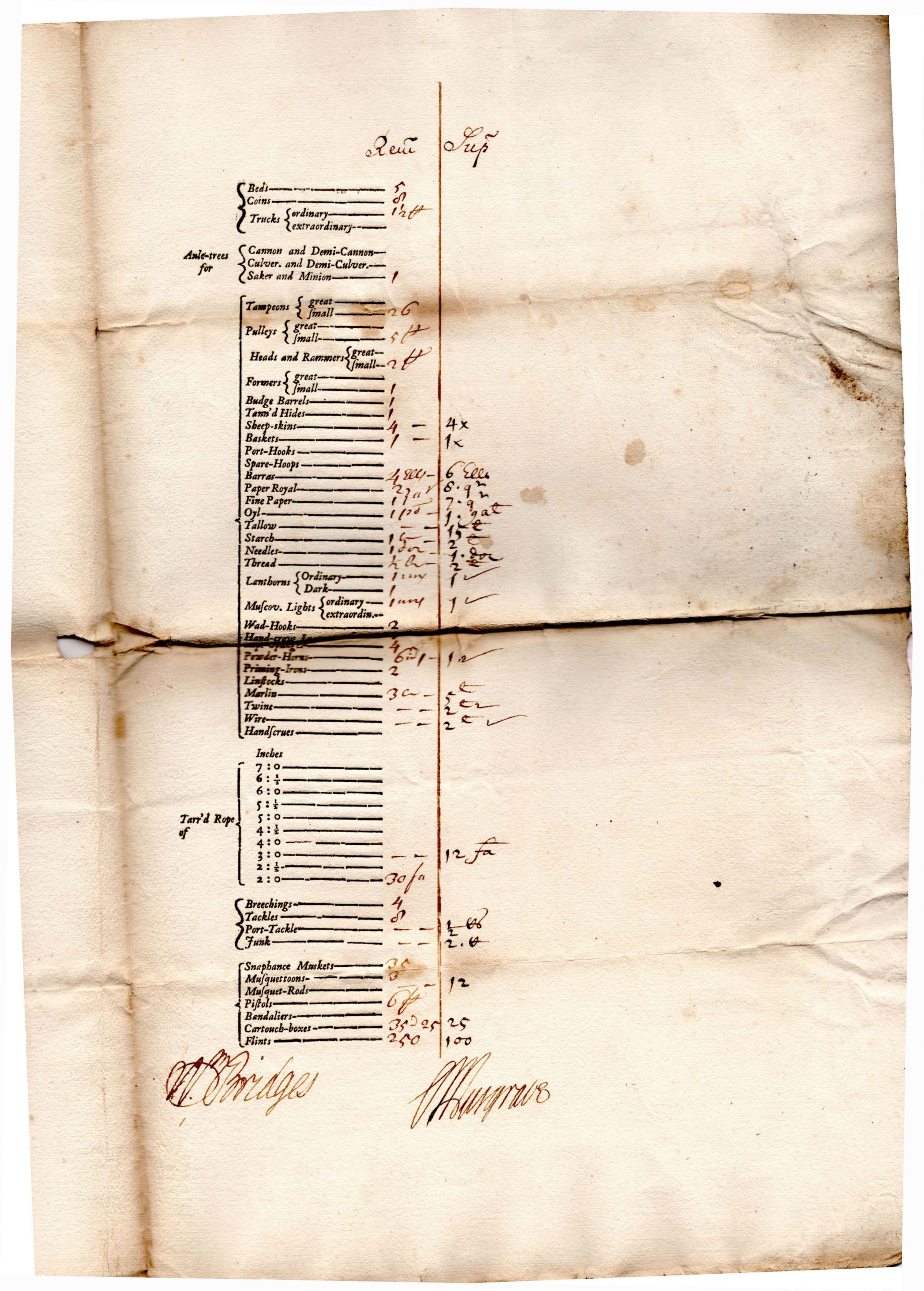
View in new tab:
The letter of 7th November regarding HMS York from Chris Lister is rather long winded. It would appear that, as usual, there is a rush for HMS York to be on her way to the Mediterranean, so, if necessary, Mr. Hooper is to restock her from his stores in advance of receipt of fresh supplies from Woolwich.
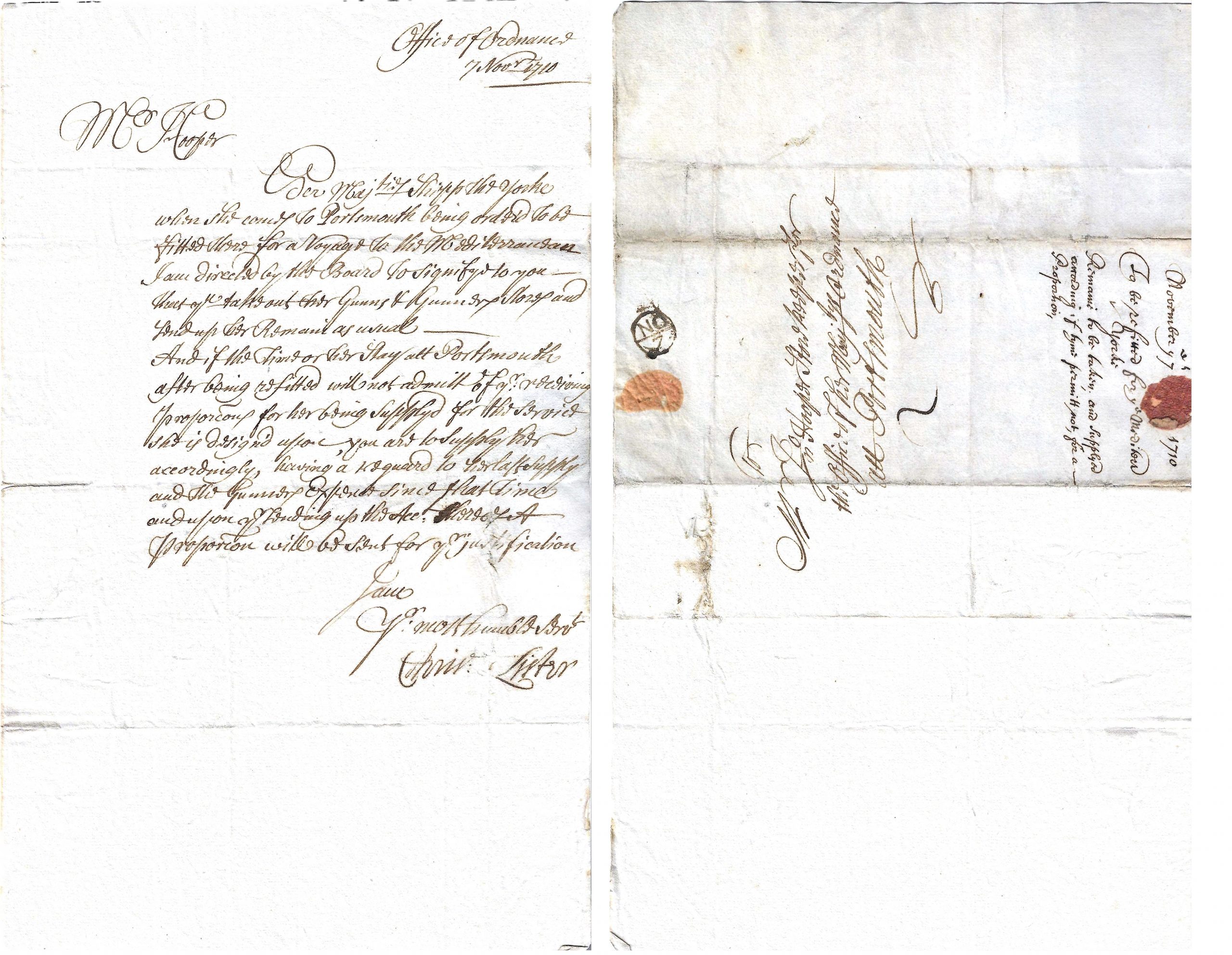
View in new tab:
On the 18th November Mr. Hoper is asked to advise upon repairs ‘absolutely necessary’ in the coming year.
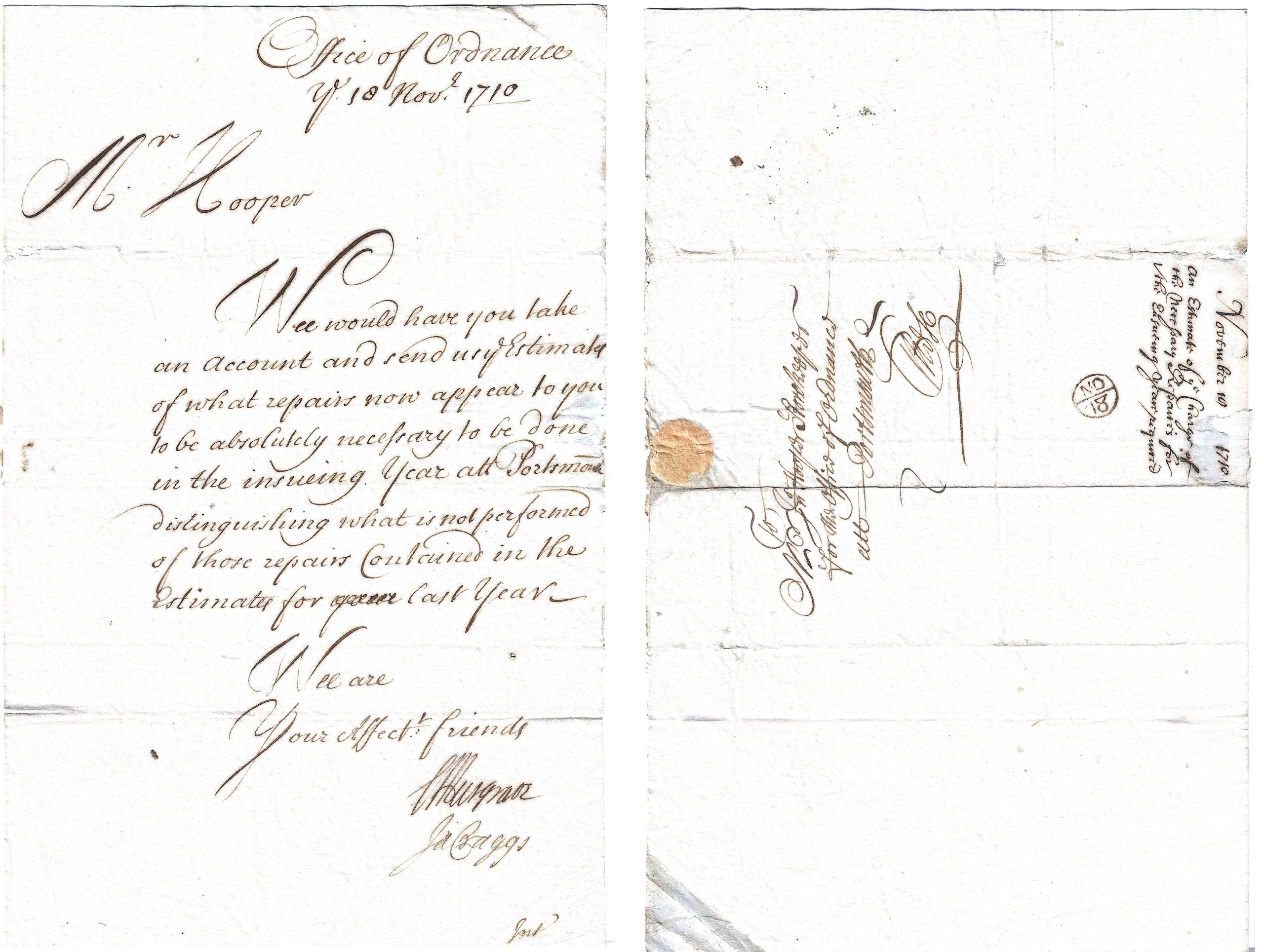
View in new tab:
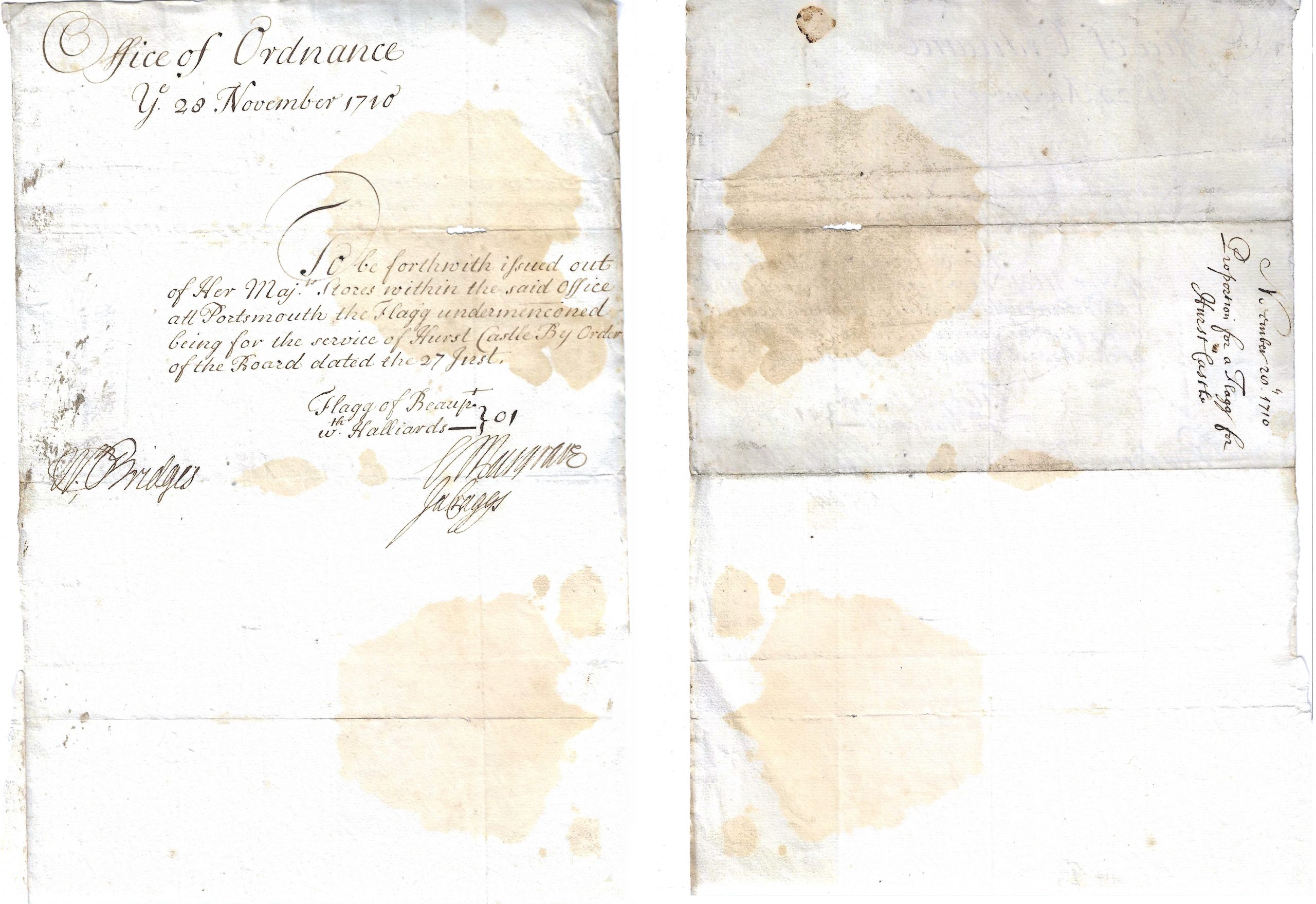
Another Flag of Beauport to be issued, this time for Hurst Castle.
View in new tab:
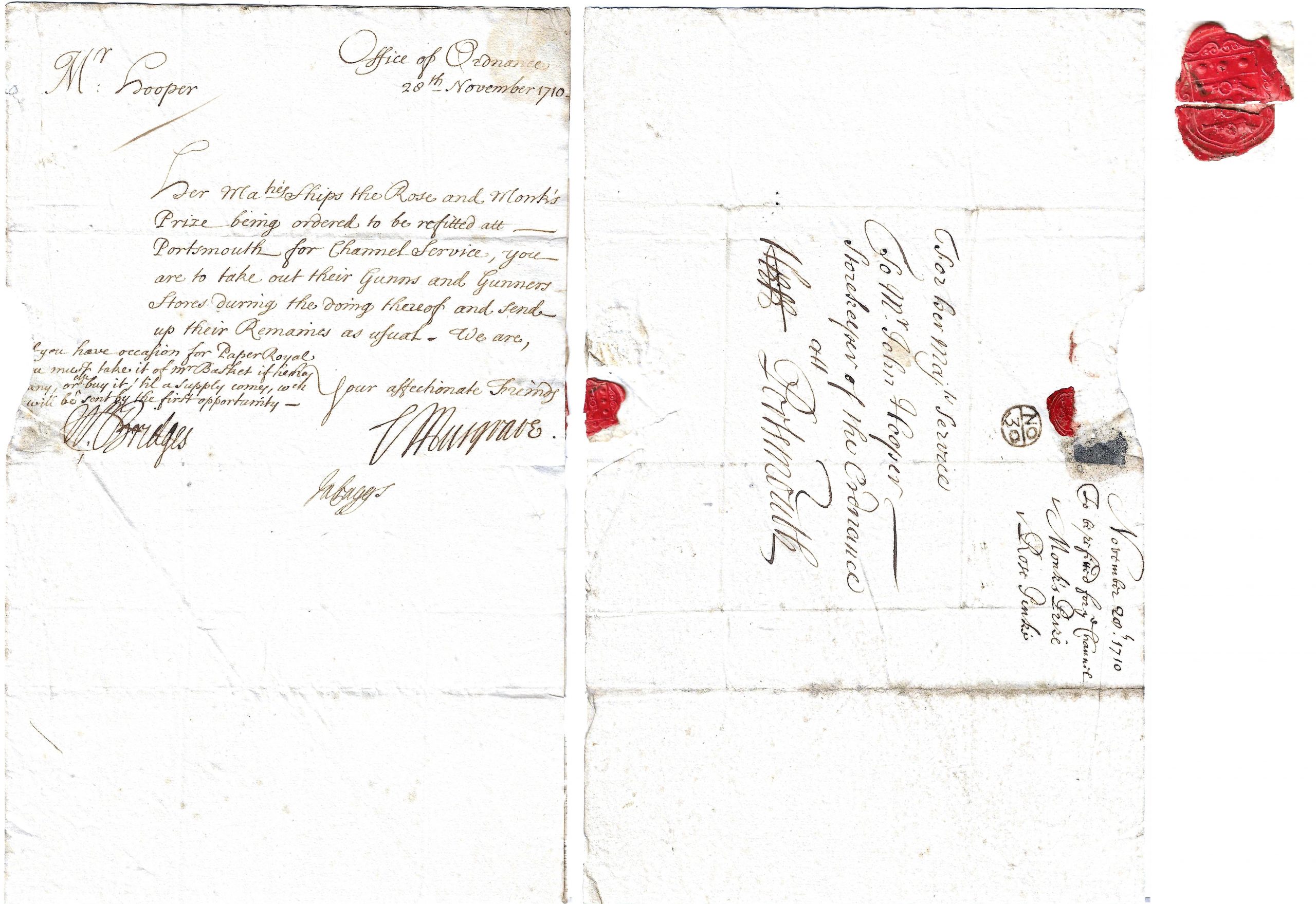
The letter from The Tower on 28th November, a run of the mill request to prepare HMS Rose and Monks Prize for refit, is rather exciting as it still bears the seal of the Office of the Ordnance. All of the letters from The Tower would have been sealed, but the wax would usually have been removed and melted down for reuse.
We can see from the scan that the letter was written on one side of the paper and the address on the reverse. This was then folded in two places horizontally, then the ends of the paper folded inward vertically overlapping slightly, before the seal was applied. The precis was then written after the seal had been broken, and the letter opened.
View in new tab:
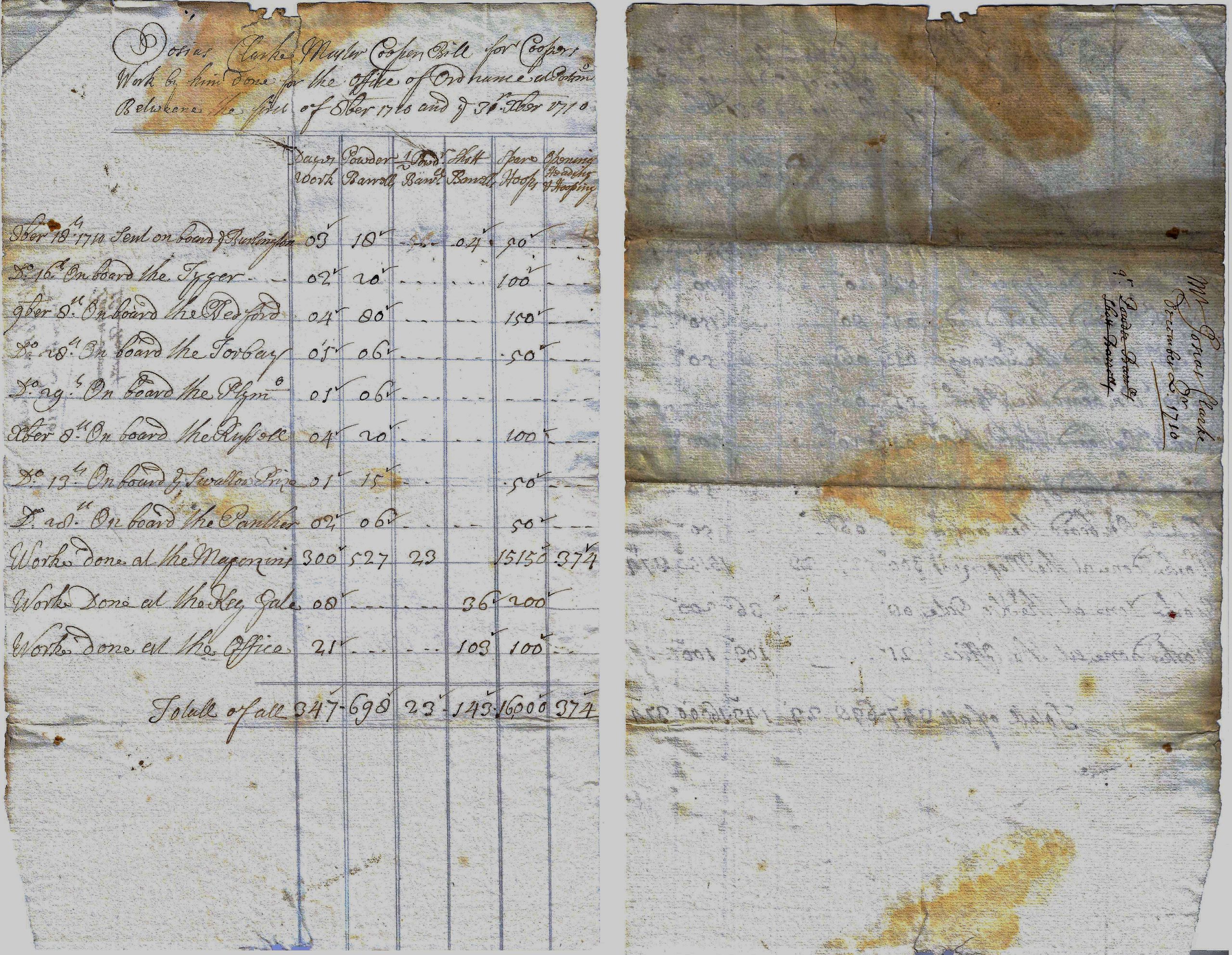
We finish 1710 with a familiar cooper’s bill from Josias Clarke.
View in new tab: